China's Disruption of RightsCon is a Wake-Up Call To Counter Its Authoritarian Influence
Michael Caster / May 3, 2026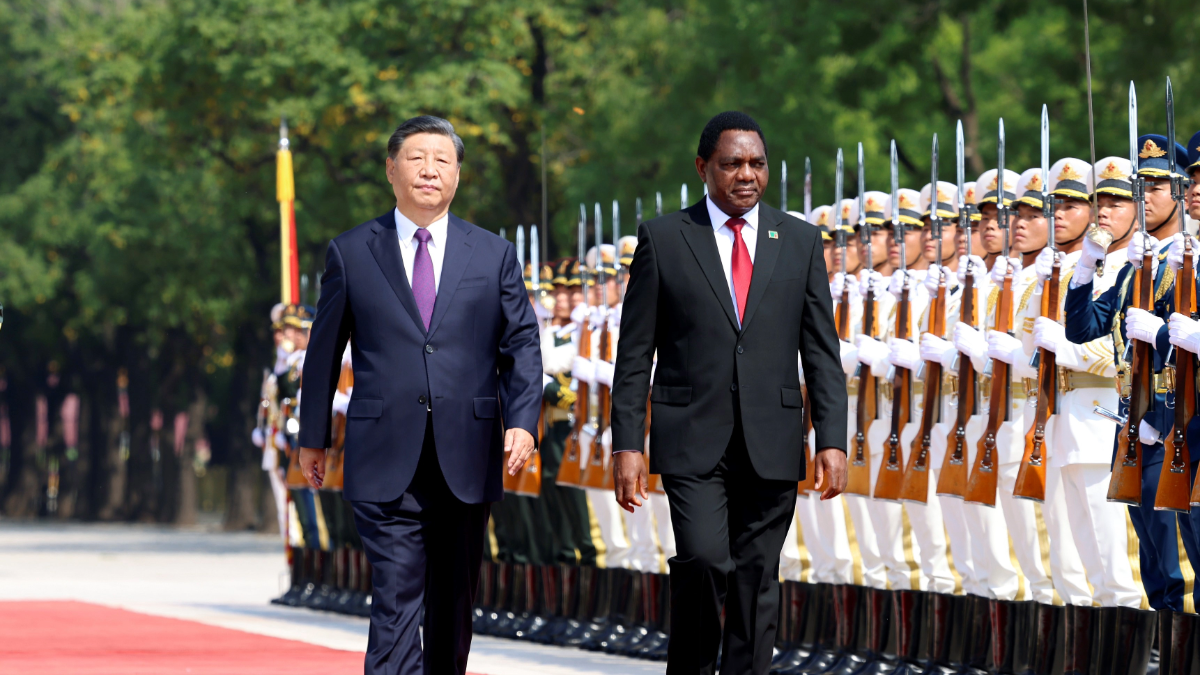
Chinese President Xi Jinping held a welcoming ceremony for his Zambian counterpart Hakainde Hichilema at the square outside the east entrance of the Great Hall of the People before their talks in Beijing, capital of China, Sept. 15, 2023. (Photo by Liu Weibing/Xinhua via Getty Images)
Earlier this week, like thousands of peers in the digital rights community, I was making final preparations to travel to Lusaka for RightsCon, where I had several sessions planned to explore China’s influence on internet freedom around the world, including what it means for Taiwan and nations in Africa. Now, like much of the global community that had intended to participate, I am reeling from the gathering's unprecedented and sudden cancellation. Thanks to RightsCon organizer AccessNow’s laudable transparency, we now know what many suspected: RightsCon was effectively canceled by the Zambian government under direct pressure from China.
In a statement released on May 1, AccessNow revealed that on April 27, diplomats from the People’s Republic of China (PRC) had reached out to pressure the Government of Zambia over the participation of Taiwanese civil society representatives. A press statement from the government further noted the need to ensure thematic issues aligned with Zambia’s “national values” and “policy priorities,” arguably shorthand for avoiding other topics sensitive to Beijing. Perhaps not so coincidentally, on April 23 China and Zambia signed a development cooperation agreement, including a $1.5 billion USD investment into its energy infrastructure.
While AccessNow says it immediately pushed back, the government’s position did not change. Ultimately, it came to represent a red line. AccessNow says “at a time when this sector is already under immense financial and political strain, what we and our community forcefully experienced is unprecedented and existential.”
What happened in Zambia also raises questions of security and civil society access for future gatherings. This includes this year’s Internet Governance Forum (IGF), scheduled for Kenya, which has adopted Chinese surveillance infrastructure, or regional fora such as the Asia Pacific Regional Internet Governance Forum (APRIGF), to take place in Nepal, which has engaged with China’s Digital Silk Road.
For those of us who had planned to discuss China’s authoritarian reach at RightsCon, this would all be ironic if it wasn’t so tragically disruptive. This is a major escalation in transnational repression and a testament to China’s influence on global digital rights far beyond its borders that deserves reflection.
This should be a stark reminder that, even as we must now face rising threats to the freedom of expression and digital rights from previously aligned governments such as the United States, old school authoritarian actors remain significant threats. To be sure, China has seized on geopolitical shifts and recent US funding cuts to expand its already significant influence in ways that continue to threaten human rights in the digital domain. While this is as much about China’s adverse influence in Africa as it is about its campaign of transnational repression against Taiwan, arguably this assault on inclusive, multistakeholder fora like RightsCon is also indicative of China’s broader authoritarian approach to digital governance, against which advocates for democracy and human rights must push back.
China’s influence in Africa
Four of the top ten countries globally most affected by influence from China are in Africa (Nigeria, Zimbabwe, Algeria, and South Africa), according to Taiwan-based Doublethink Lab’s China Index. Beyond these indicators, China’s footprint exists at multiple layers of the tech stack across the continent, including digital infrastructure, ‘smart cities’ and other surveillance tech, and censorship tools.
Last year, researchers from InterSecLab and others analyzed a leak of over 100,000 documents linked to Chinese tech company Geedge Networks—a little known company with ties to the Great Firewall— revealing a web of partnerships that exports China-style ‘cyber sovereignty’ through technology transfers that let other countries replicate similar internet controls. As noted by the researchers, the investigation identified “a pattern of commercialization of surveillance capabilities, with Geedge Networks offering a suite of products that enable comprehensive monitoring and control of internet users.” Ethiopia was one of the named country partners.
China’s attempted influence in Africa has also extended to digital governance. For example, as pledged at the 2024 Forum on China Africa Cooperation (FOCAC), this has highlighted cooperation on cybersecurity, artificial intelligence, and advancing norms in global digital governance. Noteworthy to coercion from China on RightsCon in Zambia, the previous FOCAC also announced this year as the China-Africa Year of People-to-People Exchanges.
China has likewise contributed to information integrity challenges across the continent, from helping build censorship capacity to training journalists in China’s Communist Party-driven approach to the media. This includes cooperation to ‘better tell the story of China-Africa friendship,’ a reference to a propaganda directive ‘to tell China’s story well’ first delivered by Xi Jinping during the 2013 National Propaganda and Ideology Work Conference.
It has also meant pressure on other governments to align with China’s narratives on Taiwan.
Transnational repression against Taiwan
A mere week before China’s interference at RightsCon, Taiwan’s President Lai Ching-te said he was forced to cancel his trip to Eswatini, the only country in Africa that still maintains diplomatic relations with Taiwan over the PRC, after several countries revoked overflight permits because of “intense pressure” from China.
Taiwan says the Seychelles, Mauritius, and Madagascar had unilaterally revoked flight permits, with Madagascar’s foreign ministry confirming the denial of flight permits as its “diplomacy recognizes only one China.” Reuters reported that it was the first time a Taiwanese president has had to cancel an entire foreign trip due to such denial of overflight permits. President Lai eventually arrived in Eswatini on May 2, but only after the second attempted trip was not announced in advance by either side.
In recent years, China’s transnational repression toward Taiwan has escalated. In 2024, China issued a new guiding opinion under its Anti-Secession Law threatening a maximum potential death penalty for a range of vaguely defined supporting ‘Taiwan independence’ activities, and allowing Chinese courts to conduct trials in absentia for both Taiwanese nationals and foreigners. In 2025, China issued an arrest warrant for Democratic Progressive Party (DPP) lawmaker Puma Shen. Shen is also a co-founder of Doublethink Lab, noted above.
For sure, Beijing’s escalations toward Taiwan are significant, but they are also a fraction of its broader campaign of transnational repression against overseas Han Chinese, Uyghurs, Tibetan, Hong Kongers, and others. The scale of China’s operations, touching every continent, poses a distinct threat to democracy and fundamental freedoms, including in the digital domain.
China’s vision for digital governance
Finally, while the events of the past week represent a severe example of China’s transnational repression toward Taiwan and its growing influence in Africa, this attack on inclusive, multistakeholder gatherings like RightsCon is also a reminder of the threats China poses to digital governance more broadly through its state-centric model, and why its attempts to cloak its efforts in the language of diplomacy and multilateralism must be rejected.
This is evident in China’s attempts to reframe what Foreign Minister Wang Yi has called “true-multilateralism,” which is very much about platforms it can dominate like the World Internet Conference or the World AI Conference. These exist as alternative bodies where networked authoritarian actors align while denying civil society a stake.
Its interference at RightsCon should also raise some questions over China as a host country to global digital governance fora, such as the Internet Engineering Task Force (IETF), which met in Shenzhen in March, or its plans to host the ITU World Radiocommunication Conference next year in Shanghai.
China has stressed this emphasis on multilateral engagement over the more-inclusiveness of multistakeholderism as part of its promotion of state-centric norms around cyber sovereignty. Originating with the 2010 White Paper on the Internet in China, this is China’s articulation that rule-making in the digital domain is a ‘natural extension of national sovereignty’ regardless of universal rights and international internet freedom principles. In the promotion of this norm, China seeks to position the state as the primary referent point and influencer of digital norms-setting, and elevate more exclusive multilateral fora as the prevailing venue of deliberation over the future of the internet, as articulated in its 2021 Position on International Rules-making in Cyberspace.
Understanding China’s core objection to multistakeholderism in the digital domain also requires contextual unpacking beyond its embrace of multilateralism, such as its clearly articulated disdain for universal values, a free press, and independent civil society put forth over a decade ago in a communique that has come to be known simply as Document No. 9. This is important because while China often attempts to speak in post-colonial narratives of partnership with the Global South, its assault on truly inclusive multistakeholder fora like RightsCon reveals its true colors.
Looking ahead
Precisely because China’s attack on RightsCon stems from its attempt to block Taiwanese participation, global civil society should redouble efforts at engagement and empowerment of Taiwanese civil society through inclusion at global gatherings. Like-minded governments should furthermore ensure diplomatic support. This is as much about demonstrating solidarity with Taiwan as it is about acknowledging Taiwanese civil society has a unique contribution to make with its experience identifying and responding to distinct information and digital threats from China.
China was able to exert pressure on Zambia to take this unprecedented step toward canceling a major international conference in part because China’s influence on the continent has expanded in the absence of adequate rights-based alternatives. Contesting China’s adverse influence in Africa, and around the world, cannot rest merely on criticizing its assault on human rights but must also come with positive and accessible rights-based solutions to real digital development needs. The world’s remaining liberal democracies must expand their efforts to meet the moment, or risk ceding more of the globe to Chinese-style authoritarianism.
And because China’s assault on RightsCon is further emblematic of its broader efforts to influence global digital norms-setting, responding to this incident additionally demands that like-minded governments reiterate their support for multistakeholderism. It calls for redoubling political and diplomatic commitments to human rights-based governance and safeguards, especially in emerging technologies.
In the end, while RightsCon’s cancellation is a tragedy for the global digital rights community, we should hope that it inspires a true reckoning with China’s influence and leads to meaningful cross-movement coordination.
Authors