RightsCon Canceled After Zambia Requires ‘Full Alignment’ With 'National Values'
Justin Hendrix / Apr 30, 2026This piece was updated on May 1 with additional details about China’s apparent influence on the government of Zambia’s decision-making.
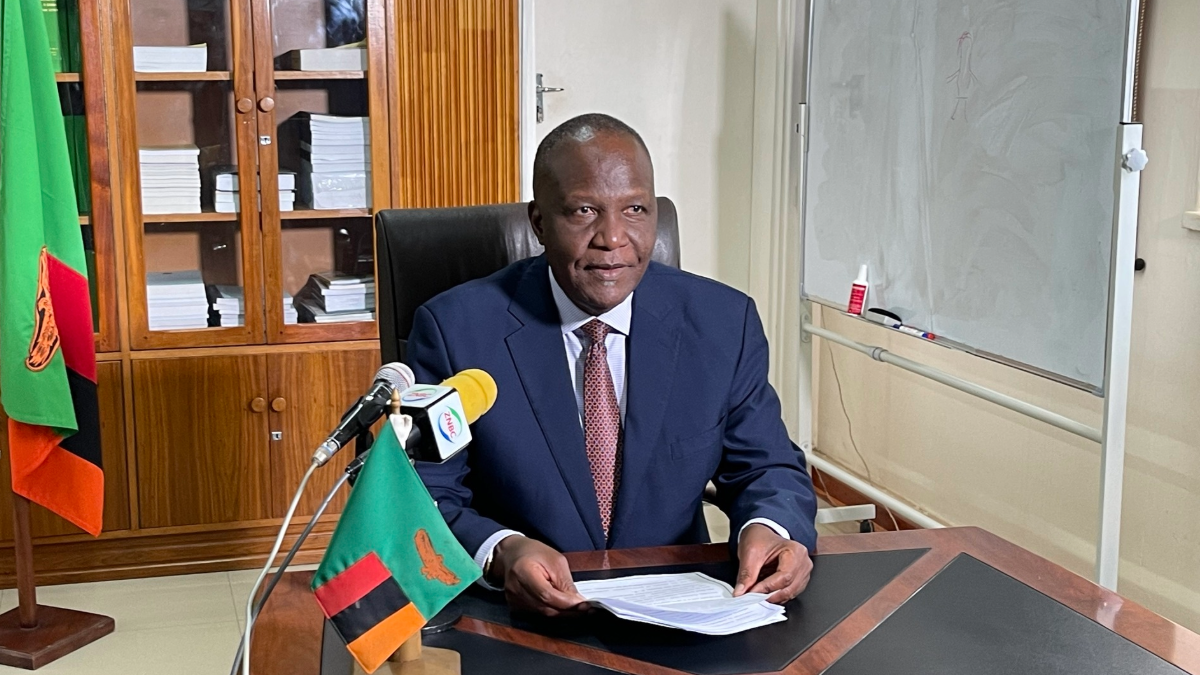
RightsCon, a global conference of thousands of advocates, technologists, academics, policymakers and others concerned with issues at the intersection of human rights and technology, was scheduled to kick off in Lusaka, Zambia, on May 5.
But with just days remaining and with many participants already en route, Zambian government officials announced they would postpone the conference in order to “ensure full alignment with Zambia’s national values, policy priorities, and broader public interest considerations.”
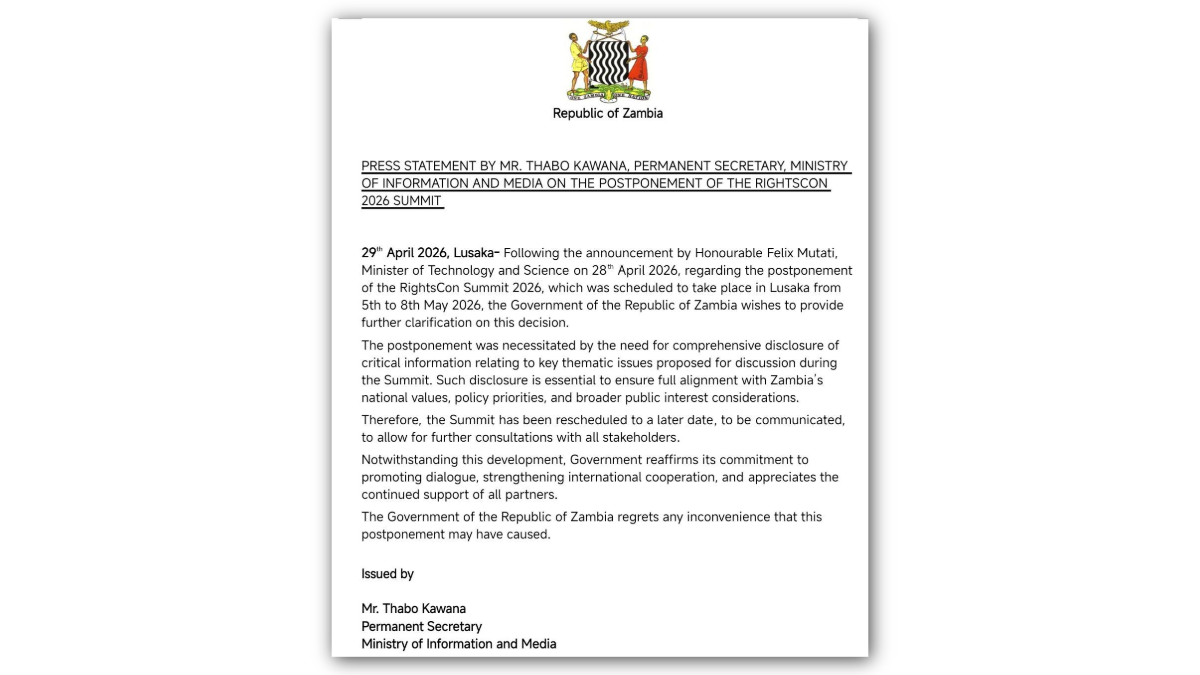
Source: Zambia Ministry of Information and Media/Facebook
On Wednesday, after attempting to negotiate a solution, RightsCon organizers announced the event would “not proceed.”
On Thursday, the Zambian news site News Diggers! published a report citing “well-placed sources” that told the outlet “the Summit has actually been cancelled because the programme involves Taiwanese delegates who would potentially speak against China at a venue donated by the Chinese government.” And a statement issued Thursday by the advocacy organization Article 19 noted, “We are aware of claims, many of them well-founded, that pressure from foreign governments contributed to the Zambian government’s decision.”
By Friday, RightsCon organizer Access Now issued a statement with a more complete account of what had apparently transpired. Chinese diplomats, they said, pressured Zambia over the participation of Taiwanese delegates who were traveling to the conference:
On April 27, one day after a government press release endorsed RightsCon, we received a phone call from MoTS about an urgent issue and were told that diplomats from the People’s Republic of China (PRC) were putting pressure on the Government of Zambia because Taiwanese civil society participants were planning to join us in person.
Despite further efforts to engage in dialogue, Access Now said, the government ultimately did not change its position.
We see this unilateral decision, and the way it was taken, as evidence of the far reach of transnational repression targeting civil society, and effectively shrinking the spaces in which we operate.
China has significant leverage in Zambia. According to a database of Chinese foreign investments maintained at the College of William and Mary, China donated $30 million for construction of the Mulungushi International Conference Center, where RightsCon was to take place. It represents just one of hundreds of investments in Zambian infrastructure totaling nearly $13 billion over the past decade, according to the William and Mary researchers.
Tech Policy Press sent questions to the Zambian government, but received no reply.
Mercurial ministers
As recently as last month, Zambia’s Ministry of Technology and Science indicated preparations were on track.
In a post on the ministry’s website, a government official welcomed the event and emphasized “its alignment with Zambia’s national development agenda.” Pictures depicted RightsCon director Nikki Gladstone briefing government officials along with Richard Mulonga, chief executive officer of Bloggers of Zambia, an organization that campaigns for digital rights and free expression that served as a local civil society partner to the RightsCon organizers.
RightsCon was set to open just more than three months before Zambia's August 13 general election. Elected in 2021, President Hakainde Hichilema is seeking reelection amid complaints around the expansion of the country’s parliament as part of a constitutional amendment package critics call election engineering.
Zambia’s digital policies have drawn criticism, including a pair of new laws enacted last year that legal and human rights experts say raise significant concerns over government surveillance and repression of speech. Bloggers of Zambia is among the domestic critics of the laws.
According to the nonprofit watchdog Freedom House, which ranks Zambia “partly free” on its 2025 Freedom on the Net index of digital rights and free expression, the government has imprisoned individuals for online speech critical of the current government, and journalists are experiencing increased harassment. (UNESCO plans to host a World Press Freedom Day event in Lusaka May 4-5. The Facebook page for Zambia’s Ministry of Information and Media is still promoting the event as “back-to-back with RightsCon” in a header image on its Facebook page.)
Reactions from the digital rights community
Across the world, those planning to participate in the program and others in the field took to social media to express solidarity with Access Now, the digital rights advocacy organization that convenes RightsCon, and disappointment that the gathering was canceled. Held for the past 14 years in various cities, RightsCon is a singularly important event for the field. (Tech Policy Press was scheduled to participate in two sessions during the week.)
“I feel for the staff of Access Now, all their partners and staff in Africa who have been pushing for a RightsCon to be held on the continent, and for human rights broadly,” wrote Aliya Bhatia, a senior policy analyst with Center for Democracy & Technology’s Free Expression Project.
“The world is bleak. We find light in each other. Watching a government try to snuff that out is a serious blow, and it should be treated as one,” wrote Mahsa Alimardani, associate director of technology threats and opportunities at WITNESS.
“This is a serious attack on civil society,” wrote David Kaye, a University of California, Irvine law professor and a former UN Special Rapporteur on the promotion and protection of the right to freedom of opinion and expression. “Thousands of people—activists, academics, government, etc.—are en route to Lusaka. To cancel at this late stage is just horrible.”
In a post on X, Paradigm Initiative, a nonprofit delivering digital rights programs in Zambia as well as the Democratic Republic of Congo, Kenya, Nigeria, Senegal, and Zimbabwe, said it condemned the Zambian government’s actions “in the strongest terms.”
As 404 Media noted, RightsCon has faced challenges in recent years due to adverse government actions. Travel to Lusaka was already complicated this year by the US-Israeli war in Iran. Some participating organizations have struggled with funding cuts due to the Trump administration’s demolition of USAID and cancellation of State Department programs focused on internet freedom and democracy. And in 2023, as many as 300 participants from Global Majority countries were refused visas when the event was hosted in Costa Rica.
Last year’s event, hosted in Taiwan, saw civil society leaders grappling with a rapidly changing world order that is increasingly hostile to the people and ideas that RightsCon gathers. “The attacks are semantic, economic, and moral,” said Luisa Ortiz Pérez, executive director and co-founder of Vita-Activa.org, in Taipei. “The moral injury is large.”
Authors