How China Mastered the Geometry of Tech Power Before Anyone Else
Konstantinos Komaitis / Dec 8, 2025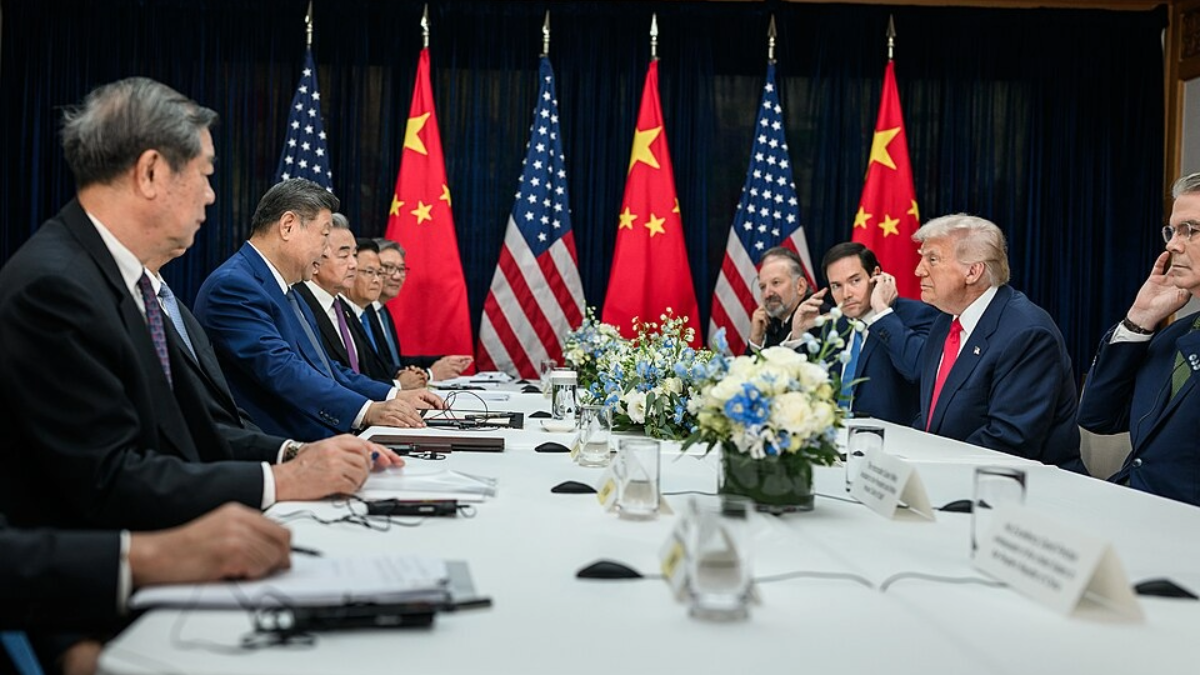
Chinese President Xi Jinping participates in a bilateral meeting with US President Donald Trump in Busan, South Korea, on October 30. (Official White House Photo by Daniel Torok)
International relations today feel less like a grand chess match and more like a sprawling bazaar — a place where influence is traded, dependencies are forged and alliances are temporary contracts rather than lifelong vows. The world is increasingly becoming a marketplace of needs and offers, of sellers and buyers, of infrastructure for loyalty and standards for alignment.
In this marketplace, power does not flow from ideology, or from the lofty rhetoric of shared values. It flows from transactional leverage. And no country understood this shift earlier, deeper, or more strategically than China. Even Washington now acknowledges this new reality: the United States’s latest National Security Strategy reframes alliances in terms of “burden-sharing,” supply-chain resilience and reciprocal economic advantage — suggesting that it, too, is adapting to a world where relationships are increasingly transactional rather than values-driven.
When Canadian Prime Minister Mark Carney talks about a new “era of ‘variable geometry,’” he is describing a world no longer defined by the solid blocs of the Cold War — not the clean parallel lines between NATO and Warsaw nor the split-screen between democracy and autocracy.
Instead, the world resembles a complex tangle of overlapping relationships: triangular in one domain, circular in another, jagged and asymmetric everywhere else. But even as democratic powers, like the US or Europe still cling to the language of principles and values, China saw that the new age wouldn’t be governed by values at all. It would be governed by interdependence — and not the benign kind. Beijing had already demonstrated this in practice: by leveraging its near-monopoly on rare earth processing to remind Japan and Europe how fragile their supply chains really were; by turning Australia’s export dependence into a tool of political pressure during the 2020–21 trade disputes; by using access to its vast consumer market to shape the behavior of foreign corporations; and, by binding dozens of countries into long-term infrastructure and credit arrangements through the Belt and Road Initiative. These weren’t abstract theories — they were the mechanics of a world where connectivity itself had become a form of coercion.
Beijing recognized that you can’t export ideology anymore, but you can export technology, and with it, rules, norms, data pathways, standards and — most crucially — dependencies. In fact, China realized this long before anyone else.
Over the past several years, China has quietly woven itself into Africa’s digital backbone. In Senegal, the Export-Import Bank of China helped finance the Diamniadio National Data Center via a loan, and Huawei helped build it with its equipment and technical support. Senegal President Macky Sall then apparently instructed that all government data and platforms be migrated to that center — a move openly justified as strengthening the country’s digital sovereignty. In Cameroon, Huawei helped build the Zamengoe government data center, also backed by Chinese state financing. And in Malawi, Huawei commissioned the country’s first national data center, signaling deepening technological ties with China.
Analysts argue that this isn’t just infrastructure aid — it’s a broader play for influence. By financing, building and equipping critical government data infrastructure, China positions itself as indispensable to the digital operations of these states.
This was never about selling gadgets. China was selling systems — the kind that outlast governments, political cycles and even generations. Whether the customer was a European democracy, a Gulf monarchy or an African strongman, Beijing made no moral judgments. The only question that mattered was: Do you need our technology?
If the answer was yes, China’s hand was already on the lever.
That’s how Huawei wound up wiring democracies and autocracies alike. That’s how Hikvision’s cameras appeared in police stations from Quito to Belgrade. That’s how BeiDou — the Chinese alternative to GPS — became embedded in critical infrastructure across the Global South.
Beijing didn’t impose a political test. It offered a simple proposition: we can connect you faster, cheaper and at scale. The unspoken subtext? You’ll need us long after the ink dries.
Where Western nations debated privacy standards and legislative guardrails, China moved. Where Western companies fretted about Environmental, Social and Governance (ESG) compliance, China delivered blueprints, bulldozers and turnkey digital ecosystems. Where democratic governments worried about value alignment, China worried about market share.
The genius was in how Beijing bundled technology with standards. A country that builds its telecom networks on Chinese specifications will find that its upgrades must also be Chinese-compatible. Engineers become reliant on Chinese training. Local partners depend on Chinese supply chains. Governments begin adopting Chinese cybersecurity norms. This isn’t just a commercial relationship — it’s a structural embrace. China doesn’t need to twist arms; gravity does the work.
This is also why it looks like China is poised to win the technology race. It’s not simply because it has massive research and development spending or a vast population of engineers. It’s because winning the technology race isn’t just about innovationbut about embedding your technology in other countries so deeply that alternatives become impossible, expensive or politically risky. It’s about shaping the architecture of global tech, not just the gadgets; it’s about building a world where other countries cannot disentangle themselves without ripping out the wiring of their own economies.
If American and European leaders sometimes sound alarmed, it’s because they’re waking up to the realization that China hasn’t just sold routers and servers — it has sold systems of governance through technology. And many governments, willingly or not, have bought into a future designed in Beijing.
China does not force you to choose; it offers you something you can’t refuse.
In today’s geopolitical marketplace, refusal is a luxury, adoption is a necessity and dependence is often the hidden cost.
The irony, of course, is that while China exports dependencies abroad, it relentlessly works to eliminate its own dependencies at home. Through initiatives like Made in China 2025, Beijing has turbocharged domestic manufacturing, reduced reliance on foreign semiconductors and consolidated its technological ecosystem. In the global marketplace, China is both the vendor and the fortress — selling openness while building self-sufficiency. This asymmetry lies at the heart of its strategic advantage. China binds others to its networks while ensuring it is bound to no one’s.
As the world slides deeper into this era of transactional relationships, political scientists still cling to the hope that alliances can be rebuilt on shared democratic values. But in practice, the data flows one way: toward whoever provides the infrastructure.
The world that China’s geometry makes possible
So what happens in a future drawn by China’s geometry? A world where countries are connected not by treaties but by fiber-optic cables running through Chinese-designed routers? Where geopolitical leverage is deployed not through diplomacy but through software updates? Where sovereignty is something you manage through a maintenance contract?
If the world accepts that the future will be governed only by transactions — if democracies convince themselves that they must abandon principles in order to compete — then this age of deals will become something far darker than a marketplace. It will become a place where human rights are negotiable, where international norms are optional, where accountability becomes a relic of another era. A world in which the entire postwar system — the treaties, the safeguards, the mechanisms of oversight built through decades of sacrifice — dissolves into the logic of: what can you offer me today?
If democracies give up ideology entirely, they won’t become more competitive; they will become indistinguishable from the actors they fear. And once that line is crossed, it will not be China that redraws the world — it will be the world that willingly redraws itself in China’s image. So, the question is not whether the West should imitate Beijing; it’s what it can still do to avoid sleepwalking into a future written by someone else. And here, the answers must be uncomfortable enough to wake democracies from their strategic drowsiness.
First, democracies must stop treating values as rhetorical ornaments and start embedding them into the very infrastructure they build. If China binds the world through fiber-optic gravity, the West must counter not with sermons, but with systems — open 5G, interoperable clouds, transparent data centers, — built fast enough and cheap enough to be adopted. A world that runs on democratic infrastructure is a world where democratic values remain relevant, not nostalgic.
Second, instead of resurrecting Cold War blocs, democracies should champion a new digital alignment — a technological third-space that lets countries adopt open-source, interoperable digital sovereignty modular architectures rather than lock themselves into Beijing’s ecosystems or Washington’s dependencies. Offer autonomy, not allegiance. Freedom, not exclusivity.
Third, the world needs to treat data with the same seriousness it once reserved for nuclear material. If information is the new uranium, then we need an international watchdog with the authority to inspect digital reactors, audit surveillance systems and hold governments — all governments — accountable before the damage is irreversible. You cannot preach human rights while letting opaque algorithms govern the lives of billions.
Fourth, make rights competitive again. Not moralistic, but material. Tie access to Western markets, advanced technology, and investment flows to enforceable protections for privacy, transparency, and due process. Not vague commitments — contractual obligations. If the West believes its values matter, it must price them into the deals.
Fifth, democracies should build coalitions that do not wait for governments to move. Cities, universities, technology firms, civil-society networks — these actors shape the digital world far more quickly than foreign ministries. A lattice of non-state alliances could set global norms from the bottom up, creating standards too widespread for any government — including China — to ignore.
Finally, democracies must offer something China cannot: exit ramps. Systems that can be swapped out without tearing a country’s digital nervous system apart. Alternatives that do not trap, but liberate. If Beijing builds digital dependencies, then Washington, Brussels, and their partners must build digital parachutes.
Democracies must also remember that human rights are not sentimental add-ons — they are the operating system that keeps technology from becoming a weapon. A world without rights is a world where tools don’t give people agency but extract it, where digital systems watch instead of serve and where checks and balances become museum pieces from a more hopeful century. If democracies want their technology to stand apart, they must hard-wire human rights into every network they build and every standard they export — not as a moral lecture, but as the safeguard that keeps power from turning predatory.
Because the true threat is not that China has drawn the geometry of the 21st century. It’s that democracies might choose to live inside it without protest. If the West wants a future where rights are more than marketing, where sovereignty isn’t downloaded through a software patch, and where nations can operate without invisible strings attached, then it must stop debating China’s map and start designing one of its own.
The age of deals has already begun. The only question that remains is whether democracies will remain customers in someone else’s marketplace — or architects of a world that still answers to something greater than the transaction.
Authors


.jpg)