What Ireland’s Data Center Crisis Means for the EU’s AI Sovereignty Plans
Louis Boyd-Madsen / Dec 18, 2025This reporting is published in collaboration with AlgorithmWatch and is supported by the European Digital Rights (EDRi), European Center for Non-For-Profit Law (ECNL), and Lighthouse Reports investigative journalism & civil society collaboration grants.
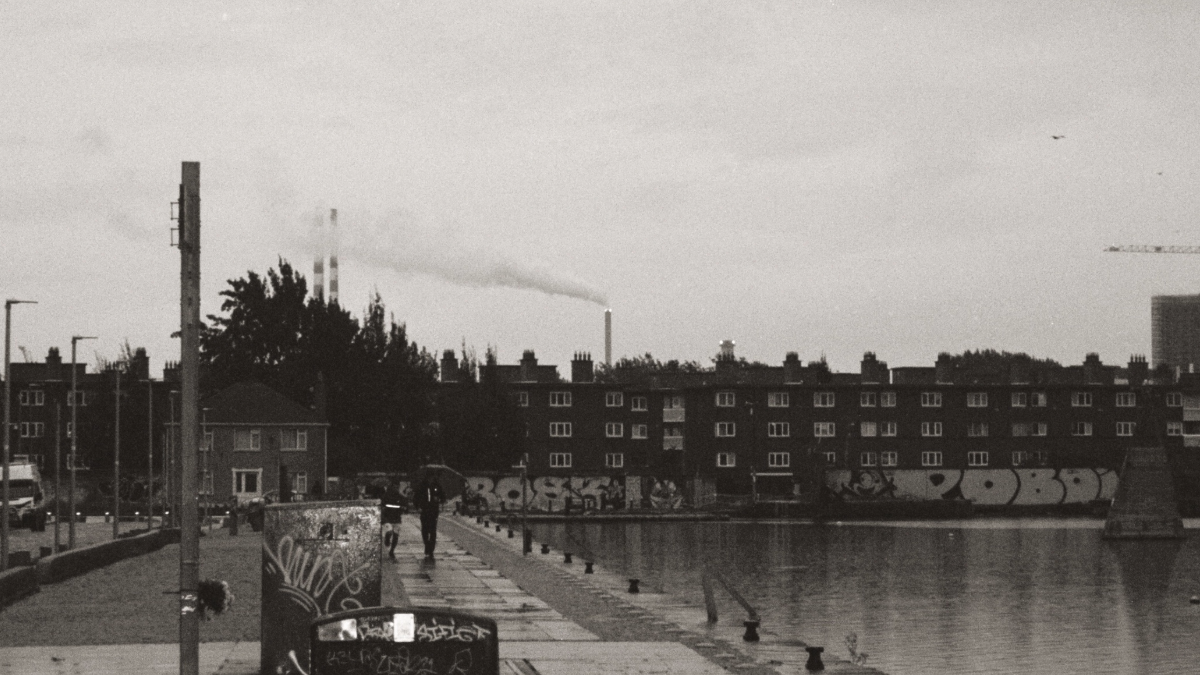
View of chimneys from Poolbeg Power Station and Poolbeg Incinerator, across Grand Canal Dock, Dublin. Photography by Louis Boyd-Madsen.
Ireland is now home to one of the highest concentrations of data centers in the world. What began as a quiet build-out of server farms around Dublin has expanded into an industrial presence with an ecological footprint that dominates the country’s electricity system. In the meanwhile, Big Tech has falsely portrayed itself as a partner in green transition.
The surge in energy consumption has reshaped the energy system around the needs of a handful of multinational tech companies. Grid capacity is being diverted to new hyperscale sites, transmission upgrades are being driven by their load, and the state is pouring billions into emergency fossil-fuel generators to keep supply stable. Households face higher bills, electrification plans have stalled, and national climate targets are slipping out of reach. What looks like a renewable success story on paper masks a system increasingly strained by a single, rapidly expanding sector of energy users.
A growing social resistance has emerged in response. In nearby towns to Dublin, such as Rochfortbridge and Naas, local communities are pushing back against plans for new developments. At a national level, movements like “Energy for Who?” are demanding that renewables and grid connections be prioritized for essential social infrastructure, including housing and transport. Recent polling suggests this perspective is broadly shared by the public. Yet, government planning has so far focused on stabilizing digital growth, rather than reimagining how it fits within the goals of a just and affordable energy transition.
Ireland has thus become a test case for the political, economic, and environmental contradictions created by unregulated hyperscale expansion. As the EU moves to triple its data center capacity under the AI Continent Action Plan, the pressures already destabilizing Ireland’s grid offer a preview of what the continent may soon face.
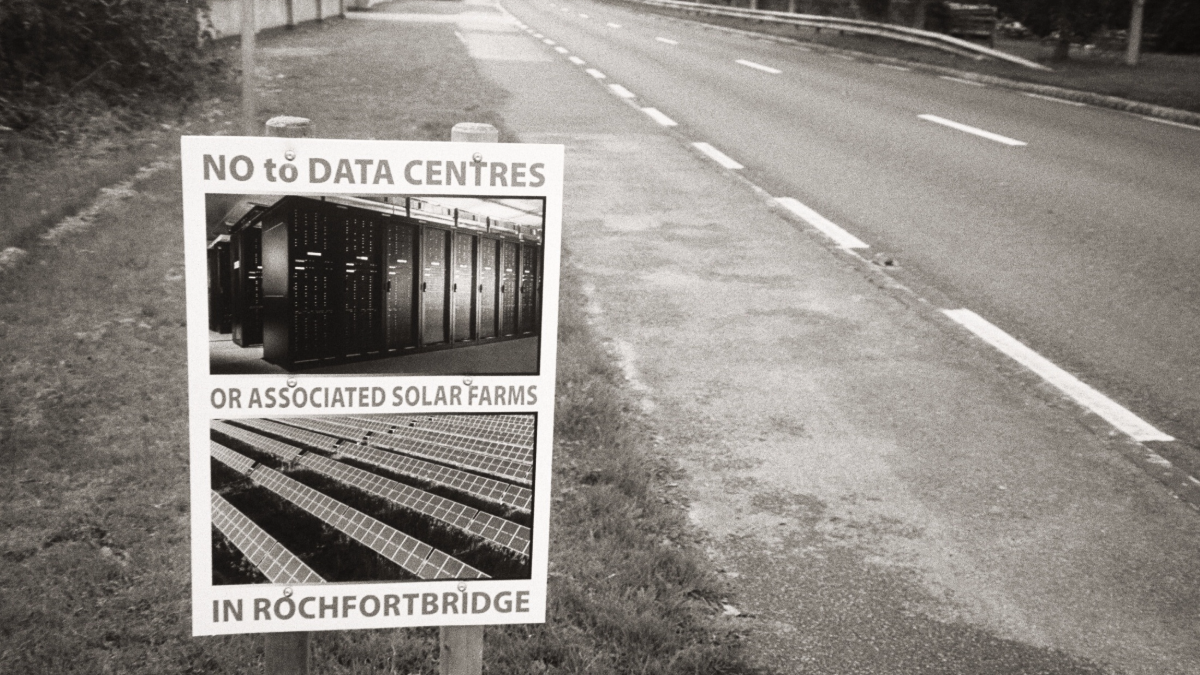
Placards on the road leading from Rochfortbridge to the energy park voice locals’ resistance to the new ‘Red Admiral’ data center proposal, the development of which has now been stalled. Photography by Louis Boyd-Madsen.
How Ireland became a testbed for hyperscale data centers
Unlike the hyperscale sites now being built across the globe amidst the frenzy of AI speculation, Ireland’s data center load growth was initially driven by more traditional uses: cloud storage, banking infrastructure, and the vast personal data archives that underpinned Big Tech’s earlier phase of expansion.
Since the start of the post-war era, the Irish government has run an economic strategy based around courting investment from foreign multinationals – using a range of tools including tax incentives and infrastructure investment. This approach found real success with the rise of the ICT industry in the 1980s and 1990s, as US multinationals flooded into the country to lower their tax obligations and set up shop for export physical electronics, software, and services to the wider EU.
As money was channeled into a small set of tech giants in the aftermath of the 2008 global financial crisis, and the demand for computational capacity rose, Dublin began to see a steady growth in data centers – linking Big Tech’s offshore headquarters to the United States via a network of undersea internet cables.
By 2017, data-center load growth wasn’t just tolerated but formally integrated into industrial planning. A Government Enterprise Strategy sought to prioritize continued digital growth and “align enterprise electricity demand with generation capacity and transmission planning.”
The tech sector grew rapidly: Today, it has become a major source of government revenue and the main applicant for new electricity demand. Energy consumption by data centers is by far the highest in Europe: in comparison to the total Irish national consumption, they accounted for a 22% share in 2024. Roughly 97% of these data centers are clustered in the wider Dublin area. In 2023, 88% of all corporation tax was paid by foreign multinationals, of which 57% was paid by just 10 companies. A report from the Irish Central Bank suggests a major driver of growing tax revenue between 2011 and 2021 was “a small number of extremely profitable ICT firms."
For academic Patrick Brodie, this dependence is the latest chapter in a much longer development model. Ireland, he argues, “hitched its wagon to the transatlantic investment relationship” in the post-war period, shaping the country’s industrial and infrastructural landscape ever since. That bargain was never just about taxes. “It was also about building infrastructure,” he says, “and about managing the environmental contradictions that came with it.”
Those contradictions are now concentrated directly in the electricity system, according to Brodie. Vast public resources are mobilized to serve capital-intensive digital infrastructure, even as shortages persist in housing, transport, and public services. “You can’t have a green transition that’s genuinely independent if it’s dictated by the needs of monopolistic tech companies,” he adds.
This facilitative model has already reappeared in different shades across Europe – from the UK’s AI Growth Zones, to Sweden’s energy tax break for data centers, or Denmark’s build-out of low-latency fiber optic and grid overcapacity. But nowhere has the potential bargain between digital growth and energy planning been pushed further than in Ireland. The consequences are now becoming visible across the country’s grid, climate trajectory, and public finances.
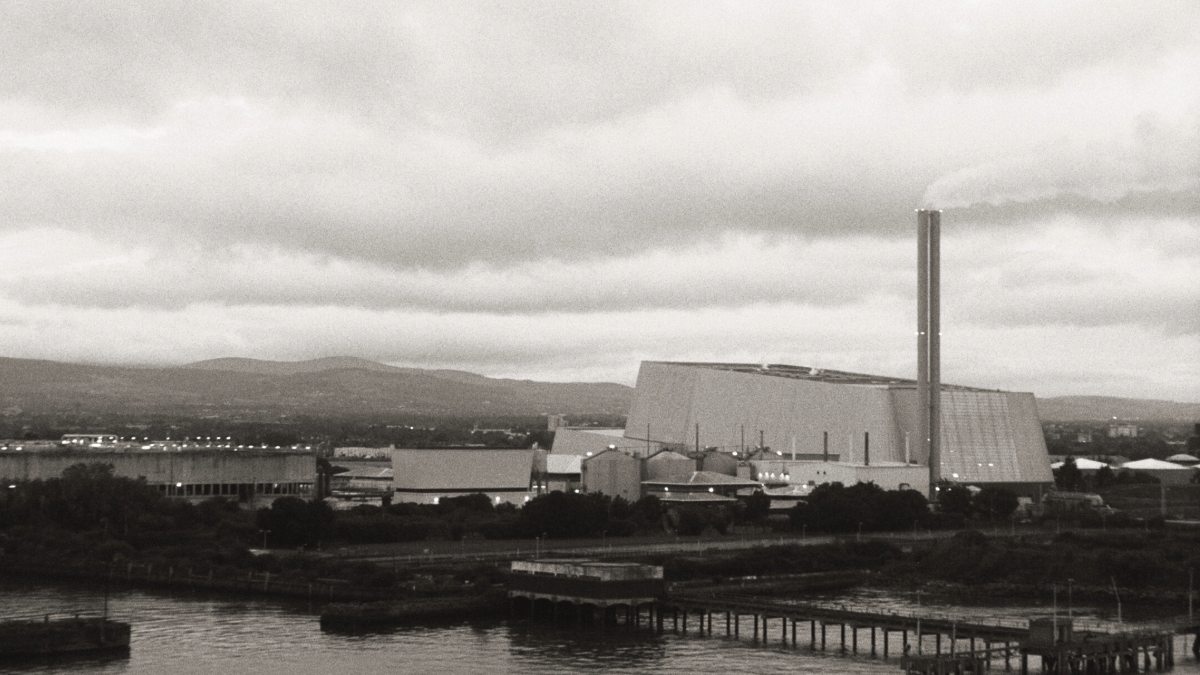
View of North Wall in the Port of Dublin, housing several generators and gas product tanks, including the 2021 emergency gas generator. Photography by Louis Boyd-Madsen.
How the boom collided with the energy system
By 2021, the Irish electricity system had reached the limits of what it could absorb. The national grid operator EirGrid warned that the load on the grid in Dublin was pushing against the system’s physical capacity and creating a genuine risk of blackouts, marking the end of the previously laissez-faire approach to grid connections.
The Commission for Regulation of Utilities (CRU) put an effective moratorium on new data center grid connections in Dublin, requiring new connections to be in unconstrained parts of the grid with sufficient local generation capacity. However, the grid remained fragile.
In response, the government and the energy system operator moved to commission emergency gas generators near the port of Dublin, the Irish Midlands, and a handful of additional sites, at an estimated cost of €1 billion. To help ease congestion, a wave of investment has been going into upgrading the grid’s capacity to distribute electricity. Much of this cost has been shouldered by Irish households, adding an average of roughly €100 per family to the bills in 2024.
Yet most of this newly created grid capacity was not used to electrify homes, rail, heat pumps, or industry. It was hoarded by data center developers. Ireland had limited rules governing priority access to grid connections, so hyperscalers simply booked capacity years in advance, effectively shutting out other users. For instance, a grid connection originally planned to serve new housing in Castlebaggot, West Dublin, was instead allocated to data centers.
The CRU suggested this trend was threatening the country’s broader targets for decarbonization and housing development: “The potential level of data center demand could significantly impact [the grid’s] ability to accommodate demand connections required to support Government policy targets such as 550,000 new homes by 2040, 680,000 heat pumps and 945,000 EVs [Electric Vehicles] by 2030, major electrified rail projects explicitly identified in the National Development Plan and other social infrastructure.”
The fallacy of renewable energy reliance
Ireland is one of the most fossil fuel-reliant economies in Europe. “About 80% of all the energy we use today for our homes, our heating, our appliances, and our industry comes from fossil fuels,” says Paul Deane, senior lecturer in Clean Energy Futures at University College Cork.
Nevertheless, tech firms continued to portray themselves as green-transition partners — largely through Corporate Power Purchase Agreements (CPPAs). These allow companies to claim renewable electricity procurement on paper even when their facilities draw from the grid’s fossil-fuel-heavy mix in practice. Europe-wide, Amazon, Google, and Microsoft are the three largest buyers.
Data from RE-Source suggests most CPPAs signed in Ireland are either financial – that is, not based on physical power delivery to the buyer – or structured in a way that has not been publicly disclosed. Only 14% are confirmed to involve a direct physical connection between the generator and the off-taker. The sources consulted for this investigation suggest the majority of these CPPAs match electricity on an annual basis rather than hour by hour.
The result is a widening gulf between corporate sustainability claims and actual, system-wide decarbonization.
Source: Re-Source 'PPA Deal Tracker'.
These contradictions can be seen clearly in the Midlands where Bord na Móna’s planned Eco Energy Park will co-locate future Amazon Web Services (AWS) data centers with renewable-energy infrastructure. AWS is aiming to contract up to 800 MW of new wind and solar generation from Bord na Móna’s wider project pipeline — a volume of electricity roughly equivalent to the annual consumption of 2.2 million Irish homes. But so far, just 105 MW has been secured through a CPPA linking a proposed new AWS site to a nearby wind farm. Whenever the wind drops, any data centers built at the site will still draw power from the national grid, including fossil-fuel generated electricity.
To guarantee stability, Bord na Móna has already applied for a 600 MW gas plant adjacent to the site, which it claims will later switch to hydrogen or biomethane, according to the company’s environmental impact assessment report. No credible pathway exists to supply these fuels at this scale.
“Renewable energy only helps meet our legally binding carbon budgets if it replaces fossil fuel demand, ” says Hannah Daly, Professor of Sustainable Energy at University College Cork. “If there was evidence that data centers were financing projects that wouldn’t otherwise have been built and that would match their demand at all hours of the year without creating bottlenecks for other renewables, they would at least not harm our carbon budgets."
Analysis conducted by AlgorithmWatch and Tech Policy Press, drawing on tech majors’ sustainability reports and press releases, suggests the total announced new capacity brought online via CPPAs with data centers in Ireland is far behind the pressure that data center expansion has already put on the energy system. Even if all announced CPPAs come online, they will still fall behind the load that has already been imposed on the system.
Source: Company press releases, sustainability reports, and announcements in trade press; authors’ analysis.
In a paper commissioned by FOE Ireland, Professor Daly found that half of the new capacity came from CPPAs, as opposed to government-run auctions, between 2020 and 2023. But this volume only amounted to 16% of the new data center demand during this period. Daly’s findings mirror our own. Despite industry claims of 100% renewable procurement, Ireland’s data centers in aggregate have seemingly deepened the country’s dependence on fossil fuels.
By outpacing renewable deployment, straining the grid, hoarding power connections, and building on-site gas generators, the tech sector has simultaneously stalled other sectors’ decarbonization and deepened the dependence on fossil fuel-fired power generation, both of which contribute to stalled emissions targets.
The real expansion is fueled by new gas generation
Yet regulators have limited power to intervene. Out of fear for the country’s energy security, the Irish government has promised to spend more on its fossil fuel infrastructure, beginning construction of a state-led strategic gas emergency reserve. The reserve will take the form of a floating LNG (liquefied natural gas) tanker and regasification plant, with an estimated upfront cost of between €300 and €900 million.
Meanwhile, developers are increasingly turning to on-site gas generation to circumvent grid constraints entirely. Microsoft’s Grange Castle campus in Dublin has a fleet of gas generators totaling 239 MW. The site is one of seven with existing gas connections, five of which are currently actively consuming gas. Analysis by Hannah Daly from Cork’s University College suggests an additional four sites are awaiting connection and 22 have submitted planning requests.
Daly shows that if existing, pending, and proposed gas-connected data center sites all operate at full capacity, they would emit up to 16.6 MtCO₂ per year — equivalent to 68% of Ireland’s total national emissions in 2023. She notes that Gas Network Ireland’s own, more conservative estimates, still predict an overshoot on sectoral emissions targets by 21-30%, driven by existing and confirmed on-site gas connections respectively.
Gas Networks Ireland and several private actors see this gas demand as a temporary, transitional problem as the network switches over to low-carbon hydrogen and bio-methane. Daly’s colleague Paul Deane remains sceptical. “Some data-center owners say they’ll only use gas for a few years, but there’s no convincing evidence of an off-ramp,” he says. “The promise of a technology in the future, isn't good enough to allow you to burn more natural gas today.”
These various interlinked problems have come to the fore in the discussions of the new Large Energy Users (LEU) Connection Policy. Expected to be finalized before the end of the year by the CRU, the policy will set out new rules for how data centers connect to the grid. The policy’s main goals are to improve grid stability, ensure sufficient on-site or nearby generation capacity, and strengthen emissions reporting.
Source: Central Statistics Office 'Networked Gas Daily Supply and Demand July 2025'.
However, in the draft text, the CRU concedes that it will not receive enforcement powers to mandate renewable procurement, emissions caps, or set requirements for the decarbonization of the gas network.
The specialists interviewed said this reflects a broader pattern: rather than confronting the political trade-offs between digital growth and sustainability, the Irish government has deferred control to regulators tasked with managing that growth as smoothly as possible. The LEU policy, critics say, is the latest example of this deference to regulatory authority.
“Ireland’s climate legislation directly conflicts with several of our enterprise strategies. There’s a lack of acceptance that it’s impossible to reconcile the constraints of carbon emission targets with what’s necessary for the growth of this industry via technological measures alone,” Daly says. “The right technologies and supply measures would need to be put in place ahead of the growth of the industry, not afterwards.”
Rosi Leonard, a data‑center campaigner for Friends of the Earth Ireland, argues that the government overestimates the sector’s mobility: companies are unlikely to abandon existing infrastructure in Ireland, even under stricter regulations, and any departure would indicate the need for broader economic diversification.
The Irish case has seen a consistent pattern: tech-sector growth is treated as inevitable, while climate obligations are accommodated around it. Managing the strained infrastructure comes at the cost of rising emissions and deferred decarbonization - a lesson that other countries facing rapid digital expansion will soon have to confront.
Why this matters for the EU’s AI Expansion Plans
Ireland’s experience is no longer a local anomaly. The EU’s AI Continent Action Plan proposes tripling data center capacity by 2030 to support continent-wide AI deployment, cloud services, and high-performance computing. But the plan does not resolve the fundamental challenges that Ireland is now experiencing: scarce grid capacity, fossil fuel lock-in, insufficient transmission infrastructure, and potential social pressures caused by rising energy prices.
The EU also risks repeating one of Ireland’s biggest mistakes on renewable energy. Its plan to use public funds to de-risk long-term contracts for hyperscale data centers — through agreements linking governments, utilities and tech firms — could end up funneling taxpayers’ money into deals that let companies claim that they use renewable electricity without actually cutting emissions.
Europe still has time to avoid these pitfalls. Countries planning to host hyperscale clusters should ensure sufficient energy capacity before data centers are built; block direct fossil-gas connections; enforce 24/7 renewable matching; and plan for the availability of clean power for critical public services and housing, rather than ring-fencing new renewables for the tech sector through CPPAs.
The Irish case shows what happens when digital expansion outruns energy planning, and when political dependency on a small group of firms overrides climate commitments. The costs - higher prices, deeper fossil lock-in, strained infrastructure, and derailed emissions targets - are now visible across the country, while access for homes, transport and essential infrastructure remains a low priority. The EU can treat Ireland as a cautionary tale, or repeat its mistakes on a continental scale.
Authors