Vietnam’s Gig Workers Are Finding New Ways to Push Back
Lam Le / Oct 2, 2026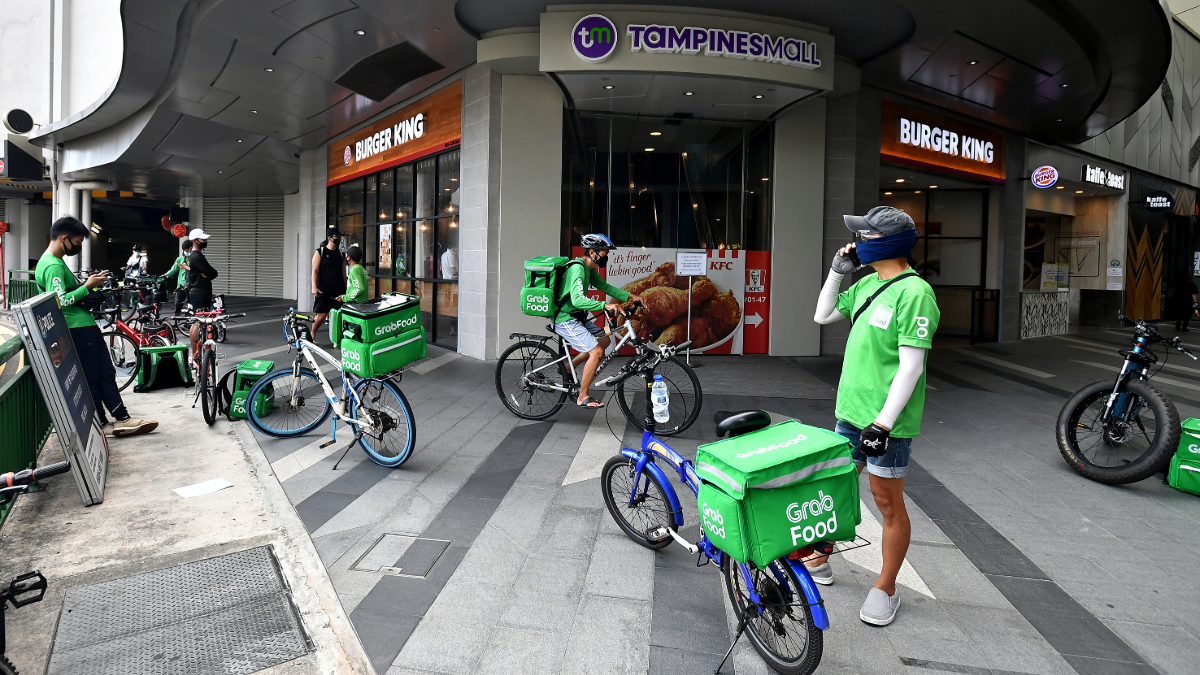
GrabFood delivery riders outside a Burger King restaurant at Tampines Mall. (Singapore Press via AP Images)
In early September, Facebook groups for drivers with ride-hailing and food delivery platform Grab in Vietnam were flooded with calls to boycott the app over excessive commissions and a lack of fare transparency.
“Let's turn off the app for two days—for the sake of our own future!” said the post by anonymous user SensibleYuzu4180 that was reposted in many groups, setting the date for September 12-13. “Attitude: Civilized, peaceful, and law-abiding — no to aggression and no to disrupting public order or security.”
“Please spend the 12th and 13th resting with your family or servicing your vehicle.”
This is not the first time drivers in Vietnam have called for a mass boycott in protest of platform policies. Previous attempts even involved drivers gathering outside their app’s office but did not attract much public attention, nor result in any regulatory change.
“How the (boycott) is organized hasn’t changed much, but drivers have been more cautious in how they show their discontent,” Do Hai Ha, a researcher at the University of Melbourne who has studied Vietnam’s gig economy since 2017, told Tech Policy Press. What’s changed is “now the people sympathize with the workers more, the press is speaking up more, creating internal pressure” for regulatory change, he said.
By Sept. 11, the Competition Commission under the Ministry of Industry and Trade announced it had requested Grab and its competitors to explain their fare breakdown, while encouraging users and drivers to submit their own evidence. If the commission finds sufficient evidence of unfair competition, this could lead to legal proceedings, though it remains to be seen how far this will be taken.
Platform work remains unregulated in Vietnam, where workers for ride-hailing and delivery apps are considered driver-partners. The fact that the Competition Commission, rather than a labor authority, stepped in suggests that while the government is paying attention to the issue, drivers are still seen as users of platform services, rather than its employees, Ha said.
Last June, the Ministry of Home Affairs said they would not include platform workers in the compulsory social insurance scheme that applies to formally employed workers, saying they can choose to participate in the voluntary scheme.
For this to become a labor issue, Ha said, it must be shown that drivers don’t have sufficient bargaining power over the platform, warranting state intervention such as allowing unionization, setting minimum wages, providing social insurance, and other rights and benefits under the country’s Labor Code.
The recent call to boycott shows the tide is changing, even as the actual boycott appeared muted.
Past boycotts were more vocal and visible, with drivers openly coordinating on social media and gathering outside their platforms’ offices.
This time, on the first morning of the boycott, it was quiet outside Grab’s office in Hanoi, with no driver in sight. An anonymous account led the call for the boycott over what they said were excessive commission rates, ranging from 40 to 50%, while in Indonesia, Grab is required by law since July to cap commissions at 8%.
Pham Mi Sen, deputy head of the Ho Chi Minh City App-based Drivers Association, confirmed that platform drivers’ pay has fallen significantly over the years. In 2015, a motorcycle delivery driver for Grab got paid 3,000 dong per km. By 2026, it had fallen to just 2,500 dong. “To shoulder the (rising) cost of living, drivers have only one option: they have to increase their working hours,” he said. But “the initiative (call to boycott) was sporadic, spontaneous, and lacked any real direction; it certainly didn't reflect the stance of the vast majority of drivers.”
Ahead of the boycott weekend, Le Tan Luu, the chair of Binh Tan App-based Drivers Association in Ho Chi Minh City, urged members to stay calm. “You have the right to raise concerns or make proposals if you find a policy unsuitable,” he added. “However, if you approach the matter calmly—backed by information, data, and adherence to regulations—your voice will carry much more weight and be far more persuasive.”
While it is hard to ascertain the actual size of the boycott, Van, who drives full-time for Grab in Ho Chi Minh City, noticed a spike in the number of rides he got assigned over the boycott weekend. “I’m still working, otherwise I’d go hungry,” Van, who requested to be identified by a pseudonym for fear of retaliation by the platform, told Tech Policy Press.
Duy Nam, 24, who’s been driving for Grab in Hanoi for just three months, decided to turn off the app over the weekend and try out rival Tada who pledged to take zero commissions. “This is not some revolution or a protest, but an expression of the drivers' outrage as they demand their rights,” Duy Nam, who didn’t give his surname, said. “It also raises a major question as to why the company takes such a high cut.”
To illustrate his point, Duy Nam showed an example of a Grab ride where the customer paid 17,000 dong ($0.65), and he was paid 9,000 dong. After a recent 78,000 dong Tada ride, he pocketed 72,000 dong after the platform deducted VAT and income tax.
The individual drivers’ choice to quietly turn off the app without taking to the streets with protest banners and the association’s choice to call for restraint are both indicative of how thin the line they’re threading between their right to voice their concerns and disturbance of public order, which in Vietnam is a criminal offense often used against protesters.
Indeed, while there have been no reports of protesting drivers getting fined or arrested, on September 14, the police fined a YouTuber for spreading unverified news that “Grab drivers are turning off the app en masse.” The police warned the public against engaging with accounts that spread misinformation about the boycott, singling out accounts that used words like “protest” and “Grab is paralyzed” without citing a clear source.
The police also quoted Grab as saying that during the weekend of September 12-13, the app continued to operate as normal. Grab did not respond to Tech Policy Press’ request for comment.
Public support is changing the equation
The loudest voices through this campaign were actually the media and Grab users, notably on Threads, which in the past year has become a hotbed for political discussion in Vietnam. State and foreign media covered the boycott before it even started, leading with stories on how drivers’ earnings have been falling over the past several years.
On Threads, users expressed solidarity with the drivers, pledging to boycott the app too. On the first day of the boycott campaign, Grab was trending on Threads with a million posts. Users shared example letters to Grab and government agencies to demand better pay for the workers, and mobilized free meals for drivers going offline that weekend. By Sunday, the Nasdaq-listed company’s stock fell by 10%.
This solidarity is not an isolated event. Last year, users from Malaysia, Singapore, Thailand and Vietnam used Grab and another popular app, Gojek, to order food and essentials for drivers in Indonesia who were at the forefront of anti-government protests.
This reflects the quasi-intimate relationship users in Southeast Asia have developed with ride-hailing and delivery drivers. “Since the pandemic, they have become essential to the daily lives of the people,” Mi Sen, the deputy chair of the drivers’ association, said. Users rely on them for everything, from the daily commute through the region’s crowded mega-cities, to deliveries of groceries, food and other essentials whenever the roads are flooded, or it’s too hot, or one is simply just too busy to go outside.
Over time, the public has come to understand drivers’ struggles, from chats during the commute and protests across the region to media reports on how platforms use algorithms to control drivers' pay and pressure them to work longer hours.
Pressure for regulation is growing
Regulation is catching up, just as the number of ride-hailing and delivery drivers has risen to hundreds of thousands, or even more than a million in some countries, and with that, the power to paralyze traffic and logistics.
Last year, Singapore’s Platform Workers Act came into effect, the first legislation in the region to recognize this form of work with rights to social security. Malaysia followed with its Gig Workers Act coming into force in March 2026. Indonesia mandated the 8% cap on commissions in July.
In June, the ILO adopted the Decent Work in the Platform Economy Convention 193, which states employment classification should be “guided mainly by facts relating to the performance of work, the remuneration or payment of the digital platform worker, among other elements, and considering the specificities of work via digital labor platforms.”
These regulations act as reference points for the Vietnamese government, but for meaningful change to happen, “the motivation has to come from within,” Ha said.
On Sept. 29, National Assembly member Tran Thi Dieu Thuy proposed that ride-hailing and delivery platforms contribute to their drivers’ social insurance during a meeting discussing amendments to the Law on Social Insurance.
On Sept.15, the Laborer Counseling and Support Center under the Ho Chi Minh City Federation of Labor organized a workshop entitled Social Protection for Ride-Hailing Drivers: Current Situation and Solutions. Among the invitees were Grab drivers and platform work researchers who said the job's flexibility is an illusion; instead, the app forces them to work dangerously long hours just to make ends meet.
Mi Sen was present there too. And in an interview with Tech Policy Press, he reiterated his message to the government: “We drivers want to have a clear classification of where we stand in this society (…) we want equality with other workers.”
“If (the platform) insists we are partners, then we must have the right to negotiate rates, working hours, and policies regarding incentives and penalties.”
Authors