Workers in Asia Are Fighting for Protections as AI Threatens Jobs
Lam Le / Jul 13, 2026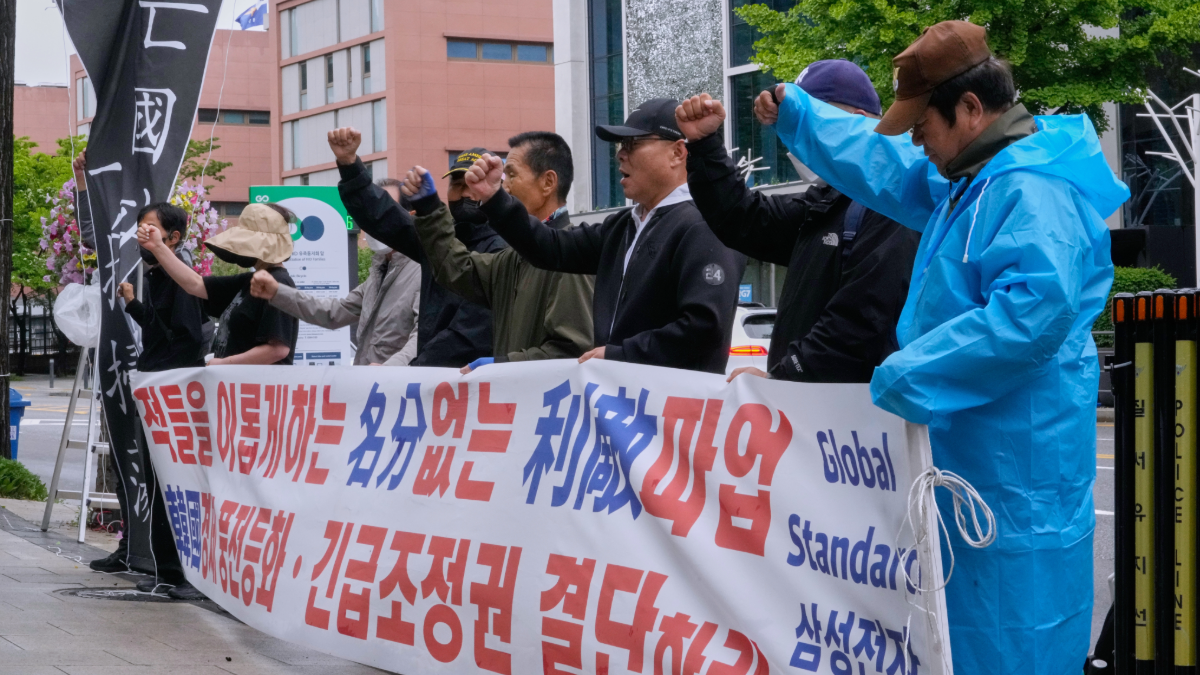
A group of shareholders of Samsung Electronics Co. hold a rally criticizing a tentative wage agreement struck between the company and its labor union near the home of Samsung Electronics Chairman Lee Jae-yong in Seoul, South Korea, Thursday, May 21, 2026. The letters read "Unjustified transfer strike." (AP Photo/Ahn Young-joon)
Hyundai Motor’s labor union approved a strike last month as workers demand job protections against the South Korean carmaker’s plans to deploy humanoid robots on factory floors.
“Not a single robot” will be allowed onto the assembly floor without a labor-management agreement, the union said in a statement.
The dispute reflects a broader struggle unfolding across Asia as artificial intelligence reshapes workplaces and raises questions over who should benefit from productivity gains. In South Korea, unions at technology companies that have benefited from the AI boom are demanding larger bonuses and a greater share of corporate profits.
Major semiconductor companies, including SK Hynix and Samsung, have already agreed to record-high payouts, with some memory chip workers expected to receive bonuses up to $416,000.
But the debate extends beyond compensation. The Korean Confederation of Trade Unions (KCTU) and labor minister Kim Young-hoon have called on companies benefiting from AI-driven profits to share gains not only with their own employees but also with workers in different departments, suppliers and subcontractors. Samsung union’s own win has alienated its workers. Those in less lucrative sections received much smaller bonuses and, in protest, left the union in droves.
Across Asia — from South Korea to Singapore, China and the Philippines — workers and governments are taking steps to respond to AI’s impact on employment. The approaches vary widely depending on each country’s political system, labor institutions and stage of AI adoption.
In China, courts have sided with some workers dismissed after employers considered replacing them with AI. In Singapore, unions are helping laid-off workers access retraining programs. In the Philippines, where business process outsourcing (BPO) workers largely lack a union, workers are campaigning for stronger legal protections.
“Before, it could be predictable. Maybe 10 years later, we still have this job. But (now) we cannot expect our existing job to really exist in the next two or three years,” Kan Matsuzaki, assistant general secretary at global union IndustriALL, told Tech Policy Press. "This is why I think the government, the employer, and the union should have a proper social dialogue.”
“This is a question about democracy and also freedom of association,” he added.
IndustriALL lists five main demands for an AI transition that is just to workers, which cover transparency in algorithmic management and data privacy; developing quality jobs and re-skilling programs, occupational health and safety, progressive AI taxation, as well as rights to organizing and collective bargaining.
“Whether it's AI-based or not, US employers have always enjoyed a great deal of freedom in firing workers,” Kim Keechang, a scholar at the Korea University School of Law, told Tech Policy Press. “So this discussion only makes sense in countries where employees have traditionally enjoyed a very strong legal and institutional protection of job security.”
AI profits are fueling a new labor fight in South Korea
South Korea’s current labor push reflects a broader shift in the country’s balance of power between companies and workers. The country’s strong unions, a pro-labor government and legal changes that require companies to negotiate with workers have created conditions that are unusual compared with many other economies. But that influence was not always guaranteed.
For years, South Korean unions were actually losing leverage as companies challenged union leaders through lawsuits and courts increasingly favored employers, said Kim. Some union leaders faced financial ruin, and some died by suicide under the pressure. At the same time, companies increasingly relied on subcontractors to avoid some of the obligations associated with South Korea’s strict labor protections, which make dismissing permanent employees difficult.
The balance began to shift in 2025, when South Koreans elected the center-left Democratic Party of Korea and President Lee Jae-myung, who worked in a factory as a teenager before entering politics. A major labor reform was the passage of the so-called Yellow Envelope Act, which took effect in March. The law expands collective bargaining rights for subcontracted workers and limits companies’ ability to pursue large damages claims against unions. It was named after the yellow envelopes supporters used to send donations to union members facing legal costs.
The law’s implementation quickly changed the labor landscape. On the day it took effect, some 400 subcontractor union groups sought wage negotiations with management.
Around the same time, Samsung workers pushed for a larger share of the company’s gains from the global AI boom, which has driven demand for memory chips. Samsung unions threatened an 18-day strike by 48,000 workers if the company didn’t agree to share higher bonuses. The negotiations, which lasted through the night, were mediated by the labor minister Kim Younghoon, a former union leader, who Kim believes contributed to the workers’ massive win.
The agreement strengthened unions’ confidence across South Korea, but their demands now extend beyond pay. “As they insist that the introduction of an AI-based solution would require employees' consent,” Kim said, unions are increasingly seeking influence over how companies deploy new technologies in the workplace.
That demand puts South Korea at the center of a growing global debate over AI governance: whether workers should have a formal role in decisions about automation, algorithmic management and workplace surveillance. The country’s approach also highlights a fundamental difference between labor systems. In places where workers already have strong legal protections and collective bargaining rights, the debate often centers on how AI gains should be shared. In countries with weaker labor institutions, the focus is more often on preventing job losses and creating new protections.
Singapore bets on adaptation as workers face AI disruption
South Korea’s approach is difficult to replicate elsewhere in Asia. The region’s governments and labor movements are responding to AI disruption through very different political and economic systems.
In Singapore, where many global tech companies’ Asia headquarters are based, the scale of layoffs remains small compared to the overall economy. But the country is already preparing for what policymakers see as inevitable.
“The general approach in Singapore by all parties is to accept that AI is likely to significantly change work and the labor market, and that it's necessary to adapt and take advantage of the changes rather than resist them,” Walter Edgar Theseira, associate professor at Singapore University of Social Sciences, told Tech Policy Press.
Unlike in South Korea, where policymakers have debated whether companies benefiting from AI should share more of their gains with workers, the Singaporean government would be “reluctant” to impose something similar if it risked discouraging investments or business transformation. “What the government doesn't want is a situation where firms leave Singapore,” he added.
Still, recent layoffs at major technology companies have increased anxiety among workers, particularly those in white-collar roles. Meta, Sea — which owns Southeast Asia’s biggest e-commerce Shopee — and rival Lazada have all announced job cuts in recent months.
“The changes we are implementing vary by team and include layoffs, open role closures, and moving thousands of employees to business-critical priorities across the company,” a Meta spokesperson told Tech Policy Press. Sea and Lazada did not respond to requests for comment.
The layoffs have prompted new community efforts to support affected workers. SG60 Voices from the Heart, an informal community that organizes sharing events in Singapore, created two separate gatherings focused on retrenchment, with a third planned for July.
The most recent events drew 50 participants aged 35-45 from different industries, including a government official who was keen to better understand the situation on the ground, Sebastian Chen, SG60 Voices from the Heart co-founder, told Tech Policy Press.
“It's like an informal mental health group or collective,” Chen said. Chen said one noticeable shift was that layoffs were no longer limited to employees perceived as underperforming. Capable workers, including human resources professionals, were also being affected, creating uncertainty among people who still had jobs. While AI is one factor contributing to these changes, Chen said many workers view it as only part of a broader restructuring trend.
“Actually, the sentiment is that AI is just an excuse,” he said.
The anxiety among Singaporean workers contrasts with the more confrontational labor response in South Korea. “Generally, all parties accept that resisting changes that would result in a reduction of competitiveness for the economy and workers here is self-defeating," Theseira said.
Instead, the focus in Singapore from a policy perspective is to view “it as an economic transformation challenge” through solutions like investments in lifelong learning via the SkillsFuture program, under which AI courses have seen recent spikes in enrollment, mid-career support programs, career conversion pathways, and workforce transformation initiatives, according to Ives Tay, Independent Skills & Workforce Consultant in Singapore.
“At the same time, tripartite collaboration between government, employers, and unions has helped create a relatively coordinated response to technological disruption,” Tay told Tech Policy Press.
Singapore’s unions continue to support laid-off members by ensuring retrenchment benefits align with collective agreements negotiated with employers. But union membership has traditionally been concentrated among blue-collar workers. Technology companies such as Meta and Sea do not have unions, though interest among white-collar workers has increased as layoffs have become more common. The National Trades Union Congress has begun outreach efforts targeting these workers, including helping some nonmembers negotiate retrenchment benefits.
But skills training and severance pay only go so far. “We need stronger links between skills acquisition, job redesign, and wage growth,” Tay said. “Small and medium-sized enterprises often lack the resources to redesign jobs around AI.”
The employment data in Singapore, however, is not telling the whole story. “Companies have incentives and policy regulations that require them to favor local employment, so the impact of AI restructuring is likely to show up first in reductions or moderations of foreign employment,” Theseira said. Besides, there’s been a rise “in the use of AI to replace certain outsourced business services, such as software development and maintenance done outside of Singapore.”
Philippine BPO workers face AI disruption without strong unions
The challenges facing workers in Singapore are amplified in the Philippines, where millions of workers depend on the business process outsourcing (BPO) industry and many lack the collective bargaining protections available in countries such as South Korea. Quality analysts, workers who evaluate the quality of customer support calls, “are the first line of BPO workers' jobs to be affected by AI integration,” Renso Bajala, Secretary General of BIEN (BPO Industry Employees Network), told Tech Policy Press. The BPO industry does not currently have a union, and terminated workers have no benefits.
In response, Bien recently launched Code AI, a campaign to raise awareness about the threats of AI integration. One of the campaign’s key messages is that workers should not bear the entire responsibility for adapting to AI.
“Upskilling should not be a burden for the Filipino workers, so it should be the responsibility of the stakeholders such as the company and the Philippine government,” Bajala said.
For Matsuzaki of IndustriALL, the disruption facing tech workers is part of a longer history. Blue-collar workers have experienced similar pressures from automation, globalization and supply chain shifts for decades.
The challenge, he said, is ensuring that workers have a meaningful role in shaping technological change rather than simply absorbing its costs.
Companies will continue to seek ways to reduce costs, including resisting unionization efforts or moving operations to jurisdictions with fewer labor obligations, Matsuzaki said.
“We cannot stop those changes,” he said. “What we need is a strong trade union movement. Solidarity is very much important.”
As AI adoption accelerates, Asia’s response is revealing different models for managing technological disruption. South Korea is pushing toward stronger worker participation and collective bargaining over AI deployment. Singapore is emphasizing adaptation through training and economic transformation. The Philippines highlights the risks faced by workers without strong labor institutions.
The debate is ultimately not only about whether AI will replace jobs. It is about who has a voice in deciding how workplaces change — and who benefits from the productivity gains that follow.
Authors