Transparency and Accountability Gaps in Trump's New AI Executive Order
Merve Hickok / Jun 17, 2026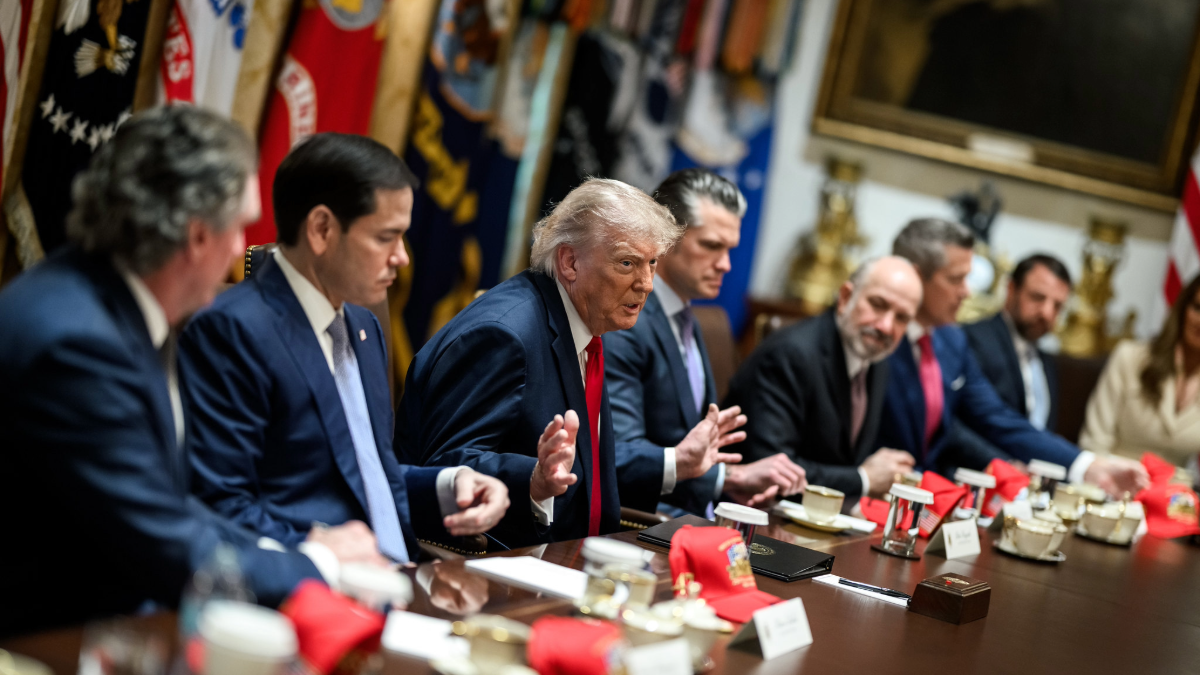
President Donald J. Trump holds a cabinet meeting in the Cabinet Room Wednesday, May 27, 2026. (Official White House photo by Daniel Torok)
On June 2, the White House issued Executive Order (EO) 14409, "Promoting Advanced Artificial Intelligence Innovation and Security." On its face, the order is a cybersecurity measure: it directs federal agencies to harden their systems against AI-enabled threats, evaluate advanced cyber capabilities, and create a clearinghouse for sharing vulnerability information. And, it asks the United States Department of Justice to go after criminals who use AI for cybercrime. Few people would object to any of that in isolation. Cyber defense for national security systems, federal civilian systems, and critical infrastructure is important.
However, the EO should attract more critical attention due to its substantive misdirection and immaturity of approach, and because of the primary agency it authorizes—the National Security Agency, an intelligence agency of the Department of Defense. We should ask who gets to evaluate the most powerful AI systems in the country, on what terms, who gets to find out what those evaluations conclude, and how the opaqueness of the system undermines public trust in the US and abroad.
A classified yardstick for "covered frontier models"
The EO proposes a framework for assessing AI models judged to have advanced cyber capabilities, such as the ability to discover or exploit software vulnerabilities at scale, before the model’s release. The Treasury Department, the NSA (acting through the Secretary of Defense), and the Cybersecurity and Infrastructure Administration (CISA) are delegated to build a benchmarking process that determines the threshold at which a model earns "covered frontier model" designation. However, that benchmarking process will then be classified, and the NSA Director will make the final call on whether a given model crosses the line. The government will design the voluntary framework with input from industry players.
Classifying the benchmark prevents adversaries from reverse-engineering which exploits the government can and can't detect. But in practice, the EO creates a situation where companies that participate will presumably learn how their own models score, while the public will be kept in the dark. Possibly, even the developers of these models who do not carry security clearance may not know. Even many of the cybersecurity professionals working in major American companies providing critical infrastructure services will not know.
In effect, an intelligence agency is being positioned not just to assess frontier AI systems for cyber risk, but to help decide which outside organizations get privileged early access to the most capable models in the world.
Secrecy creates oversight problems
In practice, the EO disregards transparency, due process and democratic accountability. Layered on top of this opaque process is a voluntary arrangement. There is no requirement for unclassified summary reporting to Congress, no role for the Government Accountability Office, no ability to acquire information through freedom of information requests, either of the benchmarking criteria or the results. Smaller AI companies, academic researchers, journalists, and civil society organizations who study AI risk will have no way to know what the threshold is, how it was set, or how consistently it is applied.
As Vilas Dhar argues, “[g]oing forward, the gravest questions about AI’s military, cyber, and social power will be answered through a classified review and private collaboration.” Such disregard for transparency and due process also opens the door for the Trump administration to take interventionist steps toward companies.
Compare this to other domains where the government evaluates products for public safety (drug approvals, vehicle safety, environmental permitting), all of which involve some combination of published criteria, notice-and-comment processes, and records that can eventually be reviewed by courts, journalists, or independent experts. The EO places the most consequential judgments about powerful AI systems almost entirely inside the classified world of an intelligence agency whose core mission and culture are built around secrecy. Secrecy leads to decisions which can undermine the interests of the public. The EO does not simply create a democratic accountability problem; it also creates practical oversight problems. Blackbox decisions make it difficult to contest agency decisions.
If anyone thinks the EO’s transparency logic will not repeat itself, only days after the EO, news of the administration asking the Center for AI Standards and Innovation (CAISI) to “stop issuing public reports” of its model assessments should be clear evidence. As I noted elsewhere, the National Institute of Standards and Technology (NIST) and CAISI are civilian entities, with public-facing work, and with missions to advance “measurement science, standards, and technology” and “foster technological advancements that benefit society.” Yet, their work is now being censored.
"Unlawful access" versus the broader data problem
The EO asks prosecutors to treat AI-enabled hacking as a priority within existing laws. The order does address data, yet it says nothing about the mass scraping of personal information used to train frontier models, the profiling and inference capabilities those models enable, or the privacy implications for government access (for example the NSA). The government gains early, privileged access to systems trained on enormous quantities of data about ordinary citizens. Most concerning is that the EO focuses only on cyber risks, while leaving out any mention of privacy, civil liberties, or public safety. By framing "AI and data" almost entirely as a cybercrime issue, the order sidesteps the implications for surveillance, data brokerage, and behavioral profiling by both government and corporations. The government must align policy with civil liberties and democratic values.
Why this matters for trust at home and abroad
The EO pre-release model review framework is voluntary, and explicitly disclaims any “mandatory licensing, preclearance, or permitting requirement for the development, publication, release, or distribution of new AI models.” Voluntariness has obvious appeal in a political environment focused on avoiding regulation. But it also means the entire system depends on companies choosing to participate or move in tandem with administration’s goals. Through the powers bestowed by this EO, the administration can make winners and losers. Meanwhile, Defense Secretary Pete Hegseth posts on social media that his department “kicked @AnthropicAI out of our building—forever.”
CAISI already has voluntary agreements with AI labs, runs pre-deployment evaluations and collaborates with US allies. The correct direction from the government should have been an EO establishing a robust and public evaluation standard for AI systems that would strengthen trust, enhance legal certainty and make American AI stack trustworthy. Instead, the current approach strengthens the position of intelligence agencies and a handful of powerful companies while leaving everyone else in the dark. What is at stake, right now, is replacing the public interest with the interests of the few, and dismantling existing public reporting infrastructures.
The strategy is also inconsistent with US efforts to promote US-made AI solutions. Secret and ad-hoc decisions create ambiguity and legal uncertainty. Very few foreign businesses will be comfortable depending heavily on AI models which can be unplugged overnight. Similarly, very few foreign governments will trust the NSA to certify AI systems for their use. In effect, the EO and future decisions dependent on it are more likely to alienate US allies and encourage countries to diversify their AI model options.
Authors