Unpacking the Great American Artificial Intelligence Act of 2026
Justin Hendrix / Jun 14, 2026Audio of this conversation is available via your favorite podcast service.
In the United States, polling shows a broad bipartisan appetite for AI regulation. An Annenberg Public Policy Center survey conducted earlier this year found 65% of Americans say the government has done too little to regulate AI, including 77% of Democrats and 53% of Republicans.
On June 4, Reps. Jay Obernolte (R-Calif.) and Lori Trahan (D-Mass.) released a 269-page bipartisan discussion draft of a bill called the Great American Artificial Intelligence Act of 2026. On the same date, they published an opinion in Bloomberg Law, explicitly calling for feedback on the draft. “This discussion draft isn’t a final product,” they write. “It’s the start of a serious national conversation with workers, researchers, startups, frontier labs, educators, civil society, state leaders, and the American people.”
The bill is organized into four titles, including ”Frontier AI Governance,” “Workforce,” “Cybersecurity,” and “Research, Development, and International Cooperation.” It would be the first comprehensive federal AI governance regime in the United States. If it became law, the bill would create binding federal development obligations for “large frontier developers,” defined as companies with $500M+ in annual revenue that have trained a frontier model. This threshold would capture firms including OpenAI, Anthropic, Google, Meta, and xAI. As analysts at the law firm DLA Piper point out, these provisions appear to draw on frontier model laws developed in California, New York, and Illinois.
The draft addresses a range of other issues, including transparency and whistleblower protections. It takes on AI fraud deterrence and cybersecurity. It has a section on “free speech” that would mandate a study and legislative recommendations on jawboning of AI firms and censorship. It supports workforce development and research to better understand the impacts of AI on the labor market. The fourth title of the bill contains provisions related to research and development, “public data for artificial intelligence systems,” and international cooperation on AI governance, which would include advancing American leadership on standards.
The bill would preempt state laws "specifically regulating the development" of AI models on a three-year sunset, while explicitly preserving state laws of general applicability and state authority over activities occurring at or after a model's deployment.
Reaction to the preemption measure drew immediate scrutiny from a variety of civil society organizations and advocates, including Public Citizen, Public Knowledge, and the AFL-CIO. Supporters of the draft include the Business Software Alliance (BSA) and the Information Technology Industry Council (ITIC).
In Congress, the discussion draft was supported by Reps. Suhas Subramanyam (D-Va.), Scott Franklin (R-Fla.), Scott Peters (D-Calif.), and Erin Houchin (R-Ind.). Notably, the co-chairs of the House Commission on AI and the Innovation Economy—including Rep. Ted Lieu (D-Calif.), who served as Rep. Obernolte's co-chair on the bipartisan House Task Force on Artificial Intelligence—said the draft "cannot serve as the basis for productive dialogue."
To learn more about the draft and their goals for it, I invited Representatives Trahan and Obernolte to the podcast. Rep. Trahan was able to speak to me on Wednesday. She’s been a leading congressional voice on platform transparency, advancing bills like the Social Media DATA Act and the Digital Services Oversight and Safety Act (DSOSA), which was a similarly ambitious piece of legislation.
What follows is a lightly edited transcript of the discussion.
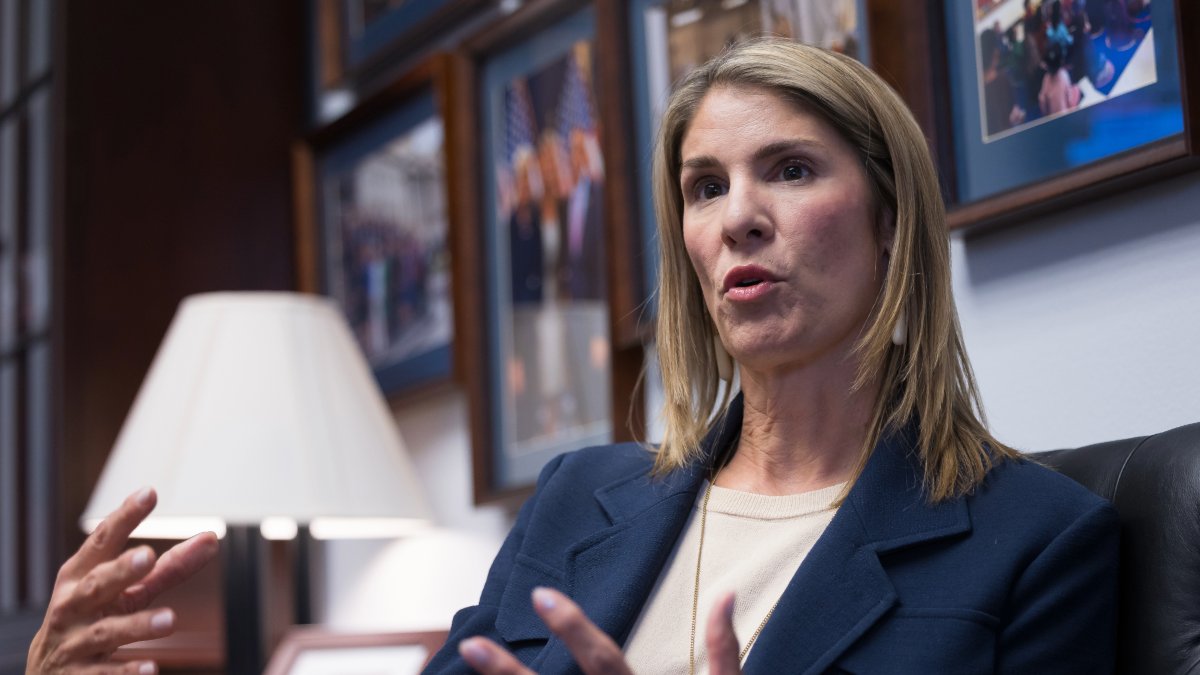
Rep. Lori Trahan (D-Mass.) speaks during an interview with POLITICO in her office on Capitol Hill on May 21, 2026. (Francis Chung/POLITICO via AP Images)
Rep. Lori Trahan (D-Mass.):
My name is Lori Trahan. I represent Massachusetts’ Third District.
Justin Hendrix:
Congresswoman, I'm pleased that you're able to join me again on the Tech Policy Press podcast. We've talked before about other legislative proposals that you have put forward, your office and you have become known for taking big swings at big comprehensive solutions to big problems. I think about DSOSA. If we can cast our minds back to the moment when you put that out, a very ambitious, comprehensive plan, particularly around social media. Now you're swinging at artificial intelligence literally with something called the Great American Artificial Intelligence Act of 2026 with your colleague across the aisle, Representative Jay Obernolte. Can I just ask for a second to step back maybe from the specifics of this and ask if in your mind you have a concept or vision of what artificial intelligence means for the United States, what we need to do in order to properly regulate this technology?
Rep. Lori Trahan (D-Mass.):
Yeah. Well, I think big picture. Artificial intelligence is going to be one of those transformative technologies that changes everything about our life and how we live, how we work. And there's enormous promise that comes with that. I come from Massachusetts, so there's AI being deployed or thought of in the cure and the treatment space for healthcare. But I think what Mythos just demonstrated in an instant is it comes with enormous risk. What I get frustrated by as a member of Congress is when we don't keep up with things that we know are progressing on an accelerated path, it's like Congress doesn't change its ability to pass laws or to establish any governance. And we've seen this before. I've always taken the foundational step of putting transparency reporting in this case auditing because I feel like you can embark on a whole host of other policy areas once you know or once you have visibility into these models, these algorithms, data, whatever it might be, which is why we worked with DSOSA early on in our career and now working on artificial intelligence.
So look, I think AI is going to be the most consequential technology of our generation, and I don't think that's an exaggeration. There's still time to govern it democratically before we seed the future entirely to the private sector or to our foreign adversaries. And that is the bet that we're making with this bill.
Justin Hendrix:
Of course, this comes out as a bipartisan proposal. You've obviously had to make multiple trade-offs going into this. The most key one I would reckon is around preemption. A lot of folks in your own party unhappy with this particular approach. Is there a case for preemption that you would make here? What won you over on being willing to sign on to this preemption mechanic in this particular proposal?
Rep. Lori Trahan (D-Mass.):
So I'm going to answer that question, but I just want to start just like I started with my negotiation with Congressman Obernolte. We didn't start with preemption. And so I'm just going to level set for your listeners and really start by saying something directly to them. We published this bill as a discussion draft because we genuinely want to hear from folks like you. The researchers, the advocates, the civil society groups in this audience, that's exactly who this process is designed for. And this is an opening bid, not a final answer. This draft is comprehensive. It's preliminary and it's narrowly tailored all at once. It's not the one AI framework to rule them all. What it is a focused effort on is tackling catastrophic risks and near term workforce impacts from frontier AI development without strangling the innovative potential of this technology.
And it is designed to equip the federal government with the reporting infrastructure and the technical capacity it needs to govern AI with evidence-driven policy in the years ahead. And so I know we'll get into talking about the specifics of the bill and the governance structure that we put in place, but I'll go to the issue of preemption. I've heard the criticism on the preemption language in the bill and I take it seriously. Look, I've spent years fighting for the exact kinds of state level accountability mechanisms that people in your audience are worried about losing and I'm not going to dismiss that concern. But here's my bottom line on preemption, and I'll just say it plainly. I will preempt, but only if we're setting the strongest possible federal standard.
A preemption provision in a bill with no meaningful federal standard is a moratorium, and I won't sign onto that. So what is the federal lane? Generally speaking, frontier model development, not products, not deployment, not use. The model itself, the weights and architecture trained on petabytes of data on hundreds of thousands of chips, that's the layer where a single federal standard makes sense. The red line that I've held throughout the entire process, states retain full authority to regulate AI at the deployment and the use stage. That is where AI systems actually interact with real people, whether it's housing decisions, hiring, healthcare, credit, states keep their teeth where enforcement is most tangible. The guardrails and the preemption provision are non-negotiable. The savings clauses explicitly preserve laws of general applicability, privacy, consumer protection, anti-discrimination, civil rights, the common law in full. So the cases against Meta and OpenAI proceed and any law regulating activities that occur upon or after a model is released, including the design of AI systems, their deployment and their use by end consumers.
And critically, there's a sunset. Preemption expires in December 2029 assuming passage later this year and that's designed to be a forcing function that prevents Congress from doing what we did with Section 230. And that's implementing a policy and then never being required to seriously evaluate whether it's working. And the sunset forces us back to the table. Now, of course, I also expect Congress to continue to regulate Frontier AI in the years to come, even while the preemption is in effect. These are initial policies that represent a starting point, a foundation for future regulation, I think they preserve optionality as the technology quickly evolves.
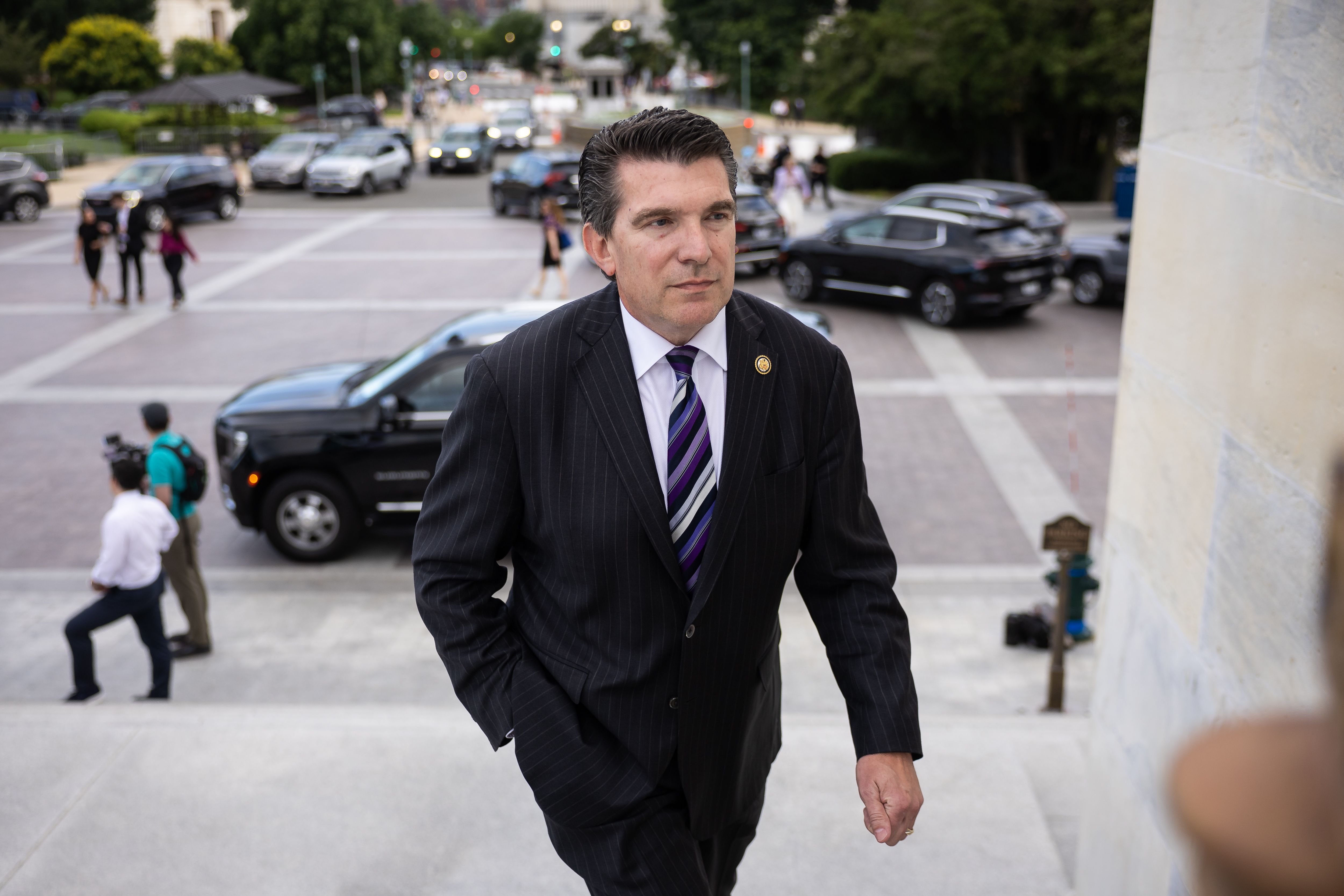
Rep. Jay Obernolte (R-Calif.) arrives for a vote at the US Capitol on June 8, 2026. (Francis Chung/POLITICO via AP Images)
Justin Hendrix:
Listening to some of those folks that you referenced who've already come out suggesting their concerns around preemption in particular. I think they're really concerned about where the line is drawn when a state wants to regulate a AI companion app that's harming minors. Does it have to regulate the deployer, leave the model developer untouched? Where is this line from your perspective? How do you believe that state law would function under this bill?
Rep. Lori Trahan (D-Mass.):
Yes. And we want it to. Look, this is a difficult balance to strike and I'll be the first one to acknowledge that. If there are genuine ambiguities in the text that could swallow state consumer protection law or civil rights enforcement, that's a problem I want to fix. That's literally why we published a draft. Come tell us where the language fails. Drawing a clean line between AI model development and AI systems built on those models is genuinely difficult to do in legislative text. I know that, but I don't accept the argument that it's impossible. Laws across the country already leverage the developer deployer distinction. The EU AI Act has specific regulations for general purpose AI models. Legislators draw hard lines every day. That's the job. My sunset combined with the savings clauses is specifically designed to correct for the places where we draw that line imperfectly.
And I'll just bring up one more thing. If you tell me the transparency auditing and verification provisions don't go far enough, just name me the additional policies. We will take them under serious consideration. What I won't accept are mechanisms that are either prone to First Amendment challenges or that are simply bad policy dressed up as accountability. But this is a moment where we want to hear from folks so that we can make the product better.
Justin Hendrix:
What do you regard as this period, this feedback solicitation you're doing? You've got this out as a discussion draft, you want to have this dialogue. What do you see as the revision path and are there specific activities or engagements that you're planning that would help along that way?
Rep. Lori Trahan (D-Mass.):
So first and foremost, it's only been out for a week now. We already have collected a lot of great feedback and with our release we put the email address where people can contact us so that we can start to distill that. It obviously falls in a couple of key buckets, but we encourage more creative ideas and thinking around this. And then we'd love to do round tables. Probably the week after next when we come back into session, we'd love to surface some of the feedback that we've received and have an open dialogue on the ones that we are trying to incorporate into legislative text and maybe the ones where we feel as though the text already covers or whatever it might be, but we want to have an open and transparent process and certainly work with our Republican co-lead on getting the bill into a better position with a coalition before we file it.
I don't put definitive deadlines around that because we really want to make sure that we're keeping it open for as long as we're getting that feedback.
Justin Hendrix:
I want to ask just about the broader political context in which this is happening. We're seeing poll after poll that suggests extraordinary concern among the American public really cross political aisle about artificial intelligence, more and more concerned about the infrastructure required to run artificial intelligence, the data center battles that we're seeing spread out in communities across the country, including in Massachusetts. There's a set of fears that the public have about the intent of the corporations and in fact, I think also the intent of the federal government around this. What do you make of this political moment how a bill like this would either will calm or potentially add to that discourse?
Rep. Lori Trahan (D-Mass.):
Look, I think that people are fearful of how AI is going to disrupt or maybe displace them in a career that they've spent years in. And there's also just a fear of the unknown. But when I'm back home, folks that I talk to, they want us to take a serious effort on this. They know instinctively it needs to be bipartisan. They know that it can't fall victim to the gridlock that has defined Washington for too many years. They're appreciative that I'm working on this. They know that I'm not a shill for big tech. They know that the risk of doing nothing or Congress falling into the traps of gridlock or too much divisiveness will lead to the same thing that they saw with social media. And that's these big, large, mostly private companies setting the rules of the road. And that is, I think, what they would find unacceptable.
So I do think even in these early stages, it is really important to have open conversations about people's fears, about their concerns, about what their expectations are for governance and that we're going to get ahead of this and keep up with it so that it doesn't cause unnecessary harms that are really being discussed broadly today. Look, my dad was a Union Iron worker. I grew up in Lowell, Massachusetts. That's a city built by people who worked with their hands. And so I know what a bad transition to a transformative technology looks like. It doesn't just displace workers. It hollows out communities. Automation and offshoring really did close all the mills that were responsible for the industrial revolution in my region of the state of Massachusetts. So I understand those fears and those concerns in my core and I'm not going to sit here in Congress and allow inaction that will literally allow the largest AI companies to fill the void with what they think is best for the future of technology.
Justin Hendrix:
You mentioned unions and labor. In particular, those are some of the groups that have come out, I suppose, swinging against this draft just at the outset. Is there a specific message you have from them, the type of engagement you'd like to see from labor groups, AFL-CIO, AFT, communications workers, et cetera?
Rep. Lori Trahan (D-Mass.):
Absolutely. So labor is not a monolith. So we're talking with all corners of labor to get their feedback to address some of the concerns or the gaps that they believe may exist. And look, I'm honest with the problem Congress faces. Frontier AI is diffusing throughout the economy, but it isn't clearly showing up in the jobs data yet. New graduates are facing record unemployment that correlates with advances in AI, but the causal link is proven. At the same time, the CEOs of these companies are going on talk shows predicting mass displacement by 2030. What is Congress supposed to do with that information? And my answer is you can't make sound workforce and tax policy without accurate data. So before we reform the safety net or the tax code, we need to understand what's actually happening. And that's what Title II does. Well, Title II starts to do.
The Labor Department must establish an AI workforce research hub within 90 days to study AI's actual effects on workers, run the scenario planning and generate actionable policy insights. We update the WARN Act. When AI is a substantial factor and a mass layoff, employers must say so in their 60-day notice specifying what AI was used, estimating how many jobs it cost and describing what retraining they offered, if any. Workers deserve to know why they lost their jobs. And then finally, we modernize federal data collection. We revise federal surveys to actually capture AI adoption and workforce impacts. We run prize competitions to develop reproducible benchmarks for measuring what AI can automate and we build a job flow tracking program for at least 15 AI sensitive occupations. And then we study a rapid AI adjustment assistance program modeled on trade adjustment assistance for workers displaced by AI. We're not prejudging what that program looks like, but we're not going to wait until the displacement hits the middle class to start designing the response.
And so I think the workforce provisions in this bill are a labor argument, not a chamber of commerce argument. The question isn't whether AI changes work. It's whether workers have any power in how that change happens. I refuse to tell my constituents, workers who lose their jobs, young people who can't find work, that I was waiting for a better opportunity to govern because we need to start that process today.
Justin Hendrix:
Another concern I think some have is that there are some basics that just aren't in place in this country, including privacy legislation. Most of the great harms we can expect and anticipate from artificial intelligence come from a lack of privacy protections. Are there other aspects of the kind of general regulatory environment that would need to change in order to make this bill work?
Rep. Lori Trahan (D-Mass.):
Yeah. And one of the things that we didn't really just do, and I'm sure many of your listeners already know the provisions of the bill. Certainly not having a federal privacy policy in place, it's just unacceptable, which is why we preserve and if anything, rely on the privacy actions that states have taken. But I'll be the first one to tell you that AI action, it has to be accompanied by comprehensive privacy. I We have to reign in data brokers. We've been talking about it for years and we have not taken the step to pass it. These aren't silos and tech policy, they're all intertwined. So I do think we address some of the regulatory regimes that have to be put in place, but those are likely going to be adjusted over time. One of the reasons why we have a collaborative enforcement model with state AGs is because we want to learn from enforcement and the best practices going forward.
So can I just take a minute to go through what we establish in terms of real federal governance for Frontier AI, just so that I can level set on... We've talked about some of the issues or the criticisms, but it's mandatory transparency. It's independent auditing. It's real-time verification of safety and security procedures. The scope is deliberately narrow. I'll own that choice. The federal aim does cover model development, frontier model development, not products, not deployment, not use. We're concentrating regulatory attention at the layer where catastrophic risks originate, that cybersecurity vulnerabilities, biosecurity risks, loss of control scenarios. That's the layer where uniformity across 50 states makes sense. Of course, within that, you have to define what frontier means in practice. So we're talking about large frontier developers, companies with over $500 million in revenue, though we're still evaluating the right threshold. The two-person startup without a legal team is not in this regime, mid-size firms, open-weight developers, researchers, they're intentionally kept outside it.
So compliance burden falls where the risk actually is. CAISI, the Center for AI Standards and Innovation, they get a tenfold funding increase from $15 million to $100 million a year. That agency has to be the credible federal counterpart to the frontier labs right now. It just isn't resource to do the job, but this bill provides the authorization and Jay and I will have to get the appropriations to match. We include whistleblower protections because the people closest to these systems are often the first to see problems. And if you report a violation of federal AI law, you can't be retaliated against. If you are, you get reinstatement, double back pay with interest, compensatory damages and attorney's fees. And so I think it's important that the transparency requirements are specific. We have independent auditing and verification. We use those independent verification organizations to embed within large frontier developers, perform those ongoing audits, evaluations and testing.
States can opt in to getting those report findings and so they can refer violations to the AG or to state AGs. This is not a self-certification regime. And so we're going to figure out what the regulatory regime for steady state needs to be by putting in something quickly that will give us data and an independent verification. We're also going to learn around rulemaking authority that we'll need to keep pace with the frontier as it moves. So that's how we're thinking about it. Of course, like I always say, we welcome the feedback on whether we can go beyond.
Justin Hendrix:
Well, I think that is a message for my listeners to take away that both your offices are open to feedback and I'm sure you'll be hearing from many folks in this community. I'm grateful for your time. I hope perhaps as this continues to develop, we'll have a chance to talk about it again.
Rep. Lori Trahan (D-Mass.):
I'd love that, Justin. Thank you so much.
Authors