Tech Hype is Cannibalizing the Future
Sun-ha Hong / Oct 8, 2026This post is part of a series on Hype Studies appearing on Tech Policy Press in 2026. More from the series is here.

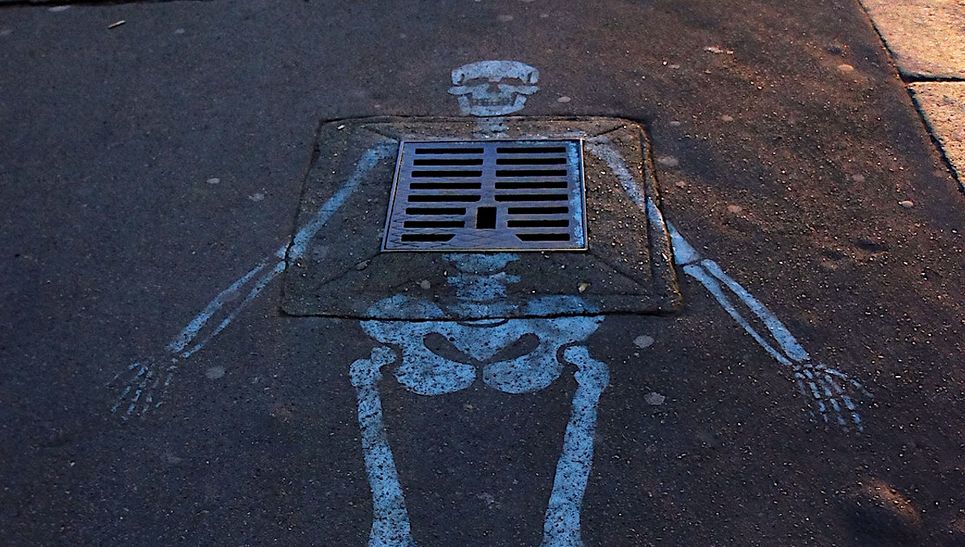
Skeleton in Paris is shared by diegoluis on Flickr (CC-BY)
Every day, we are told that we live in the future — or at least, on its precipice. “The Intelligence Age” is just a few years away, just as Marvin Minsky told us it was a few years away in 1970. Technology will solve every problem, as long as we are ‘optimistic’. But if you prefer to be pessimistic, there is also a flavor of hype for that, too — promoted by the same narrow slice of tech elites and upholding the same fantasy that technology moves in a straight, unstoppable line toward an apocalyptic Singularity.
When we pause and lean back from the screen, however, our lived present is made up of the ruins of past futures, our legs constantly kicking against the expensive debris of earlier fantasies. A South Korean journalist wanders alone through the abandoned ruins of virtual university campuses on the Metaverse, many of them operating at a ratio of seven-digit figures in development costs to three-digit figures in daily users. An American woman has partial vision restored with a smart bionic implant technology, then is suddenly rendered blind again when the company that developed it goes bankrupt. AI companies loudly lobby for state subsidies on data centers, then quietly withdraw when the time comes to deliver concrete infrastructure, jobs, and technological progress, despite their continued ability to funnel astronomical levels of funding to each other through “circular financing.” Chinese data centers lie fallow and underused after anticipatory investment, while grid overload concerns have stalled Kenya’s headline data center project.
In each case, we are not simply dealing with delays or side effects in technological progress, but hype as a vast, systematic wastage that takes from society’s finite funding, resources, and opportunities and leaves behind invisible costs and burdens.
Hype is eating the future, and leaving us the bones.
Recycling predictions
In this pattern, hype does not simply raise funding, legitimacy, and enthusiasm to bootstrap new technologies and ideas into reality. Rather, it is this cycle of anticipation, simulation, and amnesia which itself becomes the means for extracting short-term profit out of long-term stagnation. Hype works by cannibalizing the accumulated expectations from past failures to make the object of the hype appear plausible and attractive. Google Glass, discontinued for consumers in 2015, failed in its mission to effect a paradigm shift in ubiquitous computing and smart technology development, but the basic proposition for the technology has effectively been recycled into Meta’s Ray-Ban lineup. The growing public backlash to what some term “pervert glasses” indicates that Silicon Valley’s persistence was not exactly necessitated by broad market demand. Instead, such projects leverage the shared cultural expectation that augmented reality glasses are ‘the future’ — expectations cultivated by earlier cycles of hype, prototypes and spectacle.
This cannibalistic tendency is deeply embedded into venture capital, which is built around the need to expect outsized gains from high-performing investments (the largest of which are dubbed ‘unicorns’), and thus systematically pushes start-ups to project extreme growth in return for anticipatory investment. Hype thus relies on numbers, predictions, and other performative rituals of certainty to generate collective belief around what is, in reality, a far more limited set of technical capabilities and scientific evidence. It is the job of global consultancy firms to issue precise-sounding numbers, like “$2.6 trillion to $4.4 trillion” in anticipated economic growth through AI, which politicians may then treat as objective evidence for justifying grandiose commitments in national budgets with equally unclear outcomes.
The very notion of ‘predicting’ future advances in AI and related technologies has become an exercise in what economist Paul Romer once called “mathiness,” where the appearance of numbers, especially enormous ones, dresses up unquantified speculation as calculative objectivity. And like hype narratives themselves, these predictions tend to be most consequential when they are made, but are typically forgotten when the time comes to determine whether they were right or wrong. In 2016, Geoffrey Hinton foretold that radiologists would be completely outperformed by machines in five years. Yet even expert predictions tend to be staggeringly inaccurate: the environmental scientist Vaclav Smil famously concluded his review of energy forecasts over the past century by describing them as a "manifest record of failure." Like a rotating deck of credit card debt, each prediction borrows credibility from the future to purchase legitimacy in the present — and then flees to the next topic of speculation before the bill comes due.
Sometimes, failures do lead to wider stigma and skepticism around the technology in question. But this does not happen anywhere near as often as the massive levels of investment and inflated promises might warrant. The distinct characteristic of tech hype of the 21st century is the overwhelming centralization of wealth, cultural prestige and, increasingly, political autonomy that is used to instill a sense of inevitability around Silicon Valley visions of the future, and a sense of learned helplessness, or even “futurelessness,” for those who would prefer another path. Mark Zuckerberg and Meta thus live to dream another day, relatively unscathed from the over $80 billion burned at the altar of the Metaverse.
Failure serves an important function for the health of our political and economic ideas. Even the most libertarian idealization of market rationality requires that products, firms, and ideologies pay a proportional price for failure, allowing better alternatives to access those resources and opportunities. The late capitalist tech economy, however, turns to hype as a means to cheat this process. From the Stepford Wives to sycophantic, female ‘mommy apps’, or from virtual reality glasses in the 1980s to … virtual reality glasses in the 2020s, the same turgid renditions of future technology are recycled across multiple generations, often brimming with nostalgia for retrograde fantasies about society and progress.
David Graeber once joked that postmodernism might best be regarded as a “prolonged meditation on all the technological changes that never happened”. Postmodernism, in other words, may simply be our tortured response to entire generations lived out in this condition — in which we are constantly strapping in for the future, making ready each time to throw out the communities, cultural practices, and values that we have come to appreciate in their imperfections, only to be told once again that the plane must return to the gate for another unspecified checkup.
Planetary opportunity costs
There is a heavy collective cost to hype’s devouring of future possibilities. If it were only that the objects of hype tended to be delayed and disappointing, then the solutions would be relatively simple. We could try to be more cautiously optimistic about AI, trusting what Louise Amoore describes as the “promise to render all agonistic political difficulty as tractable and resolvable". We could ridicule specific failed innovations and entrepreneurs while believing that the princess is to be found in another castle, and that a different technical approach or a more likable genius will still deliver on the original promise.
But when we recognize hype as an ordinary, structural mechanism for extracting short-term profit at the cost of long-term stagnation, and for funneling societal resources toward recycled futures and away from alternative possibilities, the true cost of hype becomes apparent: it is a siphoning away of opportunity costs at the planetary level. When the Metaverse’s combined costs exceed $80 billion, this is no longer simply a matter of a private corporation’s (in)competence, but symptomatic of a wider inability in late capitalism to efficiently channel investment and enable genuinely beneficial enterprises. In every local council budget allocation for the newest surveillance camera gadget or ‘AI education’ gimmick, we waste the opportunity to raise more fundamental questions about how a future society should be built. What is the point of imagining new technologies without new ways of living? This is the question that hype keeps us too busy to ask.
David Harvey famously described capitalism’s recurring search for the “spatial fix”: from overseas colonies to remote, inhospitable regions of the Earth, and finally to outer space — throughout, the perpetual pursuit of untapped material resources that can deliver adequate profit margins to justify continued investment. This injection of new resources, markets, and profitable asymmetries can only ever be temporary, however, requiring ever more extreme strategies for identifying the next spatial fix. Hype operates along a similar logic of declining rate of profit. Each time it recycles earlier visions of the future, and repackages tried-and-failed innovations as the next great frontier, the leash grows shorter. What hype always seeks to erase from its own history — and what hype studies must repeatedly bring back to the fore — is the widespread disbelief and rejection that always bubbles just below the surface, and is today breaking out into view again.
Ultimately, the problem with hype is not that everybody earnestly believes in it: today, the problem is that hype is institutionalized and bureaucratized, becoming ever more inoculated to the disgust and ridicule aimed its way.
Read other aticles in this series
Authors

