How AI Hype Helps Render Women Invisible
Eugenia Stamboliev / Aug 6, 2026This post is part of a series on Hype Studies appearing on Tech Policy Press in 2026. More from the series is here.
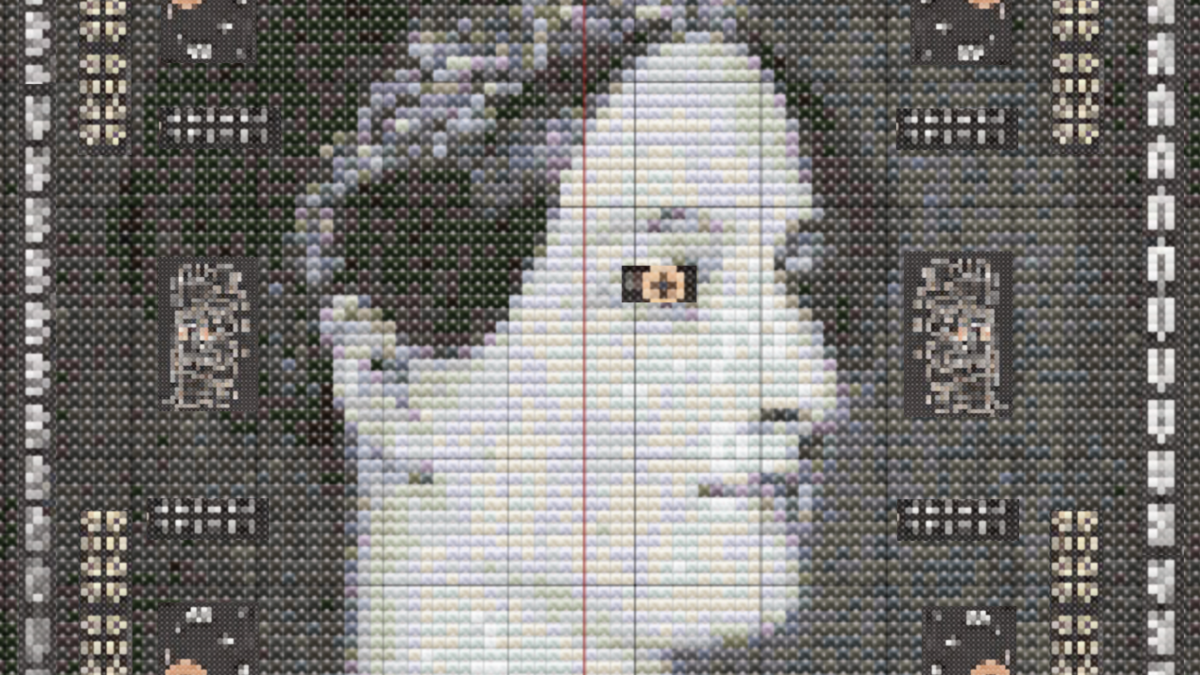
Lovelace GPU by Hanna Barakat & Cambridge Diversity Fund / Better Images of AI / CC by 4.0
AI images are a new form of structural violence—not through what we see, but through whom we do not see. The gender violence I am referring to here is not about bias. It is about AI firms subtly but consequently rendering women invisible, while the biased stereotypes we do see online are just one of its symptoms. In this regard, the hype around AI operates as a gendered regime of visibility. As AI outputs circulate widely across society they normalize synthetically created images of women and their aesthetics—or make women disappear all together. Hence, AI hype not only frames public perception of emerging technologies in simplified terms but also simplifies the reality we see: erasing the grainy, the fluid, the non-conforming. In this way, it contributes to the erasure of women online.
Hannah Arendt distinguished between power and violence in ways that remain instructive today. Viewed through Arendt's distinction between power and violence, AI-enabled gendered violence affects the democratic life of women and the conditions under which they can participate within it. Arendt links power to visibility. Power emerges through people acting together in public and participating in shared political life. Violence, by contrast, diminishes that capacity. It interrupts collective action by intimidating, isolating, and silencing those it targets—making them invisible. Violence is not always spectacular. It often unfolds through ordinary gestures that become normalized through repetition.
As we debate and negotiate the dangers of online gender-based violence, including non-consensual intimate imagery (NCII), we often focus on how AI works with gender-biased data; an unfortunate and unwanted error the developers of these technologies apparently did not see coming. Similarly, it could be too simple to say that AI hype itself causes gender-based violence. Not every AI application inherently contributes to gender violence, and not every user is a sexist antidemocrat. Rather, the AI hype and unbound enthusiasm surrounding generative AI have newly obscured questions of responsibility by presenting these systems as neutral tools whose effects depend entirely on the prompts provided by their users.
When journalists from Der Spiegel reported about the dark side of the AI deepfake industry in early 2025, many outlets and media were still predominantly focused on how deepfakes are jeopardizing public trust and information integrity. However, the so-called Grok scandal in early 2026 was a turning point in understanding gendered violence as a business model and part of the app design. Grok, a generative AI application developed by Elon Musk's company, xAI, was used to generate and circulate non-consensual sexualised images of women and children and share them on X and across other platforms, often with minimal intervention or filtering. These effects were widely framed as unfortunate mishaps: technical oversights, uneducated users, and failures of moderation—Musk even asserted the backlash was merely an “excuse for censorship” by regulators that sought to investigate.
As Eryk Salvaggio wrote on Tech Policy Press, every decision about what a model and application like Grok does, permits, restricts, and prioritizes is co-produced by the companies and developers, not just the users nor the data. Systems enabling non-consensual image generation are not technological accidents. They were developed and deployed within environments in which such uses were entirely foreseeable. The question is therefore not simply why users exploited these systems. It is why infrastructures were designed in ways that tolerated predictable harms. Predictable or not, democratically speaking, Grok is a violent technology, not just a biased one. It might practically and virtually “undress” women, but on a wider scale, it inherently intimidates and silences all women due to its potential of violence.
In fact, technologies have never arrived free of values. Philosophers of technology have long argued that technical artifacts, not just AI, always embed assumptions, priorities, and socio-technical agency. Similar, generative AI systems are not simply used for good or bad. They are shaped through countless design decisions involving training data, filtering mechanisms, shadow prompts, interface constraints, and optimization objectives. The conditions of their use are already structured before users enter a prompt. There is no neutral encounter with AI. AI is about power, and such is used to control the aesthetics of certain groups in society.
Likewise, as the first article of this series explains, hype is charged with values, worldviews and political positions. It is mobilized to attract attention, investment, and revenue, and the resulting perception of technology is therefore often simplified. Its very conditions of production—frequently shaped by consultants and marketing agencies—make it averse to nuance, unable to adequately address risks, and prone to rendering negative consequences invisible. Hype is not inherently problematic, but its objectives and underlying dynamics deserve careful scrutiny. We should remain attentive to who benefits from it, and who and what is rendered invisible, or harmed.
Synthetic discrimination: invisibility as structural violence
AI images are an interesting new form of media, but like any form of media they also advance ideologies, as Roland Meyer writes, which are opaque to users. Generative AI systems such as Grok, ChatGPT, and Midjourney are built upon complex entanglements of data, computation, and optimization. Data matters, but it is not only used well or not found. It is curated, selected, filtered, transformed, and reinforced through institutional and corporate choices. AI images are derived from calculations and not necessarily documentation of real events, like historical images showing scenes or people that existed. This is not to say public or historical images have ever been neutral or immune to manipulation, but something has changed with AI. An AI-generated image of a woman can be created without any real woman as its visual or representational ground.
Ultimately, AI favors its makers' instructions and not the voice or empowerment of its ‘objects’. AI images are not simply fake images drawn from representations of existing women; rather, they are renderings of woman-like features assembled from millions of data points. Worse, they replace existing women’s images. Even if an AI generated image is drawn by reference to a real woman, once it is edited through prompts, datasets, statistical associations and platform values, it is detached from any particular subject.
This process is visually and democratically consequential. It leads to what I call synthetic discrimination. This dynamic builds on the idea that even if AI only creates images of women synthetically, these replace existing women’s images online (at first). Besides AI images relying on mostly male designs and developers, AI images are already flooding the internet. One might object here and say that this dynamic should affect men, too, and maybe negatively. This is true, but not to the same extent. Also, men are not systemically devalued, violated or sexualized online and offline; and they are dominantly represented in AI design and data.
Securing more inclusive female representation online is an ongoing struggle, but it is getting harder. Older women are already less represented in search results and recommendation systems; women with disabilities may continue to be more absent from dominant visual cultures; and women of color may appear even more through stereotyped templates, though not as frequently as white women. These dynamics will now worsen as synthetic imagery multiplies. And now, we have to fight over seeing women at all. Once online media formats or corporate outlets use images from image generators and not from photographs, women will become even more invisible due to the synthetic images replacing them online.
The democratic concern: pushing women out of (online) publics
Synthetic discrimination refers to more than only a failure to represent women fairly—it hinders the very condition that makes democratic representation possible. Core ideas behind democracy, including participation and visibility, are rendered impossible.
As a form of structural invisibility, AI is violent, not just biased. Violence, here, is then more about rendering women structurally invisible, and less about sexualizing them. Not to say that the second is not hugely playing into the first. This is a paradox we face with AI: It can violate women’s visual representation by not even representing them as a subject while keeping them inherently vulnerable.
Referring back to Arendt, democracy lives from citizens contributing to any form of deliberation and to public debates through being recognized as legitimate speakers. Synthetic discrimination could hinder this process. What seems like an online issue will become one offline, too. The synthetic AI woman is not a political agent representing one specific, or any, woman, but representing an ideological and aesthetically charged object produced by the network and powers behind AI.
If we permit digital publics to become saturated with hyperreal AI women—considering the internet is already contaminated with AI slop—the representative space for women will keep shrinking. For now, synthetic discrimination is not the dominant online reality, but we shall not overlook the historically tight and concerning link between aesthetics and ideology, especially as certain AI technologies are fundamentally anti-democratic and their fascist tendencies are being discussed openly.
Synthetic discrimination manifests an urgent warning when it comes to violence, one that Arendt could have raised too: it is an accumulation of subtle, seemingly accidental and gradual gestures masked as technical or procedural errors. But again, the technical or visual level is not least political. Applications like Grok function as disciplinary mechanisms, as reminders of who controls participation, whose bodies remain vulnerable to public violation, and whose presence in digital spaces is conditional. In this sense, we cannot refer to Grok as only “undressing” women, because this is about body politics. Whether articulated explicitly or embedded structurally within design practices, surely the Brotopia club in Silicon Valley tends to see women less as constituencies or citizens to be represented but more as obstacles to be managed.
AI-enabled gendered violence should not be understood as a narrow technical controversy or matter of biased data. This conceals the global and monopolistic scale which powers AI. The more these infrastructures become embedded within everyday life, the more urgently democratic societies must ask what forms of participation they make possible, whose visibility they secure, and whose disappearance they render tolerable. Protecting women from AI-enabled violence and invisibility is therefore not only a matter of safeguarding one vulnerable group. It is a democratic imperative. Addressing AI hype in order to protect democratic institutions and values requires acknowledging its regimes of visibility and invisibility equally, and not only those of bias. This means recognizing that, while hype flattens public perceptions of AI, it also enables new, subtle, but consistent, ways in which women are not only turned into sexualized objects, but potentially into invisible citizens.
Author’s acknowledgement: Thanks to some amazing women who motivated this research, to Eryk Salvaggio and Christo Buschek for inspiring thoughts, and to Andreu Belsunces and Jascha Bareis for their great feedback.
Read other aticles in this series
Authors