How the AI Deepfake Boom is Outpacing Europe's Safeguards
Ana Ornelas / Jul 28, 2026From coordinated harassment campaigns to sextortion and digital violence, survivors reveal how AI-generated sexualized deepfakes are reshaping abuse while regulation struggles to catch up.
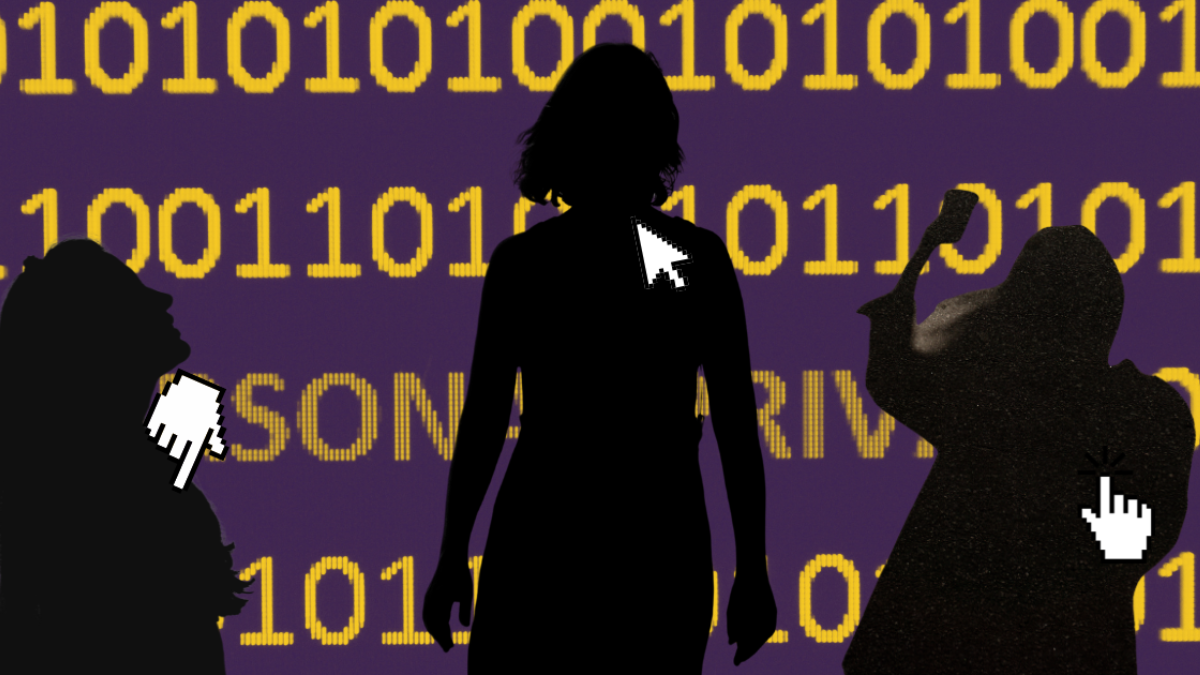
Image by Ana Ornelas
Content warning: This article discusses real stories of non-consensual sexualized deepfakes, image-based abuse, online harassment, sextortion, and the psychological impact of digital violence.
After being targeted with a swarm of fake nude photos of herself, Julie starts to have intrusive thoughts. Every time the 31-year-old journalist living in Rio de Janeiro enters a lift full of men, her thoughts start racing. Have they seen the photos? Have they had access to an intimate version of her body she never meant the world to see? The walls seem to come closer as an even scarier thought creeps in: what if one of the men was the creator of the fake images?
Julie no longer feels safe anywhere. And she feels as if she lost control over her body. What started as an online attack has now spilled into the offline world, affecting her everyday life, her reality.
On the other side of the world, in the UK, Laura* scans the Internet for fake photos of herself. Laura is a seasoned sex worker. She was alerted that her content might have been leaked from sex work marketplace websites that only paying members can access. On Google, she stumbles across a picture of herself kissing somebody famous.
The scenario is fake – the kiss never happened.
She feels sick to her stomach. As a sex worker, she is used to uploading lewd photos of herself to the Internet. But running into images that she knows have been altered feels like a betrayal. Just like Julie, Laura suddenly became aware that she had lost control over her own body and her own image.
Both Julie and Laura have fallen victim to a technology that uses AI to create fake pictures: ”Nudification” apps, also known as non-consensual sexualisation tools (NSTs), became known to the mainstream media after it was revealed that X’s AI-powered chatbot Grok had been used to create sexualised images from real photographs, mostly of women, but also children and members of the LGBTQI+ community. The backlash was so intense, it eventually resulted in a ban on such tools being included in the AI Omnibus – the law promising to “simplify” digital regulation in Europe.
Democratizing technology for evil
You see a stranger, you take a photo and almost automatically, you are able to strip their clothes away – as easily as snapping your fingers. Essentially, that is the power of an NST. The process behind it is more complex, though: an enormous amount of data is required to train the generative AI models that power these tools, which basically work by remixing existing photos of nude bodies to create an image that matches the face and outline in the photograph provided – just without the clothes.
For sex workers, the technology offers an additional insidious harm: by creating fake nude or sexualised images of sex workers, people can have access to the services they sell without ever paying – and with images created by ripping off other sex workers’ labor.
While Grok has so far been the most prominent case of AI-generated mass-production of fake sexualized images, plenty of other apps are able to do the same. The idea precedes them, of course: For a long time, photo montages of celebrities or private individuals superimposed onto photos of porn stars or naked models were commonplace. The difference now: AI allows any user to generate extremely realistic deepfakes that are incredibly difficult to distinguish from real photos.
Kolina Koltai, a senior researcher at the investigative journalism group Bellingcat from the Netherlands, has extensively looked into this kind of tool. She warns that “the speed and the ease with which someone can now realistically create content makes the difference. Nowadays, you don’t need money or a technological skill-set to make it happen,” she adds.
With the European Commission and national regulators putting a spotlight on the issue, the impact on sex workers this new wave of imprudence is producing has hardly been addressed. With old montages, people rarely talked about the women whose images had been “decapitated” to create manipulated versions. Now, porn websites are scraped without permission. Not only does this constitute a form of digital violence and abuse, but also theft; for sex workers, their content is their livelihood. But typically, they are not afforded victim status: “People unfortunately seem to be less sympathetic towards sex workers,” says Koltai.
While digital violence against women is not a new phenomenon, Julie sees some worrying changes: she recounts many attacks against her in the form of hateful replies and comments. The difference now is that these are accompanied by extremely vivid nude images of herself. Previously, the attacks originated in her having “strong opinions” on politics that she expressed on her platforms. However, after the COVID pandemic, she noticed a shift: the targeted attacks became more botified.
Julie was one of the victims of the campaign of Grok-generated nude images in early 2026, being swarmed by many different profiles on X. She would open the replies on her profile and see herself in sexualised poses in nude photos that looked eerily realistic.
She could tell that the accounts reposting the pictures had been created in different countries. They all followed the same accounts and seemed like a coordinated group of “ghost profiles” without any individual, real users behind them: “Only three of the more than 20 users that attacked me had over a thousand followers. It seemed like an interconnected network: they had a fixed speech and seemed to already know what they were going to say when they discovered my page.”
Celebrities and public figures are often the easiest targets of the swarm that attacked Julie: Georgia Meloni, Italy’s Prime Minister, took it upon herself to debunk a fake photo of her posing on a bed in a chemise. While the photo is far from pornographic, it was enough to cause public uproar and a dent in her reputation.
The deputy Prime Minister of Sweden, Ebba Busch, fell victim to a similar attack. Users on X instructed Grok to undress her in photos, augment her breasts and buttocks, or change her position so that she would seem to bend over in a sexualised posture. Busch also responded publicly to the scandal.
For Koltai, there is a monetary incentive to keep the abuse going: “Generally the people behind these apps do it because it makes money for them. It is an incredibly profitable business.” A report by the Tech Transparency Project estimates that NSTs have been downloaded a whopping 483 million times only on the Apple Store, and made more than $122 million in lifetime revenue.
Targeted attacks: When the danger is closer
Being swarmed by strangers with pornographic deepfakes and hateful messages is not the only way this violence manifests. “In many cases, the perpetrator is someone known to the victim,” Koltai explains. In Germany, the harrowing case of Collien Fernandez caused a country-wide uproar: For many years, her husband – a prominent comedian and actor – used both real and AI-generated photos of her as a form of sexual abuse, impersonating her on online platforms to contact strangers.
For sex workers, this reality of violence is even more complex, and contrary to what many people may assume, women are not the only target.
Kelly* is a non-binary refugee assigned male at birth (AMAB) who lives in Turkey and carried out sex work for a period of time to support themself while settling in a new country. They were careful to ensure that no photos of them used in online advertising would give hints revealing their identity. As a refugee sex worker, they might face sanctions both by the Turkish government and international refugee authorities.
None of that mattered to a colleague whom Kelly met in the refugee community. Aware of Kelly’s dabbling in sex work, the two ended up having a discussion over politics. “It was so stupid,” Kelly recalls.
A few days later, Kelly received photos of themself – completely nude and with their genitals on display. Their colleague was threatening to report them to the authorities. Kelly was terrified. Other people in the community were said to have received similar threats. Kelly never knew what app was used to generate the images.
Annie*, a non-binary sex worker from Poland, assigned female at birth (AFAB), also saw themself become a victim of sextortion based on AI-generated content (an extortion based on intimate images). Their ex-girlfriend sent artificial “nudified” pictures of Annie to their family, and exposed them as a sex worker. The images also spread online, and because the original photos showed parts of the house and neighborhood they lived in, their address was eventually revealed. They were forced to move and endured an unstable housing situation for months. A year later, while describing the case, Annie is still traumatized.
Unprotected
For sex workers who often live under precarious conditions due to the criminalization and stigmatization of their livelihood, the constant threat of being exposed is an additional burden. All workers interviewed as part of this investigation reported a loss of income since they started to fear advertising for themselves in their regular channels. Annie recalls being scared of working for months.
In this particular case, seeking law enforcement – or even using the limited redress mechanisms offered by platforms – is not always a viable option. In most cases, platforms ask for identifying information to take down content, which can put sex workers at risk of being exposed.
But even for those who are not sex workers and don’t face such restrictions, seeking the help of platforms can be equally complicated.
Initially, Julie felt like she should step away from the computer and wait for the whole thing to blow over. But the attacks continued. So she decided to take matters into her own hands and push back. Contacting the police and lawyers, she recalls as an incredibly frustrating experience: “They are not equipped to deal with it. The police were basically acting like I was overreacting because the photos were fake.”
Thousands of kilometers away in the UK, Laura was given a similar response. The police said they could not do much since the photo was AI-generated. Therefore, there was no way of knowing whether it was really her in the images.
Cordelia Moore, a Digital Violence Consultant in Germany working directly with survivors, explains that in many cases, victims are not even aware that they can report their experience to the authorities: “With synthetic images, there is still a large gray area: law enforcement is not prepared to deal with such cases.”
And within the platforms, it seems like that is also the case. When Julie reported the photos to X, they were taken down – but there was no trail left to follow the offenders, as many had used ghost accounts or bots. X did not provide a feasible way to properly track perpetrators.
This experience seems to be common. Lejla Podgoršek, Senior Policy Manager at AlgorithmWatch who has also been investigating the apps, explains how she has seen accounts on X that were reported for using Grok to create sexualized deepfakes disappear temporarily only to later come back to the platform.
Beyond big players like Grok, the market for nudification apps can get even murkier. “Many of them are not listed as obvious nudification apps,” Lejla explains. “At first glance, they look like something different – like a romantic companion app, for instance. It takes closer examination to see what exactly they provide, which makes it difficult to keep track.”
”Most apps are shared in closed forums. X got in trouble because Grok is more public,” Koltai from Bellingcat explains, before adding: “Grok is the world's most popular nudification service – even if initially it hadn’t been built for that.”
Who gets to be a real victim?
Laura found very little sympathy for her ordeal, even if it had lasting consequences in her life and her work. “People would say: Well, what did you expect, you post this kind of content online,” she recalls.
However, private individuals seem to hear exactly the same. Julie recalls friends using the same arguments to blame her for the deepfake attacks: “Well, you posted pictures of yourself online, what did you expect?”
The goalpost is ever shifting for those at the receiving end of the violence. This unites most victims of non-consensual nudification, whether they are public figures, private persons, or sex workers.
All of this happens in an era that pushes people to have an online presence, and in which working online is still the safest option for many sex workers – to be able to screen and vet clients and have more control over how, when, and where they work. In fact, different groups among those affected have more in common than might transpire at first glance.
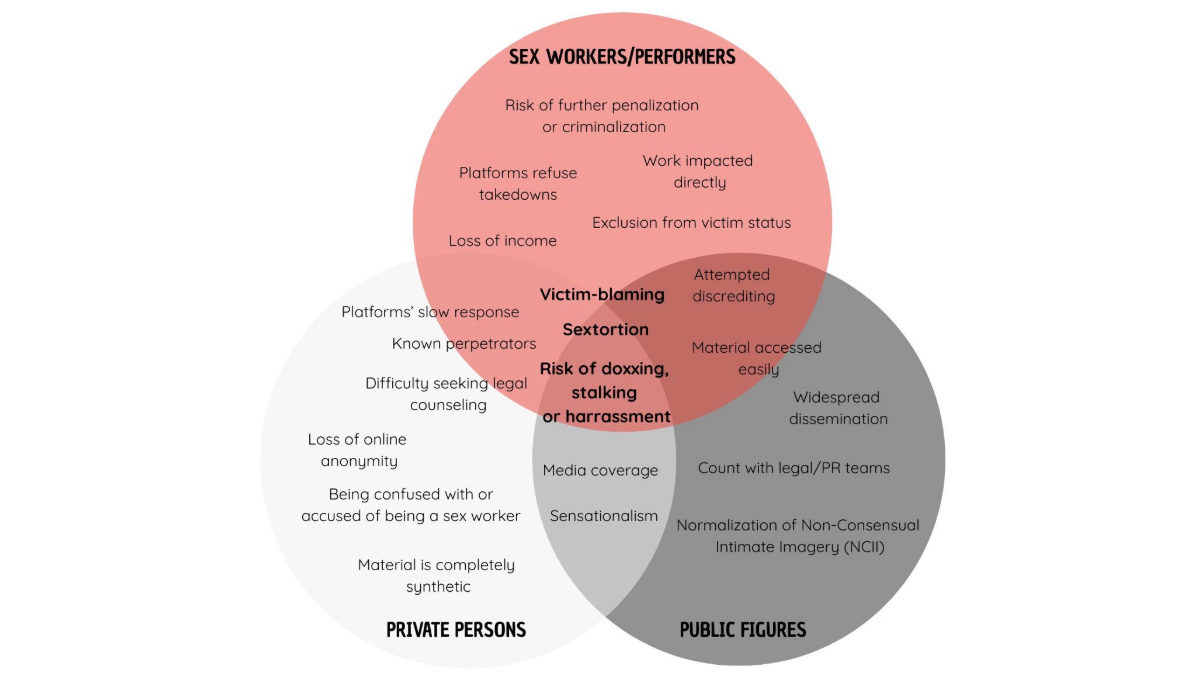
Graphic by Ana Ornelas, based on the analysis of 25 victim accounts.
NSTs: A new symptom of an old problem
Oftentimes when non-consensual deepfakes are discussed, the language used suggests that they represent a recent issue. While the realism and level of low friction and ubiquity of undressing apps is certainly a novelty, the problem itself is not.
In a seeming attempt to make everything look like a harmless joke, Elon Musk, the owner and CEO of X, used Grok to undress and put himself in a bikini. However, Musk was never risking his reputation, his relationships, or his job by appearing in a bikini. Plus, the trillionaire did this voluntarily.
This is perhaps the most fundamental and insidious aspect of NSTs and non-consensual intimate image sharing: Sexuality and nudity are used as a weapon to coerce, control, attack, abuse, and blackmail.
While such a practice could also be carried out purely for sexual gratification, this investigation shows that this is seldom the case. For the most part, sexualised images are created with the intention to humiliate and avenge. As Julie puts it: All the perpetrators had to do in her case was to write a prompt to Grok and press a button. For her, this simple action caused a devastating wave whose rippling consequences will affect her forever.
After the abuse happened, Julie felt that her perception of others has been altered: “Nowadays, I perceive men as always trying to cross my boundaries, online and offline. I feel like I am constantly under surveillance.”
Feminist historian Gerda Lerner writes that “the class position of women became consolidated and actualized through their sexual relationships”. The issue is that the sexuality of women and gender-expansive people is used as a weapon to inflict violence.
This can only happen in a society that accepts the policing of bodies and sexuality to destroy the reputation and relationships of individuals. The “loss of control” over their bodies is something all survivors describe. But Julie goes even further: “I realized that I never really had it.”
She also feels that the female body is “public property,” which relates to what feminist historian Silvia Federici wrote in The Caliban and the Witch: When peasants lost access to common land, the trade-off made by the patriarchy was that the female body became the new commons.
The misogyny that underlies and enables this kind of abuse is the same misogyny that shields perpetrators from accountability while blaming victims for the violence they endure.
NSTs function as a mirror of how this operates more broadly in society: women and gender-expansive people are disproportionately targeted by violence, with sex workers facing even greater vulnerability because of stigma, criminalization, and marginalization. When that violence is exposed, victims are blamed, while any association with sex work (or even behaviors merely perceived as adjacent to it) is weaponized to further discredit their testimony.
And as long as this misogyny remains unaddressed, it will continue to ripple through every new technology that emerges.
*Names have been altered to protect the identity of the victims.
This investigation is supported by the Algorithmic Accountability Reporting Fellowship by AlgorithmWatch.
Authors