Pennsylvania is a Swing-State Case Study for Data Center Politics
Justin Hendrix / Oct 4, 2026Subscribe to the Tech Policy Press podcast via your favorite service here.
Pennsylvania offers a particular case study in which to consider the political battle over data centers that is playing out across the United States and beyond. A new report from Data & Society, "The AI Factory: Data Centers, Power, and Resistance in Late Industrial Pennsylvania," draws on a year and a half of fieldwork across the state. It examines how boosters sell data centers by invoking Pennsylvania's industrial past, and why so many communities aren't buying the promises made by industry and politicians.
I spoke with Data & Society's Maia Woluchem and Ana Carolina de Assis Nunes and with organizer Hannah Sassaman about the findings.
What follows is a lightly edited transcript of the discussion.
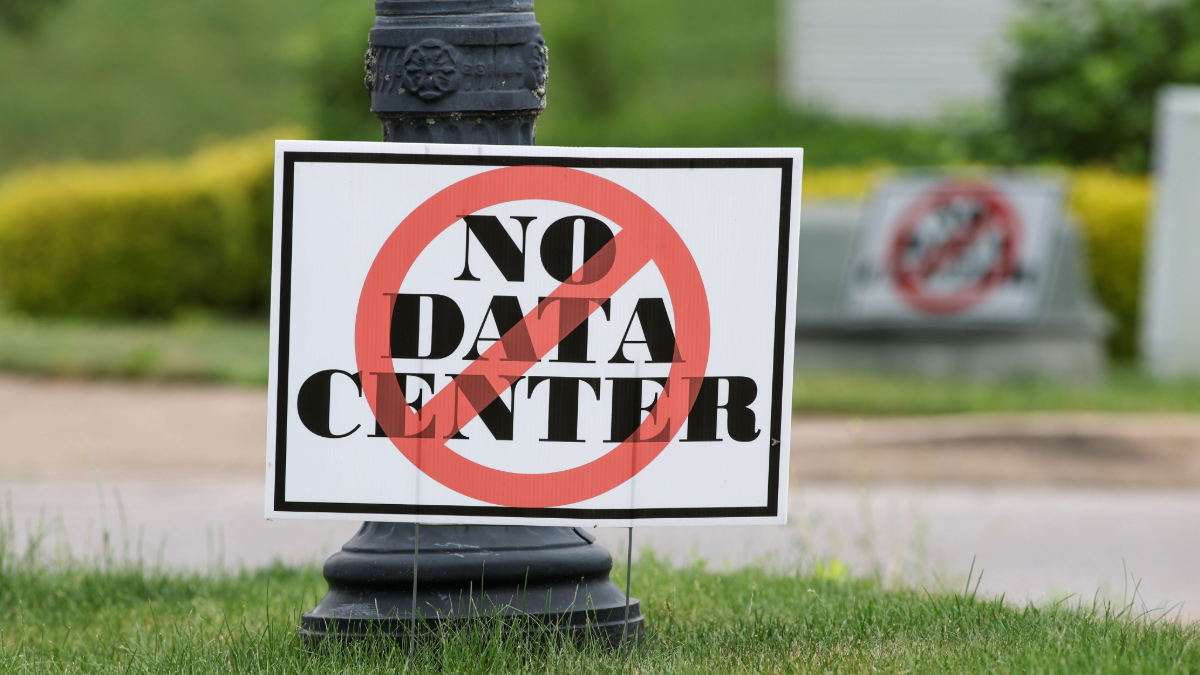
A "No Data Center" yard sign is seen in Allenwood, Pennsylvania on July 7, 2026. The sign is in opposition to a proposed 300-megawatt data center at nearby Great Stream Commons industrial park in Gregg Township. (Photo by Paul Weaver/Sipa via AP Images)
Maia Woluchem:
My name is Maia Woluchem. I am the program director of the Trustworthy Infrastructures team at Data & Society.
Ana Carolina de Assis Nunes:
I'm Ana Carolina de Assis Nunes, and I'm a postdoctoral fellow on Maia's team, the Trustworthy Infrastructures team at Data & Society.
Hannah Sassaman:
I'm Hannah Sassaman. I'm the executive director at People's Tech Project. We're based in Philadelphia, Pennsylvania.
Justin Hendrix:
And we're going to turn our eyes to Pennsylvania during this conversation and catch up a little bit about what's happening there, but also look at the results of this report that Data & Society has just put out called the AI Factory: Data Centers, Power, and Resistance in Late Industrial Pennsylvania []. I feel like I've been following this project for some time, been kind of around it, had the opportunity, Maia, to talk to you of course, and have you on the podcast even in recent months as we've been studying this issue alongside you. But I want to just start off by asking you about the title, where it comes from. I know you've borrowed this from an activist, The AI Factory, what does this phrase mean to you?
Maia Woluchem:
Yeah, it was such a great turn of phrase that came up in one of our early interviews with an organizer who's been doing incredible work around the state. But yeah, the thrust of the report was really trying to connect data centers to this long history of industrial re-imagination in Pennsylvania. It is a state that has meant so much to the country and to the global economy for its contributions and coal and steel and iron and many other things. And that idea of the factory is still really present in this conversation around AI. We were very lucky that one of our interviewees really made that connection. I believe that full quote was something like, "This here is an AI factory. It is as extractive as mining instead of mining for coal or mining for tokens." And I think that has really played out in many of the interviews that we had over the two years that we were crossing the state.
I think when a lot of boosters come to town and they sort of pull on these ideas of industrialization to try to win favor for this idea around data centers and AI, what it pulls on for people is this deep history mining of steel. And for many people that is not so much about the future, but that's about the past. And that's about, in some ways, some very traumatic experiences of the past.
Justin Hendrix:
And this might be a place to bring in Hannah too, but I think of Pennsylvania as a place that is contested. I often feel like it's the number one swing state whenever we talk about American politics. And as you say, it is somehow stuck between past and present. There's so much history and so much runs through the state, but maybe bring us up to speed. What's the picture right now when it comes to data centers in Pennsylvania? What does that look like?
Hannah Sassaman:
Well, I'm sure Maia and Ana can add a lot more, but I think just building on what you laid out, there was a storied announcement, I believe last year from our governor, Governor Josh Shapiro. He's in the middle of running for reelection for his second term. And the announcement was, I think he did it in the middle of the Lehigh Valley, which is a traditional sort of eastern side of the state, industrial part of the state, like Allentown and places like that. And he was ready to say that they were going to bring $20 billion worth of investment from Amazon into the state, building starting with two data centers, I believe one in Salem Township and then the other basically on the other side of the river from Trenton. And that was supposed to be the harbinger of tons and tons of data center development.
And he was also fast tracking permitting. He was making it possible for many different communities to try to get these data centers. And these were often in places where there had been brutal disinvestment over decades and generations. I believe the Salem Township one is in an area where the last sort of major hospital had closed a couple of years before, for example. So that's an interesting sense of the contradiction. But I think to answer your question directly, there is a robust, organic, deeply activating, incredibly diverse resistance to this kind of development in big cities like Philadelphia and Pittsburgh, in smaller cities and towns like Harrisburg, like Erie, and in the more rural counties of the Commonwealth, because there is a lot of clarity about in relationship to the union beauty that built the infrastructure of the working class of the state about what these data centers actually offer and promise.
What they offer and promise isn't much. In most places, they're situated near water that would be prioritized for the data center rather than prioritized for communities. The jobs that they offer are only in relationship to the construction jobs during the building, but after they're up, there was an estimate done by the Philadelphia Planning Commission, and we can talk in more detail about the organizing, the beautiful diverse resistance to data centers in my city. But the Philadelphia Planning Commission found that for every 5,000 square feet, there would only be one job. And then there's obviously a deep impact on everyone across the Commonwealth that relies on a variety of the electrical grid and infrastructure. They've already been impacted not just from data centers built in Pennsylvania, but also in Virginia, also in Maryland in the PJM territory where there's been about a decade of data center mass boom expansion starting and centering in Virginia that's impacting the electrical rates of our residents.
Here in Philadelphia in the southeastern part of the state, the PECO, which is the major sort of electrical company had to grant an amnesty basically of $10 million last year, and I think they're doing something similar this year for community members who just couldn't afford their electrical bills. So they literally had to offer charity for those bills. And so what we're finding is that the promises that the governor, the promises that Amazon, the promises that Microsoft, which is actually trying to reopen Three Mile Island, the big nuclear reactor site, which was the cause of the biggest natural nuclear, not natural, biggest nuclear meltdown disaster in United States history, what they're finding is deep resistance, not just to the electrical costs, not just to the lies about development, not just to the water damage, but also around what's happening inside those buildings. There's a lot of deep concern about what AI is doing to our kids, AI is doing to our families, AI is doing to our democracy.
Ana Carolina de Assis Nunes:
Our report as well, of course we are talking about Pennsylvania, but in the report, Pennsylvania kind of emerged as a microcosmo of America because this data center fight is happening in other states as well. And in the second part of our report, we explore in depth how industries in Pennsylvania, but in other parts of the US as well, they're trying to really convince folks to welcome them into their spaces by leveraging nostalgia, by trying to tell stories of a different industrial era, by trying to appeal to especially blue collar families. Oh, remember the good times when you had a stable job as in a factory is exactly what Hannah is saying. And then when the data center is in place, yeah, we are seeing other reports about the employment numbers and there are not too many. And just to highlight this fact that we focus in Pennsylvania, but also because Pennsylvania allows us to tell a bigger story about the country, there's a new report by the Data Center Watch that came out about the second quarter of 2026.
So there are a lot of projects that have been blocked. But there are new reports showing too that beyond Pennsylvania, this is happening in different parts of the US. And when Pennsylvania merges a microcosm of this larger opposition data center, we can also see that these strategies used in Pennsylvania and in different states are pretty similar in terms of appealing to this industrial past in terms to say that data centers and AI kind of a continuation of this golden days of American industrial as well.
Justin Hendrix:
And so you went and spent a lot of time there, Maia, I understand multiple weeks, traipsing across different parts of Pennsylvania that have three different regions that you targeted doing what you do, ethnography, talking to people, studying this phenomenon with this particular social sciences approach. Let me just ask you a little bit about the kind of myths that you heard that were being relied on, some of the kind of messages that the industry is trying to reach people with. What did you hear as you listened for what the industry is trying to tell people of Pennsylvania?
Maia Woluchem:
It's true. We were out in crossing the state from the week right after the presidential elections. It was quite a fascinating time to still be there as everybody still had their signs in their windows and confetti on the ground in some places all the way up until 2026. So we saw really some significant swings, but also some really huge sign points in the sort of development of this data center narrative. We were in town just about every time that Trump was in Pennsylvania. We followed a bunch of industry conferences. We got to get into a few of them to see how the sell developed over time. What we found is exactly what's sort of been noted here that we say in the report that they're relying on three big buckets of ideas. There are many under them, but the first is this idea of industrial nostalgia, and they pull on that in some ways that are really dissonant with the ways that Pennsylvania understands itself now.
We understand Pennsylvania as this purple state, this sort of blue collar imagination that arrives every election season. But in that time since de-industrialization, the biggest unions in the state are those that do care work. They're municipal workers. They're not necessarily the builders and construction workers that are being pulled on for this kind of industrial build. However, they are the ones that are showing up on the stage all the time through the narratives that Trump, Shapiro, and many other sort of industrial leaders are naming when they talk about what data centers could mean. So that vision, that very thinness that that nostalgia is a really, really key part of that sort of myth making around the state. The second is that it's not necessarily unique to Pennsylvania, but I think there are some local flavors that the vision of AI today has taken on such a profoundly nationalistic turn.
We are in this AI race, we're supposedly trying to beat China, whatever that might mean to those who are designing that kind of narrative. But that one is distinctly pulling on this history in Pennsylvania that is around war. So many of those industries that we think of when we talk about that industrial nostalgia were really building a war effort. They were building the tanks that were showing up in World War II, the steel showed up in all of those war efforts. And so trying to pull people into that nationalism at this particular time is a bit of a faulty argument. We have a quote in the piece from a journalist that we spoke to who had gone to one of those community meetings where this kind of idea of war was showing up all the time in the AI argument. And they had spoken to a veteran who showed up at that municipal meeting and that veteran is saying, "Well, I actually was in war, so what is it that they're talking about?
These aren't necessarily soldiers that we're sending away. That is not the kind of rhetoric that is going to convince me to say I'm going to give up all my water and my land. What fight are we trying to win here?" But then the last one that really fits really neatly into a bunch of these is this pull on the unions. And this is a bit of a tricky one, as has been noted, some of the labor numbers that we're seeing for data centers are really, really thin. However, we did speak to a bunch of folks from the building trades as part of our work who would say, even if this is a bubble, we have a really precious moment of time to expand our ranks, to expand our apprenticeship programs, to really take advantage of this moment, even if it's going to be really short-lived.
And we see that this alignment between nationalism, industrialism and labor is kind of crafting this narrative around what AI is supposed to mean to Pennsylvania. But all of those things, I think they kind of misread the moment that we can't talk about those things and we're also in a bigger crisis of our own. I often think back to this election time that we were leaving in or that we first started this trip in, in which we're having real debates about immigration, about healthcare, about education. And in the past two years that we have been on the road, those things have been really pulled apart for Pennsylvanians. I'm a graduate of the University of Pittsburgh and is a public university. In the time that we have been on the road, seven Penn State campuses have closed down. We had a crisis with the funding for SEPTA, for transportation.
We've had healthcare costs climbing astronomically. And so really trying to sell people on this version of the future that is based on the past or the present is not even serving what it should be serving is a very faulty way to sort of whip people into alignment around this issue.
Ana Carolina de Assis Nunes:
I'm from Brazil originally, and for the longest time at home, there was all this discussion about how come when we talk about big tech, the companies are all from the US, in Europe as well. The US really dominates this scenario. When we are talking about social media, of course, TikTok is an outlier because it's not a West industry, US made, but it's very interesting to notice how this critique is very predominant in the US as well. There's no pride in saying that the big techs are mainly American companies, and this is something very interesting to observe on the ground. There's no pride in saying, "Oh, these big corporations, look, they make billions of dollars. Look at their stocks. Look at how much money they make." There is no pride because there is no sharing of the pie. These folks are not seeing redistribution of wealth.
Those people are just seeing the money being made. They watch the news, they know how much these companies are profiting, but they do not see any of that being translated to benefits for them or for their communities. And being in Pennsylvania was very interesting too because the Gilded Age was huge. If you walk in Pittsburgh, if you walk in parts of the states, they have these beautiful buildings. You have these memories of a different industrial time where, okay, there was a big disparity in... I'm not saying that we should go back to the Gilded Age, but I'm just trying to say that there was a different approach of industries to the community. At least the buildings were beautiful. You know what factor is here, what factor was there? And all the tech companies that are trying to find their presence in town. It's very hard to figure out what companies were.
It's very hard to know what companies behind this data center. There's zero interest in giving back to the community, even when it comes in terms of architecture, in terms of design, in terms of you should be proud that we are here. So it's just very interesting to observe this complex situation where Americans are not proud of the big tech companies and American industry as they were of other industries.
Hannah Sassaman:
We've knocked thousands of doors across the country in Philadelphia working with one of the projects that we oversee called the Philly Tech Justice Collective and with a base building group that is in South Philadelphia in a neighborhood called Grays Ferry named Philly Thrive. They formed in 2019 when the largest refinery on the East Coast, the PES refinery blew up and they ran a incredibly beautiful campaign with working class, mostly Black generational neighbors to close it. But when we knocked their doors and we continued to work incredibly closely with them, we would ask the neighbors a question, which is in the place where they are trying to maybe build a data center, which is in the same industrial district where the refinery exploded called the Bellwether District. We would ask them, "What do you want to build instead? What do you want there?" Just to sort of tie these questions together.
And first of all, a lot of neighbors said, "No one's ever asked me that question." And then the second thing that they said was a ton of extraordinarily beautiful ideas. We need another grocery store that supports the community. The only major grocery store is over a very busy road called Grays Ferry Avenue. And then when another piece of industrial build collapsed, a garage that was being built for the children's hospital right over the river, the entire neighborhood, first of all, that was a deep tragedy and three workers died and that neighborhood had been fighting that garage, but also it completely cut off access for many days to the grocery store, the only grocery store. And so folks want a grocery store, folks want a library that's close by, folks want a community center where elders who are very isolated get to come together. They want a place where their young people can get trained in tech or get trained in different jobs that let neighbors actually be the center of the local economy rather than 15 guys on roller skates keeping a bunch of servers cool.
And that community is now deeply resisting not just a data center in South Philadelphia, but also another proposed potential site in Northeast Philadelphia and fighting for a moratorium. My colleagues and comrades are at city council literally right now wearing the same shirt, like No Data Centers in Philly, getting ready to testify on the relationship between Flock AI surveillance cameras as a resolution calling on the Harrisburg government to ban them and other automated license plate readers across the state. And they're also going to be speaking about the hope for a moratorium. And so all of that said, what we have is a relationship between a latent, brimming, mass of people, whether they're deeply rural from the big cities or somewhere in between, whether they're Black, brown, white, whatever their economic class is, all who are saying no to something. They're saying no to a kind of development that is deeply predatory.
And the question is, particularly in this political moment, Ana was just speaking about how in Brazil, the impact of the sort of global web of all of these big tech companies and how they extract data, how they have workers doing piece work to code things for facial recognition, how those companies extract and expand across the country. We have a big responsibility to rein them in here in the United States. The question is, in a place like Pennsylvania, as you were noting just in the perennial swing state, along with many others, in other states across the union that are facing these contradictions, folks who have not taken political action together for years, joining in with people who are at the front lines of taking political action to say no to data centers, the question is what are they saying yes to? And if we can actually really connect very deeply with those movements, including with organized labor, I came out of SEIU Healthcare Pennsylvania.
I worked there for many years in new organizing. How do we connect with the vision for durable long-term family sustaining union jobs that don't destroy our communities or support a tech oligarch that is undergirding authoritarianism, but instead build something that can create that sense of hope and pride that Ana and Maia were seeing as they walk the streets of Allegheny County. And you don't just see the ghosts of these industrial giants, but you also see the legacy of what organized people fighting together for workers' rights and for community rights have built. And so that's one reason why I have a lot of hope and I'm excited about this report because I think it really lives at that dialectic, not just about what people don't like, but what about what people are hungry for, which is I think one of the reasons they're fighting so deeply for their communities when data centers, when ICE detention centers, where Flock cameras come to town.
Justin Hendrix:
Maia, did everyone you meet across your various interviews and the work you did oppose data centers in their community? Was there sort of a subset who, not just from the building trades who were willing to negotiate, compromise or saw some benefit to the community?
Maia Woluchem:
Yeah, we have actually quite an interesting spread in some unexpected ways. I think we have heard some research about this that for some people their real interest is in energy and on grid improvements. And one of the things that was kind of being teased out over the course of our two years, we don't know yet where that has landed, but it seemed like there was a bit of an argument building around, well, perhaps this could be an opportunity to improve our energy grid because that influx of money is coming in and we have to expand capacity if these data centers are coming online. I would say that's certainly one group of folks we talked to. We also had some folks in community who would say, "Well, this nuclear plant has been here for a long time and I have the diner next to the nuclear plant and people haven't been working and maybe this is an opportunity to get them back in the building and get Main Street up again." We tried to return back to these places over time to sort of see how those narratives started to develop and change because at the outset, I think there were early people who were thinking about the data centers, but I think for most folks, we were looking at the big money, that big announcement was $90 billion coming to the state of Pennsylvania.
That is a really hard thing for municipal leaders to turn their nose at and say, "We are better than the Pennsylvania." But I think as Hannah and Ana are pointing to, that big organizing swell that started to become about things other than the money, I think started to demonstrate all sorts of other alternative paths. And one that I think has been interesting, and I hope there's more attention to this, is the data centers, and this pitch was trying to say something very particular about economic development in places that have been really disinvested. They're saying, "You all don't have money for your school system. You may not have money for your hospital system. We can give you that. Or we can give you, as in Amazon's case, they threw $20,000 to repair a community center or sorry, a community theater. They're like," Ah, here's one small - And
Hannah Sassaman:
Donations to the Boys and Girls Club.
Maia Woluchem:
Yes, exactly. It's very, very, very small compensatory amounts to say, look too, we can be a community development partner. "And I think increasingly, I would argue some of the ideas that are animating the things that are not just dissent, like building trade saying," We want to expand our ranks. We want folks to have jobs that can allow them to buy a house and go to school and all of those things. "I think in the course of that two years, we've started to see some alternative ways to get at that conclusion, which I would argue that most everybody wants. The folks who were not necessarily saying boo on this data center, “I really want my diner to succeed,” that I would argue being able to run your business, that's not something that I want to ever come out and say, Oh, you should have the opportunity to do that.
I think what we've sort of seen in some of the response is a real opening and political imagination to say, if that's what we want at the end of the day, for everybody to have a life of dignity where our water and air and land are able to support us moving forward, or we have a healthy diversified economy where we are able to access healthcare and education, all these things, we can find other ways through that. And I think we've even started to see some of the folks that we've talked to early on in our research period, I think really start to expand. I wouldn't say certainly that everybody's super anti-data center, but I think there has been quite a healthy conversation and really important organizing between all of these different factions to build something more complete than I think we could have ever imagined when we started.
Ana Carolina de Assis Nunes:
Yeah. And I think Maia is speaking directly to something that is in our report, but in also all the publications that our team put out that it's the autonomy of the communities. And right now there's a lot of effort from local organizers and communities who are learning about data centers before they get the communities. But this is recent. Before that, communities were learning about data centers once they started building, once they already had all the permissions. So this aspect of autonomy is super important. And more than just being yes or no, we're gaining favor, people want to talk, they want to be part of the conversation, they want to be part of the decision making. And one of the threads of our report is we are at this moment in American history, American 250, there were all the celebrations. That America is kind of in a crisis of identity in relation to this industry, people not in love with the industry that has defined the country for so long, people were opposing wars, and data center industry arriving in your county or in your township without asking for permission. Companies do that in other countries, companies do that in global south, not in America. So there is this element of what is America here if the companies are not treating us as participants in this conversation? This is me deployed in my community. So there is this element of autonomy that I think that comes up in this discussion of are you against or in favor? I think the question is more how can we develop this together if this is so essential to the economy of the country or even to the identity of the country as this industrial powerhouse?
Maia Woluchem:
There's a line in the report that's talking about data centers as kind of the symbol for all things. And we've been having this conversation in some ways about political economy and dignity and right to democracy in all of these ways. And there also is the kind of AI of it all that I think has shown up in some interesting ways throughout this. When asked folks in our interviews, we're talking about the data center, but how do you feel about AI and how does AI show up in these fights? And we have answers all over the map. Many of the group chats that I got to be a part of, you would see AI imagery about the next protest. So it's coming up in a couple weeks. I think that a lot of people arrive at this particular intersection of data center, economy, politics, whatever, either with a really strong analysis about AI or in some ways a little bit of a disconnection.
We've heard from some folks that it's like probably AI is inevitable, but I really don't want. So it is a bit. It can be a bit confusing, but I think we're starting to see these ideas really start to firm up as people try to, I think, get around this very thorny issue that is both personal, it's political, maybe it's sometimes even just contained within the confines of your workplace or your workplace is forcing you to use Claude in all sorts of ways. There's lots of zones at which we could be fighting this, but yeah, it's complicated.
I can say that not just in Philadelphia, but we've done a bunch of outreach and meetings and door knocking and community work in Eastern Washington State in five different communities that all line the Columbia River Valley there in Memphis and also outside of Memphis in Fayette County. We have a whole group going to knock doors in Atlanta with the People's Campaign, also formerly known as the People's Campaign to Stop Cop City. One thing that we're finding is a lot of grounds on what is AI. I remember one door I knocked in Philly, there was a grandma. It was during a giant northeast snowstorm. There was a foot of snow on the ground, 12 degrees outside, and she came out to her porch and I was talking with her and I asked how long you lived here. Did you hear about this? Rumor that they're trying to build a data center down there.
Hannah Sassaman:
We talked about that for a little while. Then she took out her phone and she showed it to me. She said, "Hannah, is this robocall that I'm getting right now and the 12 other robocalls that I got today, is that coming from these data centers?" And I said, "Yes, ma'am." And she let me inside and we talked for about 45 minutes. People can see the relationship between how AI and the companies underneath it are trying to extract more and more and more value, usually from people in a state of vulnerability like senior citizens getting their data sold online, cooked inside these places and predatory AI bots coming for them. All of that is something that people are grounded in. They're grounded in how young people are getting less and less opportunity to compete in the economy because of what AI is doing and how social media is changing how they intersect with each other.
When we were knocking doors in Memphis, a lot of the folks were very, very clear on the relationship between Elon Musk, who is with his Grok and his SpaceX AI companies, built Colossus and then Colossus 2, and he's trying to build more data centers both in Mississippi and in Southwest Tennessee. They were clear that there was a big relationship between Musk and Donald Trump and the political class in Shelby County and whether or not people could have the basic access to good food, good jobs, and a good future that they had fought for for generations. I remember we were knocking doors in Boxtown with Memphis Communities Against Pollution and with Tennessee for All and a bunch of other groups down there. And when I came up to a porch and it was a Sunday, folks were chilling out after church and they were like, "Well, what are you here?”
What are you asking us to do?" And I said, "Can you sign this petition to Shelby County Mayor Lee Harris asking him to shut down the illegal turbines that Elon Musk is using to power his data centers and that are deeply polluting the air in Southwest Memphis, a community that has dealt with a massive amount of pollution over generations, over generations of environmental racism and an industry." And what they told me, they're like, "That's not going to do anything. What we need to do is we need to all go march on his office." And so I think what we're finding here is folks are not just clear on what they want and what they deserve, but what it will take to make it happen. And what it's going to take to make it happen is both participation and the general basics of the democracy. And it might be a democracy that's under deep threat and even in decline, but even when authoritarians come to power, it's actually incumbent to use those tools pretty deeply.
But we're also needing to go deeply beyond those things. The kind of policymaking that I'm a generational actor within, I'm someone who came up, my very first campaign was fighting in Congress to expand community radio, fighting at the FCC. The incremental kinds of things that we fought for and demanded have a lot of grounds and a lot of things to learn from, and we're at a very, very different moment. So one thing that I'm grateful for the report that Maia and Ana and others did is it talks with nuance about those contradictions. Again, it's not just what people are fearful of or are trying to fight in relationship to their communities. It's what do they want instead? And so if we are brave enough to not snatch defeat from the jaws of victory, because I think that there's a lot of actors out there that are trying to play like it's the old world.
They're like, what community benefits could we get from these data centers? Or how could being in a coalition that just tries to extract resources and doesn't try to go with what the people want and the people want no, the people are saying no. And there's many groups working on that with a lot of power, not just Data & Society. We see great leadership from the data center working group and MediaJustice and Climate Justice Alliance and many others. But if we're brave enough to actually follow what the people are saying, we're not just going to stop data center development at a moment when it actually could have and already is having an economic impact on the IPOs of these companies and their ability to maintain the sort of fictional economic bubble that they've created about any kind of value inside the mass of AI that they have.
We're not just going to do that, but we're going to have an incredibly richly organized group of people that is suddenly no longer blind to the way in which tech is sort of leasing the economy with a set of brass knuckles, making stuff so much worse. And so that's what I'm really hungry for.
Justin Hendrix:
I want to come to some of the policy considerations in the paper. You say that policy intervention should slow down the process of data center development, not speed it up. That's the kind of, I suppose, bottom line here. You talk about slowing down approvals, banning NDAs and ending subsidies. I suppose my question is this, there's a range of different approaches that states are taking to data centers. It does feel to me that across the country, more or less, the states are moving towards the direction of your recommendations. There's a lot of movement to either end or reduce subsidies. And of course, this issue of transparency in NDAs has been a motivating one for many legislative solutions as well. But I guess thinking about Pennsylvania and how it relates maybe to its neighbors or to other states with which it's competing for economic opportunities, some states will take a harder line.
For instance, here where I sit in New York, others will throw open the doors. So I don't know, how do you feel like these kind of policy suggestions sit in that kind of competitive dynamic between states that are looking for economic opportunity or trying to compete on some level for jobs and investment?
Maia Woluchem:
Yeah, I think this one is such a tricky one because we hear that, we actually heard that quite a bit from the folks who we spoke to or observed from industry. These moratoria are not useful because they're just going to go to the place that's least protected. And maybe though I would argue that I feel then if we are all in agreement, which many of us are, that the speed at which the sort of conditions of a race that are forcing everybody to pay attention in some way to this argument, then I would say we got to go higher. We got to go bigger with what we think of as sort of slowing down the role of data centers and being land developers, economic policy makers, destructive of our democracy. I would argue that is a really strong threat that requires a coordinated response. So we don't get into this as much into the paper and about the scope by which we imagine that being most effective and why we land in this place that says we just need to be slowing this down in whatever jurisdictional capacities that we have in order to do that.
And maybe one point to this that I think has been discussed, other reports get at this piece, but to hit on Pennsylvania briefly, part of the reason that Pennsylvania becomes very attractive for something like this, in addition to the Marcellus Shale that is certainly producing a lot of polluting energy to support this data center push, is that Pennsylvania has so many stranded assets from past industrial revolutions. We have coal plants, we have nuclear plants, we have steel structures that are being reused for something like this. And I think we have not had to hold these companies to account as much for the risk of creating yet another generation of stranded assets. We had so many people in the report talk about we live amongst America's trash from past generations of this work. And so when we talk about the stakes of what it means to slow this down, if what they're selling is we're going to these places that are vast need of investment and we're going to provide an opportunity to do that, they have not likewise provided security, anything that says we are not going to siphon yet another generation of resources, money, opportunity from these same places and leave them with another generation of trash.
I feel that is a real urgency that needs to be attended to and why we would argue in many cases to say without some real clarity about what that means, what the stakes of that mean, because they are economic and they are as well as Hannah and Ana noted, questions about democracy, dignity, what it is that we might want alternatively, then we need to slow that down and whatever it takes to do that, you all have my support.
Hannah Sassaman:
This is a bubble. The DPUs inside the data centers have planned obsolescence built in. The energy and the water that they need is not renewable. We're already starting to see Wall Street pull out. There was a recent report showing that the amount of tax breaks that the state of Georgia offered for data centers absolutely dwarfed any revenue that they brought in. The revenue isn't sustainable. There's way more falling. The sort of contradiction that you were laying out, Justin, if it doesn't go here, might it go elsewhere? That's what states are mostly doing is they're trying to incentivize these companies thereby robbing themselves of the revenue they need to sustain their basic systems and it doesn't create knock on effects for jobs. In rural communities in particular, there aren't other benefits that come after the data centers are built. The promises of revenue for communities are mostly lies.
They're mostly gold rush opportunities from incredibly immoral developers just trying to throw lots and lots and lots of potential permits out and trying to get to a place where they can build wherever they can. And so I think it's important for communities to remember they actually have the upper hand. They're on the right side of history. Their anger is shaping what is politically possible. We are only seeing more and more elected officials from both parties come along. And so we can just come out and say we have a positive vision for what the economy can be here and we don't have to fall into the trap of saying that this is a get rich quick scheme for municipalities and states across the United States.
Ana Carolina de Assis Nunes:
Yeah, I just want to add that regardless of moratoriums being enacted in practice or other policies being enacted in practice through low data centers, the narrative effect is huge. And AP, the Associated Press, called an article from August 18, “Data centers as a toxic politics during the election season.” So you have Josh Shapiro in Pennsylvania, the governor who was really trying to bring data centers in and now he's kind of not supporting them as much or at least publicly trying to appeal to an audience that is mad at data centers and what they bring or not bring for the community. In Oregon as well, where I did my PhD research, Tina Kotek, super in favor of data centers and now elections are coming. Oh, all of a sudden data center industry is so bad. My goodness. So I just want to point out too, this aspect of narrative, regardless of moratoriums being enacted or not in different places at the narrative level of the storytelling level, they are powerful and they are shifting political campaigns ahead of the elections.
There is this level too that even the companies, AI companies have all been following the rogue AI stories that came out in the past weeks and now AI companies themselves are begging for regulations. We are very sorry for them. But you can see that the storytelling is very important here and political candidates are changing their narrative because data centers, toxic politics. Companies themselves are afraid that this might mean regulation for them. So they're trying to influence regulation to benefit themselves. But there is something happening here because of the conversation about moratoriums, even if moratoriums are not actually being enacted.
Justin Hendrix:
I think one of the interesting things about this report, because you've been at it for so long, you have been able to witness how the public discourse over data centers has changed, how it started, the kind of education process that many communities have gone through. And I would say also that journalists and politicians and everyone involved has gone through. It's been a learning experience for the public as much as it has been something that we've been experiencing as a set of industry priorities that have played out over time. Where does that learning experience go next? What are the questions you think that people have that you think we need to figure out as a community, as researchers, as journalists, also as advocates to answer? What are the questions that people are still asking?
Hannah Sassaman:
I think the question that is always incumbent on an organizer when they see a problem, like when a community is facing a problem and try to solve it is we need to stoke that uncomfortable feeling of curiosity. People need to be able to ask why. Why is this happening? Why did they target us? Whether we win a campaign and then we say, okay, now that we've blocked or slowed down or paused this kind of predatory development, then they need to be curious about what was it that helped them win? What are their neighbors hungry for? What do we want next? If they lose that campaign, and that's just as important a question, why did we lose? What are the entrenched political forces? Whether they're municipal, county, state or federal, whether they're corporate or there's other factions that were coming up against us. The question is why?
And then the other question is, and this I think has to do with something that I've been hungry for my entire life, which is how now that something that has been invisible, the idea of technology as unfettered progress has been complicated, I think durably and potentially permanently in an entire generation of people. They now have the opportunity to ask the question, what do we want instead? What would technology mean if it was connecting us rather than extracting us, if it was helping us learn rather than deporting our neighbors, if it was helping us build sustainable long-term environmentally and community just jobs and development rather than predatory ones? And so that might all seem pie in the sky, but to me it seems incredibly practical. It seems like an opportunity that time has come. And organizers like me and all of the folks I work with at People's Tech and many, many other organizations beside are incredibly excited to be moving not just from these no campaigns to campaigns of yes and to campaigns of what is this new organized base able to do in relationship to the multivalent movements for humanity in this country.
Maia Woluchem:
There is so much potential in this idea of what yes means. I'll call out our colleague, Cella Sum, who worked with us on this project, who sort of introduced these sets of questions at the end of all of our interviews that was about what would you do instead if all of this money, $90 billion was going to anything else, what would you put it towards? What would you want Pennsylvania to be in its most perfect world? And we heard so many things about this is the most beautiful place on the planet. We have 80,000 miles of rivers and streams. That is a significant part of the state of the Commonwealth. What would it mean to reinvest in our environment in the way that we did, not just a generation ago after coal and steel went under in the first place? That was a tremendous effort to reinvest in the beautiful environment of Pennsylvania and find other regenerative ways to be a Pennsylvanian. We had folks say, I would want a train that takes me to Harrisburg.
I want a train that takes me to Erie. There's only one train we have taken it many times that goes across the state from Philly to Pittsburgh. It leaves at 1 o’clock, you get to Pittsburgh—or maybe 12, you get to Pittsburgh at 8 p.m., it’s once a day going back the other direction, you can't find it. There are really critical things that if we actually care about the dignity of all people, that the ability for all people to thrive, we would invest in them. And so I think that there really is an opportunity to really focus again on the things that are at the end of that long pitch that will often be, don't we want better healthcare? Well, why don't we use AI to do that? Well, people don't have access to that stuff. Why don't we just invest in better healthcare? Why don't we just invest in better education?
And we have all the tools to be able to do that and all the imagination, I think, to make that possible. The additional thing that I will plug is that actually on the 2nd of October, we are going to be in Pittsburgh for a community-centered AI summit that brings together so many of the groups that Hannah has talked about, so many of the different types of interviewees that we have for this work, and so many other different types of actors in Pennsylvania and beyond. Those of you who are not in Pennsylvania, we surely welcome you into the space either in person or by live stream. And part of that afternoon is going to be designing a community action plan for infrastructure. What would it actually mean for instead of Meta, Amazon, Facebook, whatever, to be dictating what the future of Pennsylvania is? Why don't we actually put our own heads together and try to come up with something more generative and what can we do if that we're actually in the right place at the right time?
So we're hoping that we, by the end of the year, we'll arrive at some really generative visions for what we could be doing alternatively, but I'll turn it to Ana to Chris.
Ana Carolina de Assis Nunes:
Yeah, no, this is a very good question. In a nutshell, what comes next? There's developers or big tech companies trying to get into some communities have a deep misunderstanding of these communities and the people residing there. Either they're very naive or they are not paying attention to what's happening on the ground. Those people are actually very smart. They know that the US is the richest country in the world. The economy is incredible, but they're not reaping the benefits of any of that. At the same time that they're being asked to sacrifice to make the country stronger, to make the country richer, to make the country continue to be as powerful as it is. They don't care about that. They want to be able to know when the paycheck's coming, they want to live without knowing if they'll have money to buy food or not. I don't know.
There are so many people who they go bankrupt because of a medical emergency. People are aware of this. This country is very rich and we are not receiving the benefits of any of this, and we are asking to sacrifice a lot in the name of this national good. So I think which industry comes after the data centers, they're going to be folks asking the same questions. How is this going to actually translate into benefits for us? How is this wealth going to be shared? And we are going to really not be suffering and just experiencing basic needs. So that's why we also say that it's more than just data centers, more than just tech, more than just AI. It's about life with dignity in the richest country in the world.
Justin Hendrix:
For listeners who want to learn more about this report, they can find it by searching “The AI Factory: Data Centers, Power, and Resistance in Late Industrial Pennsylvania.” You can also find a link put in the show notes, and please also check out People's Tech Project and No Data Centers in Philly for more information on Hannah's work. I'm grateful to the three of you for joining us.
Ana Carolina de Assis Nunes:
Thank you so much for having us.
Maia Woluchem:
This was wonderful.
Hannah Sassaman:
Thank you.
Authors