Data Center Discontent Drives State Legislation Surge
Tim Bernard / Aug 25, 2026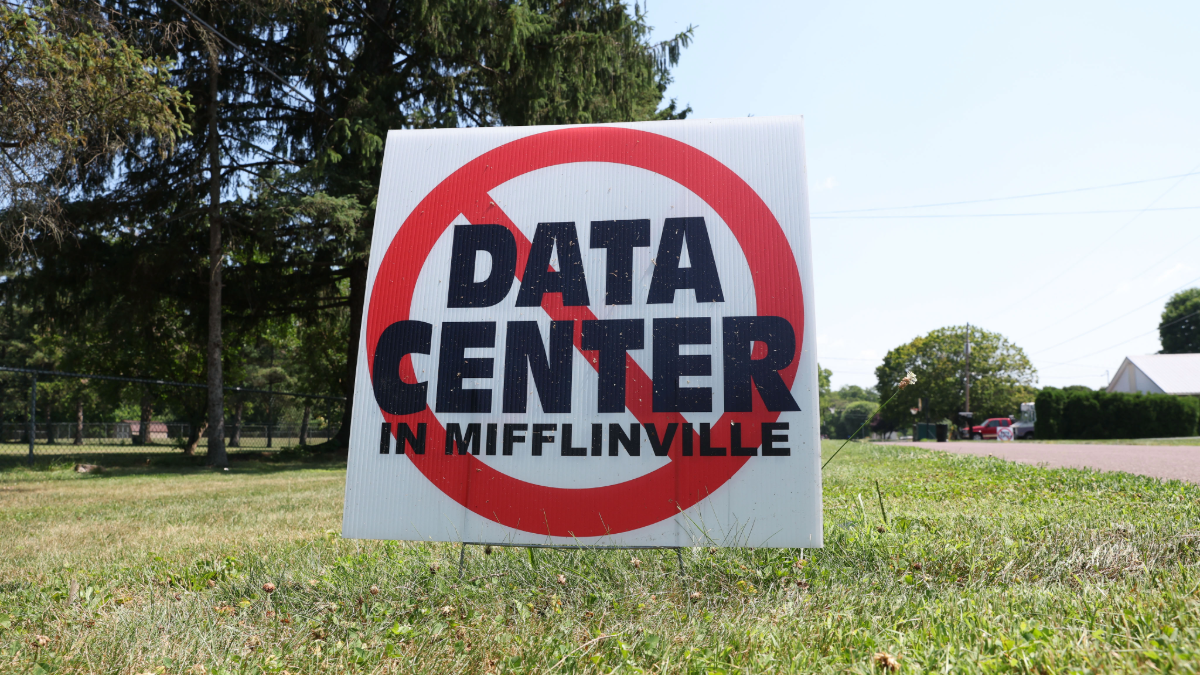
A yard sign expressing opposition to the construction of a data center is seen outside of a home in Mifflinville, Pa. on July 3, 2026. (Photo by Paul Weaver/Sipa USA via AP Images)
Over the last year, fights between communities and data center developers have broken out of their local arenas and hit the national media. As awareness of the environmental and quality-of-life toll of data centers converged with a broader AI backlash, activists have been speaking up. And legislators, especially in the Statehouse, have been listening.
Last summer, I reviewed over 300 bills about data centers from the previous few years of US legislative history for an article published in Tech Policy Press. Back then, the overall picture was of a balancing act as lawmakers on both sides of the aisle sought to lure data center development, an emerging economic behemoth, to their jurisdictions, while also starting to reckon with some of the industry’s troubling externalities.
Since then I have continued to track data center legislation on behalf of the Halt the Harm Network, an environmental justice group. Almost 400 new bills have been introduced over the last 12 months in statehouses and the US Congress. This legislative momentum corresponds to a huge shift in attitudes towards data centers and policy directions in the country. Parallel activity at the local level has possibly been even more impactful, but was not the subject of this analysis.
What has changed?
The headline shift has been away from incentivizing development. In the 2026 legislatures (which for some states began as early as the start of 2025), only a few dozen of the new bills (~54 out of 473 or 11%) dealt with introducing or increasing incentives, compared to over 32% (~98 of 308) of last summer’s data set, and a significant proportion of the newer ones are, to some extent, incentives to mitigate externalities, such as encouraging new nuclear power sources for data centers so that they don’t impact the existing electricity supply, or financing data center waste heat capture projects to lessen environmental impact. Of the more recent bills, almost 90% (~420) are attempting to tackle or investigate the problems that new data centers bring—or at least evince a dampened enthusiasm for data centers as an unalloyed benefit to communities.
The new legislative efforts have also responded to a number of concerns that were not commonly raised in earlier bills:
- Non-disclosure agreements between data center developers and governmental bodies and officials are prohibited or limited in some bills as either a general transparency measure or to enforce a specific data collection effort.
- Decommissioning and the risk of project abandonment is taken into consideration by bills that may require data centers to provide financial assurance to cover site restoration costs, or direct electric utilities to collect assurance or otherwise account for these risks when entering into contract with data centers.
- A few state or federal moratoria have been proposed in legislation (including one that passed the legislature in Maine and was vetoed by the governor), but other bills have provided guidance for local governments that are imposing county- or municipality-level pauses.
- Relatedly, state lawmakers are empowering or requiring local governments to use zoning authority to regulate data centers, or directing the provision of resources like model ordinances to facilitate this regulation.
- Amongst lawmakers more bullish on data centers, encouraging the use of new power sources, often modular nuclear reactors, but also geothermal and other sources, has emerged as a cause. In parallel efforts, data centers are required to bring some proportion of their own power, sometimes from clean sources and in increasing increments over time, so as not to be a burden on the public grid and supply.
What is actually becoming law?
As is to be expected, a fairly small proportion of the bills have become law, but running the gamut of concerns and themes. In the 2026 legislatures, 47 bills have been enacted (or resolutions adopted) as of the end of July 2026. Of these, 16 have imposed new regulations on data centers, and 9 have curtailed existing incentives. Another twelve contained some element of data collection or directing a study or report. Both of the two new laws that increased incentives were enacted back in April of last year, underscoring the sea change that has occurred over the last year.
What about Congress?
Notably, none of these are federal laws; in keeping with its reputation, Congress has had a harder time passing bills about data centers than State legislatures. It also appears more cautious in its approach. Only 14 of the 43 bills related to data centers introduced in this legislature proposed new regulations.
Reflecting the broader national purview of Washington, at least thirteen of the proposed laws directly referenced artificial intelligence in their titles (whether broadly pro- or anti-), whereas State legislators were much more focused on the practical ramifications of data centers as physical installations, regardless of their application. Reflecting the AI backlash, leading left-populists Sen. Bernie Sanders (I-Vt.) and Rep. Alexandra Ocasio-Cortez (D-N.Y.) introduced the Artificial Intelligence Data Center Moratorium Act in both chambers of Congress—one of the most severe proposals in the country, which includes a requirement for the adoption of comprehensive AI safety laws and broad labor protections before the moratorium can be lifted, as well as measures aimed at protecting local communities.
(It is worth noting that opposition to the downsides of AI as an end-product is a common motivation for some activists opposing the construction of data centers in their locales, but this issue is almost entirely absent from legislation proposed at the state level.)
Perhaps because of closer ties to the pro-AI, pro-data center White House, Congressional Republicans appear less eager than their statehouse counterparts to back bills that engage with the negative impacts of data centers. The exception to this appears to be regulation that seeks to ensure that data centers cover any costs relating to power generation and the electrical grid, protecting other utility customers from rate increases. This policy was endorsed in the Trump White House’s voluntary Ratepayer Protection Pledge, giving cover to national Republicans interested in introducing some limitations on data center development.
It is fair to say that the political tide has turned on data centers. But with the leading AI labs relying on expanding compute to justify their sky-high valuations and the deep-pocketed tech giants desperate to keep up, studies, modest regulations, and decreased tax incentives may do little to slow the pace of data center development. Tech leaders like Mark Zuckerberg and OpenAI appear to have realized that they need to significantly improve local outreach if they want to get data centers built, but the groundswell in opposition shows no sign of abating, and activists are working just as hard to keep their lawmakers focused on the risks that data centers pose.
Authors