The State of Data Center Policy in the United States
Lauren E. Bridges / Jun 2, 2026Dr. Lauren Bridges is the project lead for the Data Center Policy Database, a project of the DIGS Lab at the University of Virginia.
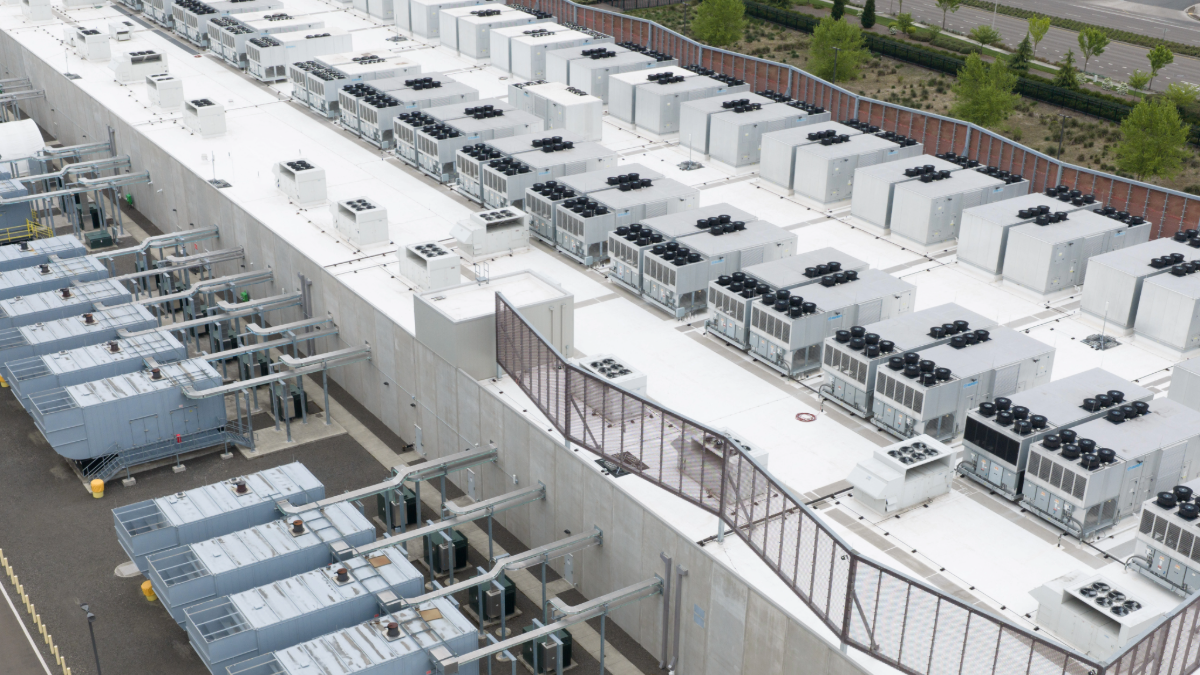
Fans that are part of a cooling system are seen on the roof of a data center, Monday, April 27, 2026, in Hillsboro, Ore. (AP Photo/Jenny Kane)
The regulatory landscape for data centers in the United States has shifted dramatically in recent years from a period of aggressive economic incentives to a phase of intense scrutiny, restriction, and community-led resistance. To track these legislative changes, the DIGS Lab at the University of Virginia reviewed more than 700 federal, state, and local policies related to data centers. The data center policy database aims to bring transparency around zoning, permitting, and regulating data centers and their impacts on communities. This is what we found.
Data center governance follows a patchwork approach between local, state and federal policy. Four major trends have emerged from our analysis, signaling a shift from an incentive-based model to increased restrictions, particularly in local zoning.
- From incentives to restrictions: Historically, states like Virginia, Texas, and Arizona competed for data centers with generous tax exemptions and streamlined permitting. However, the data shows a sharp pivot in 2025–2026. Many jurisdictions are now actively repealing or tightening these exemptions. For example, Virginia is debating sunsetting tax breaks (SB30) and Maryland has proposed repealing exemptions under certain conditions (HB560).
- The rise of moratoriums: A significant trend is the adoption of temporary moratoriums to pause development while regulations are drafted. This is occurring at the local level across diverse geographies, including DeKalb County (GA), Aurora (CO), Howell Township (MI), Norton (OH), and Saline (MI). Even states like Oklahoma (SB1488) and South Dakota (SB232) are considering statewide pauses. Maine (LD307) recently approved a state-wide moratorium but it was later vetoed by Governor Janet Mills, stating that it would block a “specific project in the Town of Jay that enjoys strong local support from its host community and region.” At least 20 moratoria have been proposed at the local, state, and federal level since 2025.
- Zoning as a primary tool: Local governments are increasingly using zoning ordinances to restrict data centers. Many counties (e.g., Loudoun County, VA; Prince George County, VA; Fairfax County, VA; various counties in NC and MI) have moved data centers from “by-right” uses to “special use permits” or “conditional uses,” requiring site assessments, noise studies, and public hearings. Some towns, like Warrenton, VA, Atlanta City, GA, and Big Rapids Township, MI, have removed data centers as permitted use effectively banning data centers from certain areas.
- State-level intervention: States are beginning to override local preferences or create new frameworks. Virginia enacted laws requiring site assessments for noise and water (HB153, SB94), Maryland proposed (HB1534) establishing siting standards, while South Carolina proposed (S0867) a new dedicated office to manage data center growth in the state.
Main issues policymakers and communities are addressing
The regulatory focus has coalesced around four primary pillars of impact. Across these pillars, communities are demanding increased transparency and protections against rising utility bills, water scarcity, and local disturbances, as well as meaningful involvement in siting decisions.
- Utility rates and grid reliability (cost-shifting): A dominant theme is the fear that data centers are driving up electricity costs for residential and small business customers. In Oregon, the 2025 POWER Act creates a new rate for high-load customers such as data centers (over 20MW). Bills have been passed in Virginia (HB1393/SB253) which require the State Corporation Commission (SCC) to establish weatherization programs for low-income, elderly, and disabled individuals. The two companion bills also direct power utilities to determine cost recovery rates for high demand customers (>25MW) after January 1, 2027. Other bills that would have explicitly prevented utilities from engaging in cost-recovery failed to pass in the 2026 legislative session such as Virginia’s HB503 and HB658. Examples of proposed bills in other states include Ohio’s HB706, and New York's S850 and S8546, California’s SB886, Michigan’s SB763, Maryland HB1082, Pennsylvania’s HB1834, all of which aim to prevent cross-subsidization where ratepayers fund grid expansions for hyperscale facilities. At the federal level, Congress has also proposed the GRID Act, which would require all data centers to bring their own power or receive power from a “captive source.” Because few of these bills require renewable power sources, data centers may add air pollution burden if their operators opt for fossil-fueled power sources, such as gas turbines.
- Water consumption and scarcity: water usage is a critical flashpoint for data centers. Regulations are increasingly mandating closed-loop cooling systems, reporting of water withdrawal and water usage, and bans or limits on potable water for cooling. Utah (HB0076), Michigan (SB761), South Carolina (S0724), and Virginia (SB553) have introduced or passed laws requiring detailed water usage reporting and limiting withdrawals. While there is a focus on increased transparency and limitations on high-use water customers, few bills consider the full water footprint of data centers. An exception to this is Colorado’s SB26-102, which would require data centers to estimate direct and indirect water use and planned water sources in their permit applications.
- Environmental and community impacts (noise, air, land use): Communities are fighting against the industrialization of rural and residential areas. Key concerns include noise pollution from on-site power sources and cooling fans (addressed in the failed Virginia HB166), mitigating air pollution on-site power generators (Virginia HB507), and the loss of agricultural land. Many local ordinances now require noise studies, setbacks from schools/residences, and air quality monitoring.
- Transparency and secrecy: There is a growing movement to ban Non-Disclosure Agreements (NDAs) in economic development deals involving data centers. States like New Jersey (A2774), Wisconsin (SB969), and Oklahoma (SB1619) are proposing laws to force public disclosure of project details, financial incentives, and environmental impacts, arguing that secrecy prevents informed community consent.
Why transparency remains limited
Despite the push for regulation, transparency remains limited due to several structural and legal factors evident in the data:
- Proprietary claims and NDAs: Developers frequently rely on NDAs to protect “trade secrets” or competitive advantages. But this is leading to legal challenges by community advocacy groups. For example, in Botetourt County, Virginia, a legal battle unfolded around non-disclosure of a proposed Google data center, which was later revealed it was projected to consume between 2 million and 8 million gallons of water daily. Similarly, in St. Charles, Missouri, an NDA was a primary point of contention, leading to the project’s cancellation.
- Fragmented reporting: There is no unified national or even state-wide registry of data center water and energy usage. This information is often held by individual utilities or local water authorities, which may not be required to aggregate or publish it in a standardized format. While bills like Michigan’s SB762 and Iowa’s HF2447 propose centralized reporting, these are not yet universal.
- Definition gaps: Many jurisdictions lack a clear legal definition of a “data center” or “high-energy use facility,” making it difficult to mandate reporting. Until recently, many facilities were classified simply as “warehouses” or “industrial,” bypassing specific scrutiny.
- Utility opacity: Utilities often treat load data as confidential customer information. Without state mandates (like the one proposed in Wisconsin), utilities are not compelled to disclose the specific consumption of large-load customers to the public or regulators.
The data reveals a nation in transition. While the era of unchecked growth fueled by tax breaks is waning, the new regulatory regime is fragmented, reactive, and heavily contested. The tension between local community sovereignty and state/national economic imperatives remains the central barrier to cohesive policy for an industry that is seeing unprecedented growth.
Authors