Data Centers, Riches and Rebellion in Big Tech’s Inland Empire
Dean Jackson / Jan 26, 2026Dean Jackson is a contributing editor at Tech Policy Press.
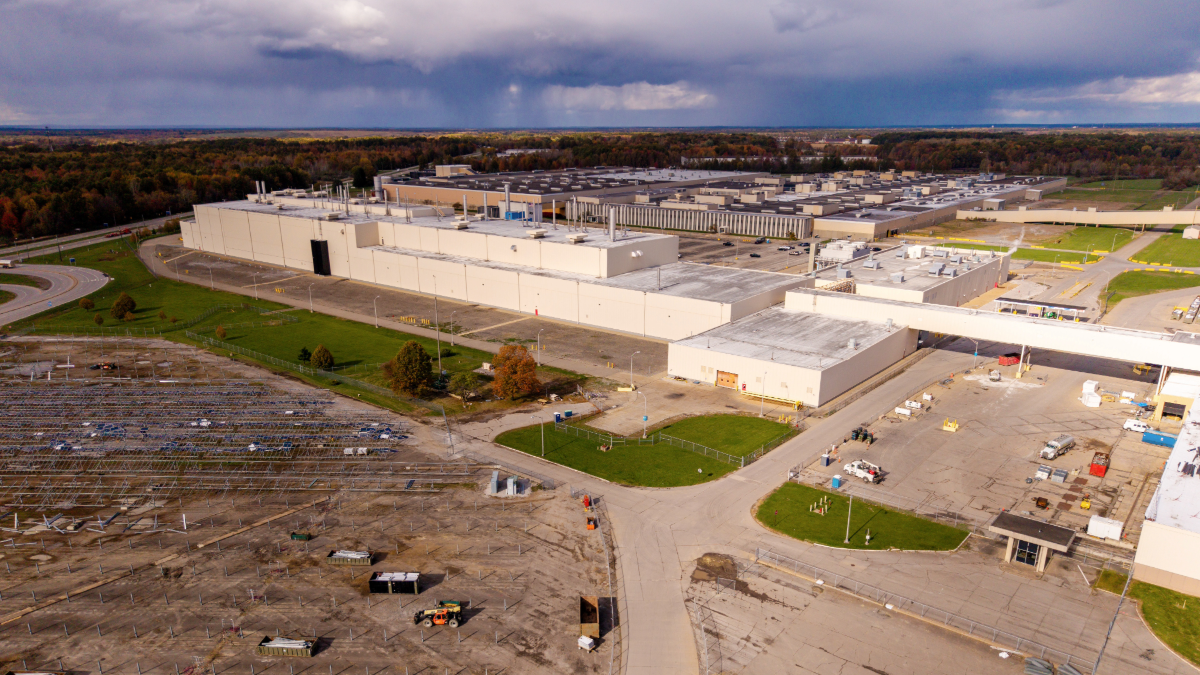
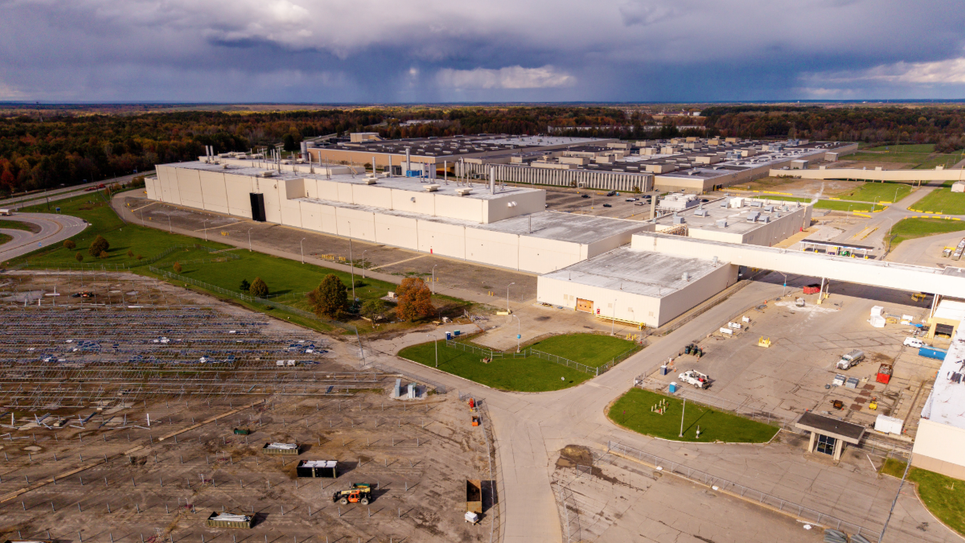
The former General Motors and Foxconn factory in Lordstown, Ohio, US, on Thursday, Oct. 23, 2025. In August, Foxconn announced it had stuck a deal to sell the giant facility to SoftBank, with the two companies planning to start manufacturing data center equipment on the same site where GM cars including the Chevy Impala once came off the assembly line. Photographer: Kyle Grillot/Bloomberg via Getty Images
Bowling Green, Ohio was once an oil town. Situated south of Toledo on Interstate 75, it is part of a region formerly called the “Great Black Swamp,” carved into the Earth by ice-age glaciers. After the War of 1812, the United States seized the swamp, expelled the Native American tribes that lived there, then drained it. The remaining soil made fruitful farmland, but it was the discovery of petroleum and natural gas in the late nineteenth century that briefly turned the city into a glass manufacturing center, earning it the nickname “The Crystal City.”
Then the gas ran out.
Today, Bowling Green is a college town of 30,000 people and one of many Ohio communities affected by another booming industry: data center development. In April, Meta announced plans to build a 715,000 square foot data center campus just north of the city, in Middleton township.
Bowling Green is far from alone. Ohio’s state capital, Columbus, is one of the fastest growing cities in the US and has by one count the fourth largest concentration of data center operating capacity in the world—behind Beijing and the US states of Virginia and Oregon. The city boasts key advantages for data center development, including abundant freshwater, ample nearby farmland suitable for development and a favorable business environment. According to the Data Center Map, there are 217 data centers operating or under development in Ohio, with 133 in greater Columbus.

Bowling Green, Ohio, in 2013. Wikimedia Commons
As some wonder if Columbus is nearing a saturation point, development has spread to other Ohio cities. Corporate rhetoric promises growth and renewal to communities still reeling from deindustrialization. In an op-ed for Cleveland.com, Josh Levi, the president for the Data Center Coalition trade association, argued that data centers “support the 21st-century economy” and that “by welcoming data centers, Ohio is attracting and developing high-tech, quality jobs in sectors like advanced manufacturing, AI, cybersecurity, health care, and other innovative, data-intensive businesses.” As the rush for land and power heats up, business lobbies from Big Tech to real estate and natural gas are jockeying for advantage with state officials.
Residents, meanwhile, have begun to question Silicon Valley’s pitch for the 21st century economy. On January 6, a Wood County Planning Commission meeting in Bowling Green erupted into shouting and expletives as dozens of residents in a standing-room only crowd called on officials to pass a moratorium against data center development. (The commissioners responded that the authority to do so lies with townships, not the county.)
Tempers are high for a reason. At stake are decades of funding for schools and social services, the health of fragile ecosystems, vast tracts of shovel-ready land, the air residents breathe and the water they drink. Big Tech’s vision for Ohio’s future demands greater scrutiny.
The New Albany experiment
With a population of less than eleven thousand, the Columbus suburb of New Albany is home to over forty data centers, with more on the way. It has become such a touchstone for national conversations about data center development that its chief communications and marketing officer declined to be interviewed, citing difficulty accommodating the volume of press inquiries.
New Albany is also the home of Leslie “Les” Wexner, an Ohio billionaire who made his fortune in fashion. His resume includes lines for major brands such as The Limited, Bath & Body Works, Abercrombie & Fitch, and Victoria’s Secret. More recently, Wexner has made billions in AI investments, including a four percent stake in the cloud-computing company CoreWeave.
Wexner is also a former associate of disgraced sex trafficker and financier Jeffery Epstein; the two men shared a business relationship going back to 1986. They traded real estate properties in and around New Albany for years, transforming it into an idyllic community of white picket fences, palatial homes, and country club regulars. Documents viewed by Tech Policy Press indicate that Wexner revoked Epstein’s power of attorney and bank account access after the latter’s arrest in 2007, and that Epstein resigned his position as Trustee of the Wexner Foundation around the same time—before the beginning of Wexner’s investments in data center development and artificial intelligence. (A spokesman for Wexner declined to comment.)
Today, industrial development in New Albany is dominated by Wexner’s New Albany Company, which is responsible for consolidating the large tracts of land on which its data centers and other corporate residents sit.

A red brick Georgian home in the Early Crossing neighborhood of New Albany, Ohio. New Albany Community Foundation/Wikimedia Commons CC by 4.0
Across Ohio, other communities are looking to New Albany as a model for data center development. Officials from other cities told me that they have visited the city to better understand its approach to development. But some are skeptical that New Albany’s approach, with so many data centers clustered together in large industrial parks, can be easily imitated. “The most ideal place to put a data center is in an already established industrial park immediately adjacent to water, natural gas, and grid power infrastructure,” Matt Heyrman, Lucas County Director of Economic Development, told me. “There is nowhere in Northwest Ohio where you have the type of acreage to purchase and compile land at the scale required as New Albany has done… it’s very rare nationally.”
Betting the farm on data center development
The backbone of Ohio’s data center development strategy consists of generous tax incentives. Under state law dating back to 2013—long before the current boom—data centers qualify for exemptions from sales tax of up to 100 percent. Concerned about the swelling cost of these exemptions, the Ohio legislature last summer included a provision in the state budget bill ending them. Republican Governor Mike DeWine vetoed it.
The ground on which data centers sit is a valuable resource in its own right. In purchase options I viewed, landowners whose property is desired by data center developers have been offered as much as $125,000 an acre—enough to make them overnight millionaires. To attract data centers, municipalities typically offer property tax abatements of up to 100 percent, sometimes for as long as thirty years. In Ohio, the majority of property tax collected goes toward local school funding; it is not an exaggeration to say that many Ohio cities are betting their next generation that Big Tech will deliver.
This dynamic is playing out across the state. Consider Sidney, a small city in Ohio’s Miami River Valley, where the city council approved a 100 percent 30-year tax abatement for an Amazon data center. In exchange for an abatement estimated to be worth $180 to $350 million over its lifespan, the city expects to receive set payments of $50 million over fifteen years. Whether that is a windfall or a loss depends on how you count—and what you think would happen if the city offered a less generous abatement.

A concrete rail bridge in Sidney, Ohio in 2012. Chris Flook, CC BY-SA 3.0, Wikimedia Commons
In a phone interview, Sidney’s mayor, Mike Barhorst, said that he hopes the construction of an Amazon data center in the city will help to diversify its economic base. “Sidney has more manufacturing jobs per capita than any other municipality in the state of Ohio,” said Barhorst. In the 1970s and 80s, the city also held the dubious distinction of Ohio’s highest per capita unemployment rate. “It was really Japanese investment that turned things around,” he said. By welcoming an Amazon data center, Barhorst hopes to prevent a similar economic catastrophe in the future. “I think this project demonstrates Sidney’s appeal for investment in the technology sector. Amazon is going to bring jobs, economic growth, and innovation and they’re going to support the local community… The communities that are not moving forward are dying on the vine.”
The data center in Sidney is expected to directly create at least seventy-five jobs in operations (meaning these numbers do not include temporary construction jobs, of which there are expected to be hundreds). If the company cannot meet this threshold, Barhorst says that the city will have the right to claw back the incentives it provided. He also believes the total number of jobs created could be much higher: “It's pretty typical when you sign an agreement like that that the actual number of jobs that's going to be created is going to be maybe as much as 10 times the number promised.”
This would be unusual for a data center project. Last June, Business Insider noted that “Data centers, which operate largely autonomously, don't produce many lasting full-time jobs… even the largest data centers generally employ fewer than 150 permanent workers, and some have as few as 25.” Most of the jobs created by data centers are temporary jobs in construction—and even those may not represent in-state workers, because crews are often brought from out-of-state. Research by advocacy organizations like Good Jobs First and Policy Matters Ohio puts the cost of long-term job creation through data center tax abatements at about $1-2 million per job—before the inclusion of local property tax abatements. The size of these incentives can, in other words, significantly undercut return-on-investment.
Dark expenditures and shadow jobs
In an interview, Good Jobs First’s Kasia Tarczynska called tax abatements a sort of “dark expenditure”: while budget processes are designed to be transparent, the same is not true for taxes that are never collected.
“People don’t realize how much money is being spent,” she said. She pointed to the tax incentive hub maintained by the auditor of Franklin County, Ohio—where Columbus is located—as a model for better transparency. The hub shows forgone tax revenue by budget area: a total of more than $205 million in 2024, including $130 million for schools, $11.4 million for children’s services, $8.8 million for libraries and $3.4 million for senior services.
Tarczynska also questioned the processes by which data center jobs are often counted. Sometimes agreements allow for the self-reporting of jobs and average wages, and companies have been known to include the salaries of the CEO or high-level management in their calculations. In other cases, lesser paid positions like security guards or cafeteria workers make up the bulk of positions at a facility.
Zach Schiller, Research Director at Policy Matters Ohio, said the state “should never have signed” agreements of the type it reached with companies like Amazon in 2014, which granted the company an essentially open-ended tax break at a time when data centers’ economic footprint was much smaller. According to Schiller’s research, ballooning rates of investment mean that the same tax abatement granted by that 2014 agreement could today cost twenty times as much as when it was agreed to. (Amazon did not respond to a request for comment.)
Business groups have not been silent on the matter. In September, the Ohio Chamber of Commerce, through its Research Foundation, released an economic impact study on data centers in Ohio. Calling the state a “breakout star” in data center construction, it credited tax incentives with spurring growth and attracting investment. What’s more, its economic modeling suggests that without the sales tax exemption, Ohio’s total “fiscal inflows would be about $500 million lower.” It also put a number on the cost-to-benefit ratio of economic incentives for data center development: for every dollar spent between 2017 and 2024, the report says, they generated $2.10.
Saurav Roychoudhury, one of the study’s authors and a professor of finance and economics at Capital University, said that this number is “actually moderate” for economic development and would be lower if it did not include construction jobs as a direct effect of data center investment. Still, he felt that Ohio’s tax policies play an important role: “people respond to incentives,” he said, arguing that even factoring in switching costs, ending the state sales tax abatement could curtail future investments.
“You can’t buy the project.”
Not everyone thinks that tax abatements are crucial. In December 2024, a Microsoft executive who oversees the company’s North American data centers told The New York Times that he couldn’t “think of a site selection or placement decision that was decided on a set of tax incentives.”
Nathan Jensen, a professor at the University of Texas at Austin who studies economic development strategies, questions why municipalities give such large abatements. Data centers are often “one of the least valuable projects for communities,” he told me. “They're mostly equipment with very few permanent jobs… they take a lot of power, and depending on the technology, some take a lot of water… and it’s not like suppliers are going to co-locate. It doesn't lead to a natural boom in development.”
If the main benefit from data centers is tax revenue, then why do local governments leave so much of it on the table? “I always tell government officials, ‘you gave a 100 percent property tax abatement. Could you have given 90 percent? Could you have given eighty?’” says Jensen. “You're basically going all in on a project and giving them the exact thing you're trying to maximize.”
Jensen warns officials against the rationale that a little tax revenue from a data center is better than none from undeveloped land, citing a 2018 review of thirty studies which concluded that “typical incentives” are the deciding factor in less than a quarter of location decisions. In other words, at least 75 percent of the time, firms would have come to town with a smaller incentive or none at all.
Jensen also said that provisions designed to allow communities to claw back tax revenue if projects underdeliver are often unenforced or amended later because neither local or company officials want projects to look like failures. In a research paper examining economic development agreements in Texas, Jensen found that companies were much more likely to challenge public records requests if agreements had been renegotiated. He titled the paper, “Who’s afraid of sunlight?”
In December, Jensen’s research on Texas was partially validated in Ohio when the State Auditor’s office released a report finding that more than half of companies which had received state tax credits or loans were out of compliance with job creation and other obligations. Some companies had created no jobs at all, and many companies faced no consequences from the state during the audit window. However, the report did not include “megaprojects” involving investments over $1 billion, a category including data center projects.
Officials are learning from their peers and beginning to question the logic of development incentives. Heyrman, the deputy county administrator for Lucas County, an area of Northwestern Ohio including the city of Toledo, said he agrees “100 percent” that tax abatements are not the deciding factor for data center projects. “This is the opposite of every other economic development project we’ve seen,” he said. “With an auto manufacturer, it’s a competition. They can put nine hundred jobs wherever they want, and they don’t have the same type of energy requirements… earlier communities probably gave away more than they needed to.”
“You can’t sell your future for these abatements,” he continued. “You can’t buy the project.”
A thirst for power and water
The number of canceled data center projects across the US spiked in 2025 as public concern spread and evolved to include new issues. In places like Middleton township near Bowling Green, the tenor of the conversation shifted: Wade Gottschalk, the Executive Director of the Economic Development Commission in Wood County, told Tech Policy Press that when the nearby data center project was announced in 2023, local opposition usually took the form of resistance to development on farmland. By 2025, it had grown to include issues like water use and electricity costs. The change was apparent through barometers like the comments residents left under local news stories on Facebook and public participation at local meetings.
As public frustration with data center development reached a boiling point across Ohio, residents began organizing in Facebook groups like “Sidney Citizens Data Center Watch,” “Rise-Up Hilliard: The Amazon Edition,” and “AW Area Community Response Awareness Group (AW-CRAP).” Their concerns include rising utility costs, environmental conservation, and health risks. Residents have started showing up to ordinarily lightly attended government meetings to voice their concerns, sometimes angrily. Wary of mounting popular backlash, some local governments have passed or are considering pauses on data center development.
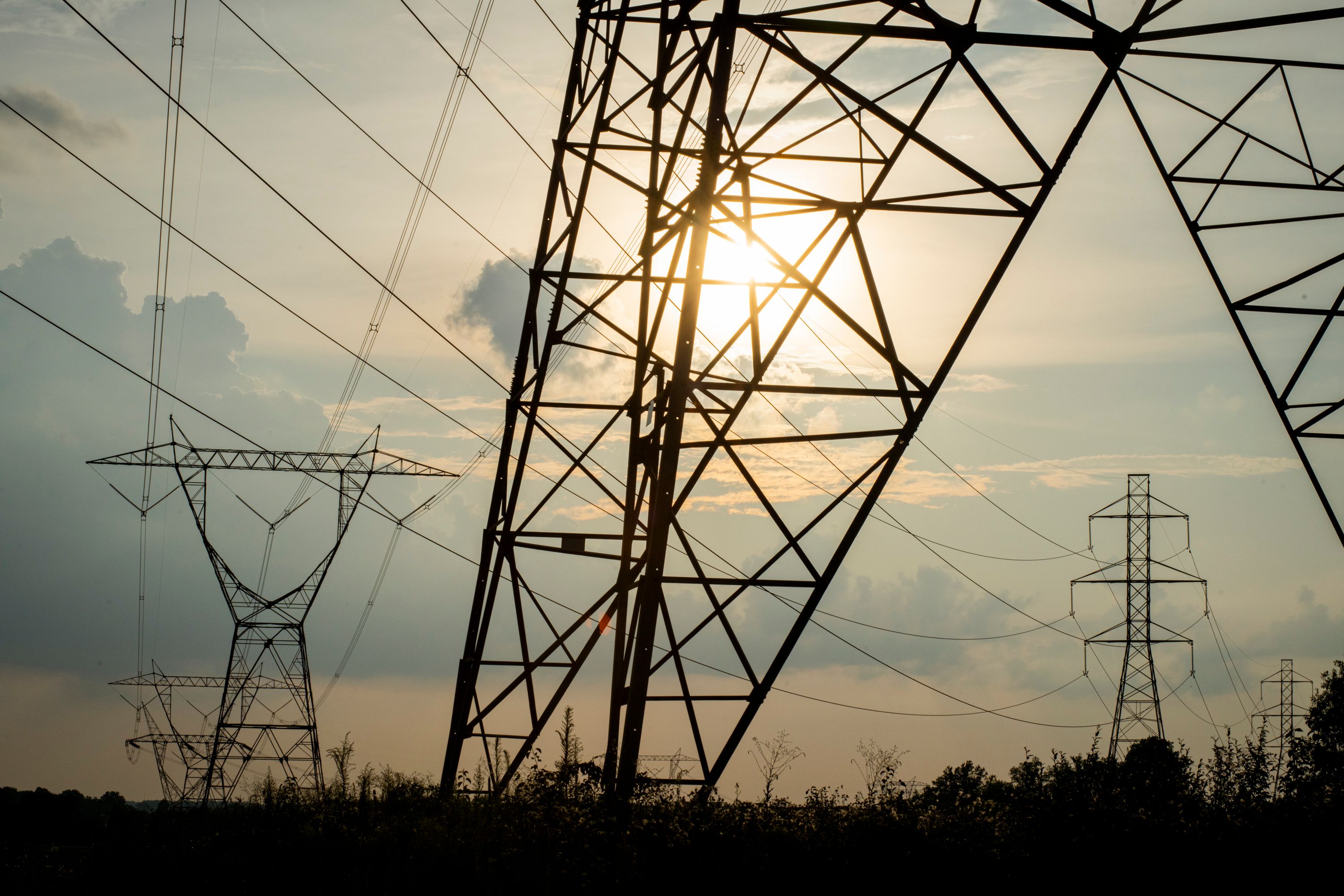
Steel lattice towers carry high-voltage transmission lines nearby the COL5 construction site on July 24, 2025 in Lewis Center, Ohio. The AEP Maliszewski Substation is nearby the COL5 data center site that could sustain reliable strong power source for the facility. The Ohio Tax Credit Authority has offered sales tax exemptions and incentives for new AI data centers in Ohio for development costs. (Photo by Eli Hiller/For The Washington Post via Getty Images)
Power-thirsty data centers are commonly considered a factor behind Ohio’s rising electricity costs, which jumped 10-15 percent in July. A Lucas County resident who asked to be unnamed described her neighbors as “terrified” about the impact of a potential data center on the affordability of their neighborhood. “People on fixed incomes can’t afford to see their utility rates triple,” she said.
Utility rates are determined through a complex process that is speculative by nature: power companies must forecast demand for electricity and the associated transmission costs before requesting approval for a rate change from the Public Utilities Commission of Ohio (PUCO). To prevent other ratepayers from being forced to heavily subsidize projected demand from data centers, the PUCO directed AEP (the utility company) to charge data centers more for their projected power needs, whether or not they actually end up requiring that much electricity. The Ohio Manufacturer’s Association has appealed that decision to the Ohio Supreme Court, where the case is pending. Still, some local officials warn that what’s done is done: rates are not going back down, and the construction of data centers across the state means residents will face higher power costs whether or not the center is located in their locality. “The’yre going to build these data centers somewhere,” as Mike Barhorst put it, and “the bill will increase no matter where in Ohio they build them.”
The industry’s demand for power appears set to grow well into the future. In January 2026, Meta signed a deal guaranteeing 6.6 gigawatts of power through 2035 for its planned New Albany super cluster—enough for an estimated five million homes in a state with just under twelve million people. The power will come from three nuclear plants, two of which were bailed out by the state in 2019 under House Bill 6—which, it later emerged, was passed in exchange for $60 million in bribes from utility provider First Energy that landed a former Ohio House Speaker in prison. Ohio repealed the nuclear bailout in 2021after the corruption came to light, and the two plants were expected to close.
Residents also fear the impact on local water resources. Local officials like Barhorst and Lucas County’s Heyrman are firm that current municipal water systems have enough excess capacity to meet data center demand. Still, a report from the Alliance from the Great Lakes urges policymakers to take a more deliberate, more regional approach to water resource planning. “Climate change… is limiting the ability of groundwater aquifers to recharge. At the same, demand from data centers, critical minerals mining, and agriculture is putting more pressure on groundwater resources,” the report states.
While tech companies say new closed-loop cooling systems will dramatically reduce their water requirements, the report warns that “eventually, recirculated water may need to be replaced due to scaling and changes in pH or it can negatively impact equipment.” The outputs of such systems may include so-called “forever chemicals” responsible for negative environmental and public health consequences. Despite these concerns, the Ohio Environmental Protection Agency is currently considering a new permit that would allow data centers to dump wastewater into Ohio’s rivers and lakes.
Silicon heartland or sacrifice zone?
Beyond budgets, dollars, and cents, residents worry about other externalities—especially pollution and environmental damage.
Cheryl Nissen, a Lucas County resident, told Tech Policy Press in an interview that she purchased her rural home as part of a lifestyle change after surviving a brain tumor and fears that a “low-frequency hum” emitted by data centers could cause neurological issues. She reached out to a neurosurgeon to ask about relevant research, but says they told her research on the impact of data center noise on neurological health is limited. (A 2016 review likewise found little research on low-frequency noise and chronic health conditions.) Nissen also fears the impact of future data centers on Northwest Ohio’s distinct ecology: known as the “Warbler capital of the world,” the region is an important crossroads for migratory bird species. It hosts tens of thousands of birdwatchers every spring and is home to the “Biggest Week in American Birding,” a festival organized by the Black Swamp Bird Observatory.

A Nashville Warbler near Lake Erie, Ohio. Bill Majoros/Wikimedia Commons.
Ted Cannelongo is among residents in the Columbus suburb of Hilliard worried about an Amazon data center that is in development and its potential impact on air quality. After receiving original approval for the project in 2022, in 2025 American Electric Power (AEP)—one of the largest US utility companies—filed a new proposal to power the data center by building North America’s largest fuel-cell enrichment center on the site. The new facility could generate as much carbon dioxide as 66,000 additional automobiles each day; Cannelongo worries that these emissions will linger low to the ground, where prolonged exposure may cause medical effects such as headaches and reduced cognitive performance. (For context, Dan Ralley, the Assistant City Manager of Hilliard, told Tech Policy Press that the nearby interstate highway already sees more than 116,000 cars in daily traffic).
In an interview, Cannelongo described how residents raised these and other issues at a meeting of Hilliard’s planning and zoning commission; even the Fire Department showed up to share safety concerns about the expanded gas pipeline the new facility would require. Participants in the meeting also noted that the site sits within a mile of an elementary school. A Hilliard City Councilmember said the plans were not what they had approved. With Amazon representatives looking on, the decision was tabled for future discussion.
But before the city could formally take a position, AEP withdrew its application—arguing that it was unnecessary because sole authority over major utilities’ facilities rests with the Ohio Power Siting Board, which had already approved the project. The fuel cell enrichment facility is moving ahead despite the opposition of Hilliard’s elected leaders. “It’s regrettable that state lawmakers have overridden local oversight, particularly since this technology is unfamiliar and new not just to our city but also the entire state,” Ralley said in a public statement.
While there is an element of NIMBY politics to data center opposition, residents like Nissen and Cannelongo are not wrong to ask officials to include public health costs in their risk-benefit assessments when considering data center projects. One recent study finds that the respiratory health consequences alone could cost the United States $20 billion by 2028. While tech companies are quick to tout environmental commitments for data center projects, the pace of the buildout means they end up settling for whatever power sources are available. In Ohio, that means coal and natural gas. In 2019, House Bill 6—the law at the heart of Ohio’s largest bribery scandal—bailed out two nuclear and two coal-fired power plants and slashed the state’s efficiency and renewable energy targets.
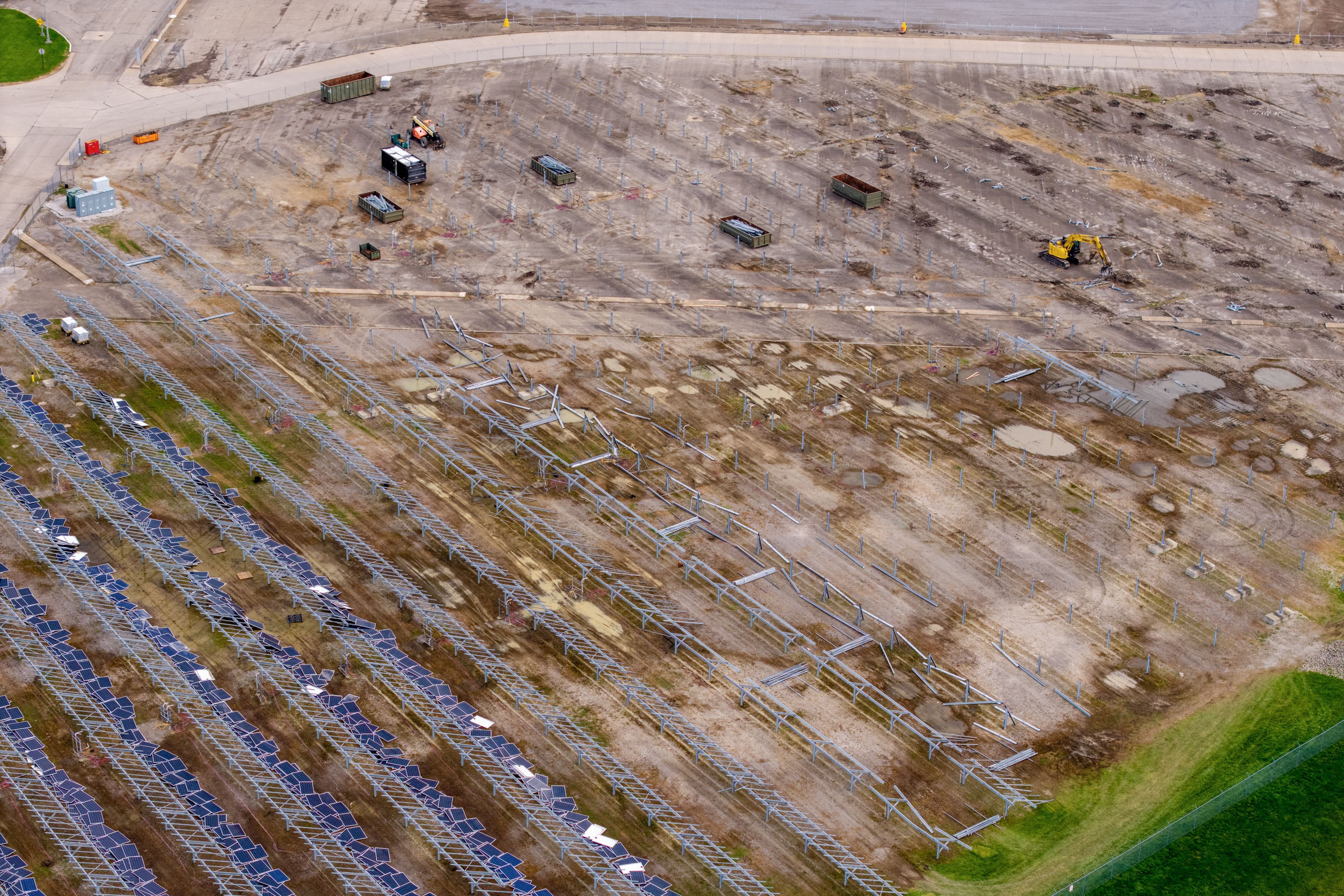
A Stargate AI data center under construction in Lordstown, Ohio, US, on Thursday, Oct. 23, 2025. SoftBank is working with OpenAI Inc. and Oracle Corp. to test what it describes as "an advanced data center design" on the grounds of a former auto plant that will be repurposed to manufacture data center equipment. Photographer: Kyle Grillot/Bloomberg via Getty Images
Big Tech’s inland empire
If New Albany represents one archetype of data center development, then Lordstown, OH, represents another. A village in the Mahoning Valley near the border with Pennsylvania, in December its city council voted to repeal a ban on data center development after a developer filed a legal complaint. In January, the council approved a six-month moratorium on permits for data center projects.
For more than fifty years until 2019, Lordstown boasted an enormous, 6.2 million square foot General Motors plant, Lordstown Assembly, where workers built the Chevy Cruz and other compact cars. During his first term, President Donald Trump made the fate of this plant a symbol of his promise to revive American manufacturing, but was unable to prevent it from closing. In 2022, the plant was purchased by Foxconn, a Taiwanese manufacturing company, which planned to build electric trucks there. But in 2025, Foxconn announced it was selling the facility for $375 million to an “existing business partner.” The unknown partner was later revealed to be Softbank, which says it plans to invest $3 billion to convert the facility into a production center for modular data center equipment.
Softbank is the Japanese firm behind Stargate, LLC—a joint venture with OpenAI, Oracle, and the Emirati investment firm MGX. Several of the key players in Stargate are financially entangled with the Trump Administration, which has championed the initiative; Oracle, for example, is chaired by Trump ally Larry Ellison, whose son stands to gain from the President’s approval in his bid to acquire Warner Brothers. MGX and Oracle are also poised to gain controlling stakes in TikTok’s North American operations.
Signage at the former General Motors and Foxconn factory in Lordstown, Ohio, US, on Thursday, Oct. 23, 2025. In August, Foxconn announced it had stuck a deal to sell the giant facility to SoftBank, with the two companies planning to start manufacturing data center equipment on the same site where GM cars including the Chevy Impala once came off the assembly line. Photographer: Kyle Grillot/Bloomberg via Getty Images
Over all of this investment hangs a question: What if the data center boom goes bust? Investors are already nervous; warning signs include centers being built without guaranteed tenants, which could leave some developers unable to recoup costs if the buildout slows in coming months. With data center development propping up a shaky US economy, a large enough pullback could lead to calls for government bailouts. The wealth of a generation of Ohioans would potentially be forfeit, first through tax abatements, then through a taxpayer-funded rescue of Big Tech and private equity. Such an outcome would be a double-ended heist.
The Lordstown Assembly deal encapsulates Trump-era economics. It has all the signature elements: big buildings, big numbers, and even bigger promises. But promises are easy to make and easy to break. It is up to local and state leaders to insist on accountability for shared prosperity. If they cannot, Ohio is at risk of becoming another colonial outpost of Silicon Valley, producing the future for somewhere else.
Authors