New York Mayor Eric Adams Built a Drone Dystopia. Mamdani Shouldn’t Let it Fly.
Langston B. Lee / Jan 6, 2026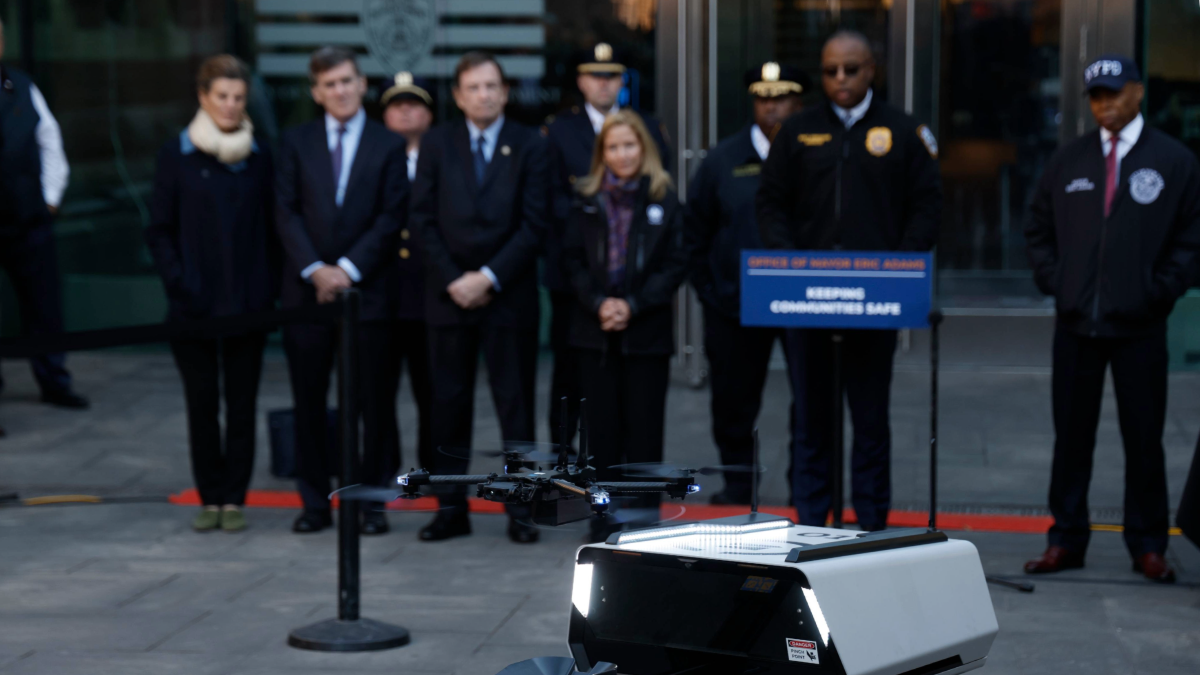
A police drone flies as Mayor Eric Adams announces the use of drones for crime intervention and rescue operations by the New York City Police Department at the Central Park Police Precinct on November 13, 2024 in New York City. (Photo by John Lamparski/Sipa USA via AP Images)
We’ve all heard the phrase “look up in the sky, it’s a bird, it’s a plane,” anticipating the thrill of spotting a superhero in flight. In New York City, we should tack on “it’s a drone,” because that’s what you’re most likely to see overhead at any given moment. The New York City Police Department (NYPD) has invested heavily in unmanned aerial technology, heralding it as the future of public safety, but the question is why? To drive arrests when New Yorkers take to the streets to protest? To stop people from celebrating Juneteenth or Labor Day? Or are drones just surveillance with better PR?
The NYPD’s drone program sells a seductive lie: more surveillance means safer communities. If police can just see more, monitor more, track more, they claim they can prevent harm and protect people. History says otherwise. Surveillance doesn’t create safety—it siphons public resources from what does. It shows you what’s happening without explaining why or stopping it from happening again. Drones hover over protests but can't address what brought people into the streets. They circle neighborhoods but can’t deliver what those communities need. The technology can dazzle us with the illusion of control while we ignore what actually matters.
Thriving communities don’t emerge from surveillance. We build them through investment in social services, by addressing root causes of the problems plaguing people: by directing resources to support people rather than to spy on them. City officials chose to expand drone surveillance despite the Handschu agreement specifically prohibiting the NYPD from surveilling political protesters. No law required it. No federal statute demands drones over protests. No state regulation mandates this expansion. Officials could spend every drone dollar on youth programs, mental health services, or affordable housing—investments with a proven return.
The drone program has shown its dangers. In May 2025, a malfunctioning NYPD-owned Skydio X10 drone crashed and caught fire on a Brooklyn precinct roof. Operators have reported near-collisions, including one NYPD drone that nearly collided with a balloon at the New York City “No Kings” protest, a collision that could have resulted in the drone falling into the crowd below.
Skydio has warned that electromagnetic interference can cause camera failures and complete vehicle loss. The NYPD flies drones over some of the most electromagnetically congested airspace in the world, flying them above crowds at protests, parades, and public gatherings where a sudden loss of control could turn a malfunctioning drone into a falling projectile. Even under ideal conditions, drones demand constant attention and technical expertise to avoid disaster. They don’t streamline anything—rather, they pile more work onto a department already drowning in overtime.
Short of grounding every drone, Mayor Zohran Mamdani can impose real constraints. The NYPD promised a public drone dashboard, but it reveals almost nothing about where drones fly or why. Mamdani should demand flight logs showing the precise location, duration, and stated purpose of every deployment. New Yorkers deserve to know when drones circle their neighborhoods and what justifies the surveillance.
The Drone as First Responder (DFR) program claims drones respond to 911 calls, but the NYPD operates them far beyond that mandate, patrolling and surveilling without any emergency. Mamdani can restrict DFR flights to actual emergency response and require cameras to remain off until drones arrive at their destinations. This policy change would eliminate the skeptical aerial patrols that treat entire neighborhoods as suspects.
Most importantly, the Handschu agreement must be honored. Drones circling protests violate this decades-old protection. There should be no surveillance of protests, no identification of demonstrators, and no drone deployment at political gatherings without clear evidence of criminal activity. The NYPD has circumvented the Handschu agreement through officers deputized to the Joint Terrorism Task Force who operate under federal guidelines, but that shouldn’t excuse constitutional violations. Mamdani can close it by requiring that all NYPD drone operations, regardless of which unit conducts them, comply with Handschu agreement restrictions.
Finally, Mamdani can demand POST Act compliance. The law requires the NYPD to disclose surveillance technology policies and demonstrate public benefit, yet the department produces redacted documents that obfuscate the truth. Mamdani has subpoena power and he should use it to compel the NYPD to show the data. How many arrests has the drone program produced? What crimes has it prevented? What justifies the millions spent on the technology that surveils far more than it protects?
Drones were never simply about public safety. The push to buy more of them was always about extending the NYPD’s ability to surveil and control New Yorkers. The city has aggressively pursued this path despite technical failures and mounting costs. In the end, these new surveillance tools are presented as an accomplishment, but in reality, they dismantle what’s left of our privacy while providing an expensive aerial view of problems the city refuses to solve.
Authors