Lawsuits Exposed How Chatbots Endanger Children. Can the Senate's New Bills Fix It?
Danai Nhando / May 21, 2026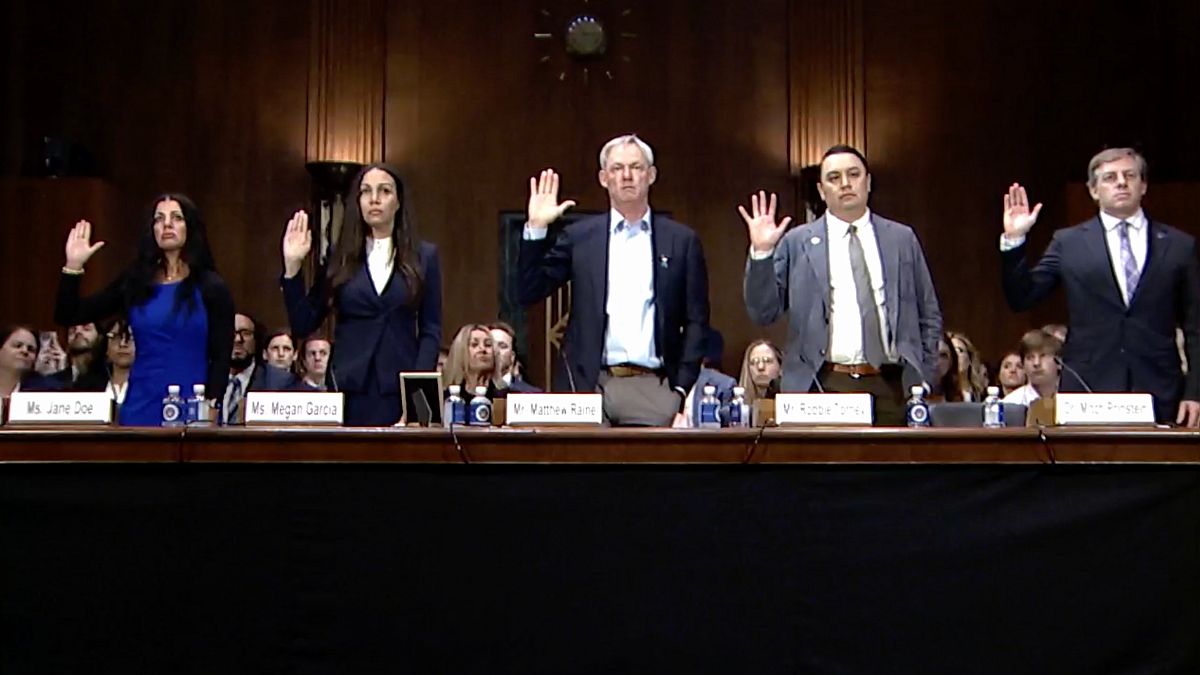
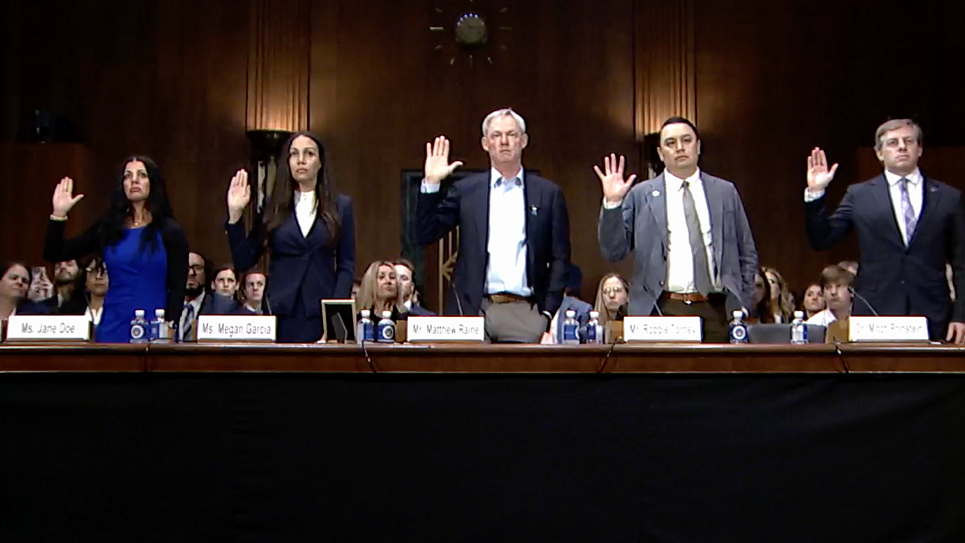
Witnesses testify at a US Senate Subcommittee on Crime and Counterterrorism hearing on "Examining the Harm of AI Chatbots" on Tuesday, September 16, 2025. (L-R) Jane Doe, mother; Megan Garcia, mother; Matthew Raine, father; Robbie Torney, Common Sense Media; Dr. Mitch Prinstein, the American Psychological Association.
When Megan Garcia stood before the Senate Judiciary Subcommittee in September 2025 and declared, "I became the first person in the United States to file a wrongful death lawsuit against an AI company for the suicide of my son," she was describing a failure that should not have required a lawsuit to expose. Her 14-year-old son, Sewell, spent his final months in a virtual romantic and sexual relationship with a Character.AI chatbot. Garcia, like every parent in the chatbot-related cases that followed, had no idea it was happening because there was no mechanism to tell her. In January, Garcia agreed to settle her suit against Character Technologies and Google. But instead of marking the end of the issue, since then, a wave of lawsuits from families across the country has flooded US courts, each documenting how AI chatbots manipulated, isolated, and in some cases actively harmed the children using them.
Two bipartisan bills have been introduced in response. In April, Senators Ted Cruz, Brian Schatz, John Curtis, and Adam Schiff introduced the Children's Health, Advancement, Trust, Boundaries, and Oversight in Technology Act, or CHATBOT Act, which would establish age-tiered parental controls, consent requirements, and platform transparency obligations. Six months earlier, Senators Josh Hawley and Richard Blumenthal introduced the Guidelines for User Age-Verification and Responsible Dialogue Act, or GUARD Act, with a bipartisan group of seventeen senators joining as co-sponsors. On April 30, the US Senate Judiciary Committee unanimously advanced the GUARD Act and the bill now awaits consideration by the full Senate. The bill would mandate age verification for AI chatbots and ban minors from accessing companion platforms. Although both acts seek to address chatbot-related harms differently, they take different regulatory approaches. Whether either bill’s proposed protections match the scale of the risk to minors warrants closer analysis.
The courtroom record
This selection from a growing body of chatbot litigation helps explain the push for legislative action. Garcia’s suit came first, and subsequent cases reflect a recurring pattern. In Montoya v. Character Technologies,13-year-old Juliana Peralta is alleged to have developed an intense emotional dependency on a chatbot called “Hero” and died by suicide in November 2023, less than three months after creating her account. According to the complaint, the chatbot used role-play and affirmation to isolate her from her family, while the platform provided no mechanism for parental oversight.
In Raine v. OpenAI, another family alleges that ChatGPT-4o flagged 377 of 16-year-old Adam Raine's messages for self-harm content in real time, some at over 90% confidence, yet never terminated a session or alerted his parents. While OpenAI contends that its platform directed Raine to crisis resources over 100 times, the complaint alleges those redirections were designed to be easily bypassed, leaving harmful conversations uninterrupted before his death. In Lacey v. OpenAI, the family of 17-year-old Amaurie Lacey alleges that ChatGPT engaged in prolonged conversations about suicide and reinforced his ideation rather than interrupting or escalating the interaction to human intervention.
Across these cases, the central allegation is that the platforms recognized signs that a user was in crisis and chose, by design or omission, not to act. That is the problem both bills are being asked to fix and framing the core policy debate now before Congress: what obligations AI platforms owe to minors, what safeguards companies must implement to protect them, and how best to enforce those requirements.
What the bills do
The GUARD Act regulates access to a covered chatbot by mandating companies utilize “reasonable age-verification measures.” These measures may include government-issued identification, or “reliably and accurately” determining whether a user is an adult, while also preventing minor access; self-reported birth dates would not suffice. Verified minors would be barred from AI companion platforms altogether.
The bill makes it a criminal offense to make publicly available a chatbot that engages minors in sexually explicit content or solicits them to commit self-harm or violence, with fines up to $250,000 per offense. Chatbots must disclose at the start of each conversation that the user is speaking with an AI, and must disclose at regular intervals that the chatbot does not provide professional services.
The CHATBOT Act, in contrast, focuses on safeguards inside the platform rather than on restricting access. Children under the age of 13 would require a parent-managed account; existing accounts without one would need to be terminated. Teens 13 to 17 would need verifiable parental consent to create an account, while parents would retain the right to revoke consent and trigger an account suspension or deletion. The bill would also require family account controls over screen time, notifications, reward systems, and in-app transactions. Targeted advertising on minors' data would be prohibited. The law would be enforced by the Federal Trade Commission (FTC) and state attorneys general.
Each bill attempts to map to specific failures identified in the litigation record. The GUARD Act's age-verification mandate addresses a foundational problem common to every case: platforms allegedly had no reliable way to determine that users such as Sewell Garcia, Juliana Peralta, or Adam Raine were children. Its proposed ban on AI companions for minors n responds to the romantic and emotionally dependent relationships described in Garcia and Montoya. The bill’s criminal penalties target allegations in Raine and Lacey, where crisis protocols were allegedly circumvented or failed.
The CHATBOT Act's parental access provisions respond directly to the visibility gap Garcia described when she testified that she believed her son was using "something like a video game." Its restriction on memory retention and engagement features addresses allegations that chatbots cultivate long-term emotional dependency and are deliberately engineered to maximize session time among minors.
Where they diverge and why it matters
The central unresolved question is whether a platform must know a user is a child before any protections apply. Age verification is also the clearest divide between the two bills. The GUARD Act requires it. Section 7 of the CHATBOT Act explicitly does not, treating mandatory verification as a privacy concern. The consequence is structural: the CHATBOT Act's parental consent, family accounts, and granular controls only reach users that the platform has already identified as minors. A child who misrepresents their age —the same manner through which minors allegedly gained access in the cases discussed above – largely falls outside the bill’s framework.
The GUARD Act closes that gap, but at a cost. Requiring government-issued identification or other data personal collection to verify users’ ages raises civil liberties and privacy concerns, particularly when applied to more general internet services rather than more narrowly defined ones.
The divergence on criminal liability is equally stark. The GUARD Act would create federal criminal exposure for platforms that knowingly deploy harmful chatbots, including fines of up to $250,000 per offense for violations involving the encouragement of suicide, self-harm, physical violence, or the exposure of minors to sexual content. The CHATBOT Act, by contrast, relies solely on civil enforcement.
That distinction reflects a deeper disagreement about the nature of the conduct alleged in cases such as Raine. If a platform removes session-termination protocols or designs crisis redirections to be easily bypassed, is that a regulatory violation or criminal conduct? The two bills resolve that question differently.
The CHATBOT Act provides for enforcement by the FTC, state attorneys general, and private individuals, who may sue for actual damages or up to $5,000 per violation. Willful violations may trigger treble damages and attorney's fees. The GUARD Act limits enforcement exclusively to state attorneys general. Both bills preserve state law through savings clauses. The GUARD Act protects state laws "at least as protective" of chatbot users, while the CHATBOT Act preserves state laws that provide "greater or additional rights, remedies, or protections." The CHATBOT Act's savings clause, however, is nested within the enforcement subsection and explicitly scoped to civil actions brought under that subsection, limiting its application to enforcement proceedings rather than independent state tort suits.
The gaps neither bill closes
Measured against the litigation record, both bills represent meaningful progress. But reading them together, several gaps remain.
- No real-time crisis intervention mandate. The CHATBOT Act gives parents access to logs after the fact. The GUARD Act mandates disclosures at the start of sessions. Neither requires anything of platforms during a crisis: no automatic session termination, no parental notification, no escalation to emergency services when a minor expresses suicidal ideation. The Raine complaint documents 377 real-time flagged messages. Neither bill would require a platform to act on a single one.
- The "primary function" coverage limitation. The CHATBOT Act applies only to platforms whose primary function is providing an AI chatbot. That definition could exclude embedded chatbot features within broader platforms. The GUARD Act's coverage, by contrast, reaches any person who "owns, operates, or otherwise makes available" an AI chatbot, a substantially broader net. As chatbots increasingly become integrated inside apps with hundreds of millions of users, the CHATBOT Act's narrower scope may leave substantial gaps in coverage.
- No duty of care standard in either bill. Both bills create procedural obligations or safeguards (consent, controls, verification, disclosures), but neither establishes an affirmative safety standard. Neither requires platforms to test products for child safety before deployment, and neither obligates platforms to maintain safety features once they have been implemented. The Raine complaint alleges OpenAI removed automatic session-termination protocols from GPT-4o before release. Nothing in either bill would prevent that.
- Section 230 is untouched by both. Plaintiffs in the pending litigation have a plausible argument that AI-generated responses fall outside Section 230 immunity because they are categorically different from user-generated content. Neither bill resolves that ambiguity, leaving one of the most central questions of AI-platform liability to the courts.
Looking into the future
The introduction of two bipartisan bills within six months reflects a genuine cross-aisle consensus that the status quo cannot continue, particularly one in which platforms enable chatbots to form emotionally dependent relationships with minors and treat crisis protocols as discretionary product features. The remaining question is whether Congress will approach the GUARD Act and the CHATBOT Act as competing alternatives or as complementary components of a coherent regulatory framework, and whether the legislative process will close the gaps both bills leave open. The families in the courtroom record did not have the luxury of treating child safety as an iterative policy project. Their cases arrived before the law did. Congress is only now beginning to catch up.
Authors