LatamGPT Navigates the Gap Between Regional Aspiration and Market Realities
Ezequiel Rivero / Mar 2, 2026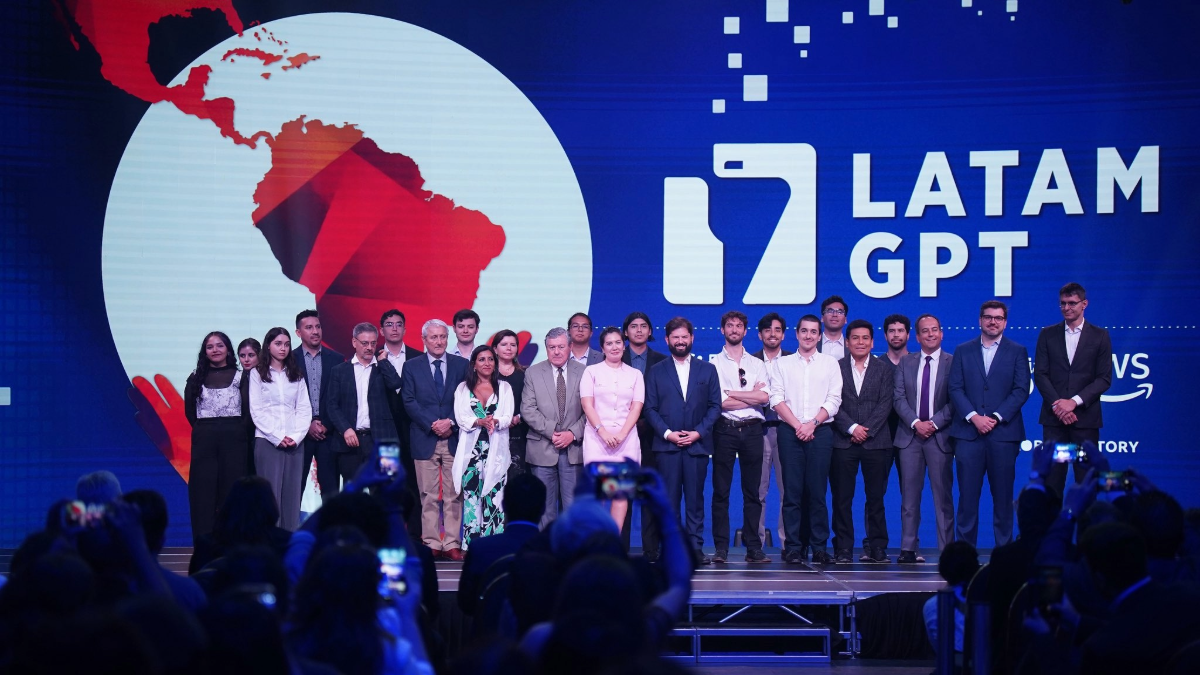
On February 10, Chilean President Gabriel Boric stood before a regional audience to unveil LatamGPT, calling it more than just a technological project. "Some might think creating a language generator from Latin America is a matter for nerds, but it's not. Here we're defending our identity and our right to exist," he declared. The statement encapsulates both the ambition and the underlying anxiety driving Latin America's first collaborative artificial intelligence model, a project that promises technological sovereignty but faces the stark realities of a consolidated global AI market.
LatamGPT represents an unprecedented regional effort to develop a large language model (LLM) trained specifically on Latin American data, contexts, and cultural nuances. Led by Chile's National Center for Artificial Intelligence (CENIA) and involving 15 countries, over 200 collaborators, and 33 institutional alliances, the project has generated a 70-billion-parameter model based on Meta's Llama 3.1 Built on more than eight terabytes of information from 2.6 million documents across 20 Latin American countries and Spain, the model aims to address a fundamental gap: Spanish and Portuguese data represent only 2-3% of the training material used in existing AI models.
The technical infrastructure behind LatamGPT marks a significant achievement for the region. The University of Tarapacá in Arica, Chile, invested $10 million in a supercomputing center, the first facility of its kind in Latin America capable of training large-scale models domestically. Importantly, LatamGPT is not a chatbot for direct public use but rather an open-source infrastructure that developers, companies, and governments can adapt for specific applications in education, healthcare, public services, and cultural preservation.
Álvaro Soto, director of CENIA, frames the project's rationale around autonomy and relevance. "No matter how powerful the large models are, they cannot cover all aspects relevant to our reality," Soto told Wired. "I feel they are very focused on the needs of other parts of the world. Imagine we wanted to use these models to modernize the education system in Latin America. If you ask one of these models for an example, it will probably talk about George Washington."
His argument extends beyond mere cultural representation. "We are the ones indicated to worry about our own needs. We cannot sit around waiting for them to have time to ask us what we need," Soto emphasized in the same interview. The project, he argues, also addresses a critical gap in regional research capacity: "Today, Latin American academics have few opportunities to interact deeply with these models. It's like wanting to study magnetic resonance imaging but not having a resonator. LatamGPT seeks to be that fundamental tool so the scientific community can experiment and advance."
The sovereignty paradox
The project's emphasis on "technological sovereignty" resonates politically but faces substantial market headwinds. The global AI landscape is characterized by extreme economies of scale, network effects, and first-mover advantages that strongly favor incumbents. Companies like OpenAI, Google, and Anthropic operate with resources several orders of magnitude larger than what Latin American countries can collectively mobilize.
Moreover, the LatamGPT initiative unfolds against a backdrop of persistent regional challenges that complicate long-term technological projects. Political instability remains endemic across Latin America, with frequent changes in government priorities disrupting continuity in science and technology policy. The project's initial funding reflects these constraints: CENIA has allocated approximately $300,000, with an additional $250,000 committed by the Development Bank of Latin America and the Caribbean (CAF). These figures pale in comparison to the billions invested by United States and Chinese technology companies in their AI development.
Even if LatamGPT achieves technical competence in region-specific tasks, dominant platforms possess the resources to rapidly develop Latin American adaptations of their existing products. The marginal cost of fine-tuning GPT-4 or other models on Spanish and Portuguese data is minimal for well-capitalized firms. This dynamic suggests that LatamGPT's competitive advantage may be more fleeting than its proponents hope.
Historical precedent offers a sobering parallel. The UNASUR fiber optic network project, announced in 2009 as an ambitious infrastructure initiative to reduce South America's dependence on US-routed internet traffic, never materialized. Political disagreements, funding shortfalls, and the eventual collapse of UNASUR itself in 2019 demonstrated how regional technological cooperation can falter when faced with sustained political and economic pressures. While LatamGPT operates on a different scale and with different governance structures, the fundamental challenge of maintaining multilateral commitment over time remains.
Modest expectations, meaningful impact
Where LatamGPT may deliver genuine value is not in displacing established AI platforms but in building regional capacity and expertise. The project has already created research networks spanning 15 countries, provided practical training opportunities for hundreds of technologists and data scientists, and established the first high-performance computing infrastructure for AI research in multiple Latin American nations. Universities and research institutions across the region now have access to computational resources and collaborative frameworks that did not exist three years ago.
The model's open-source nature enables localized experimentation in sectors where commercial providers may underinvest. Applications for indigenous language preservation represent use cases that would likely never attract sufficient attention from global platforms. Similarly, specialized tools for regional agricultural challenges, local public health contexts, or municipal governance systems could emerge from developers building on the LatamGPT foundation.
Soto's vision of success aligns with this more measured assessment. Looking toward 2030, he told Wired: "Success would be that LatamGPT has played an important role in the virtuous development of artificial intelligence in our region. That different organizations take this technology and apply it, for example, in education. That new generations of Latin Americans are better prepared because they had access to tools that spoke to them in their context, with their cultural references, with our great heroes and not just examples from other parts of the world."
Capacity over competition
LatamGPT's true significance may lie not in challenging the market dominance of Silicon Valley and Chinese AI giants, but in demonstrating that Latin America can develop technical capabilities in frontier technologies. The project faces formidable obstacles: insufficient funding, political fragility, uneven regional participation, and the brutal economics of AI competition. Yet its value should be measured not against the dominant models, but against the counterfactual of a region that remains purely a consumer of AI technologies developed elsewhere.
The question is whether Latin American governments can sustain commitment to this collaborative infrastructure through inevitable political transitions and competing budget priorities. If they can, LatamGPT may serve as a training ground for a generation of regional AI practitioners and a foundation for applications tailored to local needs. If they cannot, it risks joining UNASUR's fiber optic cables on the list of grand regional technological visions that never achieved their potential. The difference between these outcomes will depend less on technical achievements than on political will, something that has historically proven scarce in Latin American multilateral endeavors.
Authors