Inside SELC's Clean Air Case Against xAI in Memphis
Justin Hendrix / Jun 28, 2026Audio of this conversation is available via your favorite podcast service.
In June 2024, the Greater Memphis, Tennessee Chamber of Commerce announced a deal to host a substantial new computing facility. xAI built its "Colossus" data center in an old Electrolux factory. The facility was brought online at record speed, and almost immediately drew questions about transparency, air quality, water use and how a project of this scale had moved through local government so quickly.
Two years on, the story continues to expand alongside the company’s growing footprint, with a second campus, Colossus II, across the state line in Southaven, Mississippi; a contested gray water recycling plant; an ever-rising count of gas turbines; multiple lawsuits; and communities in South Memphis and beyond still pressing for straight answers.
In multiple ways, the story is a harbinger, a case study for communities across the country now reckoning with the arrival of hyperscale data centers.
One of the entities leading the way in Memphis is the Southern Environmental Law Center (SELC). The SELC has been a partner in litigation against xAI, gathering evidence on the company's unpermitted gas turbines and pushing state regulators to hold the company accountable under the Clean Air Act. To learn more about SELC’s case and what it means for the broader fight for transparency and accountability amid the AI infrastructure boom, I spoke to Amanda Garcia, senior attorney and data center project leader in the Tennessee office of the Southern Environmental Law Center.
A note since we recorded: On June 15, the Department of Justice filed a brief siding with the company. The DOJ argued that shutting down the turbines powering Colossus 2 would threaten national, economic and energy security. The department claimed Grok is one of only four AI models supporting mission-critical operations on classified networks, and a Defense Department declaration tied the model to military operations, including recent strikes against Iran. The DOJ, xAI and the state of Mississippi all asked the court to dismiss the suit. SELC called the government’s argument “an unprecedented attack on the public’s ability to defend themselves from illegal pollution.”
This is the second of three episodes on the situation in Memphis and Southhaven, and what it portends about the future of the AI infrastructure boom in the United States and the political debates and power struggles surrounding it. Listen to the first—an interview with Memphis Commercial Appeal reporter Neil Strebig—here.
What follows is a lightly edited transcript of the discussion.
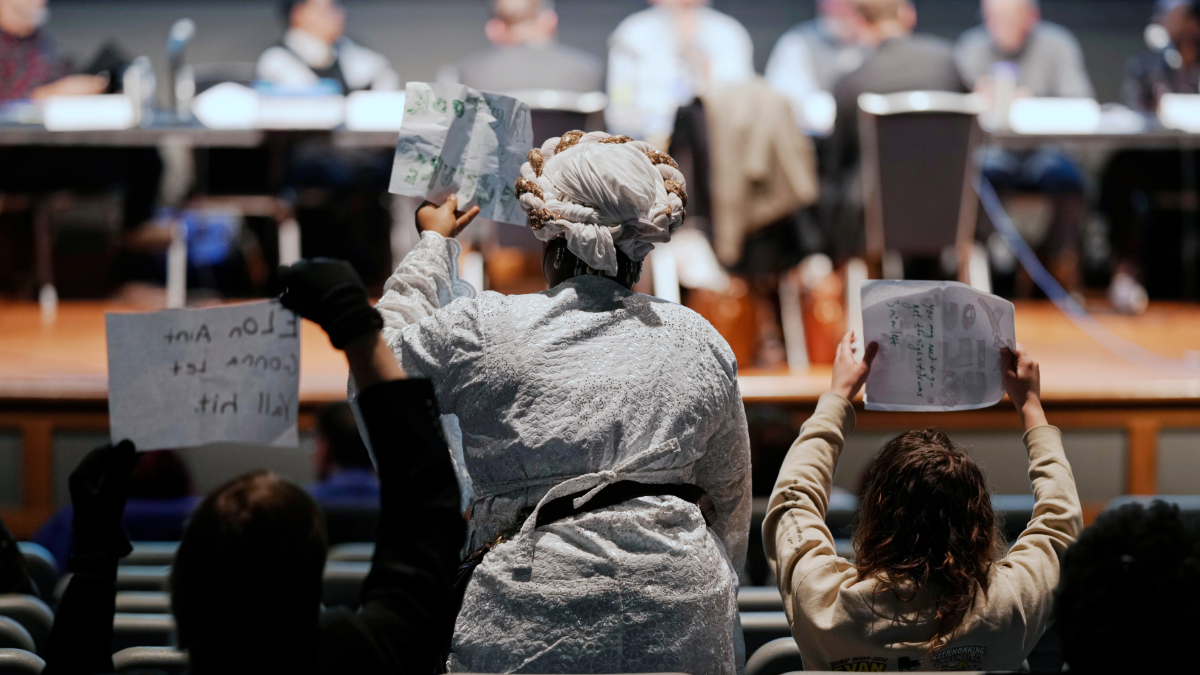
People hold signs in opposition of xAI's use of gas turbines at their facility during a meeting of the Memphis and Shelby County Air Pollution Control Board, Monday, Dec. 15, 2025, in Memphis, Tenn. (AP Photo/George Walker IV)
Justin Hendrix:
Amanda, I think I have to ask you to do two things for our listeners. One, give them the quick one-two about what SELC is and what you do looking after data centers there.
Amanda Garcia:
The Southern Environmental Law Center is a law and policy organization that is rooted in the South and we work across a full range of environmental issues. Our theory of change is that place matters, that people care about the places that they live. And so we have attorney boots on the ground in all six states where we work. We work very closely with communities in Virginia, North and South Carolina, Georgia, Alabama, and Tennessee. And our advocacy, even though it is rooted in the South, really pushes issues, elevates issues at the national level as well because we are able to tell the story of how policies affect people on the ground.
In our data center work, I think is a perfect example of that. We have been working alongside communities on local land use issues for four decades. Also, we have been in public utilities commissions at the state level for four decades. So we really have those relationships that allow us to be effective on the ground, but also to drive policy at both the state and the federal level. And in my role as the data center project leader, I help to develop strategies and guide our attorneys on data center matters across the region.
Justin Hendrix:
So it's been two years since xAI announced that it would build the world's largest supercomputer in Memphis after closed-door negotiations with the Economic Development Authority there. It is very shortly after that community members spotted gas turbines appearing and raised concerns about a lack of permits. Walk us through the Memphis story. When did SELC get involved? When did this come to your attention?
Amanda Garcia:
Justin, I've been involved since day one of the xAI issue in Memphis and really it again highlights the importance of working with communities over the long term because we had been working in Memphis for many years and we have a coalition of local environmental justice and environmental organization that meets weekly about issues that happen or that come up in the community.
And so we had gotten wind of the fact that there was a big announcement coming. And when it happened, our local community partners were ready to go. They issued a statement on day one, the day of the announcement, raising all the important questions that weren't being addressed by the Memphis Chamber and the mayor of Memphis.
Our local partners immediately issued a statement asking, "Where is the water going to come from? Where is the energy coming from? How much water and energy is xAI going to use?" And that initial statement I think really immediately changed the conversation locally from a victory lap for the economic development folks to a conversation about how is this going to affect the communities on the ground in Memphis?
Justin Hendrix:
And take us through the claims in your lawsuit. Where is the lawsuit at the moment? What are the kind of key claims that you're pursuing?
Amanda Garcia:
I think it's important to take a step back before we get into the current lawsuit because, as you pointed out, this is a situation that's been unfolding over the past two years and there have been multiple phases, and I think it really highlights the lack of transparency around data center development and the way these projects can kind of metastize and grow over time.
So when we initially heard about xAI, it was the Colossus 1 data center and the idea was that it was going to ultimately be a data center of 150 megawatts and that it would be served by the grid. But as you pointed out earlier, that scenario quickly changed and we learned that the grid connection was not going to happen fast enough for xAI's timetable. And so they set up unpermitted, uncontrolled combustion turbines. Initially it was 18 combustion turbines. At that point we raised concerns actually with the local air permitting authority, the Shelby County Health Department, and basically sent a letter and said, "Hey, these guys are running what is basically a power plant. They don't have a permit. You need to ask them to get a permit or require them to get a permit."
And the health department at that point said, "We don't think this is our responsibility. We think it's EPA's responsibility." And they basically punted to EPA. That was in August of 2024, so just before the presidential election. And initially it appeared that EPA was going to weigh in and they said they were going to issue a regulatory interpretation. And after the election happened, EPA went silent. At that point, we were not getting information from xAI, we were not getting information from the local air regulator, and meanwhile, these combustion turbines were pumping pollutants into the air 24/7. As far as we knew, they were operating 24 hours a day, seven days a week.
And that's particularly concerning because we're talking about air pollution in Southwest Memphis. It's a known air toxics hotspot and the whole Memphis area is not meeting minimum federal standards for ozone pollution, which is also known as smog. So we were really concerned about the public health implications of these turbines. So we took matters into our own hands. We've actually worked with an organization called SouthWings that provides air flights for community groups that are investigating environmental damage across the South. And through that flight, we discovered that there were not just 18 combustion turbines anymore. There were 35 and we put that information out publicly. The mayor initially said that xAI told him, even though there were 35 on site, there were actually only 15 operating. We did another flight with a thermal camera and showed that 33 of the 35 were operating.
And at that point we decided that we couldn't wait for regulators to act any longer. And on behalf of the NAACP, we sent a 60-day notice to xAI. That notice basically said, "You have constructed and are operating a major source of air pollution without getting a permit," and asked them to cease operating until they got a permit. At the same time, they had applied for a permit to operate some different turbines on a permanent basis. They claimed that the ones that they were operating without a permit were temporary. And so we were also participating in that air permitting process.
This is all for Colossus 1. After we sent our 60-day notice, xAI did end up removing all of the temporary turbines and got their permit. So in a sense, on some level we won, right? They got rid of the temporary turbines, the ones that didn't have any pollution controls. They replaced them with permanent turbines that did have the pollution controls that have to do reporting and all the things that you would expect from a power plant.
But in the meantime, xAI had also grown. Somewhere along there, and I can't remember exactly when, they announced that they were actually going to grow Colossus 1 to 300 megawatts. Eventually all of that power, all the 300 megawatts would come from the grid and they would use these combustion turbines as backup power. But in the meantime, until they could get fully grid connected, they were going to keep running first the unpermitted turbines and then later when they got a permit, the permitted turbines.
So after xAI's permit was issued and they had removed all the turbines, we actually filed a permit appeal for Colossus 1. We challenged not just the permit, but also the health department's decision to adopt a policy of not requiring permits for what they called temporary turbines. Unfortunately, we filed that permit appeal on behalf of NAACP and Young, Gifted & Green. We had a hearing. There were hundreds of people there as there had been at the original permit hearing, and ultimately the air board determined that our case was moot. And so that question of whether they could not permit temporary turbines was not answered, but shortly, actually less than a month after we had that hearing, EPA actually issued a new rule about these turbines and expressly said, "We have always treated temporary turbines as stationary sources that require permits."
So we thought, okay, now we've got a clear statement from EPA that these things need permits, but in the meantime, xAI had expanded again. They had acquired land also in Memphis at Colossus 2 and they had also acquired a site in South Haven, Mississippi, just across the border from Colossus 2 that is the site of a former power plant. And it turned out that when they removed all of those turbines from Colossus 1, they just wheeled them across the border and set them up at this former gas plant site in South Haven, Mississippi. And they told a local gathering of the business community that they were planning to copy and paste what they had done at Colossus 1, at Colossus 2 at Southaven.
Justin Hendrix:
Well, I guess I'll kind of jump in there. So at this stage we've got now multiple facilities. On some level, it sounds like we know xAI was keen to get up and running as fast as possible. Effectively, they moved very, very quickly. The authorities effectively weren't able to keep up on some level. All these processes that you're referring to happened after the fact. They get Colossus 1 up and running and powered and then they recognize that they want to build more capacity so they go to South Haven, go to Colossus 2, et cetera. There's maybe a little bit of almost like a kind of arbitrage of what's going on with these gas turbines, but where are we at right now? I mean, are they still powering South Haven with turbines or what's happening there? Have they succeeded in developing more of a power source? I know that was part of the proposition at one point, that they were going to build a more long-term source of energy.
Amanda Garcia:
Right. Great question, Justin. They are still operating unpermitted turbines at the South Haven gas plant, and it's worth stating that, okay, so Colossus 1 is 300 megawatts. Colossus 2 is 1,200 megawatts, so a much larger data center. And that data center is currently being powered by permitted turbines that are, some of them have some controls on them, but overall they are similarly not, they don't have the types of controls that they would need to have if they were permitted.
In terms of where things stand right now, we have filed a... So we once again sent a 60-day notice on behalf of the NAACP, same kinds of claims about constructing a major source without getting a permit. And we have filed litigation in the Northern District of Mississippi. We have also filed a preliminary injunction motion in that case and that is set for hearing in August. So basically two years after the initial announcement of xAI coming to Memphis, we will be in court litigating over these unpermitted turbines in August.
Justin Hendrix:
I understand with that preliminary injunction request pending, you also now expect the Justice Department to get involved. Are we expecting the federal government to effectively attempt to intervene here?
Amanda Garcia:
They have indicated that they are considering intervening and we should learn more about that in the month ahead.
Justin Hendrix:
What form do you expect that could take?
Amanda Garcia:
I really can't talk about that aspect of the litigations because it's pending, but I will say in addition to... We talked about xAI copying and pasting from Colossus 1. There is a difference here, which is that xAI is not intending to ultimately connect to the grid for Colossus 2. So instead, they proposed their own permanent power plant of sorts, but it's not a combined cycle gas plant, which is what you would expect for something of this scale like 1.2 gigawatts is a lot of power. It's enough to power a mid-sized city. Instead, it's a collection of multiple types of combustion turbines, including some that are just refurbished jet engines. And they obtained a permit from MDEQ, the Mississippi Department of Environmental Quality.
And so we have also filed a permit appeal for that installation of turbines, which again is separate from the unpermitted ones that are operating currently. They're on the same site, but they're two different sets of turbines. And that permit appeal is, we are in the process of... We're first of all, I guess, representing NAACP, Young, Gifted & Green and Safe and Sound Coalition, which is an organization of local neighbors that live near the plant. That is set for hearing in November of this year. So we have challenges to the temporary installation and the permanent installation of combustion turbines at this South Haven site.
Justin Hendrix:
I want to ask you a question about this idea of speculative demand. I know you commissioned a report on the idea that projected data center energy demand, I suppose data center demand generally may be wildly overstated. Can you talk a little bit about your findings there, how it matters for the cases that you've got in front of you right now?
Amanda Garcia:
Sure. So I think we've actually commissioned two different reports, and one was by London Economics Institute ,and that one really looked at if you add up all of the demand projections for data center development, it would outpace the ability of chip manufacturers to provide chips to run those data centers. So it really calls into question whether what is being proposed by the data center developers is really feasible even from their own technological standpoint. And you're starting to hear tech companies talk about that, like the pressure on the chip market.
And once we had that report, we decided to look more specifically at our own utilities in our region and the demand forecasts that they were using in their energy planning. And when we took a look at that, once again, when you compared what our utilities were projecting with third party estimates of potential demand over the next 20 years or so, they didn't match up. And there's a certain amount of course, data center developers are shopping around, they're getting in the queue in multiple jurisdictions, but they're ultimately only going to develop a data center in one of those jurisdictions. So that's part of it.
The other part is that our utilities are regulated, mostly vertically integrated monopolies. They make their money by building new shiny things. And so they have historically had an incentive to overbuild new capacity and this has just kind of put that on hyper-speed in terms of the amount of investment.
The problem, of course, is that if all of that demand doesn't materialize, who is going to be left paying for these stranded assets? And right now, the answer, in our region at least, is largely everyday rate payers are the ones that are going to be left holding the bag if we overbuild. And we are almost certainly overbuilding because ultimately there's going to be... All this data center development is not going to come to fruition, and some of it that does come to fruition may fall by the wayside over time.
Justin Hendrix:
So you mentioned that SELC has been working on these types of issues for decades. If you look back at the history of industrial development in the South, maybe more generally, is this a kind of precedent-breaking industry or does this look like other things that your organization has seen in the past? I mean, clearly the scale is historic. I mean, the amount of many, many, many hundreds of billions, trillions that are being invested in data centers across the country and the world is one of the largest infrastructure projects, I assume, that we can point to as a singular effort of the species on the planet over some period of time. But I don't know, are there patterns you see or ways that this breaks the pattern?
Amanda Garcia:
I think this is breaking the pattern. As you point out, the scale and also the pace of development. I mean, and xAI is a perfect example of this, right? They came in and built a data center in 122 days and they have expanded that massively over the past two years. And we're talking again about the type of infrastructure that normally would take years to develop and a power plant that provides power for... that would otherwise be providing power for a mid-sized city and is just being operated to serve this one company. The amount of water that the xAI data center requires is also hugely significant in terms of relying on a community's fresh drinking water source.
So I think we're seeing in particular the systems that we use to process development applications and go through permitting and all of that are not set up for something of this scale. These are something that economic development... There's been a use of NDAs, non-disclosure agreements in economic development for a long time, and they've always been problematic, but they are even more problematic when you are talking about impacts of the scale that we are talking about.
And what we hear from communities over and over again is we need to have a seat at the table when we're talking about impacts that could have these profound effects on our community, on our shared resources like drinking water, like air quality, like energy usage, all of these systems that we all rely on together, and our decision-makers are making these decisions kind of behind closed doors without community input. And so I think I really think about the data center rush as pushing these systems to the breaking point and it's the reason why we need better policies.
And that's what you're starting to see across our region and across the country. It's starting at the local level because that is where people are feeling the impacts most directly. And I literally this morning got a picture from my colleague in Birmingham of 200 people waiting to get into the Birmingham City Council meeting where they are deliberating over common-sense protections for what are the terms on which we are willing to allow data centers into our community. You see communities across the Southeast adopting moratoria. They're pressing pause. They're saying, "We know our systems are not set up for this and we really need to have a conversation as a community about whether and on what terms we're going to allow data centers to be part of our landscape, to be part of our water system, to be part of our electricity system."
So I do think that is happening. We're also starting to see conversations happening at the state level. There was a lot of data center legislation proposed. I know Tech Policy Press just published a great article that kind of summarized the state of play at the state level. And it's early days in terms of what the state level protections are going to look like, but it is what we're seeing on the ground that is driving those conversations. And same thing at the federal level. We're starting to see some legislators proposing legislation to address the impacts of data centers, but it is early days, but it is very much being informed by the experience of people on the ground and the concerns that are being raised by local communities.
Justin Hendrix:
Does seem to me like Memphis also kicked off in many ways the national news cycle on this, that it was one of the most prominent examples, most severe examples I think in many ways the kind of mixture of variables in that particular situation lent themselves to lots of coverage and the personalities involved, the companies involved, the nature of the harm to the local community there was so apparent in many ways. Also, a lot of really amazing activist voices, folks from the civil rights community and others who I think did an enormously good job of getting out the word beyond Tennessee certainly about what was going on there. Are there other places in the South now, you point to Birmingham, are there other places that you're working in that you think may be other points of national prominence over the next months or years as this conversation carries on?
Amanda Garcia:
I think we are really seeing the data center issue across the spectrum of rural, urban, low wealth, wealthy, conservative, more liberal communities in our region. Memphis is obviously an urban predominantly lower wealth, Black community, but we have seen and are continuing to see a lot of data center development in more rural areas in our region as well. I don't have a crystal ball about which one is going to become the most highly visible, but I will say that I think that communities across the southeast are really looking to the model of community activism that Memphis provided.
And you mentioned the Civil Rights Movement, which of course Memphis is a center of civil rights history, and the same sorts of community organizing principles that have informed civil rights advocacy as well as the environmental justice movement are being used by communities of every type across the country right now to push back against data centers.
So our clients at the NAACP actually convened a meeting in August of, I think it was in August of 2025 where they developed a frontline framework, basically it was informed by the 17 principles of environmental justice and the Jemez Principles of Democratic Organizing, but it applies those specifically to the data center context. And I would encourage anybody to go look at that frontline framework in terms of how the community organizing is happening.
I will point to another way in which xAI was unfortunately influential and then I'll tell you about a situation that's happening right now that illustrates this point, which is basically this idea of standing up their own power source onsite or nearby rather than waiting to get connected to the grid. President Trump has endorsed this idea of developing fossil-fuel-powered onsite or dedicated generation. I call them popup power plants and we are unfortunately starting to see more of those in our region. And so then you're talking about not just the impacts of the data center itself on site, but also all of the attendant air pollution and the same concerns that we have had at xAI.
And a recent example of this is happening, is unfolding right now in Spartanburg, South Carolina, a very rural, very conservative community where a data center initially set up with 50 megawatts of onsite power and recently announced that it is going to increase that to 450 megawatts of onsite power and the community is really getting organized and engaging, is very opposed to this idea that they're going to be hosting this massive data center and a power plant onsite to serve it. So I do think the popup power plants and more of the rural data center development are kind of a big theme of what we're seeing right now.
I think the primary thing that I would want folks to take away from xAI is that it is a cautionary tale for communities in terms of what happens when communities don't have a seat at the table, right? You end up with a project that is not in line with the community's vision or values and the importance for local leaders and policymakers of making sure that communities are involved. And so we have a guide at SELC called Getting It Right: Local Approaches to Data Center Development that talks about making sure that your local zoning ordinances are allowing for that opportunity for public engagement and input early in the process before the data center locates and gets up and running.
The other thing that I would just want to highlight for folks is that although data centers are posing a huge threat to Southern communities, they are also providing a huge opportunity that we see people taking advantage of. And that is the opportunity to get involved in the democratic process, to show up to public hearings, to show up to your city council meeting, to advocate for what you want. And we're really seeing that engagement again across the political spectrum, people demanding more and better from their local leaders to do the work that government is supposed to do in balancing the needs and interests of industry with the needs and interests of the community.
So I really take a lot of hope for democracy from the data center work because I am seeing such profound levels of engagement from people all across the South on this issue. As you pointed out, it started in Memphis. It started with a community that is deeply rooted in community organizing and advocacy and civil rights ensuring that people get a seat at the table, and that's the model that we're seeing play out across the country and it's pretty inspiring.
Justin Hendrix:
Amanda Garcia, thank you very much.
Amanda Garcia:
Thank you, Justin.
Authors