How State Utility Regulators Are Shaping AI Infrastructure Deployment
Deborah Glosser / Jun 18, 2026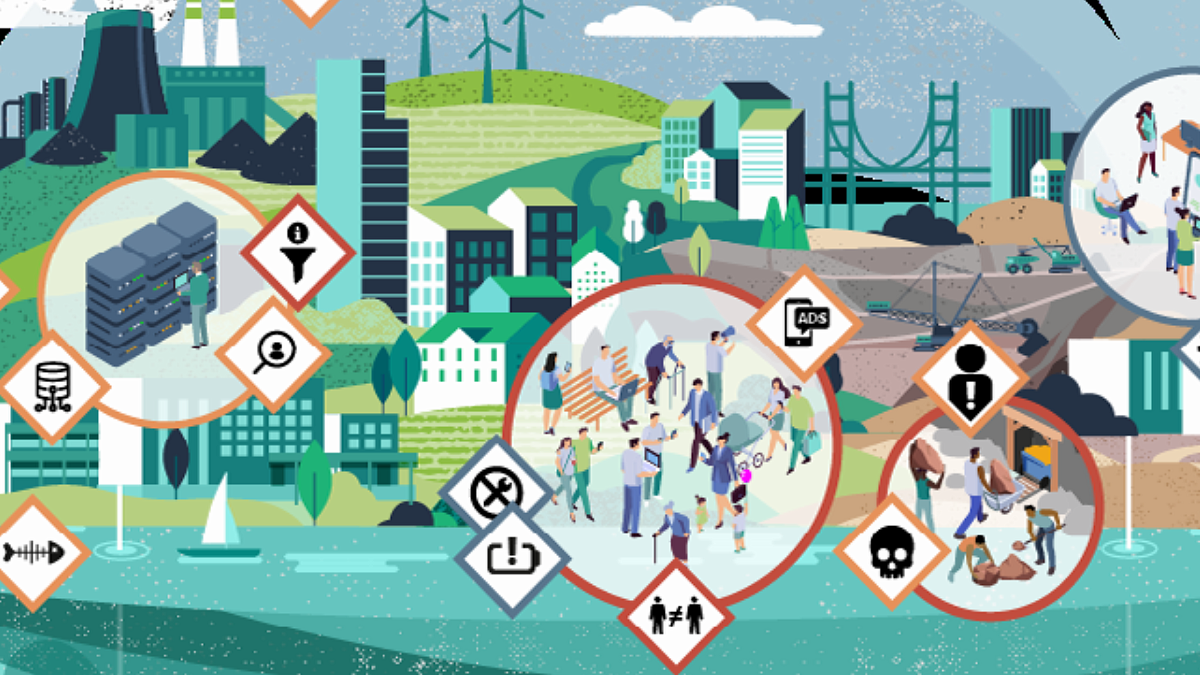
Detail from Digital Society Bell by Lone Thomasky & Bits&Bäume. Better Images of AI / CC by 4.0
State public utility commission (PUC) regulators are now active participants in shaping the deployment of AI infrastructure. As of early 2026, 27 states have legislation pending to govern how new large loads (a category that encompasses most modern data centers) are evaluated, priced, and connected to the electric grid. The substantive questions these rules address are familiar to utility regulators, yet largely absent from AI policy discourse: Who bears the cost of new electricity generation and transmission investments needed to serve these facilities? How to assess whether utility commitments to new infrastructure are prudent given uncertain demand? And what regulatory protections should existing customers have against the risk that projected demand does not materialize?
Traditional cost-of-service regulation socializes infrastructure costs across the ratepayer base, a framework workable for incremental load growth but increasingly strained when a single new customer can require investment approaching the scale of existing customer classes. Idaho’s House Bill 911, set to take effect in July 2026, offers a framework for understanding how this layer of regulation works in practice. The statute requires that any new load above 50 megawatts receive service only under a PUC-approved contract. That contract must satisfy a statutory “no harm” test and demonstrate that the new load will fund its full share of generation, transmission, substation, and distribution infrastructure costs. Many other states are considering legislation to address these same issues. Idaho’s statute is unusually clear in how it operationalizes cost-causation principles, making it a useful reference point for state frameworks evolving in response to AI infrastructure demand.
Who regulates AI-related energy infrastructure: the federal and state jurisdictional architecture
This article focuses on traditional regulated utility states where a vertically integrated, investor-owned utility holds a monopoly franchise and the PUC sets retail rates, approves major capital investments, and reviews resource planning projecting future demand. PUC proceedings are adjudicative and adversarial, with utility filings tested through discovery and testimony from intervenors. The decisions are subject to judicial review.
Regulatory authority over these kinds of electric utilities is split between state and federal jurisdictions. Generation acquisition by a regulated utility for retail service is primarily a state issue. Utility plans to build or contract for new generation are reviewed through state Certificate for Public Convenience and Necessity (CPCN) proceedings, which assess whether proposed projects are in the public convenience and necessity, and Integrated Resource Plan (IRP) processes, which evaluate long-term planning options. Approved costs are recovered through retail rates set by the state PUC. Wholesale electricity generation, including generation sold into competitive markets, falls under the jurisdiction of the Federal Energy Regulatory Commission (FERC).
For AI infrastructure served by traditional regulated utilities, cost causation questions are settled primarily at the state level. Transmission regulation is more complex: state PUCs have authority over siting and retail rates within their borders, while FERC has authority over wholesale transmission service, interstate planning, and the regional transmission process administered by Regional Transmission Organizations and Independent System Operators. FERC also issues orders affecting national transmission planning, including recent rules on regional planning, electricity generator interconnection reform, and long-term planning aimed at large load growth. Major new transmission projects often require both state and FERC approvals.
Where AI infrastructure lands within this regulatory architecture depends on scale. A data center that connects to a regulated utility's network typically triggers state regulatory processes only. Larger deployments requiring new high-voltage transmission or significant new generation commitments require coordination across state PUC processes and FERC regional planning. Multi-state transmission projects like the Gateway West line running from eastern Wyoming to Idaho and also serving PacifiCorp's six-state territory illustrate these challenges: each state reviews costs and benefits within its own jurisdiction while FERC oversees regional planning.
The regulatory pathway is rarely cleanly federal or cleanly state-based. Federal policy proposals focused on permitting reform or preemption alone miss the substantial role that state PUCs play in approving underlying generation and transmission investments, while state frameworks operate within constraints set by FERC's transmission planning and interconnection rules. Understanding either layer in isolation produces an incomplete picture of where binding constraints on AI infrastructure deployment actually lie.
What state regulators are deciding now will shape deployment for decades
Substantive disputes in these proceedings cluster around four interrelated questions, each being resolved in the current state PUC proceedings and legislative action.
Cost causation
States are actively defining which costs incurred to serve new large loads are properly assigned to those customers and which should be socialized across the entire rate base. The traditional cost-of-service model provides some guidance: costs that would not have been incurred but for the new load are typically directly assignable, while costs that benefit the broader system are typically allocated.
Applying that principle to AI infrastructure, however, remains contested. If a utility builds new generation that exceeds new demand from a data center but is justified by the planning reserve margin (the excess generating capacity above forecast peak demand that utilities maintain to ensure reliability) that it requires, who pays for the excess capacity? Idaho HB 911 takes a strong position: new large data centers are responsible for their full share of generation, transmission, substation, and distribution investments that would not be required by the public utility "but for the new large load." How that test is applied in individual proceedings will determine the share of infrastructure costs developers bear. Variation across jurisdictions will, in turn, shape where data center development is economically viable.
Prudency
States are also working out, in real time, how the doctrine of prudency applies to utility resource commitments driven by AI-related demand projections. Prudency asks whether an investment was reasonable given what the utility knew at the time of the decision.
Applied to AI infrastructure, the inquiry is novel. Projections for data center electricity use vary considerably depending on assumptions about the pace of AI deployment, and utilities making long-term resource commitments based on those projections face a real risk that load will not materialize at the projected scale or timeline.
The standard PUCs adopt now will shape utility behavior going forward, both in how aggressively they commit to new resources to meet speculative energy demands and in how those commitments are structured. Strict prudency standards push utilities to require firmer customer commitments; permissive standards allow faster buildout but greater ratepayer exposure to unrealized projections.
Stranded-cost risk and financial security
A stranded investment is one made to support infrastructure that no longer has a customer base sufficient to recover the costs. A utility that builds generation and transmission to serve a data center that later shrinks, relocates, or fails to obtain the required federal permits may be left with stranded costs traditionally recovered from its remaining ratepayer base.
Several states are now requiring financial security from new large-load customers to protect against this risk. Idaho HB 911 requires these new users to furnish financial security "in a form and amount approved by the commission, that is reasonably sufficient to protect the public utility and its other customers from the risk of stranded costs, unrecoverable costs, or unrecoverable investments."
The level at which PUCs set those requirements will determine how much skin in the game AI infrastructure developers must have before a utility commits.
The gap between projection and realization
Underlying these questions is the difficulty of regulating long-lived infrastructure investments based on demand projections that may never materialize. IRPs must project demand decades into the future, and AI-driven load growth has introduced a substantial new source of uncertainty.
Some announced data centers have been scaled back, delayed, or canceled after a utility has already committed to new infrastructure on the basis of original projections. Other projects appear likely to exceed initial projections.
State regulators are now developing mechanisms to manage this uncertainty, including phased approvals tied to customer milestones, cost recovery tied to realized load, and contractual structures that align the utility's obligations with the customer's actual demand schedule. The frameworks adopted now will determine how regulatory systems handle the next several years of AI infrastructure buildout, whether AI demand projections prove too aggressive or too conservative.
Where AI infrastructure policy is actually being decided
The state regulatory layer is a material variable in AI infrastructure deployment, and the frameworks governing it are being shaped through proceedings happening now. Decisions made in 2026 on cost causation, prudency, ratepayer protection, and demand realization risk will set the terms for where data centers can be built, what they will cost, who bears the financial risk, and how fast capacity can come online
For the AI policy community, the implications are practical: Federal AI policy proposals, whether focused on permitting reform, federal preemption, or industrial strategy, operate within a regulatory landscape substantially shaped by state PUC decisions and state legislation. Analysis that fails to engage with the state layer tends to overestimate federal impact, underestimating binding constraints. The substantive proceedings before state PUCs are not background noise. They are squarely in the foreground.
These proceedings are public: Filings, testimony, orders, and legislative records are all accessible. The questions at stake are familiar to utility regulators but are not yet familiar to most of the AI policy community. Closing that gap is a reasonable next step for anyone whose work intersects with the physical deployment of AI infrastructure.
Authors