From Davos to New Delhi, Rupture of Global Order Tests AI Governance
Alison Gillwald / Feb 17, 2026Alison Gillwald is a Distinguished Fellow at Research ICT Africa and an Adjunct Professor at the University of Cape Town.
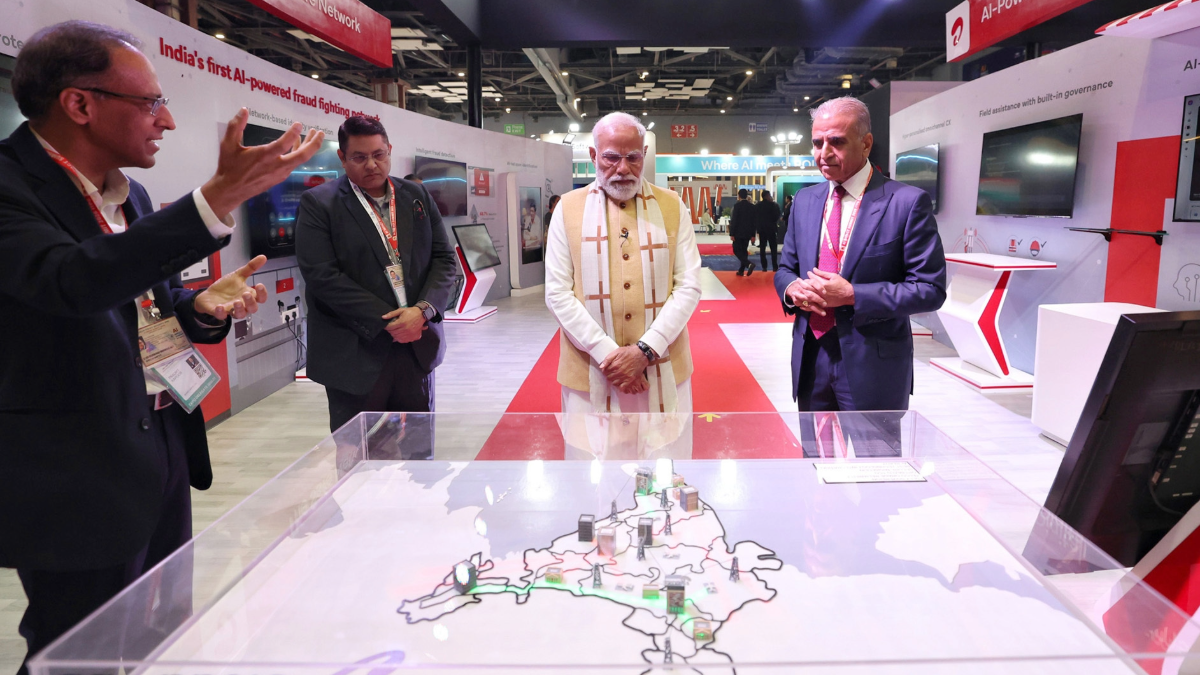
Indian Prime Minister Narendra Modi inaugurates the India AI Impact Summit 2026 at Bharat Mandapam, in New Delhi Indian on Monday, February 16, 2026. (Photo by India Press Information Bureau / Handout/Anadolu via Getty Images)
While the focus of the latest geopolitical and geoeconomic machinations is on more traditional notions of power, territorial sovereignty, and securing access to oil and trade, this is merely the backdrop for a struggle for dominance over advanced, data-driven technologies and the critical resources required to develop and deploy them. A close reading of the Trump administration’s new National Security Strategy (NSS), for example, reveals that ‘strategic assets’ being referred to are data infrastructures and artificial intelligence systems.
And in response to such US posturing on its doorstep, Canada Prime Minister Mark Carney is pushing for "sovereign AI" to maintain control over technology within national borders, investing heavily in computational infrastructure traditionally supplied by the US, while collaborating with international partners to advance AI safety and security. Carney recently struck a trade deal with China, the US’s biggest AI rival. Through a new Office of Digital Transformation, artificial intelligence is now a cornerstone of Canadian economic policy aimed at driving productivity and industrial innovation.
This is the important context for the Davos discourse, couched in references to the Cold War era, the end of the international order, and alarm about the possible deployment of dual-use AI technology in warfare. No mention there of the amplification of inequality by general-purpose AI technology cutting across all aspects of the economy and society, and little reference not only to the uneven impacts of harms on marginalized communities but also to the unprecedented opportunities associated with advanced data-driven technologies—some of the issues which will be reflected at least to some degree in the Global South focus of AI Impact Summit taking place this week in New Delhi.
Far more significant than the much-referenced ‘rupture of the international order’ by Carney in his acclaimed Davos speech last month was his acknowledgement of a long-standing falsehood: that the rules-based international order under US hegemony had operated equally, in the service of all nations.
Even more important was the tacit recognition that Canada (and other Western middle powers) were complicit in this—though justified on the grounds that it enabled the provision of global public goods—was the public articulation that the uneven application of the rules, due to power asymmetries, meant that benefits accrued to the most powerful nations.
Carney explained that he was compelled to expose the lie of “mutual benefit through integration” now as integration itself had become “the source of your subordination.” This condition is not new for the Majority World. It is perhaps why the disintegration of the international order has not been universally lamented.
Many non-Western middle powers have long expressed such sentiments within the United Nations, the Bretton Woods institutions, in the G20, and, more widely, within the G77. It is this sense of structural servitude that led to the establishment of BRICS by leading emerging economies and some older non-Western economies in 2009, and its expansion in recent years.
As a former central banker, Carney’s appropriate concern that the revered institutions that stabilize the world financial system are under threat—the World Trade Organization (WTO), International Monetary Fund (IMF), World Bank—does not resonate for many Global South countries. Or at least not for the same reasons. The rules of the game have largely failed to serve the diverse interests of the majority of the world. They have seldom received the protection afforded by the system to participate in global trade and diplomacy, to which Carney refers.
What is of concern for many countries in the Global South now is not the failure of these institutions, per se. Rather, it is the uncertainty and volatility that the breakdown of the international order brings to their economies, long constrained by colonial legacies, conditional ‘tied-aid’, crippling loans, and asymmetrical trade and failure to regulate equitable access to increasingly critical digital public goods.
That it has taken, not a genocide in Gaza, the starvation of millions of people from civil war in Sudan; crippling sovereign debt of African countries resulting from much vaunted international financial system; the planetary crises of climate change or the pandemic and vaccine crises, but the threatened invasion of Greenland and the weaponization of tariffs by the United States over Western middle powers, clearly demonstrates in whose interests the world order operates.
It is within this geoeconomic context that the governance (or lack thereof) of the intensifying global processes of digitalization and datafication must be viewed. What does it mean for global decision-making that the normative framework, long claimed to uphold democracy and equality, but on whose agendas democracy has long been absent, as references to human rights have given way to human-centric, inclusion, rather than equity, and responsibility instead of justice?
Carney frames the present rupture as an opportunity for the traditional middle powers to foster a more equitable global order. Do middle powers have the potential, as Carney urges, to “build a new order that embodies our values, like respect for human rights, sustainable development, solidarity, sovereignty and territorial integrity of states?” How would that be different from what was there before? And while he cautions against nostalgia for the old order as a strategy, there is nothing nostalgic about it for many countries in the Global South. In a multipolar world, what do the middle powers that Carney seeks to mobilize offer the south that alternative formations, such as BRICS, don’t better represent?
How Carney and other middle powers will navigate engagement with Washington in the wake of the exposed falsehoods of the old order remains unclear. These debates are unfolding amid questions over whether such coordination should happen within existing UN institutions or through alternative networks of like-minded states. At the same time, the French G7 presidency faces equally unprecedented challenges, with member states potentially at war for the first time in eighty years, and a T7 specifically on AI for Middle Powers.
Under the US presidency, does the G20, which has flouted the international order and unilaterally boycotted South Africa’s Presidency theme on Carney’s values of solidarity, sustainability (and equality, which is not a strong driver of the dominant Western unilateral order) just carry on as normal with middle power acquiescence? Middle powers said little and did nothing in response to the US’s spurious expulsion of South Africa from this year’s G20 to take place in Florida and the blacklisting of South African officials to prevent their attendance. Not much solidarity there.
Although the G20 member states ultimately endorsed the South African presidency's 2025 Leaders’ Declaration, it was primarily a diplomatic success despite sustained US obstruction. It included references to renewable energy financing, more equitable critical mineral supply chains, and debt relief for poorer countries. Yet it conspicuously avoided South Africa’s bolder priorities: meaningful reform of the UN system and restructuring of the global financial architecture, including sovereign debt cancellation for the poorest states.
Across multiple G20 working groups during South Africa's presidency, Ministerial Declarations failed to materialize. In their place were weak “Chair’s Statements,” diluted in the pursuit of consensus and stripped of political force.
This was reflected in the digital agenda as well. South Africa’s presidency in 2025 represented both a continuation and a culmination of this progressive trajectory. It was the third BRICS democracy to lead the G20, and it brought an explicitly developmental framing rooted in equality, solidarity, and sustainability. South Africa was clear that this was to be an African G20, one that placed questions of justice, redress, and structural inequality at the centre of debates on digital transformation and global governance.
The fate of the progressive High-Level Task Force on Artificial Intelligence, Data Governance, and Innovation for Sustainable Development, alongside the Digital Economy Working Group, reflects this dynamic. Both were reduced from strong Ministerial Declarations to Chair’s Statements that retained few actions related to the themes of solidarity, equality, and sustainability.
South Africa’s 2025 G20 presidency offers a stark reminder of the limits facing middle powers. As the first African country to hold the presidency, expectations ran high that it could advance a developmental, inclusive agenda. Instead, the process revealed the regressive positions of dominant Western democracies working in concert with multilateral agencies, selling their conventional wisdom wares under the threat of funding cuts from the US. Ambitions for reform—including AI governance, digital inclusion, and debt relief—were diluted or sidelined, highlighting how entrenched power asymmetries and the influence of conventional knowledge partners maintain the status quo.
Push back from G20 engagement groups, such as the Think20, Business20, Labour20, and the well-organized, self-proclaimed M20, fell on deaf ears and had little impact on outcomes in the Sherpa track.
And what of the forthcoming India AI Action Summit in New Delhi this week, with its greater focus on the Global South? Will it build on the far stronger BRICS statement delivered under the Brazilian presidency in 2025, which observed: “The proliferation of governance initiatives and the diverging views in multilateral coordination at the international level may aggravate existing asymmetries and the legitimacy gap of global governance on digital matters, further eroding multilateralism as a result”?
The old order is clearly unravelling; efforts to build a more equitable global system remain constrained by entrenched structures and vested interests of dominant powers. The rupture is real, but turning it into meaningful change for the Majority World will require more than rhetoric and a repetition of values that have seldom materialized in actions. It will require fundamental reform of the multilateral systems, with the equal participation of sovereign states committed to redressing the deep structural inequalities that are being amplified by advanced data-driven technologies.
Authors