What Is at Stake as Global Leaders Gather for India’s AI Summit
Varsha Bansal / Feb 16, 2026Varsha Bansal is a fellow at Tech Policy Press.
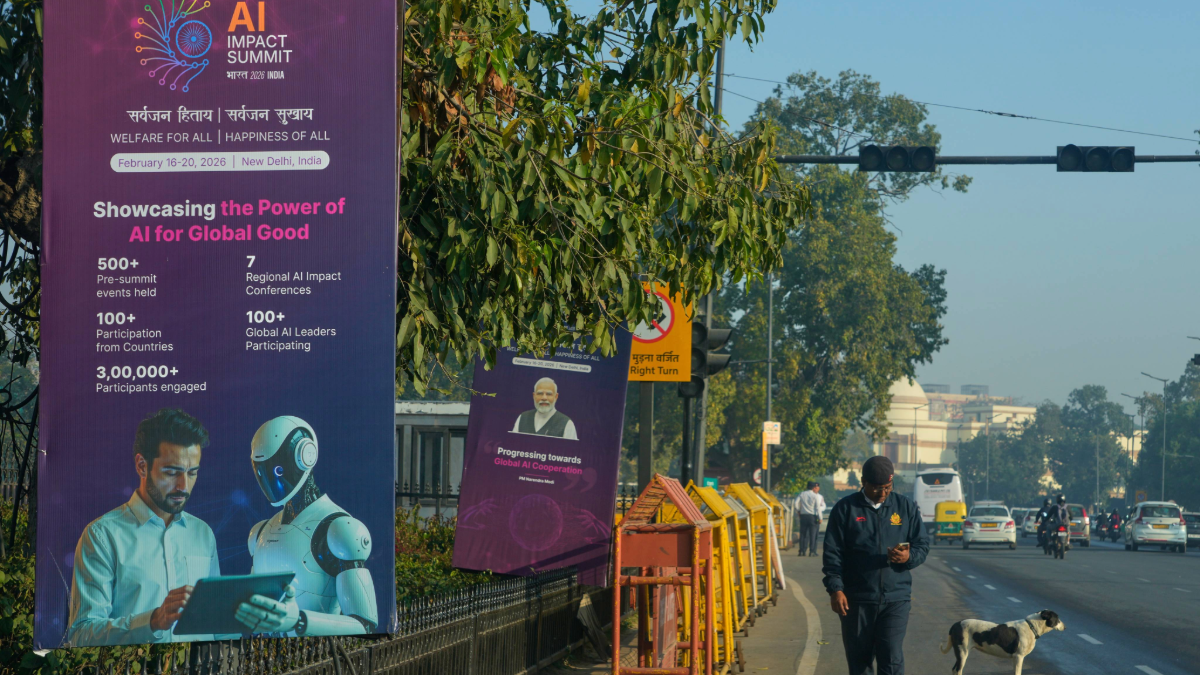
Banners announcing the India AI Summit with images of Indian Prime Minister Narendra Modi stand beside a road leading to the summit venue in New Delhi, India, Monday, Feb. 16, 2026. (AP Photo/Manish Swarup)
India is hosting the flagship AI Impact Summit this week in the capital city of New Delhi. The five-day event, with over 35,000 registrations from more than 100 countries, is expected to see participation from heads of government, ministers, top tech and AI company CEOs, policymakers, civil society groups and many others from around the globe. The buzz is so high with so many high-profile visits that some of the luxury hotel prices in the city center have shot up to over $20,000 a night.
Prime Minister Narendra Modi welcomed global leaders on Monday, sharing his enthusiasm about bringing the world together to discuss AI. “The AI Impact Summit will enrich global discourse on diverse aspects of AI, such as innovation, collaboration, responsible use and more,” Modi posted on X.
This event marks the first time for a country in the Global South to host a major AI summit of this scale. “Hosting the summit in India, the first in the Global South, highlights a shift toward solutions shaped by emerging economies, offering an opportunity to examine AI governance that serves everyone, not just a few,” said Jules Polonetsky, CEO of think-tank Future of Privacy Forum. Polonetsky flew in from Washington DC to Delhi to speak at the summit.
For decades, policy experts say, the frameworks and guardrails around emerging technologies have been shaped primarily within advanced economies, with this summit broadening that circle. “The summit signals that AI governance can no longer be designed in isolation from the aspirations and constraints of the Global Majority,” Dhruv Garg, a partner at public policy research organization Indian Governance and Policy Project (IGAP), told Tech Policy Press. “It is about recalibrating voice and influence in a domain that will define economic and political power for decades.” IGAP has organized a few pre-summit events and has planned a panel for the summit on AI governance and inclusion.
The Indian government has been working to make this an event of unprecedented scale, with close to 500 pre-summit events in the last six months, and is expected to have nearly a hundred main summit events covering everything from AI and mental health to the long-standing question of automation and jobs. Even the terminologies used for the themes of the summit have a cultural imprint: the primary theme being supported by three “sutras”— Sanskrit for foundational principles — people, planet and progress; while the working groups are split into seven categories — called “chakras.”
Policy experts say the summit could accelerate AI adoption in government at both the state and federal levels, similar to how the government’s Digital India mission sped the spread of technology across the country. “A summit like this, with this much bandwidth allocated to it by the government, even if the agenda is flat, ends up making AI a priority focus for ministries and state governments,” said Nikhil Pahwa, founder of tech policy publication MediaNama. “That reduces the time for adoption of AI.”
The summit could also spur new investment. “India has a large technology workforce, and for some of the businesses that will attend the summit, it’s an opportunity to understand and invest in Indian AI companies to meet their own goals,” he said.
Billionaires, tech CEOs, and ministers
A cursory look at the summit agenda pops up some of the big names from the world of artificial intelligence. Among top tech CEOs, we can expect Bill Gates, Sundar Pichai, OpenAI’s Sam Altman,Anthropic’s Dario Amodei, among others. Indian business leaders Mukesh Ambani and Nandan Nilekani are also expected to attend. “There’s an all-star lineup for the main summit day,” said Astha Kapoor, co-founder of policy think-tank Aapti Institute. “Everyone who is anyone in the global AI and India AI ecosystem is expected to be there.”
While there are several hundred panel discussions, roundtables, and exhibits taking place, some expect the general tenor of the summit to be more focused on the applications of AI, and how they can be leveraged to drive economic growth in the Global South. “There have already been several pre-summit events around themes like AI in manufacturing, healthcare, robotics, governance, etc.,” Shashank Reddy, managing partner at Evam Law & Policy, which is organizing one panel for the summit. “The main summit will also likely focus on the same.”
Last year, both OpenAI and Anthropic ventured into India, while Google said it would pour $15 billion to build data centers in the country. Reddy expects some of the CEOs to make “public declarations of further substantial investments into data centres and miscellaneous AI-related fields by global giants to tap into what has rapidly become one of the largest markets (by users) for AI.”
Beyond product or investment announcements, Mohanty expects the tech CEO conversations to be focused on where they see the state of the technology. “So talking about applications in agriculture and healthcare and governance and education,” he said. “We will hear a lot about applications of AI for scientific development and how it’s important to ensure that AI is accessible to all.” Apart from use-cases, there could also be conversations around “linguistic diversity or multilingual models and small models,” said Kapoor. The summit will witness the launch of some indigenous AI models by local Indian startups.
From safety to implementation
The India summit represents more than just a change in geography. Kapoor says that the way each country hosting this summit has framed the theme of the event is a reflection of their own needs and the geopolitics of that moment: at Bletchley Park in 2023, it was “Safety,” whereas in France during 2025, it was on “Action.”
This seems like a natural progression where the earliest gatherings concentrated heavily on existential risk and abstract safety frameworks, which, experts say, was an important phase in establishing guardrails. Now, the next stage has widened discussions around competitiveness, innovation ecosystems and regulatory coordination among advanced economies. “We are now in a more mature phase centered on implementation and impact. Governments are grappling with how AI interacts with labour markets, welfare systems, democratic processes and public trust,” said Garg. “The India summit reflects this shift.”
He further adds that the summit focuses on deployment in large, diverse and high-population environments. “It recognizes that governance cannot be separated from development strategy. The debate has moved from whether AI should be regulated to how it can be governed responsibly while expanding access and opportunity,” said Garg. “That is a more complex and more consequential conversation.”
With the summit, India wants to position itself as charting a “so-called third way on AI,” where AI improves people’s lives through applications for social good, says Urvashi Aneja, founder of tech policy research organization Digital Futures Lab. But with the Indian government cutting its budget to the IndiaAI Mission by half, Aneja says states are courting Big Tech for investment. “Big Tech is also selling sovereignty as a service and positioning itself as essential for delivering on AI for development,” she adds, referring to the sovereignty rhetoric that the Indian government has promoted.
While this is the paradox India is facing—attempting sovereignty but also depending on Big Tech for infrastructure and investments—Kapoor says it might be a trade-off as the government believes that adoption is the path to development. “India’s focus is on use-case led adoption, which is what is assumed to be the thing that leapfrogs the country ahead,” said Kapoor. “And if that happens to entrench Big Tech in the process, then that isn’t, in my view, immediately problematized.”
What does a successful summit look like?
Policy experts say that the true measure of success will be whether this summit structurally amplifies the voice of the Global South countries, not as a token presence but as a co-architect of global AI norms. “Artificial intelligence will have a disproportionate impact on Global Majority populations,” said Garg. “These societies have younger demographics, rapidly digitizing economies and varying regulatory capacities. Decisions about AI governance, infrastructure access, intellectual property and model deployment will shape employment patterns, education systems, financial inclusion, and political stability across these regions.”
In practice, this would mean institutionalizing representation from these states in standard-setting, research collaboration and funding flows. It would also mean strengthening domestic capability while ensuring that all countries in the global south have a substantive influence in shaping global AI governance. “AI norms must reflect demographic reality and development priorities, not only capital concentration,” said Garg. “If that recalibration takes hold, this summit will mark a turning point when AI governance begins to reflect the majority of humanity rather than a narrow set of technologically advanced economies.”
At the same time, Pahwa gives a sobering reality check. “Many, many parts of the puzzle have to come together for any country to win the AI battle,” said Pahwa. Even though India is seeing local models improve regularly with Indian startup Sarvam releasing “some fairly good models” in the past few weeks alone, he says, “India does appear to be lagging when compared with both the US and China.”
At the same it’s true that winning this battle requires considering many variables: hardware, training data, model architecture, usage diffusion, among others. “We're seeing ChatGPT platformize, and Gemini and Copilot spread into all Google and Microsoft-owned surfaces, in order to build user habit. Adoption of global models is far greater than that of local models in India,” said Pahwa. “I think that's a battle already lost.”
Authors