Amicus Briefs Say Trump Immigration Policy Chills Researchers’ Speech
Murad Ali Bhatti, Siddharth Muchhal / May 12, 2026Murad Ali Bhatti and Siddharth Muchhal are former legal externs at the Knight First Amendment Institute at Columbia University, where they worked on issues related to free expression and tech policy.
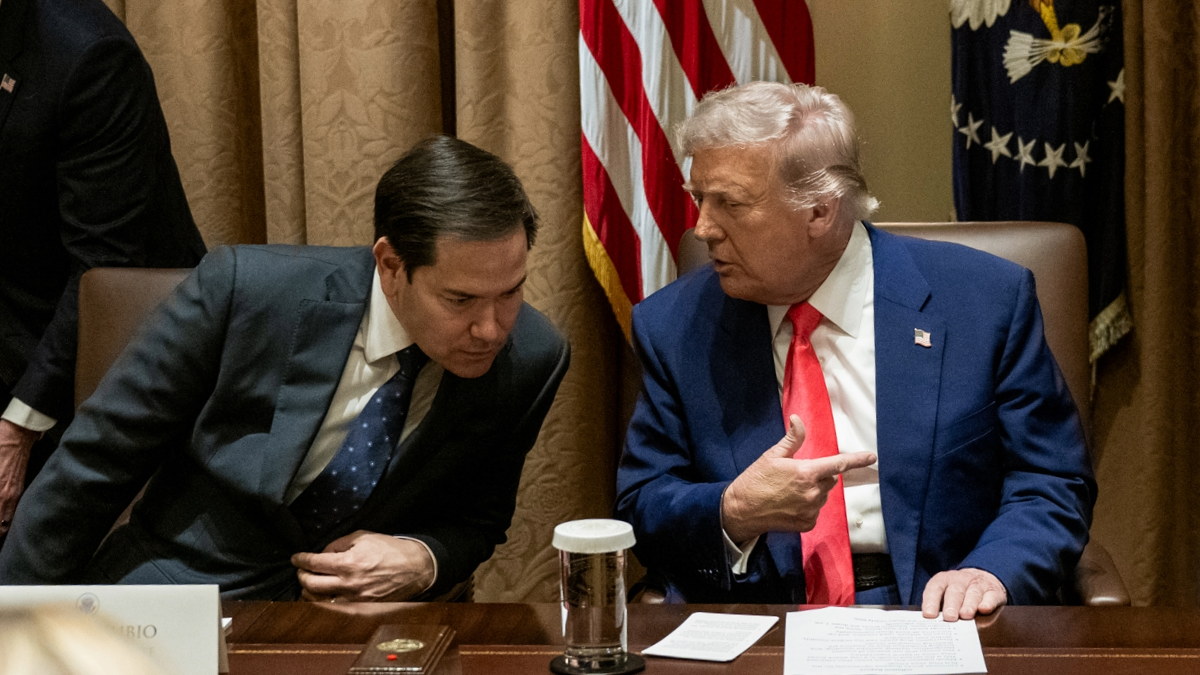
US Secretary of State Marco Rubio confers with President Donald Trump on Thursday, April 10, 2025, in the Cabinet Room. (Official White House Photo by Molly Roberts)
As a federal court considers whether to block a US immigration policy challenged by the Coalition for Independent Technology Research (CITR), three amicus briefs argue that the case is about far more than immigration restrictions on noncitizen researchers, fact-checkers, and trust and safety workers. At stake, they contend, is whether the government can use its immigration authority to shape the conditions under which online speech is produced, moderated, and studied.
In Coalition for Independent Technology Research v. Rubio, the Knight First Amendment Institute at Columbia University (where we worked as legal externs) and Protect Democracy, representing CITR, argue that a Trump Administration immigration policy targeting noncitizens for deportation and exclusion based on their work in the areas of social media research, disinformation, content moderation, and related issues penalizes particular viewpoints and chills protected speech in violation of the First Amendment. The lawsuit alleges that the policy also violates the Fifth Amendment and the Administrative Procedure Act.
The policy was announced in May 2025 by Secretary of State Marco Rubio, who said it would apply to foreign officials and private individuals the government deemed “complicit in censoring Americans.” Since then, it has been expanded and enforced against a wide range of individuals. In December 2025, the government reportedly directed consular officers to scrutinize visa applicants’ resumes, social media activity, and public statements to determine whether they had engaged in work such as fact-checking, content moderation, or trust and safety efforts, and to deny visas on that basis.
The lawsuit argues that the policy has already introduced a climate of uncertainty and fear, prompting some researchers to scale back their work, withdraw from public advocacy, or reconsider whether they can continue working in the United States.
The amicus briefs, filed by the Electronic Frontier Foundation (EFF), the Integrity Institute, and the International Fact-Checkers Network (IFCN) at the Poynter Institute for Media Studies, argue that those effects are already being felt across the research community.
Each of the three amicus briefs approaches the case from a different angle, but together they describe an ecosystem in which researchers, journalists, and trust and safety professionals play a central role in verifying information online and helping ensure that ideas can be freely shared and debated. The briefs argue that the policy alters the conditions under which that work takes place.
The EFF brief frames content moderation as a system that relies on both internal decision-making and sustained outside scrutiny. It emphasizes that moderation—the process by which platforms edit and curate user-generated content—has long been integral to online forums serving a wide range of missions, viewpoints, and communities, even as it remains complex and difficult to carry out effectively at scale. Because of that complexity, the brief argues, independent oversight by civil society experts, including nonprofit organizations, academics, and technical researchers, is essential.
These groups act as “watchdogs” studying how platforms apply their rules, identifying inconsistencies or harms, and pushing for changes that better protect users’ ability to speak and receive information. Platforms have often responded by revising their policies, adjusting the enforcement of their community standards, and increasing transparency. Policymakers have, at times, also recognized this oversight role as part of the broader ecosystem that supports free expression and due process online. Deterring or excluding those who do this work, the brief argues, would remove a critical layer of accountability, limiting the public’s ability to understand and challenge how platforms govern speech.
The Integrity Institute brief focuses on the day-to-day work of trust and safety teams. These professionals address illegal activity on platforms, including explicit depictions of minors, and “monitor, flag, and remove multiple types of legal but harmful content” such as scams, harassment, and misinformation. The brief argues these workers help maintain the “speech environments that private social media companies create, moderate, and facilitate under the protection of the First Amendment,” while requiring them to “balance several interests, both those required by law and those established by best practices and policy decisions,” often in real time and at scale.
The brief also emphasizes the global nature of this work. Foreign trust and safety workers play a key role in building connections to their “country’s government, to civil society, to content creators within that country, and to local advertisers.” By restricting their ability to travel, collaborate, and participate in U.S.-based institutions, the policy disrupts the development of these systems and risks weakening the platforms themselves.
The IFCN brief places the policy within the framework of press freedom and newsgathering. It argues that fact-checking is a core journalistic function that provides “context and verification for the public’s consumption of news media” and is therefore a protected activity under the First Amendment. As the volume and speed of information have increased, so has the need for reporters and researchers who can assess the accuracy of claims in real time—a role that has been critical during events such as the COVID-19 pandemic, the 2020 US presidential election, and the ongoing wars in Iran and Ukraine, where accurate and timely information has informed decisions about welfare, governance, and safety.
The brief warns that the Trump Administration’s immigration policy is designed to “dissuade foreign journalists from challenging, fact-checking, or even accurately reporting on the Trump administration for fear of retribution,” directly tying the policy to the risk of retaliation when journalists scrutinize government statements or narratives. By creating the risk of visa denial or retaliation, it pressures foreign journalists and researchers to self-censor, avoid public engagement, or decline opportunities to collaborate across borders, directly deterring them from serving this role.
It further argues that the policy enables retaliation against foreign speakers whose speech the government disfavors, infringing on the freedoms of speech and the press, and warns that these pressures “will inevitably cause IFCN’s members to alter their behavior” by declining travel and collaboration opportunities and choosing not to publish their work. Retaliatory viewpoint discrimination aimed at the press, the brief argues, is particularly “nefarious” given the press’s role in shaping public understanding.
The timing of the case is significant. Taken together, the briefs point to a broader shift in how the government has tried to constrain speech through immigration policies. Rather than regulating platforms directly, the policy targets the people who study and help shape them. This approach is less visible than traditional forms of censorship, but potentially more far-reaching. By chilling research, speech, and advocacy across the field, the policy limits the ability of the public, policymakers, and platforms themselves to understand and respond to the dynamics of the digital environment.
Authors