The Trump Lie About Europe and Why it Matters
David Kaye / Jan 9, 2026David Kaye is a law professor at UC Irvine, a former UN Special Rapporteur on freedom of expression, and the author of Speech Police: The Global Struggle to Govern the Internet (2019).
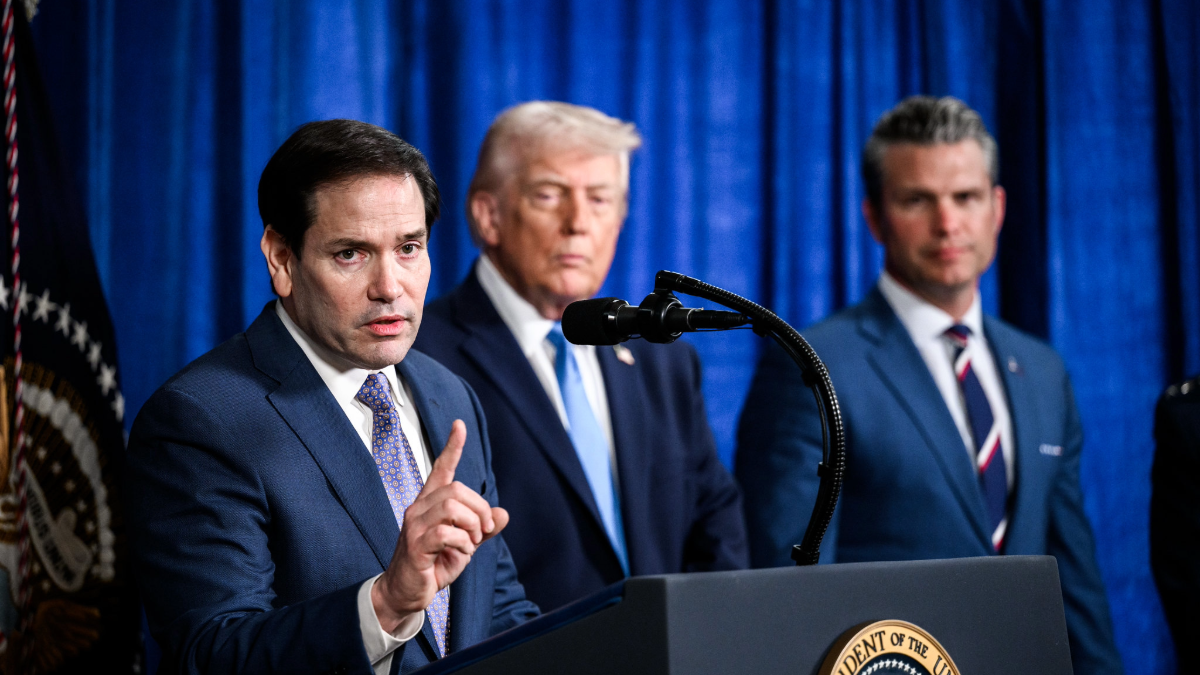
Secretary of State Marco Rubio delivers remarks at a press conference at Mar-a-Lago in Palm Beach, Florida, following Operation Absolute Resolve in Venezuela leading to the capture of Venezuelan President Nicolas Maduro, Saturday, January 3, 2026. (Official White House photo by Molly Riley)
Just before Christmas, the United States State Department imposed unprecedented visa restrictions on a former European Union Commissioner, Thierry Breton, and several civil society leaders who have battled online hate and disinformation. Deploying the rhetoric of the right’s faux free speech agenda, Secretary of State Marco Rubio accused them of being “agents of the global censorship-industrial complex.” “Ideologues in Europe,” he tweeted, “have led organized efforts to coerce American platforms to punish American viewpoints they oppose.”
The problem? Among other things, it’s not true. There is no censorship. There is no complex. There is no viewpoint discrimination. The administration is promoting disinformation about European law and policy for reasons that go well beyond social media regulation.
So what has Europe actually done to trigger such an outrageous response by the snowflakes in the Trump administration?
It’s instructive to back up a bit for some context. For over a decade, neo-Nazi and other right-wing parties, along with Russian government proxies, have been using social media platforms in Europe to stoke hatred and violence against migrants and other minorities and spread disinformation of all kinds. Europeans have struggled to address the rise of online hate and offline violence against the backdrop of their own dark history of racial and antisemitic incitement to genocide.
Early on, individual governments and the European Commission tried to get the companies to deal with these problems, but the companies insisted they too saw the same harms and would address them themselves, without the need for new law. When company self-regulation seemingly failed to meet the challenge, governments experimented with legal approaches that often drew criticism from civil society as going too far, enhancing the power of the platforms without clarifying the rules. I occasionally joined in that criticism in my prior role as UN Special Rapporteur on freedom of expression.
In 2022, however, the European Union adopted an innovative and balanced approach to online harms, approving a regulation, the Digital Services Act (DSA), that requires the largest platforms and search engines to assess and mitigate any “systemic risks” they may cause and to open their content moderation processes to transparency.
The DSA may not be perfect, but it is hardly the stuff of speech repression. Rather, it is a tool for the public’s access to information, benefiting both European and American desires to crack open the opacity of firms that so dominate the information diet of hundreds of millions of people. Yet in a harbinger of what was to come, Elon Musk went ballistic in early December when the EU issued a 120 million Euro fine against X, the company he owns, even though the fine itself was not based on speech X hosted but the company’s failure to meet basic transparency requirements. In a tweet that perfectly exposed his real agenda, Musk called for the destruction of the EU itself.
Now, with its visa bans, the Trump administration and its allies in Congress, Silicon Valley and right-wing media are treating Europeans as if they just criminalized journalism or invaded a neighboring country (as Russia’s Vladimir Putin, seemingly unworthy of their hostility, has done). Techdirt editor Mike Masnick addressed the free speech issues in this new attack. But still the question looms: why use such an outrageous tool even if they oppose the DSA and other European approaches that aim to address hate and disinformation? Why this, and why now?
In fact, the bullying hardly concerns “free speech” as a value the administration genuinely cares to understand or protect. Rather, the administration and its allies are promoting the falsehood of European censorship as part of a concerted effort to undermine democracy on both sides of the Atlantic.
First, the lie perpetuates the unfounded assertion that the largest social media companies and academic researchers censor conservatives. It is an illuminating right-wing fantasy of victimhood that Representative Jim Jordan (R-OH), supported by a small but well-monetized band of Substackers and would-be free speech warriors, has pushed for years through hearings in Congress.
The censorship fantasy became government propaganda on Trump’s first day in office, when he issued an Executive Order asserting the federal government had forced platforms to censor speech.
It is a dogma without borders, and Vice President JD Vance took it global when he lectured an elite group of European leaders at Munich in February, telling them to stop “censoring” their opponents. He humored himself and his allies alone when remarking, “if American democracy can survive ten years of Greta Thunberg’s scolding, you guys can survive a few months of Elon Musk.”
The State Department sanctions – including similar (recently lifted) sanctions issued last summer against a Brazilian judge it baselessly alleged censored Americans – are the natural result of a hollow argument that any attempt to address hate and disinformation must be repressive.
The second and related reason for the administration’s lies is political. The administration’s leaders, including Musk, do not want Europe to regulate the largest platforms in a way that exposes their political allies on the right, such as Germany’s AfD, France’s Rassemblement National, Hungary’s Fidesz, and the UK’s Reform. The administration has made plain its support for a racist far-right in Europe, what its recent National Security Strategy refers to as “patriotic European parties.”
The risk these reactionary parties face is obvious. The right’s populist rhetoric, much like Stephen Miller’s in the US, rests on an argument that migration and “non-European” minorities are the root of all economic and social problems in Europe. To push this argument, they regularly traffic in hate, incitement and disinformation.
Neutral regulation designed to uncover the ways in which social media platforms amplify online hate, like the DSA, will no doubt implicate these very same parties in ways that could damage them at the polls. The Trump administration knows it and wants to protect the far-right’s channels for hate and disinformation.
Third, the White House, its allies in Congress and key corporate figures are opposed to any regulation that imposes even modest burdens on the largest American technology firms.
The State Department sanctions are focused on those involved in or advocating for responsible platform behavior. But Silicon Valley, with its inside dominance of administration policy, promotes a broader worry that European regulation will interfere with the free rein the companies want in order to push AI products into the European market, to extract data without constraint, and to consolidate their supremacy over any competitors, Chinese or European. Any effort that might interfere with that agenda, such as requiring steps to evaluate the impact of such products on fundamental rights to privacy and speech, is seen as hostile. The failure of the DSA would, in this sense, be a battlefield victory in a larger war.
Finally, the lie and its attendant policies aim to distract from the unprecedented censorship and repression the Trump administration has been implementing in the United States.
Trump administration censorship is well-documented. Among other things, President Trump and his administration have coopted government websites into megaphones of propaganda. They are silencing scientific and public health experts, weaponizing the Federal Communications and Trade Commissions against media, suing media outlets, punishing the speech of visiting scholars and students, proposing to ban certain forms of protest, censoring art and history, and aiming to destroy public media.
They have launched an all-out attack on academic freedom, unlawfully stripping universities of research funding in an effort to force them to adhere to political criteria for admissions, campus protest, curricular design and much else.
The list goes on. Ask Jimmy Kimmel or any number of Trump’s targets in culture and media. Trump officials are free speech phonies, alleging censorship while engaging in far worse forms of it themselves.
Online hate and disinformation do not have easy solutions. But the Trump administration’s lies are not about free speech. They are about power – preserving its own, promoting its far-right allies in Europe, and protecting its partners in Big Tech.
Authors