Trump Ends America’s Leadership on Internet Freedom
Konstantinos Komaitis / Jan 8, 2026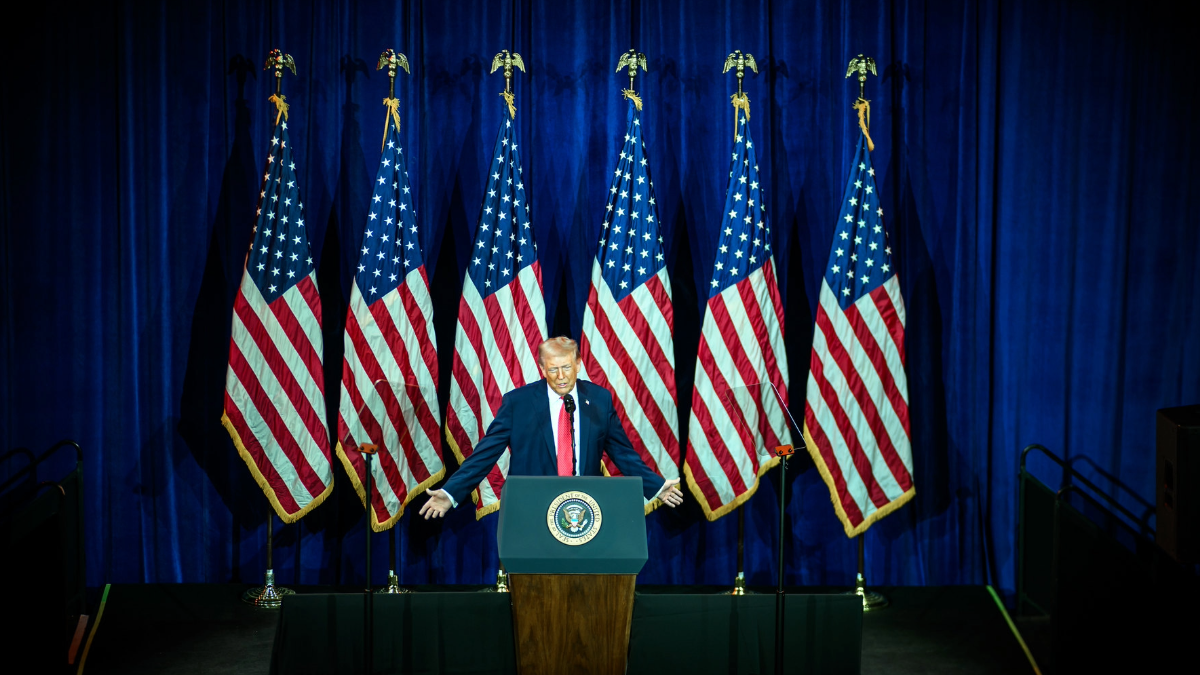
United States President Donald Trump delivers remarks at the Donald J. Trump - John F. Kennedy Center for the Performing Arts in Washington, D.C., Tuesday, January 6, 2026, en route the White House. (Official White House Photo by Daniel Torok)
On January 7, President Donald Trump issued a sweeping directive withdrawing from 66 international organizations, conventions, and treaties deemed “contrary to the interests of the United States.” Buried among climate, development, and human rights bodies was a decision with outsized strategic implications: US withdrawal from the Freedom Online Coalition (FOC)—the only alliance explicitly committed to defending human rights and openness on the Internet.
This was not an obscure bureaucratic adjustment. It was a declaration. The US has now formally stepped away from a core element of the normative architecture it helped build to shape the global Internet. Whatever rhetoric Washington continues to use domestically and internationally, the message is unmistakable: Internet freedom is no longer a pillar of US foreign policy.
The FOC was launched in 2011 at a ministerial conference in The Hague, at a moment when optimism about the Internet’s democratic potential was still intact but already under strain. Then–Secretary of State Hillary Rodham Clinton used the occasion to articulate a simple proposition: that the same rights people enjoy offline—freedom of expression, privacy, association—must be protected online.
The US’s original vision was not merely theoretical; it had tangible consequences for dissidents on the ground. Consider the 2022 "Woman, Life, Freedom" protests in Iran. When the Iranian government implemented a near-total Internet blackout to mask its crackdown, the FOC served as the primary diplomatic engine for the "Joint Statement on Internet Shutdowns in Iran." This wasn't just paper; it coordinated a multilateral effort to pressure tech companies to provide bypass tools and satellite linkups to protesters. As Iranian activists noted at the time, the FOC’s collective recognition of their digital right to assembly provided the political legitimacy needed for Silicon Valley to intervene in a conflict zone. By walking away now, the US is dismantling the very mechanism that once turned Western values into a lifeline for those behind a firewall.
From an initial group of roughly 15 states, the FOC has grown into a coalition of more than 40 governments across regions, income levels, and political systems. It is deliberately informal, consensus-based, and explicitly multistakeholder in orientation. Its purpose was never about treaty-making but norm-building: issuing joint statements, coordinating diplomatic pressure, and providing political cover for civil society actors operating in hostile digital environments.
The US was never the sole pillar of the FOC. European governments, small states with advanced digital policies, and Global South members all played meaningful roles. But Washington was an early driver—politically, diplomatically, and financially. Its participation signaled that Internet freedom was not just a Western talking point but a strategic priority backed by the world’s most powerful democracy.
That signal is now gone.
The coalition will survive—but the signal matters
It would be wrong to suggest that the FOC will falter, let alone collapse, in the absence of the US. The coalition has long-standing institutional continuity, an active support unit, rotating leadership, and a committed and diverse membership that understands both its purpose and its value—perhaps with renewed clarity at this moment. Indeed, US withdrawal may allow the FOC to further consolidate itself as a genuinely plural diplomatic forum, less exposed to the volatility of US domestic politics and more firmly grounded in shared international ownership.
Yet resilience should not be conflated with reach.
The FOC’s impact has never derived primarily from its formal statements or institutional architecture alone, but from the broader geopolitical context in which its positions were articulated. When member states spoke collectively about internet shutdowns, surveillance practices, or digital repression, those interventions were amplified by the presence of actors able to project influence across multiple policy domains—trade, security, development, and diplomacy. The departure of one such actor does not silence the coalition, but it will alter—at least in the short term—how its interventions are received and contested in global forums.
In international politics, absence is seldom neutral. It shifts the terrain on which norms are debated and influence is exercised, recalibrating whose voices carry weight and under what conditions. If the FOC withdrawal was a quiet exit through the back door, other recent actions have been a sledgehammer to the front gate.
This retreat is punctuated by the simultaneous abandonment of other bodies, including the Global Counterterrorism Forum, a body essential to digital security. By severing these ties, Washington is not just leaving the table of internet freedom; it is dismantling the very multilateral safety nets designed to protect the hardware and networks upon which that freedom relies. To this end, it is important to note that the withdrawal from the FOC should not be understood in isolation. It fits into a broader pattern of US foreign policy increasingly defined by unilateral action and selective disengagement from multilateral constraint.
That trajectory was starkly illustrated by the US operation in Venezuela in the beginning of the new year that resulted in the arrest and transfer of President Nicolás Maduro to US custody. Regardless of one’s assessment of Maduro’s legitimacy or record, the operation bypassed multilateral authorization and triggered widespread condemnation from across Latin America and beyond. The message was clear: Washington is prepared to act alone, even when doing so undermines established international norms.
Seen in this light, withdrawal from the FOC is not an anomaly but a part of a broader recalibration in which normative leadership is treated as optional, and institutional restraint as expendable. For countries already skeptical of Western claims to a “rules-based international order,” the optics are damaging. For authoritarian governments, they are instructive.
This unilateralism doesn't happen in a vacuum. While Washington retreats into a posture of 'America Alone,' its primary systemic rival is doubling down on 'China Everywhere.’ Nowhere is this shift more consequential than in the contest over global digital governance. For more than a decade, China has advanced an alternative vision of the Internet grounded in state sovereignty, centralized control, and political stability over individual rights. Beijing has promoted this model through infrastructure exports, standards-setting bodies, and increasingly through diplomatic engagement in the United Nations and technical forums.
Until recently, the US and its allies could credibly counter that vision by anchoring a competing set of norms—open networks, multistakeholder governance, and universal human rights online. The FOC was one of the few venues where those principles were articulated collectively and consistently.
By walking away, Washington does not merely reduce its own influence. It creates space for China to reappropriate the language of governance and rights, reframing them to align with state-centric interpretations. Concepts like “internet freedom,” “digital order,” and even “human rights” are already being redefined in ways that subordinate individual freedoms to regime stability. This is how normative power works: not through coercion alone, but through the slow reshaping of meaning.
The irony is that the US is ceding ground at precisely the moment when digital governance—covering artificial intelligence, cross-border data flows, and platform regulation—is becoming central to geopolitical competition. The withdrawal from the FOC signals retreat just as the battlefield expands.
Why this matters beyond the Internet
Internet freedom is not a niche issue. It intersects with economic competitiveness, democratic resilience, national security, and global influence. Norms established today will shape how technologies are deployed, how dissent is managed, and how power is exercised for decades.
Historically, the US understood that leadership in these domains did not come solely from technological dominance or military power, but from institutional presence and normative consistency. Walking away from coalitions like the FOC undermines that legacy.
The reality is that the coalition will continue and its members will adapt. But the broader international system is adjusting as well—and not in Washington’s favor.
The US withdrawal from the FOC marks a clear strategic choice: to deprioritize multilateral norm-setting in favor of unilateral discretion. That choice may appeal to Trump's base voters domestically but, internationally, it carries costs.
Influence does not disappear overnight, but it erodes when presence becomes conditional and principles become transactional. In the digital domain, where rules are still being written, absence is itself a form of decision.
The US has not merely left a coalition. It has vacated a position of leadership in the fight over the future of the internet. Others are already moving to fill the space.
Authors