White House 'Censorship' Grievance Fantasy Kicks Into High Gear
Dean Jackson / Dec 5, 2025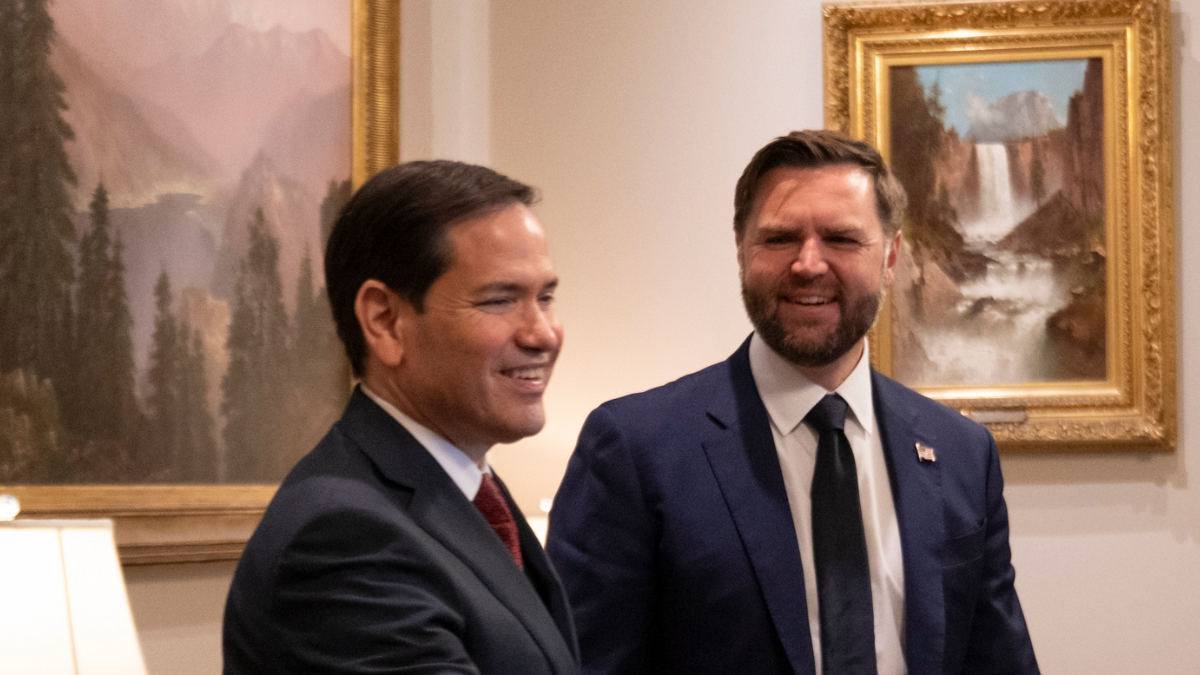
United States Secretary of State Marco Rubio and Vice President JD Vance and members of the US delegation in the West Wing Lobby of the White House, Friday, October 17, 2025, before a bilateral meeting with President Donald Trump. (Official White House photo by Molly Riley)
Sometimes stories, like yuletide spirits, come in threes. When it comes to the ongoing transatlantic battle over digital regulations, three separate stories drew headlines this week that together indicate an escalation of the dispute between Washington and Brussels and crystallize the broader narrative of which they are a part.
The first arrived with little advance warning. According to an exclusive report in Reuters, in a cable sent on December 2, the Trump administration instructed US diplomatic missions to screen the past employment of H-1B visa applicants for evidence they were complicit in censoring expression protected under US law. According to Reuters, applicants and their family members can be rejected for working in areas including “misinformation, disinformation, content moderation, fact-checking, compliance and online safety, among others.”
First Amendment scholars were quick to condemn the directive as an unconstitutional restriction on free expression. The cable is, in effect, an effort to censor tech companies and their employees for alleged acts of censorship. It comes after a May 2025 announcement by Secretary of State Marco Rubio that foreign government officials would be denied US visas for enforcing local laws against US social media companies—or, as Rubio called it, “censorship of protected expression in the United States.”
(To date, the highest-profile known target of this policy is Brazilian Supreme Court Justice Alexandre de Moraes, who fell afoul of the Trump administration for an alleged “witch hunt” against Brazil’s former President, Jair Bolsonaro. Bolsonaro is serving a 27-year jail term for plotting a coup d'etat after his electoral defeat.)
Two trust and safety professionals granted anonymity due to the sensitivity of the issue told me that beyond its political ramifications, these changes may have severe personal and business consequences. One, who specializes in child safety, first came to the United States on an H-1B visa and believes that under this policy they never would have been able to start a career protecting children from online harm. (“Trust & Safety” is a broad keyword, indeed, and would include professionals working on all manner of harms, from child sexual abuse material to fraud and scams to nonconsensual intimate imagery.) The other noted that in the past, companies have helped employees with H-1B visa complications to relocate abroad. Ironically, if Silicon Valley does so again in response to the new State Department guidance, it could mean that the US loses the jobs but the content moderation, much of which is required to address illegal content and behaviors, will continue.
The second story came two days later. On December 4, the European Commission issued a €120 million Euro fine against X for violating the European Union’s Digital Services Act (DSA). The fine, which comes after a lengthy investigation, had been long-anticipated. Hours before its announcement, US Vice President JD Vance posted to X that “Rumors [are] swirling that the EU commission will fine X hundreds of millions of dollars for not engaging in censorship. The EU should be supporting free speech not attacking American companies over garbage.”
But the EU Commission’s announcement was explicit that the fine is specifically for A) the “deceptive design” of X’s blue checkmark system, B) the failure of X’s ad repository to meet standards of accessibility and transparency, and C) X’s failure to provide researchers with access to data. None of those violations have anything to do with content or speech. Foreign countries have laws too, and they enforce them to protect their public. Vance’s tweet (and a similar one today by Rubio) makes little sense in this context; it is as if he were criticizing another country for fining an American tobacco company which failed to apply a required warning label in that country.
The €120 million fine may seem small next to Musk’s half-trillion dollar net worth, but the real gravity comes from what may happen next. Will Musk comply? If not, how will the EU respond? Might it, like Brazil, threaten or enforce a ban on X’s European operations? If it does, how will the Trump administration react? This relatively small sum could become the largest flashpoint to date in the far right’s war against content moderation.
This brings us to the third story. Also on December 4, the Trump administration released its National Security Strategy. It includes a section on “promoting European greatness” which warns that the continent faces “civilizational erasure” due to declining birthrates, economic trends, and EU policies on “censorship” and immigration. Painting a grim caricature of the continent which will be unrecognizable to many Europeans, the strategy calls for “cultivating resistance to Europe’s current trajectory within European nations.” Rather than seeing the EU and the NATO alliance as among the 20th century’s greatest achievements for peace and prosperity, the strategy discusses the bloc as if it were an alien occupier. It does not spell out what “cultivating resistance” in European states looks like in this context, but it likely entails material US government support for the extremist right wing parties it appears to call Europe’s "political opposition.”
These three stories are each part of the larger geopolitical contest which now defines transatlantic relations. Tech policy and a ridiculous conservative grievance fantasy about mass censorship are the tip of the spear in the administration’s plan to overturn the postwar international order and replace Europe’s liberal democracies with something more akin to the present American regime. Washington seems unbothered by the possibility this future might actually look more like Europe’s dark and bloody past. Brussels, meanwhile, bears the dual burden of self-defense while maintaining principled commitment to human rights and the rule of law—things which do not constrain its opponent. True “European greatness” depends on the continent’s ability to pull off this balancing act.
Authors