AI Data Centers Should Help Finance Independent Local Journalism
Steven Waldman / Jan 22, 2026Communities must have the right to say ‘no’ to data centers altogether, but those seeking concessions from developers should demand support for independent local journalism, writes Rebuild Local News president Steven Waldman.
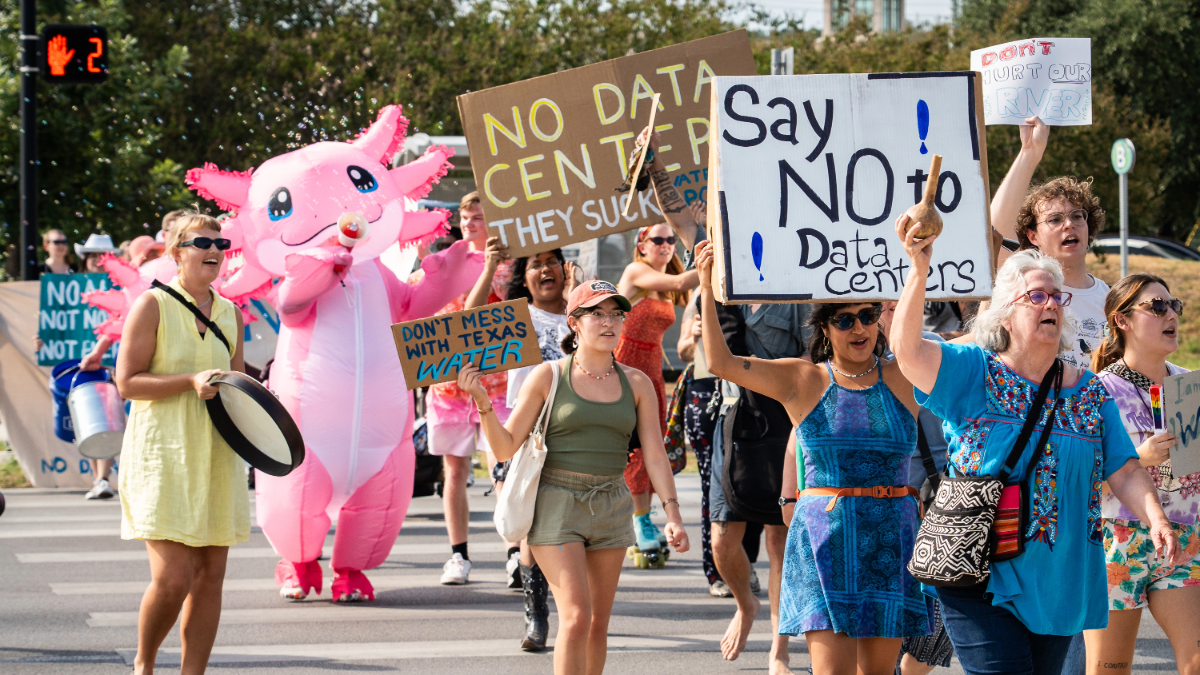
SAN MARCOS, TEXAS - AUGUST 19: Protesters walk together in the March for Water and a Sustainable Future. Activists marched for San Marcos City Park to City Hall to protest proposed data centers in the area. (Sara Diggins/The Austin American-Statesman via Getty Images)
Communities are trying to get AI companies to ameliorate the “negative externalities” created by data centers – whether it’s higher electricity prices, increased water consumption, or pollution. Some companies are, in turn, trying to proactively offer tangible community benefits, everything from fire house renovations to electricity price guarantees.
Local leaders should add one more ask to the list: funding independent community journalism.
In a narrow sense, having local business reporters would help ensure that the commitments made to communities by AI companies and data center developers are kept. The reporters could do crucial accountability journalism—tracking pollution levels, comparing electricity prices to other areas (and to corporate promises), reporting on possible water shortages, considering the impact of temporary workers on housing supplies and costs, monitoring compliance with agreements over time, and unearthing any political deals or corruption that might have crept in.
The idea of having Community Benefit Agreements that help with the provision of information has some precedent. When cable television companies wanted communities to give them the right to hang or bury cable wires, communities often demanded and got the creation of public access channels (and other benefits). Indeed, C-SPAN was basically an offering from the cable industry to ward off tougher cable regulation.
In the case of data centers, there’s a way to do this so the AI companies cannot manipulate the coverage: the companies should be required to donate a substantial grant to a community foundation or an initiative like a Press Forward Local news initiative to create an endowed business reporting position. The foundation would then determine what local news outlet would manage and employ the reporter – but the journalist's work would be available for free to the whole community.
Won’t this kind of coverage just happen anyway? No. The number of local journalists has dropped 75 percent since 2002, so few communities will have reporters to track the impacts of the data center – or many other important local issues.
Tech companies are already offering a variety of services through Community Benefit Agreements. Amazon, for instance, seems to be offering to fund everything from fire house renovations to community theater. Microsoft has proposed a bundle of commitments in Washington state that it says will provide protections against cost hikes, add workforce training and “invest in nonprofits.” So this can be included in the voluntary agreements between the companies and the local governments.
Or, governments could use a sliver of increased local tax revenue generated by the data centers to fund the watchdog reporting. For instance, Henrico County Virginia is using revenue from data centers to create a $60 million housing fund. Make $61 million, with the extra going to cover housing as well as AI.
They may not fully realize it, but having a healthy local news system is in the financial interest of AI companies. AI that attempts to answer questions about local matters in areas with few journalists will provide low-quality or misleading information. Conversely, if properly used by a professional local reporter, AI can be very beneficial.
From a community perspective, the case for subsidizing local reporting in general goes further than the need to hold the AI companies accountable. When communities lack local news, they are more likely to have greater polarization, corruption and misinformation. Strengthening local reporting – especially if these reporters are trained in how to use AI – strengthens communities.
In addition, the further erosion of local news is one of those “negative externalities” that AI is likely to create. AI-search ingests information (including from local news providers when they exist) and provides summarized answers, without compensating the news outlets either directly or by sending traffic.
The politics of restraining data center growth appears to be bipartisan. Florida Gov. Ron DeSantis and former Georgia Rep. Marjorie Taylor Greene, both Republicans, have recently called for restrictions.
This approach accepts that there may be benefits to the communities that host data centers – especially more jobs and tax revenue – but there are many potential risks, too, including some that cannot be known right now. Communities must have the right to say ‘no’ to data centers altogether. But for those that choose to permit their development, we need local reporters to serve as watchdogs, and it’s in the interest of the community itself to demand such a service.
Authors