X is a Preferred Tool for American Propaganda. What Does It Mean?
Justin Hendrix / Apr 5, 2026Audio of this conversation is available via your favorite podcast service.
Last week, The Guardian reported that United States Secretary of State Marco Rubio has directed American embassies and consulates to counter foreign propaganda. Notably, the cable apparently endorses Elon Musk’s X as an “innovative” tool to help do it, even as it instructs diplomats to coordinate with the US military’s psychological operations unit to counter what the administration deems as disinformation.
Today’s guest is Kate Klonick, a law professor at St. John's University and a senior editor at Lawfare. In a piece on Lawfare last week, Klonick says that the State Department issuing a formal cable endorsing a specific social media platform for use in its messaging—and doing so in the same document that it encourages collaboration with military psychological operations—would have been nearly unthinkable until recent months. But it’s just the latest in a series of developments that suggest Elon Musk’s X is regarded as the preferred tool of the state. Let’s jump right in.
What follows is a lightly edited transcript of the discussion.
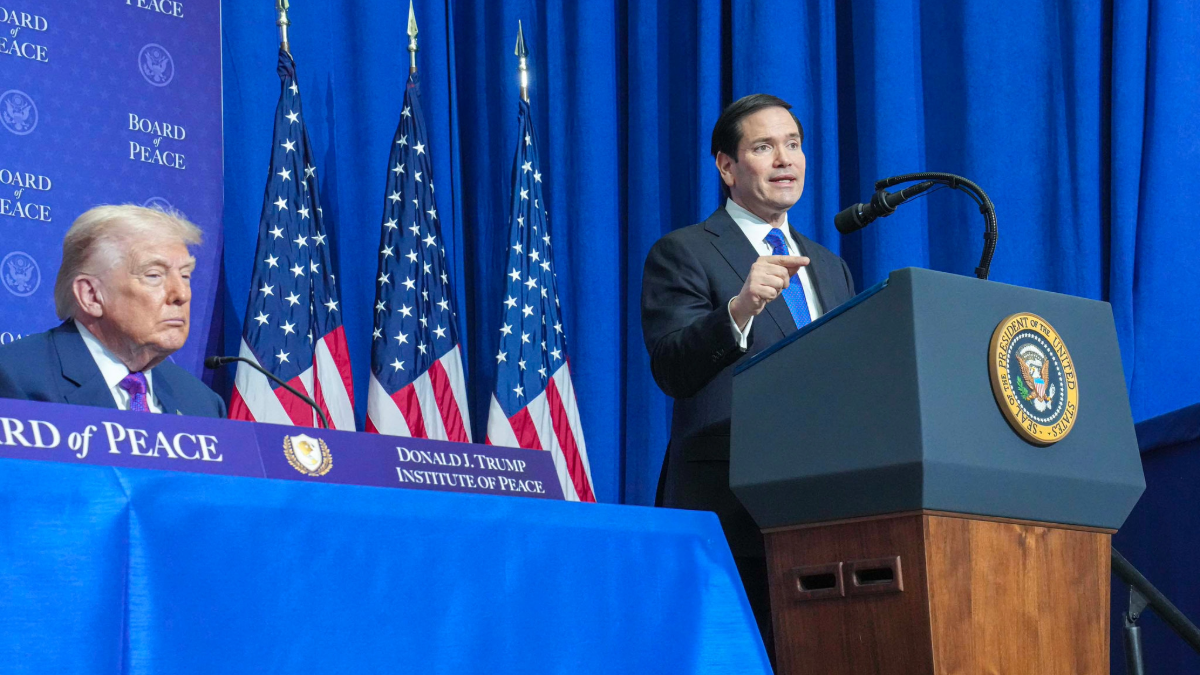
Secretary Marco Rubio attends the Board of Peace Inaugural Board at the Donald J. Trump US Institute of Peace in Washington, D.C., February 19, 2026. (Official State Department photo by Freddie Everett)
Justin Hendrix:
Kate, the last time you were on this podcast, we talked about what we were dubbing the dumbest timeline. It was all about the TikTok ban. I think we might still be in the dumb timeline.
Kate Klonick:
I wouldn't argue with you. I would say it's only gotten dumber. Especially on the TikTok ban.
Justin Hendrix:
Yeah, the TikTok ban did not work out the way I think some folks expected. And maybe it'll come up a little bit in our conversation today. We're going to talk about this piece that you have in Lawfare on Wednesday, “The State Department's X Directive and the End of Platform Independence.” We had this piece in The Guardian, "US directs embassies to team up against foreign hostility and use X to counter American propaganda." Tell us what happened. What did The Guardian uncover?
Kate Klonick:
Yeah, so I guess that they got ahold of a diplomatic cable that came from Secretary of State, Marco Rubio, that directed foreign embassies and consulates around the world that were US embassies, obviously, to launch coordinated campaigns for American propaganda and to explicitly push American propaganda and to counter foreign propaganda. And I think one of the most significant parts of this is that Rubio endorses in this diplomatic cable, specifically using X, as opposed to any other types of platforms to do this work. And he also specifically mentions that it should be coordinated with Military Information Support Operations, MISO—or what was formally known as MISO, which is now known as PSYOP, the Military Psychological Operations Unit. And that entire idea is basically to carry out this US funded narrative that feels like it came from the bottom up, feels organic, feels like it's just a thing that's happening, but it's actually a directed propaganda campaign.
And I found this to be a remarkable kind of high watermark of something that's been slowly… I mean, we've been frogs in boiling water for a long time, and I guess this was the moment that I'm like, "Okay, if you haven't hopped out now, you're never going to hop out." You have to look at this and decide that this is too much.
Justin Hendrix:
Okay. Let's step back just a second and let's talk about how you arrive at that conclusion. We've got a cable endorsing a particular social media platform by name, the tool of US diplomacy. That's what your deck says on the Lawfare piece. This appears to have some fascinating details, the US government, both taking on covert and overt messaging in order to do its thing. I mean, this isn't the first time we've heard this, right? The US government has been up to this stuff for a while. We've seen various other propaganda campaigns utilizing social media. What makes this different?
Kate Klonick:
Yeah, there's a couple of things that make this different. One is that X would be totally fine at being openly a tool of the US government. That is a significant part of this. There's also just the openness of it, the formal cable endorsing this specific social media platform and psychological operations is just, it would not have been something that happened three years ago, five years ago, ten years ago. And just that takes place in a landscape of slow changes that have changed the legal accountability, the operational independence of the platforms, and how these institutions have been resilient to this new administration and all of the pressures of tech oligarchs. And all of that has combined to make this moment also one of immense hypocrisy from the right, which has pushed this since 2021, this incredibly robust kind of narrative—or they think it's robust, this kind of fabricated narrative. They've robustly pushed a fabricated narrative of essentially the tech platforms and the censorship industrial complex, so to speak, working with government to take down or keep up certain types of content or to propagandize other types of content, all of these types of things.
Specifically, they've proclaimed a silencing of right-wing voices and a promotion of left-wing voices and things like that. And so now you have literally the government telling individuals in government to use platforms to push this and that they will find help and avenues to do it through X. And it's just so different than the world that we lived in, I mean, I guess as I spell out in the piece, pre-Elon Musk's takeover of Twitter.
Justin Hendrix:
So I've got going through my mind, Jack Balkin's triangle. We've got state power on the one hand, and we've got the private power and platforms on the other hand, we've got users on the other third leg of that triangle. This feels like a real collapse in a way. We're seeing this kind of triangle fold in on itself a little bit just with regard to this campaign. Is that the way you're thinking about it in your head a bit?
Kate Klonick:
Yeah, 100%. I love Jack Balkin’s triangle, and I think I've said it on this podcast with you before. Jack Balkin's speech triangle. Jack starts his description by saying that essentially for most of world history, we're in a dyadic model, which is just the concern of the state censoring people. And you have the press pushing back against that. You have other types of things in service of that. But the real concern is the boot of the state on the neck of people and silencing the right to freedom of expression.
And the internet creates through speech platforms, through social media, through all of these things, this third prong, adding that node to and creating a triangle is an incredibly empowering thing for speech, an incredibly empowering thing for citizens. I mean, as we've found out, it is also an incredibly powerful thing for governments to route around a lot of the privacy laws and protections that we have in this country and to surveil citizens through these platforms. But essentially, you have this third node. So you can route around censorship. You can keep your stuff up if your government takes it down.
And one of the things, I guess, when we say we're describing this and you're saying it's collapsing, I say yes, one of the things that I have been worried about, and I think this is just the triangles of perfect visualization to understand it, is this collapse of these two nodes getting closer and closer together. And essentially the closeness of the state and the platform, these two powers, which are the biggest and most obvious powers and have the least collective action problems as compared to users, citizens on the other side, is that essentially the closer that government and industry and platforms get, the more they can align and coordinate against user citizens, the greater risk to user citizens' privacy and speech. And Rubio's cable to this in this regard, a lot of the things that have happened in the last 15 months are indicative of that collapse and that alignment.
Justin Hendrix:
And of course, sitting at the center of this situation at the moment, Elon Musk, this character who was in the United States government, clearly a close relationship with the Republican Party, seemed like he might be on the outs a bit with the administration, now right back in. The fact that Rubio's cable calls the company, not just mentioning the company, but labeling it innovative, feels like it tells us something about Musk's role in all of this. What exactly is going on here, whose political objectives are being served?
Kate Klonick:
Yeah. I mean, that's absolutely part of this because to understand this on many levels, I take the piece that I wrote up in Lawfare, it goes back to basically the early 2000s and all of the things these platforms did or used to do in order to push back on government control or government use of the platforms to do various types of things, whether it be pushing back on subpoenas or going to court over right to be forgotten. There's just a whole host of things. But I think that the better place to start is Elon Musk's acquisition of Twitter in 2022, because the structural consequences of that transaction are super significant.
You took a publicly traded company, which you might think that corporate governance has light power, but it was more than we have now. And essentially what you had was, you had two things. You had FEC disclosures that had to kind of come through. You knew what the company was doing, whether it was losing money or making money. You had some concept of what was happening, what its structure was like. And then you remove all of that from another type of transparent obligation, which is that of the pressure of the corporate board and representing public shareholders. And those shareholders needed to care about brand safety and advertiser concerns, and advertisers and brand safety are depended on trust and safety and content moderation to make sure that Twitter was making money and making good on their investment.
And so if you just become a private company, you don't have a board you have to please, you don't have shareholders, you have to please. You can just completely eliminate, and that's what he did, and that's the structural piece of this, the entire kind of operations wing that does trust and safety because you don't have any reporting requirements. No one cares if you make money. You can take, in fact, a completely terrible business decision and fold it into a bunch of other things like SpaceX, as he did, and XAI, and make it a couple trillion dollar valuation because it's a private company. None of those companies are public yet, although there's about to be an IPO. None of those companies are public yet, they don't need merger approval.
And so all of that happens and it's outside the realm of any type of pushback or accountability from even the market. Even the market doesn't have any way to hold Musk accountable on X or Twitter. And so that's a huge change. And that also means that Musk can just really, he can be as absolutely evil billionaire, megalomaniac dictator about the speech policies of X as he wants to be. He can shadow-ban and down rank whoever he wants to. He has kicked tons of people and banned them on the platform. He promoted his own posts and the posts of his friends. He is openly working with far right movements in Europe before elections to promote various parties and demote other types of parties.
All of these things are happening and there's no type of pushback from a board, anything other than essentially like the European Union, which is trying to bring him to heel under the Digital Services Act. But that is a key piece to why all of this works and why Rubio likely thinks that X is in fact an innovative platform for this because it's willing to play ball in a way none of the platforms have ever played ball before.
Justin Hendrix:
I mean, just going back to our conversation on TikTok, I'm trying to imagine how the United States would've read this or how people would've read this in the United States if we came across a cable signed by a Chinese foreign minister, TikTok as an innovative platform to conduct messaging campaigns on behalf of the Chinese government. It feels like it's the same thing effectively, and other governments around the world should more or less read it that way?
Kate Klonick:
Yeah. I mean, that's one way in which this is significant. The other thing is the fact that this is essentially a tacit acknowledgement that the government trusts X and believes that X is more responsive to its goals than other platforms are. Essentially, you could read this as they think that they think they have X in their pocket, that it is like a pseudo government in service of the US government platform, and that's terrifying.
Justin Hendrix:
I was just going to say, it's not that long ago that Meta literally reported, "Hey, the US government is engaged in covert propaganda campaign to undermine Chinese COVID vaccines." And under previous regime, Twitter was, as you say, more likely to have a little institutional pushback against the US government or other governments that might want to engage in various information operations, but this just seems like, "Hey, we're in business and our goals are completely aligned. We've got a certain set of politics we want to advance. The owner of X is on board and we're in business."
Kate Klonick:
Exactly. And so I think that there is, at the end of the day, this cable and the messages that we just discussed and you just summarized are of what this communicates, that X is in line with the US government. It is, I don't know, the most open and obvious admission, in my opinion, of a future that we've seen coming for a while, which is that there was a lot of trust we had that platforms would push back on government control and that that would be in their interest to do in various ways. And instead, what we've basically seen is that billionaires have realized that they can buy one of the most massive speech platforms in the world and then sell it to the highest bidder government for propaganda purposes. And that they will own a seemingly organic website with 250 million people at least on it that looks like it's organic content that will essentially be used for pushing certain types of diplomatic or government agendas.
If he will do this for Rubio, what is to stop him from doing this for Modi? What is to stop him for doing this for Orbán? I mean, who knows if he's already doing that for all of these different kind of authoritarian governments. And you have that future just here. And I think that for a long time, a lot of us who watched this space were waiting and hoping that the tension and the war between governments and platforms was actually, even though there was such a push for regulation, I think that there was a fear that it would drive these two players closer together and that they would start cooperating. And this is, in my opinion, a realization of that fear.
Justin Hendrix:
I want to press you just a little bit on what this should mean for Europe and for leaders there. The State Department has announced it's very, in my view, interventionist policy towards Europe. It wants to advance far right interests there. It wants to mold Europe in the kind of politics that the current administration thinks would be most advantageous. A lot of Europeans still on X, a lot of European journalists, leaders, they weren't really part of the exodus that you saw perhaps a little bit more in the United States. I don't know, what do you make? Is X going to be a great channel to feed propaganda towards Europeans or to accomplish these various political goals?
Kate Klonick:
I think that the other thing to remember here is that some of this push that you've been hearing from JD Vance, from Brendan Carr, the chair of the FCC, this going over to Europe and pushing this agenda of free speech and the claims that the Digital Services Act are censorial in some way of US tech companies, that that's not actually such a righteous talking point, that it's actually not that they're super worried about, that is the beard for what they're actually trying to do was essentially to jawbone for this idea that they would like the laws of Europe and the fines to not be exercised as strongly against these tech companies. And that, I think, in my opinion, maybe that's maybe some people will say that's a cynical take, but I think it's just a realistic take because nothing that they're doing at home shows that they have any commitment to freedom of expression, for sure.
That essentially that's actually what's happening. It's not really that they care that Europe is going to be taken in by their propaganda. It's that they really are just trying to increase the influence that will make it so that they're doing their due diligence and being protectionist of US tech companies.
Justin Hendrix:
Let's just also focus a little on Murthy v. Missouri. You talk about legal questions that were left unresolved. You talk about the politics of that case, the political coalition that put it together, how they, I suppose, are exposed in this as a bit hypocritical?
Kate Klonick:
Yeah. I mean, it's the same vein of the hypocrisy that I spoke of before. It's just rich coming from the right and from Rubio and others. After 2021, there has been this absolutely fabricated narrative, overdramatized, I mean, and it's not just me that say it's overdramatized. I just want to be really clear. This case, Murthy v. Missouri, which it was a case that they brought while Biden was in office, accusing the Biden administration of contacting members of tech companies and people in tech companies and demanding or threatening some type of government action in order to get certain types of content removed from various social media platforms, things that talked about the genesis of COVID, things that talked about anti COVID vaccine kind of chatter, all of these types of various non CDC approved messaging that they wanted to have taken down. This is called jawboning. It's contrary to the First Amendment, and they brought a case that went all the way to the Supreme Court, and it was literally laughed at. I listened to the oral arguments. I'm sure you did too, Justin. The justices were like, "What do you have here? Why is this case here?"
And then you have Amy Coney Barrett basically write the opinion that says there's nothing in the factual record to support any of this and send it back down basically because of lack of standing. And so I just think that you have this administration that is so quick to point the finger or to claim censorship when the government talks with any social media platform. And now you have the Secretary of State telling everyone in foreign offices around the world to do propaganda in order to make an innovative push and that it will basically be the best place to do this type of work because it'll be the most conducive and that content moderation policies are to be the most favorable.
And I mean, it's just exactly, it's way worse than anything that they had evidence of in the Biden administration. And there just seems to be no trace of irony and no trace of just that they have just switched this position now that this shoe is on the other foot and that they're in charge of the government and that they have friends that are running these social media platforms. And it's an incredible lack of principle and hypocrisy.
Justin Hendrix:
I guess the rationale would be, this isn't about American speech, this is about changing views abroad?
Kate Klonick:
Yeah. I think that if this hadn't been such an overt cable that was sent to every single office, no one's breaking news that the US engages in propaganda abroad, that every nation doesn't have some type of kind of propaganda push and tries to convey, to create and shape the narrative on their government in other places. It's the fact that it specifically being an openly being directed by the Secretary of State through psychological operations and to my mind that it's specifically endorsing one particular favorably positioned platform. It just speaks that essentially that X has been bought by the Trump administration. It certainly hasn't been bought by the US government as far as, in my personal opinion, I don't think that this will be the favored platform of a Democratic administration. And I think that's just an incredible statement.
And that is, I think, the big takeaway. Not that there is propaganda happening abroad or that the US engages in it, but how we're going about it and how we're leveraging these online spaces.
Justin Hendrix:
You end your piece by saying, "The question is no longer whether the government can use social media as a tool of state craft, it already is. The question now is whether any institution, legal, normative or structural retains the capacity to check it." What do you think? You step back, you've been watching these issues for a long time. Maybe we have reached a real low point here. It seems like it could still get worse. I'd never want to discount that. It could get worse. Certainly tomorrow we'll read some new piece of news that will indicate we've reached yet another level, a rung lower. Can you cast your mind forward? Is there any solution to these issues to maintain that balance that is, I suppose, contemplated by that triangle we talked about, how to keep some institutional protection moving in both directions or in all directions, I suppose, between government, the private sector, platforms, media on the other hand, and user citizens on the other?
Kate Klonick:
I mean, I honestly am not super optimistic at this exact moment. And I spent the last 15 months as I know a lot of people have trying to figure out new theories of change to get at this type of this new incapacity of legal systems and this new incapacity of norms or media to control or contain any of these types of transgressions. I mean, I guess that there are still avenues through the legal system. We are seeing courts push back generally on things that the administration is doing and the administration generally abiding by those rulings. You are seeing them continue to openly go flout what we have known to be until this point. But I mean, I think that the midterms could bring a small vestige of ideally congressional pushback on this rampant executive power. And honestly, I just don't know if the government is going to continue to have the resources in light of the war in Iran to be fighting on so many fronts.
It's not going to be particularly powerful or they just don't have a lot of time or space or energy to devote to bothering the EU on behalf of tech companies when they have a massive energy crisis. And so tech is very important, especially in AI, but it will fall slightly below not having any type of energy to run the data centers that all of this AI is based off of.
So I do think that maybe that will... Wow, I just found myself, I'm like, oh, I'm actually finding myself arguing for the energy crisis that it will slow everything down and suck up the administration's time and capacity so much that they won't be able to continue waging this war on freedom of expression. But I guess yes, that's kind of where I am.
Justin Hendrix:
I suppose if we're going to slide into authoritarianism, anything that might stand in the way we might regard as a positive development, even if it's extraordinarily painful.
Kate Klonick:
I think that you are seeing the legal system stand up and rule against the current administration. And depending on where you land in the political spectrum, I do think that there is a future in which the rule of law at least comes back. And a lot of the principles that our democracy adheres to are reinvested in and things like freedom of expression and non-government interference with private speech, all of those types of ideas. And so I think it is going to be the fight of a lot of people's lifetimes. It's going to be a fight in which a lot of the things that we've spent the '90s, the 2000s, people generally have spent pushing forward more progressive agendas. I think that those agendas are going to unfortunately be at the wayside for quite a while. And we're going to have a period in which people are on more of a defensive foot as they're confronting these issues and trying to make sure that we don't lose all semblance of the concepts of freedom of expression and the right of citizens to speak up against their governments.
Justin Hendrix:
Is there a future where you see a real reset though between Silicon Valley and Washington? I mean, this feels like almost like an inevitable trajectory to me that the concentration of wealth, the concentration of power would eventually combine. Is there a world where that goes back to a happier, healthier place in any real way?
Kate Klonick:
I don't know how dark you want me to get here, Justin, but honestly, the only thing that can, in my opinion, push back against these individuals who many of them, their net worth outweighs or is larger than nations in Europe and their entire GDP. I don't know how you get at that, especially in kind of this global world and this global economy, you could say taxes, but honestly, you can just forum shop for taxes and you can forum shop for favorable types of places to live and you can go wherever you are and run your empire from wherever. And so I just think it's actually, I think it is going to be the problem of the future is how to constrain the complete kleptocracy of our governments by a trillionaire, billionaire few. And it's a good fight, but it is going to be incredibly difficult.
Justin Hendrix:
Kate, I got to ask you about one last thing that was in the press this week. Casey Newton had a piece on his Platformer newsletter about the Oversight Board and the idea that apparently Meta has discussed ending funding for it. You are someone who knows the Oversight Board in its early constitution better than anyone. I understand you were embedded there, wrote about it for the New Yorker early on. I don't know, what do you make of this?
Kate Klonick:
I mean, actually it's in keeping with the theme of this piece that I wrote and everything we've discussed, frankly. I think that the Oversight Board, and I'm working on a piece about this as well, and so hopefully I'll have that out next week sometime. So watch this space specifically at Lawfare. But the big picture is that I essentially think that the Oversight Board was this incredibly optimistic, incredibly promising moment in which we tried to empower the node of the triangle that was citizen users without the use of government. And some can say that it was a self-regulatory dream that never was going to have teeth and was a waste of money and never was going to have any type of purchase. There's a lot of things that you can say about the Oversight Board, but one thing that you can't say about what it's done in the last five years is do is treat any of these issues as light or trivial and not take in its job incredibly seriously.
It has been staffed by incredible people. It has an amazing set of board members who've written very, very smart decisions that are incredibly thoughtful. It has done a great job creating a signal through the noise of any civil society and various interest groups to feed back to Meta so they can change their policies. And it has had a huge effect on the content moderation policies of the platform at least until 15 months ago, and I think they still have an effect on it. But I think that the big picture of it is that it speaks to an era that now seems so quaint. It now seems so gone as an era of new governance, an era of multi-stakeholderism, an era of cooperation and good faith and platforms really wanting to do the right thing and not being completely driven by the bottom line, even when people thought that they were. There were moments.
I believe when I spoke to Mark Zuckerberg that he believed that the Oversight Board was the right thing to do, and that's why he was doing it. I mean, he thought it would maybe get an amount of some hot water on content moderation decisions, but I think he also thought it was the right thing to do. And I think he's changed his mind. I don't think that this was all a rouse from the get-go. So I guess in that sense, the idea that the Oversight Board will get phased out is one of them. For me, it seems inevitable, but it also just seems inevitable because of the time that we're living in. It just seems like it speaks to a way of doing business that no one is doing businesses and why would Meta keep business in this way?
No one is doing multistakeholderism anymore. No one is caring about these things. It is all turned into a pay-to-play and brinkmanship and bottom line mentality. And so I think that it's just of a different time. And I think that we will look back and be a little bit regretful that we didn't try to push for more buy-in from that, from other platforms, that we didn't try to mandate that platforms have organizations like the Oversight Board to speak to users rights and principles generally, and to give feedback on what the policies are on the site. I think that we're going to regret that, but I don't know. We'll see.
Justin Hendrix:
Well, and Casey does report that there's possibly some solution where the board gets hived off and goes on its own, truly independent, I suppose, maybe even entirely independent of Meta's funding. So I guess that story's not entirely written yet. We'll see what happens. There's certainly a long time between now and 2028. I'll just have to have you back on. We'll talk about it in a little more depth when we have more details.
Kate Klonick:
And there's a lot that I think that I can add in context and analysis, and I have some more reporting that I think is going to be a little bit more of the story and what's going to happen with the Oversight Board. And yeah, I think that it's definitely just going to be a thing that I'm always going to be glad happened no matter how it ends up in the next couple of years.
Justin Hendrix:
Kate Klonick, thank you so much. You can find her writing these days over at Lawfare and look forward to having you back on again to see if we've escaped from that dumbest timeline.
Authors