Why Social Media Platforms Should Adopt a 'Militant Democracy' Framework
Justin Hendrix / Oct 4, 2026Subscribe to the Tech Policy Press podcast via your favorite service here.
What should social media platforms do when the state itself becomes a threat to democracy? In a new paper published in the journal Information, Communication & Society, Daniel Kreiss and Lorcan Neill, both at the Hussman School of Journalism and Media and the Center for Information, Technology, and Public Life at the University of North Carolina at Chapel Hill, borrow from "militant democracy," a framework scholars developed in the 1930s as fascists exploited democratic freedoms to seize power. They offer a framework for wedding platform policies to democratic principles.
With midterm elections just weeks away in the United States and elections playing out in Brazil and beyond, I caught up with them about what the framework suggests, and what trust and safety executives can do even in a context where the interests of platform owners are fused with those of autocratic leaders.
What follows is a lightly edited transcript of the discussion.
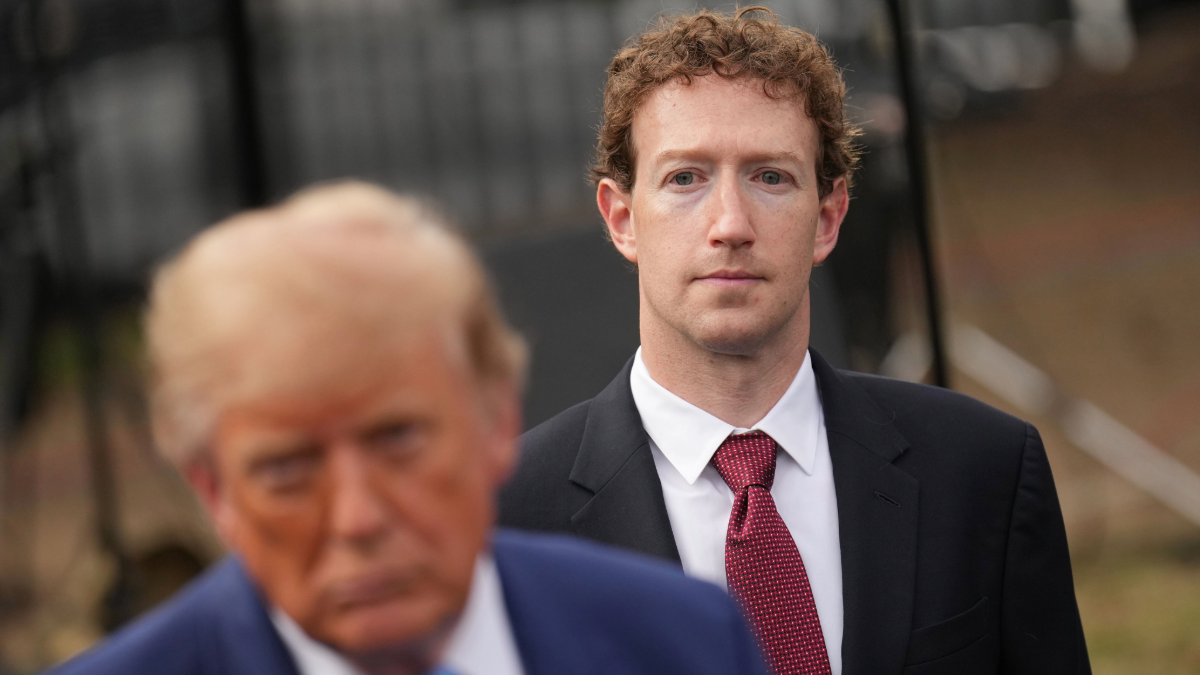
Meta CEO Mark Zuckerberg listens as President Donald Trump speaks to reporters at the White House in Washington, Tuesday Sept. 29, 2026, after meeting with top executives of AI firms. (AP Photo/Jacquelyn Martin)
Lorcan Neill:
I'm Lorcan Neill. I'm a PhD candidate at the Hussman School of Journalism and Media and a graduate research assistant at the Center for Information, Technology and Public Life, both at the University of North Carolina at Chapel Hill.
Daniel Kreiss:
Daniel Kreiss, the Edgar Thomas Cato distinguished professor in the Hussman School of Journalism and Media, also one of the co-founders and co-PIs of the UNC Center for Information Technology and Public Life.
Justin Hendrix:
And Daniel, welcome back to the podcast. Lorcan, welcome here for the first time. Glad to talk to the two of you. I got in touch after I saw Daniel posting to Bluesky about a new paper called “Militant Platform Democracy: A Framework for Democracy-Worthy Platform Policies.” And Daniel, I'm not sure how many times you've been on this podcast, but it's certainly been more than once. And I feel like this more or less has been the topic of our discussion from day one. So always excited to effectively get an update on your thinking and where things have got to and what you've added to the record here with Lorcan. But I think I might just start for the sake of the listener on this phrase, militant platform democracy. Where does it come from, this idea of militant democracy as a concept? How would you explain it for the listener that might not be familiar?
Daniel Kreiss:
Well, first of all, thanks so much for having us. I think I'd say yes every time you ask because your work is top-notch, Justin. And I'll also say, I mean, it's kind of sad that we have to continue having the same set of conversations. In fact, I think things have gotten progressively worse, unfortunately, with the things that we care most about. So militant democracy refers to a framework that scholars, most notably Karl Loewenstein, developed in the late 1930s as they watched fascists take power through democratic elections in countries across Europe. And basically the idea was simple. It was that democracies do not have to a scene and just sit by as anti-democratic actors take power and then subsequently dismantle the rights and freedoms of democracy itself. So the general idea and with incredible clarity, I mean in the 1930s is that basically fascism, which was the concern at the time, was using liberal freedoms itself in order to subsequently dismantle liberal freedoms like speech, press, assembly, parliaments, et cetera.
So what militant democrats and the framework of militant democracy basically calls for is to simply say we shouldn't let those people take power in the first place. And if that means curtailing some of their basic democratic rights, then that is what we should do. And it's taken different forms. Mostly it's been designed in the context of state power, so constitutional design, but things like banning certain political parties, for instance, would fall under that category or restricting rights of assemblies or let's say fascist symbols, et cetera, depending on the country. But the idea is you don't let people weaponize those very freedoms because once they take office, then they'll take away and they'll strip those freedoms away from other people.
Justin Hendrix:
You start this paper off with this idea that what's needed right now is democratic clarity, and maybe that's slightly where you feel folks arrived back in the 30s, 40s, so long ago when they're facing down the barrel of fascism, it was a moment of clarity. Is that sort of what you mean there, that we need a similar kind of clarity about the moment that we're in?
Daniel Kreiss:
Given what we know about backsliding governments, democratic governments around the world, it's no longer okay for those of us who study things like platforms, regulation, et cetera, to just carry on as if everything is normal. We need to figure out what's at stake, what's happening, and what can we do about it? I think a lot of the challenge is that the academic fields that we're in at least, and I think to a lesser extent, but professional conversations in the field of trust and safety, take shape from assuming that we're in stable consolidated Western democracies and therefore propose a set of things like state regulation of platforms that during normal times are really great ideas. Because in essence, we want to use platform power and to use the power of governments to rein in the commercial excesses of social media, tech platforms, et cetera. But the fundamental thing that Lorcan and I are thinking through is, well, what happens when that state has already been captured or is in the process of being captured?
And then anti-democratic political leaders like Donald Trump can wield the state against civil society and against free media and against free platforms themselves. Why would we go on talking about increased state regulation when basically all that's doing is giving Trump more power? And I think that's our biggest concern is that any context of regulation or any context of governance is the better word here, we have to think through the context within which it's taking shape. But in backsliding democracies, it doesn't make any sense at all to be talking about state regulation of free media because in essence you're just giving the car keys to the drunk.
Lorcan Neill:
Our goal with this piece is to provide a starting point for conversations that break out of this mold of focusing on state regulation of government regulations and thinking more critically about what do we do with platforms in terms of their content moderation policies in states, like Daniel said, that are either undergoing democratic backsliding or have already backslid into authoritarianism and any kind of state level regulation is likely going to make things worse and increase the power of the autocrat that's taken power. I think the other part of this that's important to note is that we feel it's democracy's under threat now, that the alarm bells are ringing now, that it's important that we start having these conversations now about what we do to try and either hold the line or push back the autocratic and anti-democratic forces that are massing more and more power in countries like the United States and across Europe and South America.
We feel this is part of our responsibility as researchers, as academics, and people who just generally care about democracy to put forward an argument that people don't have to necessarily agree with. We are by no means acting like this is the golden plan or the only plan that can be put in place here. We are simply putting a red line in the sand and saying here is what, based on our research, based on our expertise, what democracy worthy platform principles would look like and hopefully giving a ballast to the thousands of good trust and safety people who do work at these platforms who toil underneath the more market driven, less democratic, maybe incentivized leaders of these corporations is to give them something that they can go to their bosses with or go to their superiors with as a way to try and affect change from the inside out.
Justin Hendrix:
I think the phrase you use in the paper is morally bankrupt leaders, if I'm correct.
Daniel Kreiss:
Don't we say craven too? I think we say craven as well at some point.
Justin Hendrix:
Let's make sure we get craven in there. You're not pulling your punches, but let me just ask for the sake of getting it in people's heads clearly. I feel like we come back on this podcast a lot to Jack Balkin's triangle, the state, platforms, the public, civil society, the balance of power between these entities, these institutions. Make the case for what role you think platforms have in this moment when it comes to defending democracy or being, I suppose, at worst neutral in the battle over outcomes with relation to democracy and authoritarianism.
Lorcan Neill:
Yeah, I think there's a couple of different things we talk about here in terms of the either responsibilities of platforms to be pro-democratic and also the reasons why they should be. Whether they like it or not, platforms are integral to political processes and elections and other kinds of forms of government around the world. We kind of conceptualize them as communicative institutions of civil society. So whether it's campaigning, whether it's reporting, whether it's advertising, platforms are embedded within our political systems and processes. So to absolve them of being in some ways responsible or at least to be more pro-democratic absolves them too much of their influence. And there's also the fact that the very democratic values around free speech and the accumulation of power and wealth in a free market society that made them the giant corporations and gave them these influence they have today are the values that these anti-democratic leaders so often destroy in terms of free expression, free assembly, free press.
So when they are not taking action against anti-democratic political leaders and allowing their technologies to be used by these folks to undermine these values, they're essentially acting as agents of the state at that point. So what we're kind of calling on here is that platforms have a kind of responsibility given how ingrained they are in political processes, but also a financial and reputational advantage of supporting democratic causes to be more pro-democratic in how they prioritize the collective democratic rights of their users over the single expressive rights of political elites.
Justin Hendrix:
This paper kind of gets into some of the other phenomena we've witnessed. Of course, you spent an enormous amount of time thinking about January 6th as a moment and why it's so important. Here you also address instances where these issues rise up in Brazil, in India. I don't know, it feels like we're just kind of collecting more and more evidence, more and more phenomena as we go along that sort of play this out. But I don't know, is there anything else that you'd point to, Daniel or Lorcan, just in terms of the phenomena that we've witnessed over the last couple of years that kind of point in this direction?
Daniel Kreiss:
So what we know from a pretty massive now comparative political science literature is that what we're seeing in the context of democracies backsliding around the world is a process of executive aggrandizement, which is just a fancy way of saying someone gets elected to office and then they gradually expand their powers and undermine accountability over what they have the power to do. So the US is a really great case. In fact, it's a pretty dramatic one in terms of the speed and the rapidity with which Trump has undermined accountability over his power. But this can take many forms, right? So it can happen through capturing state institutions. It can happen from then using those state institutions in order to create an uneven electoral playing field or to target opposition media or opposition funding. It comes with attacks on media. We saw a pretty vivid case playing out in front of us, like banning media outlets whose coverage Trump doesn't necessarily like.
The important thing in this, I think, is it starts there. It starts with a political leader, a political movement, and often a captured political party that sort of works, wins an election and then works to undermine aspects of the democratic state itself. Platforms play a role in that, in facilitating that power taking place, but they're not creating democratic backsliding itself. It's mostly because they are a vehicle through which anti-democratic leaders take power. And then once they're in power, they use those same platforms in order to browbeat, bully the opposition, harass election officials, whatever that might be, that will then help them, again, undermine basic checks or accountability over their power. Now, what we are arguing fundamentally in this paper is to say if platforms are being used in this way, if they are vehicles for anti-democratic leaders to take office, and then if they are vehicles through which executive aggrandizement happens, they should have the normative democratic clarity to say, no, we will not be used in that way because we have a set of democratic commitments.
What does that mean? That means having a clear set of principles that guide things like content moderation, who has the rights and responsibilities to use their platforms, which content they take up, which content they leave down, that they can make these decisions proactively from a democratic standpoint, one, to prevent anti-democratic actors from taking power in the first place, and two, once they take power to then stop enabling them and giving them a platform to do things like harass the opposition, target political enemies, whatever that might be. So to your basic question, who decides? We think platforms should decide for themselves because they are communicative institutions of civil society because they should have a set of democratic commitments because that's in their business interest, it's also in their democratic interests. And because they themselves have espoused these principles like freedom of expression, like acting to protect things like electoral democracy, they've explicitly stated this through their platforms and through their policies before, so it would require their clarity.
And here's the ironic thing since you brought up January 6th, what we argue, and I think what is incontrovertibly shown in the context of the various committees that produced the reports, platforms knew exactly how their platforms were being weaponized. They knew exactly what they could have done in order to stop January 6th from happening, but they didn't do it. They didn't do it because they were worried about free speech, because they were worried about who might be taking power afterwards. There was a complex mix of motivations, but it's precisely because they weren't clear about what their commitments and their values are, and they didn't listen to their own employees that they didn't take action soon enough. Trump should have been de-platformed far before January 6th happened. The election lies that were circulated in order to undermine the election should have been prevented from being on every major platform.
There shouldn't have been covert and coded calls to political violence on January 6th. That should have been prevented in advance. It should have remained a very niche phenomenon from a discredited and illegitimate politician after he lost the election.
Justin Hendrix:
Aren't we in the case though now where it seems clear that the platform owners are politically aligned with Trump and actually quite happy to see the executive take on more power? I mean, we've got this kind of added dimension now where even more than perhaps in January of 2021, these platforms are all defense contractors. They're all allied with the American state on some level and seem invested right now in Trumpian politics.
Daniel Kreiss:
Well, here's the thing, not to be too nihilistic, but what are you going to do about it? You're going to propose state regulation? I mean in the US, you can't do that either because again, the state is aligned with the platforms here. That's the biggest thing we fear. We fear state power the most. So the only thing we're kind of left to do is to say, look, you have these democratic responsibilities, you need to have that clarity, and then we could push civil society and from below to try to create a pro-democratic movement. But proposing state regulation in the platforms right now is basically just handing Trump the tools to further erode democratic freedoms.
Lorcan Neill:
We're pretty open to peace that we're not naive about whether these principles are going to be enacted tomorrow by the platforms. That's not our goal here. Our goal here was to kind of set out a set of standards and principles that could be used down the road, hopefully, or by other platforms that do have more robust commitments to pro-democratic policies and supporting and protecting democracy. Because we also know that there was a time that platforms, at least on the surface, cared more about democracy when they banned Trump, of course, following January 6th, granted too late, but also when they put extra guardrails on his accounts, when they're much more active in filtering election disinformation and putting tags on things, all of that has largely been rolled back since the 2020, 2021 high point of content moderation. So we kind of make this argument in the paper that platforms have done this before and have shown a willingness before to at least have some commitment to democracy and some commitment to free and fair elections.
So there's no reason why we can't expect that same commitment, and we argue a much broader, deeper commitment from them now, even if it's not going to take effect tomorrow.
Justin Hendrix:
It also strikes me where two months out from the midterm elections, there is the possibility of civil unrest or more state violence potentially even tied to election day itself. We'll see this idea that there'll be federal troops and/or FBI agents, others dispatched at polling places. We've heard various promises from the administration about this. It strikes me that the platforms could find themselves in a real dilemma if in fact we're not looking at the type of violence we saw on January 6th, which was violence by individuals in many ways against the state, but rather violence by the state against individuals that's intended to interfere somehow in the election process. This is not a question so much as a prompt. I don't know. You put this paper in, I don't know, I assume many months ago, things have changed, the situation has changed and evolved since then.
I don't know, what are the kind of imaginaries that you're entertaining at the moment?
Daniel Kreiss:
If there's any sort of underlying theme of the paper, it's that platforms have to proceed from an analysis of power. And I mean, I guess one of the things is we want to just take off the table is actually it's not a dilemma, right? This is a state alleging that an election is going to be stolen without any evidence whatsoever. This is a state that is captured by a president and a political party that has an interest in making that argument and then engaging in intimidation and violence in order to create an unequal electoral playing field. This is a state that has investigated opposition members, protestors, et cetera, in an attempt to silence and intimidate and bully in order to weaken the power of the opposition in order to contest elections. There's no dilemma there. What do platforms do? Platforms should be platforming the opposition.
Platforms should be working overtime to make sure that they're protecting opposition voices as alternatives to the state and giving them the highest level of protection and taking down partisans that are aligned with state power, including agents of state power themselves from using platforms in order to create that unequal election playing field. Oh, and by the way, and this is something that's interesting, is we actually have a body of Facebook Oversight Board rulings that have exactly made this distinction in other countries before, where they have said that pro-democracy activists that are using platforms in order to hold the state accountable deserve a different set of speech protections than those seeking to silence them because they're aligned with state power. So there's actually precedent here as well that platforms can make this distinction. They also then have to override their immediate business interests and put the thumb on the scales for democracy here in the United States.
Lorcan Neill:
We're also trying to push back somewhat on the binary that seems to happen a lot, whether we're talking about the media, other academics, political commentators and thinking about pro-democracy and anti-democratic forces. They are not two sides of the same coin that deserve the exact same rights as the other. One side is committed to a pluralistic multiracial democracy where people have rights, freedoms, and basic kind of pursuit of happiness in life. The other side is the opposite of that. They are basically ruled by folks who want to enact strict hierarchies and eat unequal social systems based on the color of somebody's skin, the faith that they practice, where they're from, and ultimately kind of enact regimes of pain and suffering. So to view them consistently as two sides of the same coin also risks kind of legitimizing the anti-democratic forces alongside what should be more protected and more uplifted by folks like ourselves is the pro-democracy and platforms like they have in the past.
Justin Hendrix:
So another thing that I kind of gravitate towards in this paper is the idea that platforms should be taking intervention based on the situation on the ground in particular nations. And you kind of say, "Well, things look different in a backsliding democracy versus an electoral autocracy versus a obviously authoritarian state." The US at the moment, it feels like it's in a kind of tricky spot. It's in a kind of transitional point. If you look at some of these democracy indexes like V-Dem, they no longer grant the US the status of liberal democracy. They think of us more as an electoral democracy. Obviously on a steep slide at the moment, it seems like. And I feel like I'm talking to you while there are headlines swirling around about Trump kicking out established media organizations from the White House press pool and launching what to anyone who's paying any attention looks precisely like the type of authoritarian state media alternative that one might see in various other countries around the world.
What's your sense of how platforms should view the United States right now, what their operating mechanic should be for thinking about the status of US democracy? Is it in a place where it could be salvageable or do we have to kind of trade on the idea that it's in a kind of difficult to arrest decline?
Lorcan Neill:
Kind of like what I said earlier, I think there's no denying. We have the empirical evidence from folks like V-Dem, from political scientists, from folks in our field that show that the US is undergoing democratic backsliding now. Democracy's under threat now. The V-Dem graphs are great in the sense that you can see that the level of democratic backsliding during Trump's second term is actually happening at a quicker rate than countries like Turkey or India or El Salvador or Brazil when they were going through democratic backsliding. So in many cases, the situation in the US at this current moment, and if it continues along this trajectory and speed, is going to be worse than how those countries ended up when they backslid into more authoritarian types of government. So I think there's a reason to think of platforms being the kind of key nexus here in that they exist outside of the state.
We don't make any argument that they are somehow state power or have the ability to enact state sponsored violence or use the military or police force. So they have this freedom that agents of the state don't have to go above and beyond what state regulation could even provide in terms of protecting democratic freedom to democratic rights because they're not, they're private companies. They're not bound by the political forces or the government regulations that other regulatory bodies would be. And so that's how we kind of ground our core democratic concerns in terms of what are the principles that platforms should focus on when they're creating these policies or thinking about how they'd be more pro-democratic. It's like first and foremost is the right free and fair elections because elections are the cornerstone of democracy. It's how democracy happens without free and fair at elections. Where are we exactly starting from?
And then of course the second one is the promotion of democratic norms, countering threats and violence. January 6th in the US and January 8th in Brazil make very clear how technology can be used as a vehicle for political violence and political threats and cause people to act differently. That's the kind of key nexus of the threat that makes it specifically powerful for people to act differently in terms of at the very least who they're voting for or at the very least if they're going to protest or not. It's very key to how they hold onto power. And then finally, the last kind of democratic concern as we call it, is accounting for these power differences in contexts across different democracies. And this is where basically accounting for differences of social groups, but also differences in where these threats of democracy are happening are so important.
So the threats that are currently happening in India are going to look very different than what's happening in the US, which is going to look very differently than trying to moderate Bukele in El Salvador or try to support pro-democratic movements in Poland. There's not going to be a one scale or there's not going to be a one size fits all scalable approach to this for platforms. This is going to be a kind of context dependent, highly specialized effort that requires a lot of nuance and experts who know what they're talking about in these countries and in these contexts.
Daniel Kreiss:
Maybe to put it a little more colloquially, I think to your question, Justin, this piece was written from a perspective of hope, clarity, and agency, hope that we can reverse this tide. I mean, I think we know from the literature, everything is always potentially salvageable. There's no one end state where things are just consolidated until the end of time. In fact, part of our presumptions that there was only one path to democracy I think kind of led us to a moment of walking away from our clarity that democracy is a contingent achievement. So this is very much this idea that we have hope for a better world. We have hope for that world of a pluralistic, multiracial, multi-ethnic democracy premised on a set of freedoms that civil rights activists have been fighting for in the United States for a very, very long time. Clarity is exactly with we need to be just very clear-eyed about what's going on and we need to be very clear-eyed about our commitments and what we're ultimately going to draw a line in the sand for.
And I think one thing we know from the democratic backsliding literature is what Nancy Bermeo calls is that oftentimes these processes are characterized by a vexing ambiguity. It's really hard to know through any one set of actions, well, where's that line where we're not democratic? Where has it been crossed? It's really tough for citizens to sort of say in the chaos of every single day that brings new news that at some point we've hit a no return or at some point this is truly worrying, et cetera. But even though it's vexing and it's ambiguous, that shouldn't take us away from being able to say with clarity that add all these things up, where's the trajectory? Where's the bigger picture? Where are we heading? So that ambiguity should not be paralysis. And then finally, and I think this is something that Lorcan and I believe deeply in, it's the agency to do something about it.
We didn't write this because we thought platforms are so far gone they're never going to do anything again. We wrote this to sort of remind them that we're actually all in this together. We all have a set of stakes in this, civil society, journalists, democratic activists, both political parties that have an interest in playing this democratic game in perpetuity in the future where someone can lose an election and then get off the mat and then go fight the next one. We all have a stake in that. So if we didn't have that agency, I think we would say, look, it's over, it's lost. There's nothing to do except to go hide, live in the shadows or move to Canada, whatever that might be. But I think if you look at other examples like Hungary and Poland that are deeply inspirational, South Korea, countries have sort of walked back Brazil from exactly these threats and then are going down the long hard road of how do we correct those flawed institutions that got them to that place in the first place?
How do we build back stronger? How are we resilient? And then how do we consolidate democracy? That is what the agency sort of requires where we go from here.
Justin Hendrix:
Well, in many ways you could read this paper also as a communication to trust and safety workers, how they should think about this. We've already kind of brought up this problem of there being often a misalignment between what trust and safety workers might believe or want inside their organization and what your ultimate boss who may or may not be accountable to anyone may believe or want. But if there are trust and safety workers thinking about elections, thinking about these issues that might listen to this or might pick up your paper, what would be the one takeaway you'd want them to have? What would you want them to think coming out of it?
Daniel Kreiss:
I think it's exactly the clarity argument. What's going on and then what should we do about it if we have this commitment to democratic life? And I think again, the overwhelming evidence is clear that the United States is in a moment of democratic backsliding, that we're in a moment of global democratic recession as the most recent V-Dem 2026 report called it. So given that this is happening, the question is what can the people working in these companies do to arrest that sliding away from democracy? What can they do to promote democratic institutions and norms and publics? And what can we all do? And I think it's really about that clarity and then the agency that they can actually take. And we know, and I think this is a great point. We've been working with platforms for over a decade now, and there are so many good people who care about democratic outcomes, who've been making arguments about what they should do differently if they actually centered their democratic commitments.
And oftentimes that falls on the deaf ears of their bosses or gets lost because there's trade-offs between revenue or other sets of concerns. But that fight is still worth having. And we also, just to validate, we see you. When we acknowledge and we see the importance of your work, even if your bosses don't always see that. And I think that's a great story of January 6th of the heroes who sort of worked within those companies to say, "We need clarity about what's happening and we need to do something to stop it." And who fought until the very, very end. And that was a noble fight that also resulted in, I think, preventing future violence from happening because eventually what was playing out on television screens and the violence at the Capitol became too much to bear. And then that coupled with the internal pressure to do something about it ultimately led them to make the right decision when they de-platformed Trump after January 6th.
What would've happened if we had the same movement within a Republican Party to de-platform Trump from Republican Party politics so that he couldn't take office again and then lead the United States further down this road of backsliding? We needed more heroes in a Republican Party to step up and to center their democratic commitments and to take their action as democratic gatekeepers. And that's what we're calling and hoping that platforms step up and do now.
Justin Hendrix:
Well, Daniel, Lorcan, I hope folks out there are listening, reading your work and will take action as a result of your suggestions here. So I thank you for joining me.
Daniel Kreiss:
Thanks, Justin. Thank you.
Authors