Why Parental Consent Policies for Social Media Do Not Help Families
Jonathan Haidt, Marisa Shea, Zach Rausch, Ravi Iyer / Nov 2, 2026
A child peers at a smartphone screen. Shutterstock
As governments around the world act to protect kids online, many — including the EU and several US states — are considering age minimum policies that include parental consent provisions. These policies typically allow kids in specific age brackets (e.g., 13- and 14-year-olds) to create accounts on social media platforms such as TikTok, Snapchat, and Instagram with parental permission. This can sound like a reasonable middle ground in the debate over kids and social media. Why not let each family decide? But parents and policymakers should not be fooled.
These models fail parents and kids in three significant ways:
- They perpetuate the collective action trap in which parents feel they must allow their children access to risky or harmful social media platforms so they won’t be socially isolated.
- They fail to protect kids through puberty. The kids who “win” the argument with their parents are exposed to addictive and manipulative designs, harmful content (e.g., suicide and self-harm encouragement), and unwanted contact with adult strangers during a time when they are undergoing rapid brain development.
- Parental consent does not make addictive products safe for children.
Policies should instead mandate strong and enforceable age minimums for harmful and addictive social media platforms; mandate safer design and only allow companies to provide their service to minors once they’ve proven it is safe; and shift the burden of enforcing restrictions away from overburdened parents and onto the companies. If we want to protect kids on these platforms, we need actual reforms, not a codification of the status quo.
1. Parental consent models keep everyone locked in the collective action trap.
It might seem that parental consent simply lets parents make a decision based on their own calculations about what their child is developmentally ready for. But in reality, by leaving the door open for kids to beg for access because their friends have it, parental consent policies undermine parents’ ability to hold a firm line and delay social media use until the end of puberty. In other words, these policies codify the current harmful system where parents and kids are caught in a collective action trap that benefits no one but the companies.
A collective action trap is a situation where everyone does something suboptimal because if they were the only person to choose otherwise, they would end up even worse off. An example would be a parent choosing to give their child access to TikTok at age 12 because otherwise their child would feel socially ostracized. Economists have measured this kind of trap directly for social media platforms. In a study published in the American Economic Review, college students reported needing to be paid $55 to deactivate TikTok and $47 to deactivate Instagram if everyone else stayed on. Yet the same students were willing to pay $24 to have TikTok deactivated for all of the participating students at their university themselves included, and $6 for Instagram. And in a 2025 Harris Poll of American parents conducted with Jonathan Haidt and his research team, 54% of parents said they felt they had to give their children social media, not because they deemed their child ready, but because so many other families had already done so. This is the social media collective action trap at work.
There’s a reason that social media companies strongly prefer policies that include parental consent and push for this approach at every opportunity: instead of freeing families from the trap, policies that include parental consent models cement it in place. As soon as some parents allow their children access, other kids will beg for permission, parents will feel pressured to give in so their child isn’t left out, and the companies keep their youngest users — along with the data and revenue they provide. Meanwhile, families end up back where they started: forced to choose between isolating their children socially or exposing them to products they know are harmful.
What parents and kids need is to be freed from the trap by a well-enforced age minimum for harmful and addictive products, which is why the great majority of parents globally support age limit policies.
2. Parental consent models do not protect puberty.
Over the past decade and a half most children have gone through puberty on social media, and any parental consent model is likely to leave this status quo intact. Developmental psychologists see puberty as a “sensitive period” in which the brain is especially “plastic” or malleable. The brain is changing from the child form to the adult form, and those changes are guided by whatever a child does repeatedly. Neurons that fire together wire together, as brain researchers say. A child’s brain will enhance connections among whichever neurons and circuits are activated repeatedly, at the expense of neurons and circuits that are underused. That’s why it’s essential for policies to protect kids through the end of puberty — which is over by around age 16 for most teens.
The average adolescent in the US spends nearly five hours a day using social media, according to a 2023 Gallup survey. In the EU, 25% of teens exceed six hours of screen time on a typical school day, and that percentage jumps to 46% of teens on weekends. Policies that allow social media access with parental consent will fail to improve this for most adolescents.
At stake here is not just adolescents’ mental health, which a growing body of evidence suggests can be damaged by social media use via multiple pathways, but also their cognitive and social development. Social media use typically rises as children enter puberty, and that usage is correlated with reading and attention difficulties. A JAMA study of more than 6,000 adolescents found that those whose social media use rose to about one hour a day by age 13 scored roughly 1 to 2 points lower on standardized reading, vocabulary, and memory tests than children who used little or none. (The tests were scored like IQ tests, in which the mean is 100 and the standard deviation is 15.) Those who reached three hours a day by age 13 scored 4 to 4.5 points lower on vocabulary and memory tests, close to one-third of a standard deviation, which is a substantial effect in education research. By one benchmark, this is roughly 8 to 11 months of typical progress in reading and math for a 9-year-old, and 12 to 15 months for a 13-year-old. A separate Karolinska Institute study followed 8,324 American children for four years and found that social media use predicted a gradual rise in inattention symptoms. Television and video games did not. A 2026 study in Nature Human Behavior of more than 5,000 Italian students found causal evidence that students who got access to social media earlier performed more poorly than those who gained access later, even when comparing groups of kids that were similar prior to gaining access.
The latest Programme for International Student Assessment (PISA) data, based on the test performance of 15-year-olds in 91 countries, has raised a global alarm bell about deteriorating educational performance. The OECD reported in September that PISA 2025 produced the lowest average reading, science, and mathematics scores it has ever recorded. Average reading scores fell 28 points across OECD countries between 2015 and 2025, which the OECD equates to about a year and a half of learning. Andreas Schleicher, OECD’s director for education and skills, noted in the report that falling rates of reading for pleasure and the shift to digital reading, such as skimming social media feeds, are prime suspects (among others) in the drop in reading scores.
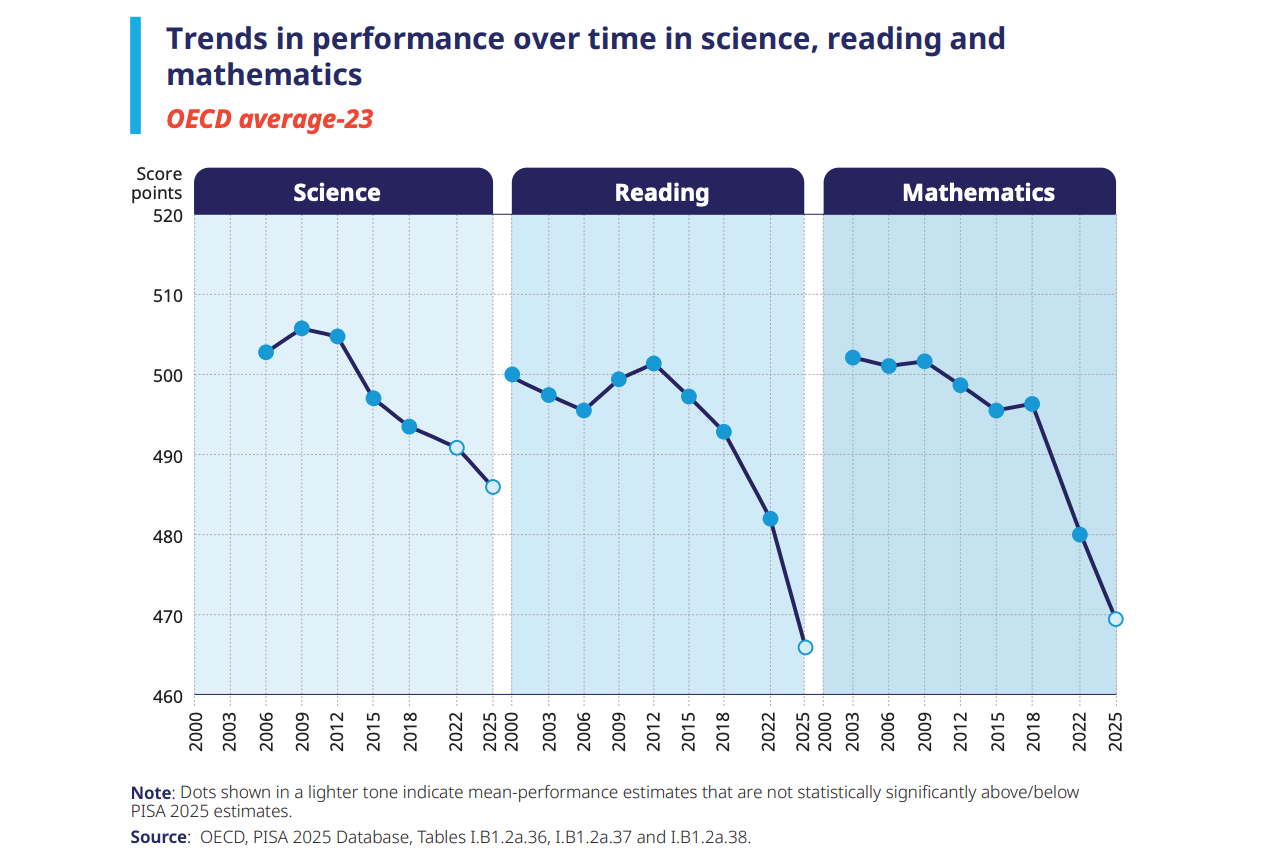
PISA score declines in science, reading, and math (OECD nations; 2000-2025). Screenshot source: OECD Insights and Interpretations (p.11)
Beyond these cognitive costs, social media platforms also enable widespread unwanted contact between adults and children (including sextortion), expose children to harmful or age-inappropriate content (including self-harm, suicide, and pornographic content), intensify social comparison and status competition, and fuel cyberbullying and harassment. These risks to kids’ physical safety and social development may be especially harmful during puberty, a period marked by increased risk-taking and heightened sensitivity to peer evaluation and social acceptance.
To raise a generation of high-performing, mentally healthy young people, we must protect their brain development until the end of puberty. The age range of puberty varies across cultures and historical eras, but in modern developed nations it generally begins between ages 8 and 13 for girls, and a year or two later for boys. By almost any measure, the median boy and the median girl are still in puberty on their 15th birthday, which means that their brains need protection from mindless scrolling until at least age 16.
This means that any country that allows its 13- to 15-year-olds to access social media with their parents’ permission will continue to expose adolescent brains during a highly sensitive developmental period to products that a growing body of evidence suggests are harmful to that development. Platforms want this to happen. Parents don’t.
3. Parental consent does not make addictive products safe for children.
In March, a California jury held that Google and Meta were responsible for depression and anxiety in a woman who used social media for many years as a child, sometimes for as much as 16 hours a day. The jury found that the companies were negligent in the design of their platforms and that they failed to warn users of the risks.. This jury verdict built on what research and internal company documents have already been telling us: Big Tech companies deliberately use design elements that encourage compulsive use. These design elements are especially risky for children and teens because executive function and self-control are among the last brain functions to mature. In fact, a TikTok internal report from TikTank, a company research team, that was revealed in an improperly redacted court filing observed that “Tiktok is particularly popular with younger users who are particularly sensitive to reinforcement in the form of social reward and have minimal ability to self-regulate effectively.”
Addictive products are designed to cause a compulsive desire to use the product, making it difficult for children to regulate their use and for parents to enforce limits. That is why we do not allow companies to sell cigarettes or alcohol to minors, regardless of their parents’ consent. As a society, we recognize that some products pose risks to children that parental permission cannot eliminate. Parents should not be expected to manage, through supervision and ineffective parental controls, the addictive features that companies have built into their products.
Conclusion
Lawmakers around the world are heeding the call of parent-advocates and researchers. They’re standing up to social media companies and introducing policies that seek to better protect kids online. To ensure these policies truly help families, lawmakers must ensure that the proper parties are responsible for the safety of social media companies’ products.
Parental consent requirements are a favorite proposal of the tech industry, and they should not be trusted. At a time when families fight over screen time and parents feel that technology makes parenting harder, parents need laws that protect their kids and make parenting easier. Simple rules, simple age limits — as we have for nearly all other addictive products — are the best way to protect kids, help parents, and solve the social media collective action problem once and for all.

Authors