Why 'Made in Europe' Won’t Fix AI’s Deeper Problems
Margarida Silva / May 27, 2026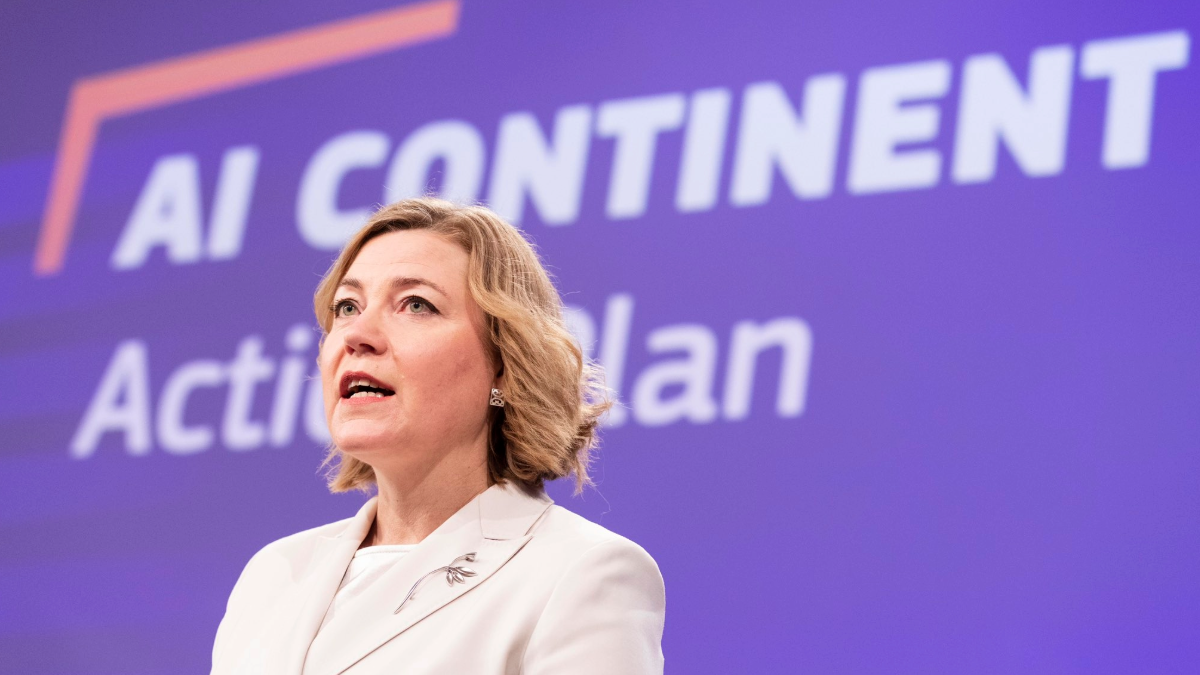
Henna Virkkunen, Executive Vice-President for Tech Sovereignty, Security and Democracy of the European Commission. Source
After repeated delays, the European Commission is set to present its long-awaited tech sovereignty package on June 3, aimed at expanding Europe’s cloud and AI infrastructure capacity. The proposals are part of a broader plan to establish the EU as an “AI continent,” increasing the use of AI in public services and creating a preference for technology “Made in Europe.”
While the push for tech sovereignty signals a strategic shift, the Commission’s parallel drive to embed AI everywhere, all of the time, risks significant costs for the environment, public budgets, and workers.
Public procurement as a policy lever
Public procurement is rarely politically glamorous but it is one of the most powerful tools available across governments. Every year, public authorities, ranging from EU institutions to municipalities, spend an estimated €2.6 trillion buying products and services. This is equivalent to 15% of the EU's total GDP. That spending power gives the public sector more leverage over markets and the economy.
At the EU level, there are now intense discussions on how to channel this buying power to bolster digital autonomy and innovation.
In cloud services, the sovereignty argument appears quite straightforward. Following geopolitical tensions and concerns about US policy shifts, questions around data access, security and vendor dependence have become more salient. Yet, Microsoft, Amazon and Google together still control over 70% of the European cloud market.
But what makes a cloud sovereign?
What counts as sovereign infrastructure remains unresolved. The European Commission has attempted to define the concept, but the answer is contested. US-based hyperscalers have lobbied heavily against exclusion from the EU’s sovereignty push, arguing that such measures would be discriminatory. This is a common refrain in Big Tech’s Lobby Playbook.
European cloud providers, in turn, are demanding a strong European preference that takes into account the location of corporate headquarters to prevent “sovereignty-washing”. Their concerns intensified after the EU Commission awarded a sovereign cloud contract to a Google joint venture.
Open source advocates, civil society organizations and policy institutes have stressed that ownership rules alone are insufficient. To prevent future dependencies, they say, sovereignty must be complemented with a preference for open source technologies and interoperability standards.
According to an EU official, the cloud sovereignty plan has been met with “very effective lobbying” that painted it as too expensive and burdensome. The latest delay reportedly came after warnings from the US ambassador to the EU that “protectionist” measures could threaten the US-EU trade deal.
From cloud sovereignty to AI industrial policy
Cloud infrastructure is only one part of the EU’s tech sovereignty push. The much wider ambition is the EU’s plan to become an “AI Continent”: Europe’s own attempt at joining the corporate-led “race to win AI” by boosting a “sovereign EU AI ecosystem”.
To achieve this, the Commission wants to boost AI use by, among others, the public sector. In their own words, the Commission is aiming to “accelerate the adoption of European scalable and replicable generative AI solutions in public administrations with a special focus on education”.
This aligns closely with the demands of European companies such as Mistral, which has advocated for EU policies that would “drive demand for homegrown AI” as the “only way to win the AI race.” The company frames AI development as a “collective duty” to ensure systems reflect European values, and supports measures including deregulation, tax incentives, and “Buy European AI” procurement preferences.
GenAI is not just another digital service
Extending sovereignty policies from cloud infrastructure to generative AI appears consistent on the surface, but the underlying technology operates on fundamentally different terms. Generative AI, the type of AI championed by OpenAI, Anthropic and Mistral, is based on large language models that are trained and run on massive clusters of specialized and expensive chips. While these clusters are mostly hosted on data centers, just like other cloud services, they require much bigger data centers, which consume a lot more energy. According to the International Energy Agency, “a typical AI-focused data center consumes as much electricity as 100,000 households, but the largest ones under construction today will consume 20 times as much.”
These models are also extremely costly to run, which is why the start-ups making them have made several partnerships with Big Tech firms. Now they are increasingly turning to governments.
Limited but expanding public sector adoption
Public sector uptake of generative AI in Europe remains relatively limited but is growing. This also sets it apart: Public services already heavily use clouds both for “infrastructure-as-a-service” and “platform-as-a-service”. A sovereign push there should mean replacing services that are already used.
Data from the European Commission’s Public Sector Tech Watch shows that out of almost 2,000 cases of public administrations using AI in Europe, only 200 involve genAI. That is just 1 in every 10 AI projects.
Examples include the Commission’s internal tool GPT@EC, which provides controlled access to models such as Meta’s Llama and OpenAI’s ChatGPT, and the European Parliament's use of Anthropic’s model to make “Archibot,” built using Anthropic’s model to assist with queries to its historical archive.
At the national level, the Maltese government just announced a new partnership to give access to ChatGPT to all its citizens. They joined the Greek and Estonian governments in distributing access to ChatGPT to schools.
Like many public procurement databases, the data is too incomplete to make sweeping assessments. But the broader picture is clear enough: the public sector use of genAI is still limited, though growing. And this growth is happening despite significant unresolved risks.
An EU Commission report found that public administrations raised various concerns with these tools, including risks to privacy and data protection, the potential for creating inaccurate and misleading results, built-in biases, intellectual property violations, and their environmental impact.
Interestingly, the report also indicated why Big Tech’s AI products might have a leg-up, as it uncovered that “public administrations sometimes give preferential treatment to technological companies that are already providing them with services and platforms”. In other words, if a public body already buys cloud services from a specific provider (whether Microsoft or Amazon), it will likely also buy AI models from them. It might not even do a full procurement process.
This was the case when the European Parliament chose to use Anthropic’s model, as the Irish Council for Civil Liberties exposed. The Parliament also ignored social and environmental impacts, and crucially never considered whether lighter and cheaper technology could have achieved the same result.
Procurement lock-in and systemic risk
This pattern raises a structural issue: procurement decisions in AI are increasingly shaped by existing dependencies in cloud and software markets. Rather than a neutral market, public procurement risks reinforcing incumbent dominance.
At the same time, the risks associated with generative AI are materially different from traditional digital services. Beyond energy consumption, these systems rely on opaque training datasets, complex global supply chains, and large-scale labor inputs that are often invisible in procurement frameworks.
This is already generating political and social contestation, particularly around the expansion of energy-intensive data centers and the working conditions of data laborers involved in model development and maintenance.
Rethinking “Made in Europe”
This is where the Commission’s “Made in Europe” framing starts to fall apart. Unlike what Mistral says, simply buying European genAI would not inherently reflect EU priorities or objectives. The problem is not only who owns the technology. It is also the technology itself. A European logo on a genAI system does not reduce its energy consumption, make its supply chains transparent, or guarantee that it serves the public interest.
The EU should look to California, home of the US giants, where state legislators are now discussing ways to use AI public procurement to protect data workers at home and elsewhere.
When it comes to AI, the EU simply has to stop buying into self-interested corporate narratives around the AI Race – whether they come from the US or the EU – as synonymous with the public interest. The EU needs a different approach: one grounded in frugality, necessity, and democratic accountability.
Authors