Europe Tried to Take Control of Its Digital Stack in 2025. Where Does It Stand Now?
Chris Stokel-Walker / Dec 19, 2025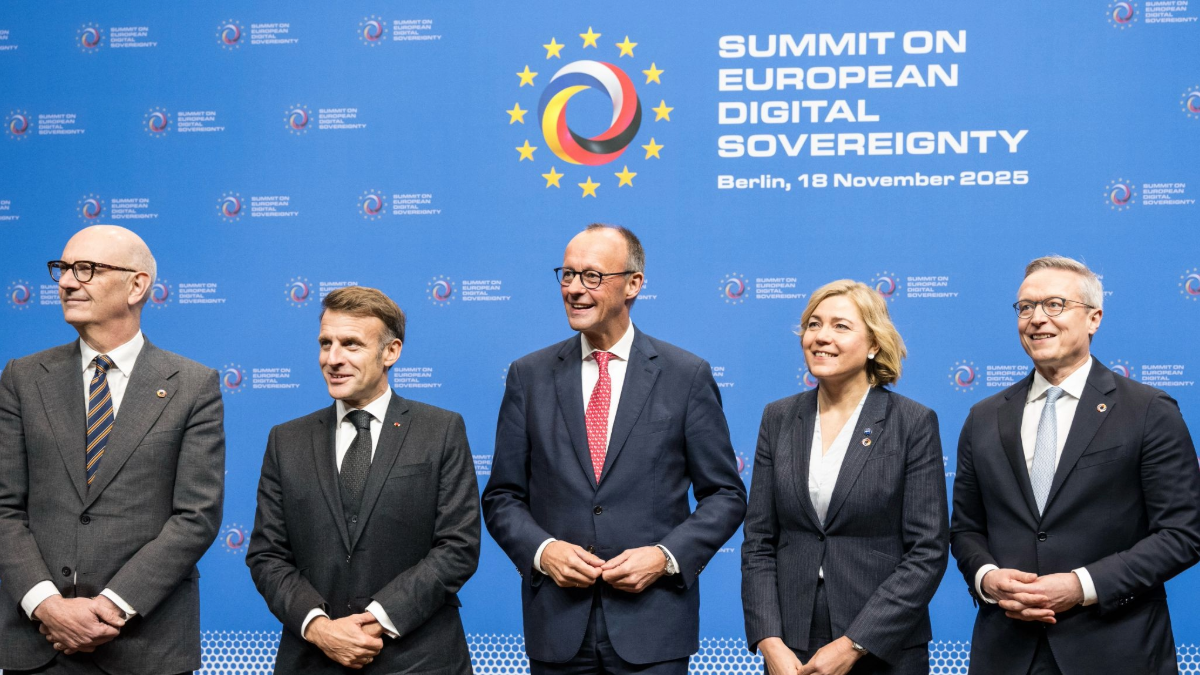
European leaders pose at the Summit on European Digital Sovereignty in Berlin on 18 November. Source
Market concentration has long been on European legislators’ minds. The European Commission has gone further than most to tamp down on monopolies and big tech’s excessive behavior in an attempt to stoke competition within the bloc. It’s one main reason why the Digital Markets Act and Digital Services Act were implemented in the last few years. But this year, more than any, has been one where digital sovereignty has propelled to the top of agendas across Europe.
At a November summit in Berlin, representatives from European states agreed on seven strategic pillars to reduce technological dependency and enhance EU competitiveness, ranging from regulatory simplification to the development of frontier AI.
Trump’s re-election and his administration’s efforts to weaken European tech rules have hardened thinking in Brussels, fueling fears of a US digital kill switch. There’s a real fear of a US president leaning on a digital kill switch. And given just 1% of the European Commission’s own cloud stack runs on a homegrown champion – OVHCloud, with the remaining 99% beholden to US firms, that matters.
“We now live in a world where Trump is perfectly willing to weaponize dependencies, almost to the same extent that China has long been willing to do,” says Zach Meyers, director of research at the Brussels-based think-tank the Center on Regulation in Europe (CERRE). In particular, Meyer worries about how much of Europe’s critical infrastructure sits on US cloud platforms. The big three American hyperscalers account for nearly two-thirds of Europe’s cloud market, while the share European providers hold has dropped from 27% in 2017 to 15% today.
The political reflex to that threat is understandable: if Europe is vulnerable because it rents key infrastructure from American giants, then the answer must be to grow some giants of its own. It’s part of the motive behind EuroStack, a coalition including Nextcloud, IONOS, Ecosia, and economist Cristina Caffarra. EuroStack argues for buying, selling and funding European digital infrastructure ahead of US competitors in cloud, AI and connectivity, where credible options exist.
This runs alongside Europe’s attempt to develop and promote homegrown champions – both big and small through its recently announced multi-billion Euro Scaleup Europe Fund. The recent partnership between the two, raising €1.7bn for Mistral at an €11.7bn valuation, is held up as proof that Europe can “do scale”. “If these companies are just replaced by European ones doing the same thing, we’ll be slightly better off, but it won’t be enough,” says Cecilia Rikap, associate professor in economics at University College London. And given the costs to build a fully European ecosystem could reach €5 trillion, the impetus is to get this right the first time.
The European champion trap
“Just building European hyperscalers would be a sub-optimal solution,” says Chloe Teevan, who heads the digital economy and governance team at the European Centre for Development Policy Management (ECDPM). She says: “Many in the space don’t want to see the EU just develop another form of the same thing we see in the US and China.”
Yet building European tech in a way that doesn’t replicate the same power structures already in place requires longer-term thinking than many might have, in Brussels or in industry. “It’s much easier to sell the idea of creating the next European Google than to commit to 10-, 15-, 20-year bets,” says Meyers. Building a European competitor to Amazon Web Services or Microsoft Azure now, in markets already dominated by hyperscalers with colossal economies of scale, is “pie in the sky,” he reckons. And for those who want to try and unpick US hardware dependency from the European tech stack, Meyers’ argument is blunt: trying to decouple wholesale from US cloud risks hurting European competitiveness more than it helps sovereignty.
Others are also worried about the concentration of critical state functions in a small cluster of firms. Teevan points out that Europe’s economy is not and should not try to be the US in miniature. It’s a “market of SMEs”, she says, with a long tail of mid-sized manufacturers, service firms and public agencies. SMEs account for 99.8% of all businesses in Europe, according to European Commission data, and contribute 53.1% of all the value added by businesses to the continent.
What building a European stack could look like
Building a European stack is tricky, it requires technical infrastructure, hardware, and binding contracts, all of which take time.
The EU’s Data Act is meant to address some of those issues by strengthening switching rights for cloud customers. But its own timetable highlights how long this takes in practice: the Commission has committed to switching charges being removed from January 2027, despite the main provisions applying since September 2025.
Then there’s the physical constraint. Sovereign services still need somewhere to run. An Ember analysis found that in legacy European hubs such as Frankfurt, London, Amsterdam, Paris and Dublin, grid connection queues average between seven and 10 years. Europe can want more localized compute as much as it wants, but policy intent can be scuppered by the realities of building. Another risk is that a European tech stack is all well and good, but it does rely on other countries for its constituent parts – for instance, Taiwan for core parts of the process of making and obtaining semiconductors for data centers. “There's always going to be supply chains that cross borders, and the idea that you can eliminate your vulnerabilities is not very realistic,” says Meyers.
That’s all before you get to the challenge of paperwork and planning. Starting a business in Europe takes around 20 days and costs 23% of income per capita, compared to four days and 1% in the US. Add layers of language, national law, and red tape, and exits become even harder. The EU also requires navigating a range of different languages and national legal frameworks, dissuading some from setting up firms in the first place. That’s before getting to the point of publicly listing your firm in an exit, which introduces even more hassle – a major disincentive for anyone thinking of offering a solution. The sums on offer from Europe, which includea €180 million tender for sovereign cloud services announced in October, aren’t exciting enough to engage new entrants.
Where EuroStack stacks up
One vision of EuroStack, as a tech stack built around digital public infrastructure and the digital commons, rather than privately owned walled gardens, could help. Putting open standards, open APIs and interoperability at its core means smaller firms and public agencies can compete on a better footing.
There’s already one precedent that could help show how to work things. The European Digital Identity Wallet – the EU’s overhaul of eIDAS – will require every member state to offer at least one certified wallet and to recognise those issued elsewhere in the bloc. The federated model allows different national systems to interoperate with one another. Crucially, it also puts a deadline on the idea: member states are required to offer at least one EU Digital Identity Wallet by 2026.
“The European model is richer if it is built on SMEs rather than on American-style hyperscalers,” argues Teevan. That’s in large part because it’s how Europe is designed – to promote and benefit SMEs – and because the continent’s infrastructure is unsuited to building big businesses, from strong single market rules, constraints on state aid, and fragmented capital markets that make it harder to build and protect very large, vertically integrated firms in the US sense. The importance of smaller enterprises has been particularly clear post-pandemic, with the Commission noting most of the economic recovery has been driven by more agile, smaller firms, rather than larger, slower ones.
Don’t pick winners
The temptation is to pick winners. Meyers points out that Chinese industrial policy runs internal tournaments before backing global champions. Europe, by contrast, often nurtures “big fish in small ponds”, he says – national champions that enjoy political protection, limited competition and weak incentives to innovate. “We need to be supporting multiple companies in a sector and letting the best one win, rather than picking one and putting all of our money behind it,” he says. That means structuring funding calls, public-sector procurement and research programmes so they don’t just funnel money to the incumbent national giant.
It also involves picking your battles. Meyers believes general-purpose cloud services can’t become sovereign anymore thanks to the dominance of US hyperscalers. But Europe has a real edge in industrial applications of AI, he says, thanks to ASML’s dominance in chipmaking tools, and industrial automation platforms from the likes of Siemens and Schneider Electric.
It’s also important that a European stack isn’t limited to Europe. Teevan and her co-authors argue that meaningful tech sovereignty will require alliances with countries in the Global South, like India and Brazil, that are building their own digital public infrastructure. “There are plenty of others who are in the same boat,” she says.
Authors