What Policymakers and the Public Need to Know About the Cult of AI
Nathalie Maréchal / Sep 17, 2026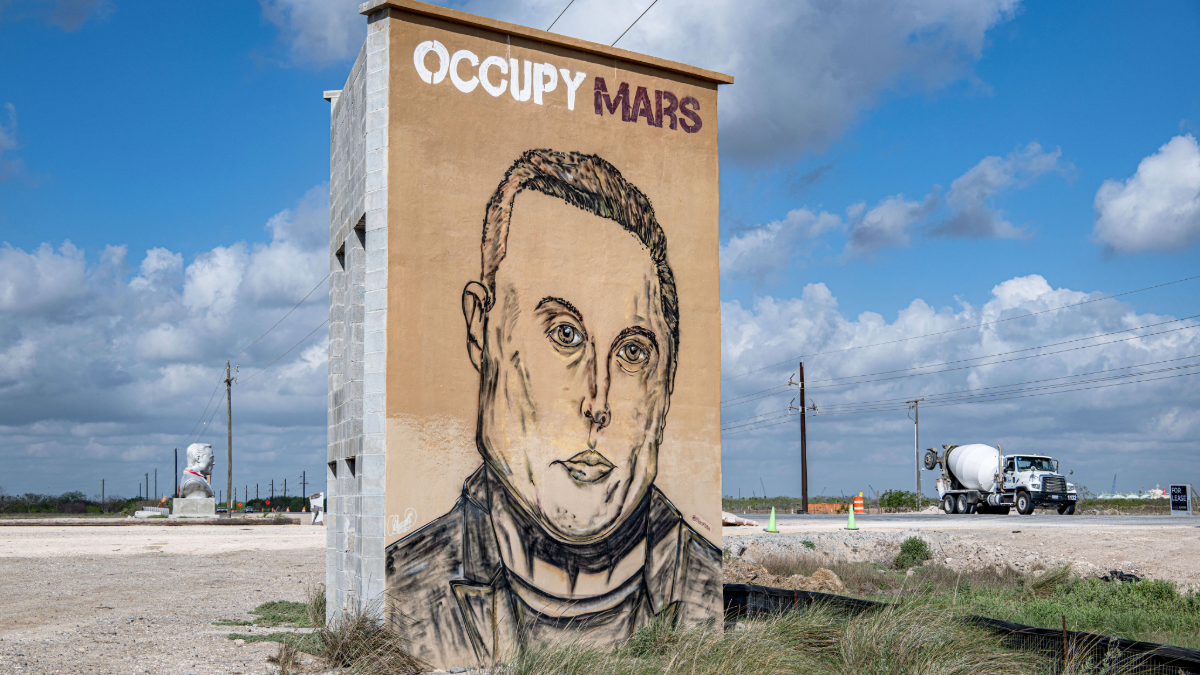
Artwork including a giant bust of Elon Musk sits along the route the billionaire's SpaceX Starbase south Texas launch site. (Photo by Laura Brett/Sipa via AP Images)
In June, SpaceX’s initial public offering (IPO) briefly created the world’s first trillionaire in the person of Elon Musk. While the initial frenzy around the IPO eventually died down, Musk remains worth more than $900 billion, and SpaceX retains a market capitalization of more than $2 trillion. A major component of SpaceX’s pitch to investors hinges on the claim that the tech industry is on the verge of creating “artificial general intelligence” (AGI) or “artificial superintelligence” (ASI), a class of inorganic, sentient, omniscient and omnipotent beings that would surpass any individual person’s intellect, domain knowledge, and wisdom — or possibly all of humanity’s combined. The idea is that this AGI/ASI will be able to solve all of humanity’s problems rationally and efficiently, so developing it as quickly as possible, using any resources necessary, is a moral imperative, not to mention the investment opportunity of a lifetime.
If that sounds like typical Silicon Valley speculative hype, that’s because it is. But this particular hype is grounded in a particular set of beliefs that are no longer held merely on the fringes of the tech industry or the more esoteric corners of the internet. What’s more, many of the conclusions rooted in these beliefs (i.e., that AI is the most transformative technology of all time, promising/threatening seismic changes to the workplace, the economy and world politics, to which we can only adapt) are currently treated as settled fact in mainstream discourse. But at the same time, the more eyebrow-raising tenets of these beliefs are brushed under the rug, too bizarre to be discussed in polite company — at least inside the Beltway and the Brussels Bubble.
According to this belief system, these synthetic, all-knowing beings may be morally equivalent to people, as they will contain “the light of consciousness,” to use Musk’s preferred phrase, whatever that means. What’s more, believers anticipate uploading their "consciousness" to the cloud and merging it with AGI to create “posthumans” or “transhumans” who will eventually succeed homo sapiens as the universe’s apex species — a “worthy successor” to humankind. And they are so excited about this grim future, they’re willing to go to extraordinary lengths to get there.
This is, in a word, bonkers. Most of all, it is dangerous, and the danger is amplified by our collective tendency to dismiss fringe ideas before it’s too late. It’s hard for many of us to accept that people actually believe this stuff, much less base consequential decisions implicating trillions of dollars of investments, billions of lives, and humanity’s collective future on these beliefs. And this was my reaction, too, until 2025: these ideas are so out there, so blatantly divorced from empirical reality and basic morality, why should I waste my time and my sanity debating kooks? In short, because the kooks are now in power, and they are using that power to dismantle the institutions designed to keep the rest of us safe, healthy, and free.
The billionaire believers in the cult of AI are perpetuating a “coup from above” — to quote Shoshana Zuboff — to build a world that caters to their every whim and desire without the need to persuade or even coerce other people to do their bidding. The dream of the AI cult is a world where people are superfluous, or exist only as extensions of intelligent machines. No amount of wishful prototyping of “AI for Good” projects will change the fact that Big Tech, which is now Big AI, is in thrall to an AI cult whose ultimate objective is to automate away human labor, agency, creativity, and autonomy, and to replace democracy with (br)oligarchic rule over a permanent underclass.
Consider Musk. He is a man who routinely uses his wealth and power to spread hate speech and mis/disinformation, foment pogroms, (attempt to) buy elections, and put millions of dollars’ worth of life-saving public-health and economic development programs “through the wood chipper.” Despite the fact that his AI products may be most famous for generating nonconsensual sexualized images of millions of women and children, he is still welcome on stage among the elites at the World Economic Forum, where earlier this year he predicted that within five years “AI will be smarter than all of humanity collectively.” While his views may be among the most visible and extreme of the tech oligarch class, they are not unique.
If you care at all about human rights, democracy, or the environment, it’s time to pay attention to the red flags that signal adherence to this dangerous worldview and its many variations — which I join others in calling technofascism — and start pushing back. In this essay I’ll share an overview of its two major components — the AI Cult and the Dark Enlightenment.
Why the tech policy community needs to talk about the AI cult
A small community of scholars and journalists have been researching and writing about what Timnit Gebru and Émile Torres termed the TESCREAL bundle for years now — TESCREAL stands for Transhumanism, Extropianism, Singularitarianism, (modern) Cosmism, Rationalism, Effective Altruism, and Longtermism. But, for some reason, most political and media elites shy away from confronting this circus of worldviews head-on, which in turn creates a kind of chilling effect among working-level policy wonks: surely, if this were a big deal, people would be talking about it more!
I’ve heard from some of my peers in civil society that the acronym itself is a turn-off — fine, we can use different terms. As Torres notes in their newsletter, Adam Becker calls it “the ideology of technological salvation,” while Douglas Rushkoff simply refers to it as “The Mindset.” Gil Durán coined the phrase “The Nerd Reich” (which is also the title of his newsletter, podcast, and new book) to describe the nexus between “tech authoritarianism, billionaire extremism, the Network State and the meta politics of California.” There is also considerable conceptual overlap with Anita Say Chan’s concept of “techno-eugenics” and “the Tech Right,” a term now in mainstream use that the right-wing online personality Richard Hanania unpacked in 2023. More colloquially, I like to call it “the AI cult.”
The cornerstone of this cult is the assertion that computational programs like LLM chatbots are conscious, all-knowing, and omni-capable, or will be soon — which is pure nonsense. (Some prominent voices in this space, such as Gary Marcus and Yann LeCun, argue that LLMs are simply the wrong path to achieving AGI.)
Many thought leaders in AI policy discussions politely refrain from expressing opinions on the topic of AI consciousness, or on whether a computational system could ever surpass human capacity across domains, likely to avoid confrontations with potential allies who share near-term strategic objectives. This has some merit, and has proven effective at repelling industry attempts to preempt state-level AI legislation. Alliances with strange bedfellows are a regular feature of democratic policymaking, not a bug. Nonetheless, it behooves public interest advocates to be clear-eyed about what they believe, and how they see tactical partnerships fitting into their broader plan. As Gebru, Torres, Becker, Rushkoff, Durán, Chan, and others make clear, followers of the AI cult do not share a commitment to democracy, the rule of law, or civil and human rights.
There is a world of difference between viewing AI as “a separate species, a highly autonomous, potentially superintelligent entity” whose governance demands “drastic policy interventions or technical breakthroughs” on one hand, and treating it as technology — albeit a potentially “general-purpose” and “transformative” one — that is built, shaped by, and controlled by humans who imbue it with their own values, goals, and preferences. As Arvind Narayanan and Sayash Kapoor put it, “viewing AI as normal technology leads to fundamentally different conclusions about mitigations compared to viewing AI as being humanlike.”
It’s hard to overstate the centrality of AI sentience and omnipotence to the ideology of technological salvation, as a plethora of “manifestos” from tech CEOs and other AGI/ASI enthusiasts illustrate. When venture capitalist Marc Andreessen wrote in his 2023 Techno-Optimist Manifesto that technological change “is why our descendents will live in the stars,” that AI is “literally making sand think” and “is best thought of as a universal problem solver,” he was outlining a set of beliefs and normative commitments that are utterly disconnected from empirical reality. The authors of the “AI 2027” and “AI 2040” speculative manifestos similarly base their arguments on claims such as: “AIs that are smarter than humans in every way” are not only around the corner, but will take most of our jobs and start recursively self-improving themselves, and thus “become even more competent, speeding up research even faster, making them even more competent, and so on” — leading to “AIs that are far beyond human level, created entirely by AIs, themselves created entirely by other AIs, without any human in the loop since several generations back.” (Quotations are from AI 2040: Plan A.)
Crucially, these manifestos depict the AI future as inevitable, both in the “weak” sense that the actually-existing tools we have today aren’t going away and in the “strong” sense that the entire social, economic, and political world order is on the brink of total upheaval because of impending AGI/ASI. Manifesto authors may or may not genuinely believe this is inevitable. What’s undeniable is that they desperately want this upheaval to happen, so they dedicate their industry’s public relations and marketing firepower at persuading us that resistance is futile. Anyone who tells you there’s no sense in fighting for a better future just wants you to give up.
Unpacking the ‘TESCREAL Bundle’
As Gebru and Torres detail, the ideas comprising the acronym build on each other, going back to early transhumanism’s roots in second-wave eugenics, in the mid-20th century. Starting in the late 1980s, the Extropian movement (coining an antonym to “entropy”) brought together futurism enthusiasts to discuss how technology might change and improve the human condition. In parallel, Ray Kurzweil and Eliezer Yudkowsky theorized that humanity would eventually merge with machines, an event they called the Singularity. While Kurzweil and Yudkowsky differ in their specific predictions, they agree the Singularity will result in an “intelligence explosion” that will lead our posthuman descendants to colonize the universe.
The C in TESCREAL stands for (modern) cosmism, which “envisions a harmonious integration between humanity, artificial superintelligence (ASI), and the universe itself, with the ultimate goal of transcending biological, physical, and temporal limitations.” (This is in contrast to Russian cosmism, which dates back to the 19th century). Colonizing space would require radical changes to human biology: we evolved to live on Earth, and are no more suited to life in space than we are to the depths of the ocean. Thus cosmism goes hand in hand with transhumanism, the commitment to using technology (including purely speculative ones) to dramatically alter our bodies and extend the human lifespan, perhaps even reaching immortality. Immortality is a central preoccupation for many TESCREALists, most infamously Bryan Johnson, the tech entrepreneur who has made it his mission to cure death.
In 2009, Yudkowsky founded LessWrong, “an online forum and community dedicated to improving human reasoning and decision-making.” Its contributors, known as Rationalists, claim to “want to be better reasoners so they can have more accurate beliefs about topics they care about, and make better decisions.” They also “were convinced many years ago that AI was a very big deal for the future of humanity,” and the forum dedicates significant attention to “AI Alignment” and “AI Safety.” (“AI Alignment” refers to intellectual inquiry focused on “ensuring that transformatively powerful AIs are aligned with human values.” “AI Safety” is a contested term that refers to preventing various kinds of harm associated with AI technologies.)
As Torres explains in their newsletter and scholarship, effective altruism (EA), in particular, is rooted in an extreme form of utilitarianism that views “how many lives will this save?” as the primary or even the sole question that should drive ethical decision-making. Hence the calculation that it is more “effective” to fund mosquito nets (to prevent malaria transmission) than cancer research, or that it is more ethical to focus on maximizing one’s earning potential to support philanthropic giving than to choose a career in public service or humanitarian aid (“earning to give”). This is the kind of rationalization that imprisoned crypto entrepreneur Sam Bankman-Fried deployed to great success, at least until FTX’s rampant fraud brought the company down: fraud is justified because the proceeds will be used to fund AI development, which in turn will do so much good in the world that the ends justify any means.
Longtermism adds consideration of potential future lives to the calculus: ethical decision-making should consider not only today’s population, but the sum total of all possible lives that could exist in the future. The age-old “First, do not harm” principle is jettisoned in favor of hypothetical benefits. When, in 2018, Elon Musk berated National Transportation Safety Board (NTSB) officials investigating fatal car accidents involving Tesla’s Autopilot feature that “we’re saving more lives because of Autopilot than people are lost” before hanging up on them, he was implicitly deploying longtermist arguments about the relative value of human lives and the legitimacy of the state. Musk claims that he shouldn't have to abide by the rules governing NTSB’s crash investigations because any deaths resulting from Tesla’s technology were mere collateral damage in pursuit of improving the Autopilot technology, guaranteed (in his view) to save many lives in the future. (Musk has also called longtermism “a close match for [his] philosophy”.)
In the Techno-Optimist Manifesto, not only does Andreessen argue that developing AGI will save lives, he goes a step further: “We believe any deceleration of AI will cost lives. Deaths that were preventable by the AI that was prevented from existing is a form of murder.” For him, accelerating AI development is a moral imperative, and he suggests that anyone who pushes for guardrails in the development and deployment of AI is guilty of a capital crime. Is it any wonder that he and his partners in the White House have made preempting state-level AI legislation (without first replacing it with equivalent federal protections) a centerpiece of Trump’s tech policy agenda?
From this effective accelerationism (often referenced by the acronym e/acc), a duty to maximize the human population on Earth and beyond quickly emerges. And since we don’t know how to colonize space, or even how to support and govern the growing terrestrial population, we must develop AGI so it can figure that out for us, even if that means diverting resources away from other life-saving programs. Ergo, the most ethical way to live is to earn as much money as possible and spend it on the development of AGI in order to colonize space, regardless of the collateral damage to people who are actually alive today. (Do you sense the theme here? The present doesn’t matter, because the future will be better.)
That is, in fact, the mission behind the SpaceX IPO: “To build the systems and technologies necessary to make life multiplanetary, to understand the true nature of the universe, and to extend the light of consciousness to the stars.”
Other AI companies’ mission statements likewise implicitly assume adherence to the TESCREAL worldview. OpenAI’s mission — to ensure that artificial general intelligence benefits all of humanity — presupposes that AGI is achievable and desirable, and that the company is in a position to determine all of humanity’s best interest. Anthropic’s current mission statement takes for granted that “AI will have a vast impact on the world,” committing the company to “securing its benefits and mitigating its risks.” This mission evolved from the one used at the company’s 2021 inception, and that still appears on some company websites: “to ensure that the world safely makes the transition through transformative AI.”
Make it make sense, please
So how can we reconcile effective altruism and longtermism’s stated commitment to saving lives with the hundreds of thousands of deaths linked to Musk’s abrupt dismantling of the United States Agency for International Development (USAID), and the millions more we can expect in the years to come? To put it simply, Musk appears to believe that some lives matter more than others: sacrificing Black and Brown lives today is an acceptable price to pay to reach AGI, and thus “saving” the lives of their own (white) descendants, in the future. But Musk realizes that saying so out loud would feed the backlash against the political project of AI, so he insists that “feeding USAID into the woodchipper” didn’t actually kill anyone. And if it did, well, that would actually be the fault of philanthropists like the Gates Foundation and Mackenzie Scott, who failed to immediately step in to fill the funding gap.
In theory, the destruction of USAID should have prompted a reckoning in those segments of the EA community that are ostensibly committed to global health and international development. But that doesn’t seem to have happened. According to anthropologist Mollie Gleiberman, the reason is that effective altruists use humanitarian concerns as fig leaves for their transhumanist agenda: given the chasm between traditional moral values and longtermism’s cold utilitarianism, the movement’s most “urgent” task is to “proselytize” and “convince others of the fundamental rightness of their worldview and ensure ‘emerging technologies’ are prioritized on global research agendas.” To do so, effective altruists have deployed a consistent narrative strategy: first, frame EA as “the logical extension of the global aid and development sector,” then steer public debate to the notion of “existential risk” (often abbreviated as “x-risk”), at the exclusion of more quotidian threats to human rights like automated discrimination, mass surveillance, industrial-scale propaganda, etc. What may first seem like incoherence or hypocrisy is actually strategic misdirection.
AI boomers vs. doomers: A false dichotomy
The AI cult’s adherents are no more monolithic in their beliefs than followers of any religion are: there are many subgroups who vigorously debate and contest each other’s beliefs. Yet these subgroups share enough common beliefs that we can usefully group them into a single category, even as it is helpful to understand the main theological disputes between the different currents. Indeed, Gebru and Torres describe the disparate strands behind each letter of “TESCREAL” as a “bundle” of “interconnected and overlapping ideologies” with roots in 20th-century eugenics. Émile Torres’s newsletter helpfully summarizes the bundle’s commonalities and differences:
All believe that we should build an ASI super-being, although some say we should delay building it until value-alignment has been solved. All agree that the ultimate goal is for posthumanity, in one form or another, to colonize the universe and climb the Kardashev scale (a measure of how much energy civilizations use). All believe that these posthumans must be conscious, because an integral part of fulfilling the grand destiny of intelligence is to spread the light of consciousness to every star in every galaxy. All say that we’re on the verge of the Singularity, which will inaugurate a fundamentally new epoch in cosmic history — a period of phantasmagoric change, incredibly rapid progress, and a burst of new forms of artificial intelligence. All agree that if everything goes well, the result will be a cosmic utopia marked by radical abundance, immortality, and cosmic wonders beyond anything our puny human imaginations could possibly conceive of. The differences in worldviews, you find, amount to relatively small variations of an otherwise identical vision about what the future should look like (emphasis in the original).
Similarly, the much-vaunted divide between AI “boomers” and “doomers” is overstated. Both Republican and Democrat 2026 primary campaigns have featured massive influxes of cash from two sets of super PACs. On the boomer side, Leading the Future (the biggest donors to which are OpenAI president Greg Brockman and his wife) has been funding pro-industry candidates, while the Anthropic-backed Public First has supported candidates who favor increased regulation and oversight.
Tech Policy Press readers are likely familiar with OpenAI and Anthropic’s respective origin stories: Elon Musk and Sam Altman originally founded OpenAI in 2015 as a nonprofit to develop AGI that benefits all of humanity. Again, this mission presupposes that AGI is achievable and that a small group of people in California are in a position to determine what it means to benefit “all of humanity”. In 2021, a group of OpenAI employees (including siblings Dario and Daniela Amodei) left the company to start Anthropic with the goal of developing AGI faster than their former employer, whom they no longer trusted to keep humanity’s collective best interest in mind. Early funding for Anthropic came almost exclusively from the EA community, including Sam Bankman-Fried, Jaan Tallinn, and Dustin Moskovitz. (The Musk/Altman litigation over OpenAI’s conversion from non-profit to public benefit corporation similarly highlighted that these broligarchs share the same goals, while disagreeing about which one of them should be trusted to do it.)
This history, combined with the two companies’ diverging approaches to defense contracts and the 2026 primaries, has given many people the impression that Anthropic is somehow “more ethical” (read: less intent on dismantling liberal democracy) than other Big Tech firms. The Trump administration’s clear antipathy for the company and its CEO, Dario Amodei, feeds that misconception. I can’t speak to the inner thoughts of the company’s leadership or its employees. What we do know is that Anthropic is an explicitly EA/longtermist company dedicated to creating AGI, founded and led by adherents of TESCREALism, and whose initial funding came from EA sources. So while it may be tactically sound to treat enemies of the enemies of democracy as allies, that does not make them friends.
The ‘Dark Enlightenment’: From cyberlibertarianism to the ‘Nerd Reich’
Unfortunately, the AI cult isn’t the only fringe belief system to have escaped containment. Over the past 30 years or so, cyberlibertarianism and garden-variety bigotry (notably anti-Black racism, misogyny, ableism, and transphobia) have fused to produce neoreactionary thought, perhaps best known for Peter Thiel’s infamous 2009 declaration that he no longer believed freedom and democracy to be compatible. The essay in question explained that since electoral democracy does not yield the (libertarian-coded) results that Thiel wants, he would focus his efforts on creating feudal city-states on the high seas, in geographies where the state is too weak to intervene, and, eventually, in space.
After publishing that essay, Thiel went on to financially support Curtis Yarvin, who developed the idea of localized “realms” or “patchworks” that would each be ruled by a tech CEO. Tech entrepreneur and venture capitalist Balaji Srinivasan popularized the concept under the Network States label, which the Trump administration now calls “freedom cities.” Whatever you call these enclaves, the core idea is to create sovereign city-states beyond the law’s reach, where CEO-kings would be free to “innovate” to their hearts’ content, without needing to worry about environmental or labor protections, due process, or the needs and interests of others. Crucially, they would be beyond accountability: the only remedy available to residents under their thumb would be to move away. (For more on the genesis and implications of these ideas, I recommend The Nerd Reich, by Gil Durán.)
The Dark Enlightenment is morally repugnant in every respect, rejecting the values of democracy and human rights in favor of something like the Law of the Jungle. Trump advisor Stephen Miller put it most clearly in a January interview with CNN’s Jake Tapper: “We live in a world, in the real world, that is governed by strength, that is governed by force, that is governed by power. These are the iron laws of the world that have existed since the beginning of time.” Forget government of the people, by the people and for the people: in this paradigm, might makes right, the strong do what they can, and the weak suffer what they must.
Neoreactionary thought, which is also reflected in the so-called “alt-right” and MAGA movements, is distinct from the AI cult in that the two schools of thought evolved separately before eventually converging, thanks in no small part to Curtis Yarvin and his patron Peter Thiel. Today, though, these two currents are tightly intertwined, and together underpin the political project that Silicon Valley and the Trump Administration are jointly pursuing: imposing rigid racial, gender and class hierarchies, erasing human and civil rights protections, dismantling constitutional democracy, abolishing government functions they deem unnecessary (USAID, Department of Education), privatizing those they can use to enrich themselves (SpaceX), replacing remaining public servants with automation, and generally enabling graft, corruption and massive transfers of wealth from the public to the billionaire class. This is technofascism.
The AI Cult + the Dark Enlightenment = Technofascism
While the term is sometimes used to describe “a form of fascism that uses modern technologies to attain its ends,” historian Janis Mimura coined “technofascism” in 2011 to describe a “radical, authoritarian form of technocracy” in which the public and private spheres are fused, and is driven by a quasi-religious belief in technology (in this case, both actually-existing “AI” tools and speculative technologies like AGI/ASI). MIT’s Catherine D’Ignazio defines contemporary technofascism as “the collusion of large technology firms, right-wing billionaires, and tech culture with authoritarian and anti-democratic political agendas,” noting that “Today’s technofascism is acute because it has been exacerbated by extreme wealth inequality, financialization, environmental destruction and billionaire delusion.”
The key insight for tech policy professionals to internalize is that technofascism “is not simply a rejection of existing democratic norms but the active promotion of a complex, often contradictory, patchwork of heterodox ideas, values, and objectives aimed at radically reshaping society,” as Stephen Diehl puts it. Depending on your individual and educational background, you may take for granted that there is a rough normative consensus about the nature of the social contract, governments’ duty to rule in the public interest, and the centrality of human rights and dignity to policymaking. Technofascism “operates largely outside this established window, fundamentally challenging its foundational assumptions about human equality and the desirability of democratic governance,” according to Diehl.
Tech policy requires us to “separate the technology from the socio-political system it’s embedded in,” even as we acknowledge the mutual interaction between the two domains. Technologists need to understand the socio-political context just as much as social scientists and lawyers need to understand the underlying technology, and we all need to understand and grapple with the ways in which technology and politics shape one another in a never-ending iterative process. Unfalsifiable beliefs about technology and its future (ie, AGI/ASI is coming, etc.) structure tech industry decisions about product development, political positioning and strategic communications. We aren’t doing ourselves any favors by ignoring the centrality of either the AI cult or of the neoreactionary Dark Enlightenment to the current polycrisis.
Conclusion
The money that is about to rain down from those made extraordinarily wealthy by the SpaceX IPO, and the anticipated OpenAI and Anthropic IPOs, makes it all the more urgent for public-interest tech policy professionals to develop a more sophisticated understanding of the ideological currents that permeate the AI industry. There are ways to operate with integrity in this deluge, but finding those options requires understanding the intellectual currents behind EA funders like Dustin Moskovitz’s Coefficient Giving (née Open Philanthropy) and Jaan Tallinn’s Survival and Flourishing Fund. Ideas and proposals from organizations funded by, or otherwise aligned with, effective altruists — many of which position themselves as dedicated to “AI Safety” — should similarly be evaluated with a healthy dose of skepticism about underlying assumptions about AGI/ASI. Would the idea make sense if AGI/ASI never happens? Is this proposal more concerned about how actually-existing technology affects people today, or about the well-being of our descendants many generations in the future? How does the notion of an AI race against China figure into the argument? After all, a race implies a finish line, and what is that finish line if not the development of AGI/ASI?
This is why, for example, I am deeply skeptical about proposals like Sen. Bernie Sanders’ (I-Vt.) AI Sovereign Wealth Fund Act, particularly following his willingness to associate with far right leader and former Trump advisor Steve Bannon on AI issues. Sanders appears to sincerely believe that AGI is imminent, or possibly may already be here — his interview of Claude suggests that he views the LLM chatbot as a kind of oracle. By analogizing AI to Norway’s oil wealth, the proposal also assumes that AI companies’ products and services will play the same central role in the economy as fossil fuels have played for the past century, which remains to be seen. Moreover, this would give the federal government even more of a stake in the AI industry’s financial success, potentially making the AI cult’s vision for an “all AI, all the time” society a self-fulfilling prophecy.
Such skepticism may become even more important should Democrats regain at least one chamber of Congress in the midterms, and throughout the 2028 campaign cycle. While effective altruists have largely been displaced by effective accelerationists under Trump, they were deeply influential throughout the Biden administration, both in Congress and at the White House, and are poised for a comeback. For moderate, industry-friendly establishment Democrats, it is much easier to maintain healthy skepticism vis-a-vis cartoonish effective accelerationist villains than enthusiastic idealists gushing about “human flourishing” while worrying about “existential risk” — particularly when those same idealists have deep pockets. It will be up to civil society to remind elected leaders that AGI/ASI is far from a certainty, and that we shouldn’t base policy decisions on the assumption that it is inevitable, or even desirable.
Once you understand that the broligarchs are eugenicists who care more about hypothetical, future AI-enhanced lives than about today’s population and believe that it is their right and their duty to sit atop a brutally hierarchical society where cold, computational “rationality” trumps human rights and dignity, a lot of things start making sense. Like joining forces with a wannabe authoritarian who is willing to do what it takes to make the world safe for AGI. Or planning to take over Gaza and threatening to invade Greenland, both of which offer prime real estate for a Freedom City. Or blowing up the transatlantic alliance over European tech regulations. Or using American immigration policy to defend Silicon Valley from the tech accountability movement. The list goes on.
For now, my charge to you is to pay attention to the implicit assumptions underlying claims and arguments about AI policy. Notice when someone is implicitly deploying arguments associated with the AI cult or the Dark Enlightenment, and push back against assumptions like, “AGI/ASI that is more capable that any human is inevitable,” “we can and should automate as much human labor as possible,” or “AI adoption is imperative to avoid being left behind.” Longtermist arguments that offer a “utilitarian framework to justify neglecting immediate crises in favor of speculative, large-scale projects aligned with the technological elite's interests and capabilities” should be rejected entirely.
The frenzy of the AI investment boom and the disorienting tempo of headlines about very real AI cybersecurity threats will continue to distract both policymakers and the public from the most substantial danger that is before us—not a malignant AGI/ASI or a failure to conjure a benign one, but the unchecked concentration of wealth and power in the hands of a delusional set of billionaires who aim to foreclose on the future. Those who work on tech policy matters and wish to advance a more just, equitable, and sustainable future have a duty to draw lines and defend against that outcome.
Further reading
To continue learning more about the AI cult, the Dark Enlightenment, and technofascism, here are a few places to start:
Books
Long reads
Newsletters
Podcasts & videos
Authors