Welcome to the Trump-Nvidia-China-AI Hyper-Spectacle
Graham Webster / Nov 24, 2026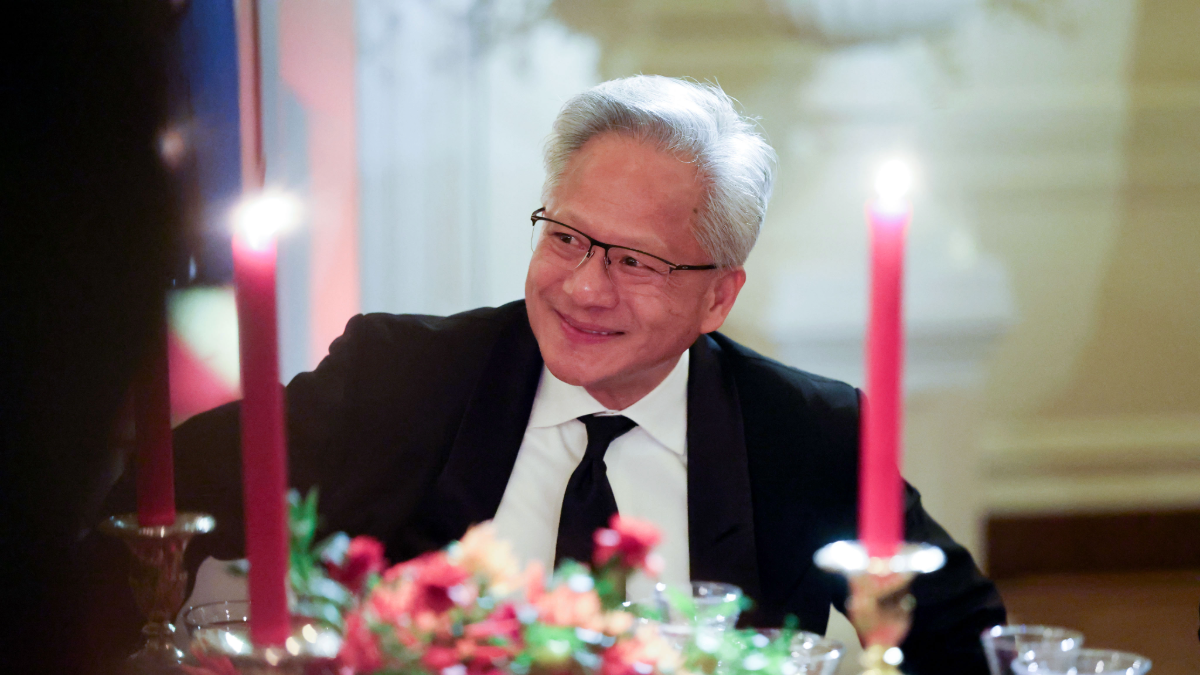
Nvidia CEO Jensen Huang looks on as US President Donald Trump hosts a state dinner for Chinese President Xi Jinping and first lady Peng Liyuan in the East Room of the White House on Sep. 24, 2026 in Washington, DC. (Photo by Kevin Dietsch/Getty Images)
In reinstating Jensen Huang as CEO of Nvidia after the intervention of United States President Donald Trump… after Trump’s meeting with China’s leader, Xi Jinping… after sources told reporters the US government believed a woman Huang had an affair with may have been working for Chinese intelligence… after US voters moved hard away from Trump’s Republicans with AI and corruption among the top issues… after Trump bought shares of Nvidia… after Huang came along on an earlier trip to see Xi… after officials reportedly informed Trump that Huang may be compromised by Xi’s government… after the Trump administration weakened AI chip controls on China… after Huang became one of the strongest voices arguing for selling AI chips to China… after the Biden administration initiated chip controls… after the US government pinpointed chips as its best lever in slowing down Chinese AI development… after policy thinkers became concerned about dire geopolitical consequences should China get ahead of the United States in AI… after AI futurisms of the LLM era began to contemplate machines with godlike power…
After all that, Nvidia’s board has fused AI futurism, great power competition, the rule of law, Silicon Valley profits, the stock market, policy capture, data center and AI opposition, White House corruption, Chinese Communist Party influence, sex, and elite impunity into a unified hyper-spectacle. Surely I’ve forgotten another deep breath worth of things. (There are exhaustive timelines available from The New York Times, which broke the Nvidia scandal, as well as the Wall Street Journal, TechCrunch, The Guardian, and many other outlets.)
This agglomeration of events, issues, passions, and outrages is an analytical nightmare from hell. Each invocation of Trump corruption or Chinese model release unavoidably triggers sympathetic neurons on the other end of society’s addled collective brain. Specific empirical questions such as whether Alice Huang was working directly for China’s Ministry of State Security will be nearly impossible to discuss without some people involuntarily but stubbornly thinking of Trump’s evident sympathy for a powerful man facing consequences over bad behavior with women, or about data center politics in a rural county.
In dubbing this a “hyper-spectacle,” I am mangling an idea advanced by the French theorist Guy Debord in The Society of the Spectacle, first published in 1967. “The whole life of those societies in which modern conditions of production prevail presents itself as an immense accumulation of spectacles. All that once was directly lived has become mere representation,” Debord begins (emphasis original). “Images detached from every aspect of life merge into a common stream, and the former unity of life is lost forever.” He calls it “a world view transformed into an objective force.” (If you’ve read the book, forgive me and don’t worry: We will not be reviewing 1960s discourse on socialism or the nature of time.)
Issues get conflated all the time. Yet the way in which the diverse questions underlying this heap of themes has been anointed as one by voices ranging from social media gadflies to button-down national security commentators reminds me of Debord’s insight: The image serves to cut us off from the real. You can see an involuntary glee in the way some people intone about the gravity of a situation that, just this once after years of grinding corruption and AI speculation, also comes with a titillating sprinkle of a potential spy-sex scandal.
The hyper-spectacle alienates each of these serious matters of political life and techno-social systems from real events and uncertainties. It stops even careful thinkers from pausing to ask whether billions of dollars of smuggled semiconductors are, as some chip control advocates believe, a dire national security threat to the US—or, rather, not-so-simply a series of very large violations of export controls, possibly with parts of the Trump administration looking the other way. Both options are a big deal, but when everything is tied together, it’s hard to keep track of the stakes.
The average news article or commentary cannot be expected to receive the attention necessary to sort out this mess. But I hope some of us—not least the members of Congress who are now unavoidably on their way into the hyper-spectacle’s vortex—will be able to disaggregate this jumble and navigate the important and real consequences. Here are just a few of the challenges:
First, the entire premise that Nvidia and its products are the future, a future to which Huang may or may not be personally essential, rests on an estimation of the transformative power of artificial intelligence and the inputs necessary to achieve it. The popular assumption embedded in the hyper-spectacle is that something extremely powerful and perhaps godlike is on the precipice of emerging, and that Nvidia GPUs are crucial to its advancement. Maybe! It is also possible that something radical will happen, at another time, with another form of material input. Or that the present trajectory of AI development may plateau, bringing more modest transformation (and, therefore, more modest implications for national power and geopolitics and markets). Far too often, the stakes of AI are assumed to be maximal and total, rather than uncertain and multivalent.
Second, the hyper-spectacle incorporates as an assumption that (a) Chinese access to Nvidia chips and related semiconductor inputs will be decisive in (b) a national quest to achieve transformative AI, that then (c) endangers the US. That’s three assumptions, actually, each of which could independently turn out to be false. You can believe it is strategically wise to adopt these assumptions, but they are still guesses about an unknown future that are too easily bundled into the day’s electric headlines.
Third, AI questions are fused with Trump questions, which themselves are a fusion of partisan politics, the fight to reestablish the rule of law, and the longer-term matter of money in politics, among other things.
Fourth, the AI questions themselves are misleadingly jumbled. Individual data centers: good or bad for a specific community? Increasing use of fossil fuels: worth it, or hastening catastrophe? LLM products: how to govern? Catastrophic or existential risk of AI: urgent problem needing Chinese cooperation, sci-fi nonsense, or marketing? Social, cybersecurity, or economic harms of LLM use: who is responsible? None of this can be handled if people are styled as anti- or pro-AI. “The spectator feels at home nowhere, for the spectacle is everywhere,” Debord writes.
Fifth, the specifics of the Huang² affair really matter. It is fashionable now to say the scandal is not whether Jensen Huang may have been sleeping with a spy, but rather all the other stuff he did. On the one hand, this is a reasonable acknowledgement that, over time, the specifics and sourcing for Alice Huang’s alleged connections with Chinese intelligence have looked less certain. Yet what actually happened here is important to the concrete, real-world, titillation-free implications, and the political recoil.
There is simply too much here to think about all of the details at once, but if we’re going to confront even a few of these disorienting challenges, thinkers and political actors will have to try to pull what’s really going on out of the integrated hyper-spectacle of futurism, scandal, and international relations. Congressional investigators specifically will be tempted to invoke everything from spy-sex to existential risk in their quest to go viral on our phones, and any subtlety they muster could attract denunciations from people shouting into the social media void with the hyper-spectacle to back them up. If we’re very lucky, though, the structure afforded by legal process, and a politician’s desire to avoid embarrassing failure when taking on an unprecedented breadth of scandal, will bring us back toward a political life directly lived.
Authors