We Need to Disentangle Hype from AI and Quantum Computing
Danny Tobey, Ashley Carr, Michael Atleson / Mar 5, 2026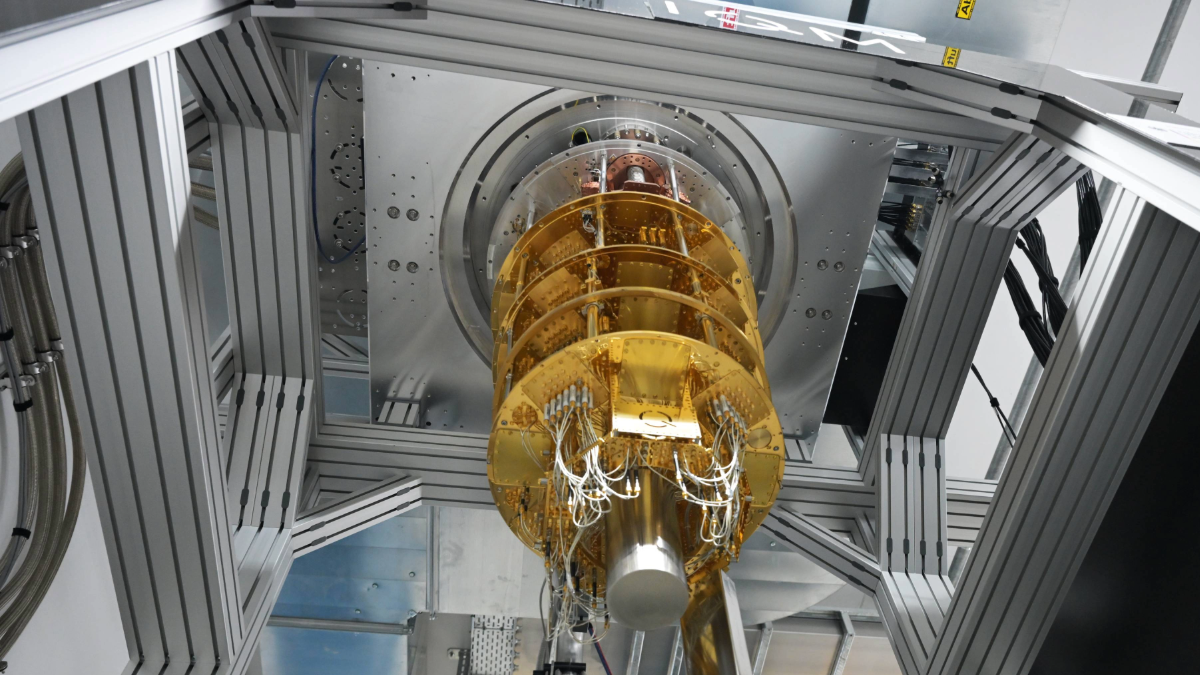
February 12, 2026, Bavaria, Garching: The predecessor model of the Euro-Q-Exa quantum computer, Q-Exa, can be seen at the Leibniz Supercomputing Center (LRZ) of the Bavarian Academy of Sciences and Humanities. Photo by: Malin Wunderlich/picture-alliance/dpa/AP Images
What’s a complex, emerging technology poised to bring about some combination of profound and prosaic changes to our world? One that demands the United States “win” a global race to develop it? One that seems mysterious or magical and is often depicted in science fiction movies?
If you answered, “AI,” you’d certainly be right, but quantum technology is increasingly thrown in the mix, even birthing a new conjoined buzzword, Quantum AI. Much like AI in its pre-generative stage, quantum is bursting with promise that feels just out of reach, and like AI, we may find ourselves in an LLM moment where the technology suddenly seems closer to the dreamed-of future. What will hopefully not ride along with quantum is the sort of hyped product claims we’ve seen often for AI. Those claims have led to enforcement actions and private litigation alleging AI-related fraud or deception, and it’s what’s in store for the quantum-AI connection if claims aren’t kept in check.
“Quantum AI” can be defined as the use of quantum computing to take the place of traditional computing resources in running AI systems. This advance—which is still in the research phase—could enhance machine learning and other complex computational tasks, including increased speed and accuracy and at less cost. Benefits could also run in the other direction, with AI-related techniques enhancing research in quantum computing. Possible applications of these two technologies may exist in healthcare (e.g., drug discovery), finance (e.g., trading strategies and fraud detection), logistics and supply chain management, materials discovery, energy systems, and cybersecurity.
Along with these exciting possibilities, it would be unsurprising to see hyped claims about new products and services that combine AI and quantum technology. That’s because deceptive claims about any new technology are common—an unfortunate fact for true innovations and one that can make it harder to gain public trust and for honest companies to succeed. This fact is reflected in the damaging cycles of AI hype that Princeton’s Arvind Narayanan and Sayash Kapoor explore in their 2024 book AI Snake Oil. Back in 2013, noted AI researcher Yann LeCun said that hype had “killed AI four times in the last five decades.”
When generative AI hype reached the point of some outlier companies making false or unsubstantiated claims about what they were selling to other businesses and consumers, regulators took notice, as did plaintiffs’ lawyers. In recent DLA Piper client alerts, we’ve discussed the FTC’s “AI-washing” cases, similar actions taken by the Department of Justice and the SEC, and the rise of securities class actions alleging AI-related fraud.
Curbing the hype, but not the enthusiasm, for quantum-AI combinations may be especially important given their great promise. Even if many such applications are still far away, some companies have been making announcements about their development successes. Further, the Trump administration supports investment in quantum technology, and the Nobel Prize in physics recently went to scientists who demonstrated “that the bizarre properties of the quantum world can be made concrete in a system big enough to be held in the hand.” (The reference to “bizarre properties” also recalls a quote attributed to noted physicist Michio Kaku that, “of all the theories proposed in this century, the silliest is quantum theory” and “that the only thing that quantum theory has going for it is that it is unquestionably correct.”)
The prospect of deceptive claims that trade on the excitement for quantum AI – and for quantum computing generally—is not merely theoretical. Last year, news reports detailed a global AI-related investment scheme, known as the Quantum AI scam, that exploited the mystique of the technology by referring to a “Quantum AI” trading platform. This over-the-top fraud, featuring celebrity deepfakes and reappearing on social media, is similar to FTC investment fraud cases like a 2023 case against WealthPress, which included claims about an algorithm that would allegedly help identify profitable trades.
A few FTC enforcement actions have, in fact, included false “quantum” claims. A 2023 case, K W Technology, included allegedly unsupported health claims that a product “uses quantum theory technology,” and the 2020 Quantum Wellness Botanical Institute case included claims about an “age-reversing formula” developed by company researchers. A 1998 case against an infamous infomercial marketer featured claims about curing various addictions via a doctor’s “revolutionary breakthrough that he had discovered while studying quantum physics."
“Do you guys just put the word ‘quantum’ in front of everything?”—Scott Lang, played by Paul Rudd (Ant-Man and The Wasp, 2018)
Meanwhile, popular movies continue to spark our imagination about quantum physics by playing liberally on its themes, explicitly or implicitly, such as in “Everything Everywhere All at Once,” “Interstellar,” “Palm Springs,” “Coherence, “Prince of Darkness,” “Primer,” “Donnie Darko,” “Inception,” “Tenet,” and “Ant-Man and the Wasp: Quantumania.” The TV show “Quantum Leap,” which premiered in 1989, is another example. Given how hard it is to accept even the basics of this technology as real, these movies, fun and wild as many of them are, can inadvertently help to create pathways for less grandiose but still dubious marketing claims.
The takeaway for companies deciding how to publicize their quantum AI advances is thus to treat it, in one sense, like any normal technology and only make marketing claims that have evidentiary support. Doing so will have benefits for science and industry as well as for consumers. As for companies that don’t keep their claims in check, regulators may well take notice, at which point those companies may find themselves needing a large quantum of solace.
Authors