The Real Iranian Women Protesters Trump Made Look Synthetic
Mahsa Alimardani / Apr 24, 2026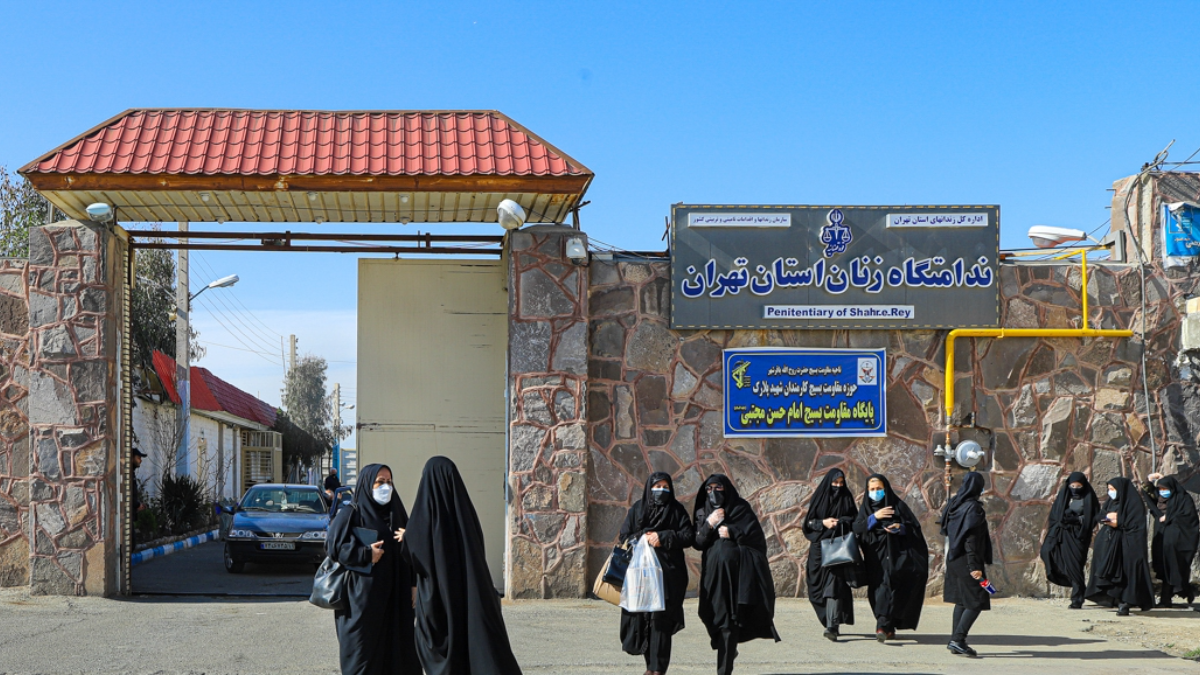
A 2021 photograph of Qarchak women's prison in Tehran Province, Iran. Tahmineh Rahmani/Student News Agency (Wikimedia)
Real Iranian women protesters are being held in Iranian prisons under threat of capital punishment. Their cases are now harder to defend than they were a week ago because the credibility of the documentation that human rights work depends on is being eroded by people who claim to be defending them. AI tools are being used to enhance real photographs until they look manufactured, and entirely AI-generated images are being presented as if they were of real people, often side by side as if they are the same thing. The distinction between the two is being lost, and the real women in real prisons disappear into the noise.
The eight women whose photographs President Donald Trump amplified on Truth Social this week are the latest example.
On the morning of April 21, hours before US and Iranian negotiators were due to meet in Islamabad, Trump posted a collage of eight women’s faces on Truth Social and addressed Iran’s leadership directly. “I would greatly appreciate the release of these women,” he wrote. “Please do them no harm! Would be a great start to our negotiations!” The post included a screenshot of a post by Eyal Yakoby, a 23-year-old American pro-Israel activist, claiming the Islamic Republic was preparing to hang the women shown. Within hours, the official @WhiteHouse account amplified the message on X. The State Department’s Persian-language Instagram account, @usabehfarsi, translated and republished it for Iranian audiences with US government branding.
By the end of the day, Iran’s judiciary had its answer. It declared the post ‘fake news.’ “The women who were claimed to be on the verge of execution,” the statement read, “some of them have been released, while others face charges that, if convictions are upheld, would at most result in imprisonment.”
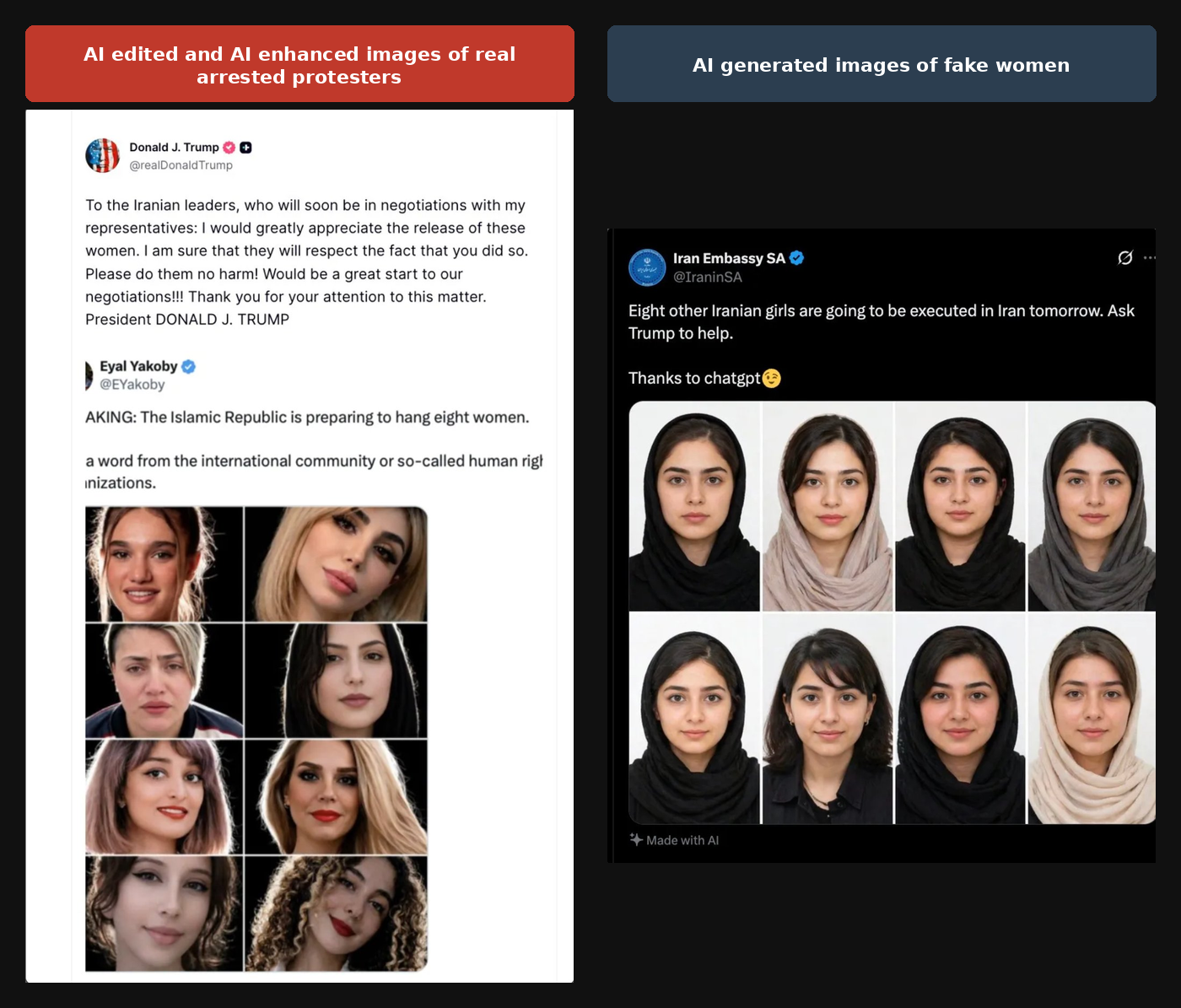
Left, the post shared by President Trump; right, a post shared by the the Iran Embassy SA account.
Twenty-four hours later, Trump posted again. "Very good news!" he wrote, claiming the eight women would no longer be killed. "Four will be released immediately, and four will be sentenced to one month in prison. I very much appreciate that Iran, and its leaders, respected my request, as President of the United States, and terminated the planned execution." The @WhiteHouse account amplified this too. The specific numbers came from no human rights organization, no court filing, no reporter. There were claims about an execution that Iran's own judiciary said was not scheduled. What Trump’s strategy is remains unclear. What is observable is that this faulty narrative was advanced by the US government with little visible regard for the truth or the harm to the women named in it. There is no apparent evidence that any human rights or journalistic verification work was done by anyone in the chain that carried the post into the diplomatic record with Trump’s statement. As Sarah Jeong reports in the Verge, this case is a “mingling of fact and fiction into a fuzzy distortion that fuels an endless disputation of real human rights violations.”
But the Iranian judiciary was not telling the whole truth either. It appears to have embraced Trump’s gift: a flagrantly inaccurate framing that it could use to swat away the underlying reality of Iranian government abuses and human rights crimes. The names in the collage are all documented political prisoners arrested or disappeared since the January 2026 protests. The photographs themselves were real. These were images of real women, taken by real cameras. What likely brought AI into the loop is that they were visibly altered images, with stylized black backgrounds, beauty filtering, and the smoothing artifacts characteristic of AI-enhanced retouching. This is “AI enhancement” or “AI editing,” a different operation from AI generation, which produces images of people who do not exist from a text prompt with no underlying subject.
The distinction between enhancement and generation matters, because it determines whether the photograph has any relationship to a verifiable life. It is also increasingly difficult to make this distinction in practice. AI retouching or editing is now increasingly built into standard photo editing software used by most people everyday, which means more and more authentic images carry some AI trace. The category of "AI-enhanced real photograph" is no longer exotic. It is becoming increasingly common, and the analytical work of distinguishing enhancement from generation is getting harder at the same time as it is becoming more necessary.
What the documentation actually shows
All eight of the women are real. Some of them are in grave danger. None of their cases match the framing Trump employed.
Bita Hemmati is the only one of the eight with a confirmed death sentence. Branch 26 of the Tehran Revolutionary Court, presided over by Judge Iman Afshari, sentenced her in mid-April alongside her husband and two neighbors on the charge of “operational action for the hostile government of the United States and hostile groups.” HRANA noted the prosecution relied on broadcast forced confessions.
Mahboubeh Shabani, 33, was arrested by Mashhad intelligence agents on February 2 and is reportedly held in Vakilabad Prison’s women’s ward. The Norway-based Hengaw Organization for Human Rights documented her case. She has been charged (with no verdict) with ‘moharebeh’, enmity against God, a capital offense that could face execution under Iranian law, for using her motorcycle to ferry wounded protesters during the January 8-9 unrest.
Diana Taherabadi was 15 when she was dragged from her home in Karaj in her pajamas; she remains in the juvenile section of Kachouei Prison. Ghazal Ghalandari, 16, was taken in a similar raid in Yasuj and moved to an undisclosed location.
Venus Hossein-Nejad, a 28-year-old Baha'i woman, was taken from her workplace in Kerman, forced to deliver a televised confession, and denied medication for bipolar disorder in detention. Golnaz Naraghi, a 37-year-old emergency physician, was arrested in Tehran and transferred to Qarchak Prison. According to Iran Human Rights in Oslo, both Hossein-Nejad and Naraghi have since been released on bail.
Panah Movahedi, a 24-year-old professional kickboxer, disappeared during the protests in Tehran's Punak neighbourhood on 9 January, according to the Oslo-based Iran Human Rights, which emailed a verified case summary to the fact-checking site Lead Stories on 22 April. Her family has had no information about her whereabouts since. Similarly, Iran Human Rights confirmed Ensieh Nejati was arrested in Darab, in southern Iran, on 10 January. There have been no further updates on her case.
What credible human rights organizations have collectively documented is a regime apparatus quietly executing its crackdown through revolutionary courts, juvenile correction facilities, forced televised confessions, and arbitrary charges that can amount to executions, against women whose actual stories are searing on their own terms without AI enhanced images or sensationalised versions of their stories.
The pattern
This was not the first time Yakoby shared what has been identified as AI-generated material related to Iran. On April 9, he posted a purported image of the aftermath of January’s crackdown. Shayan Sardarizadeh of BBC Verify flagged it within hours as AI-generated. Sardarizadeh pointed out that the Persian-language shop signs in the background were nonsensical and the bodies in the foreground had anatomical errors. Yakoby deleted the post.
This dynamic is not only about what AI can produce. It is also about the doubt AI creates around content that is entirely real. Two days earlier, on April 7, he had reposted authentic footage of Iranian casualties, footage that did not need fabrication. Underneath, one reply read: “With Central Casting, AI, and the manipulation and manufacturing of headlines that get inorganic reach on social media has made me question everything. Nobody is innocent here, and I don’t want American tax payers to fund NATO or be involved in the Middle East at any capacity.”
That reply is the dynamic’s logical endpoint. Faced with an information environment in which authentic and synthetic content sit indistinguishably side by side, audiences do not become better at telling them apart. They withdraw. The pattern on display here is not disinformation in the conventional sense; the underlying events are real. It is propaganda: real cases packaged with synthetic, unverified, or instrumentalized material in service of a political agenda. The damage is not the falsehood. The damage is that real human rights cases, propagandized this way, look fabricated.
Three currents, one vacuum
I have written before about how the existence of AI-generated content allows authentic documentation of Iranian state violence or authentic protests to be dismissed as fabrication, and about how that dynamic operated at wartime scale during the Israeli and US strikes earlier this year. What is now visible, after the ceasefire and the regime’s reconsolidation of its information architecture, is a more general and more dangerous pattern. Synthetic and unverified content about Iranian human rights abuses are being produced from every direction at once, by actors of incompatible political orientations, with the same net effect.
The Iranian state itself runs an industrial AI propaganda pipeline, used to inflate its military capacity during the war, using documentation of real tragedies in a bastardized way for its own propaganda and to present to the world one voice for 93 million Iranians during an internet shutdown, while appealing to discourses of global south oppression, anti-war sentiments and leftist westerners. Opposition and diaspora media have produced their own fabrications. Iran International earlier this year shared an AI-generated video purporting to show political prisoners being transferred to an IRGC base to turn into human shields. The Iranian judiciary then issued a formal statement identifying the video as a fabrication and using it to dismiss the broader category of prison documentation, or their notorious mistreatment of political prisoners during wartime, as enemy psy-ops. The video was quietly removed, but the regime had already taken advantage of it..
The regime is not only weaponizing other actors' AI fabrications. It has begun producing its own to mock the dynamic. Hours after Trump's victory claim, the Iranian Embassy in South Africa, an official Islamic Republic account, posted a grid of eight AI-generated images of Iranian women in hijab with the caption "Eight other Iranian girls are going to be executed in Iran tomorrow. Ask Trump to help. Thanks to chatgpt." The account opted into the AI-generated label by the platform. The regime is performing –or trolling —what it has helped engineer. They are mocking the dynamic Trump has just demonstrated by collapsing it. The collage that Trump shared was AI enhanced; the Embassy's grid is AI generated. The mockery works because most audiences cannot, or will not, tell the difference, and the Embassy is performing that very confusion: a category of evidence so degraded that anyone can produce a collage of synthetic women and have the absurdity itself land as commentary on the credibility of the entire Iranian human rights record.
The amplification chain that carried the original collage into the State Department's Persian feed represents a third current: propaganda actors instrumentalizing real human rights cases with unverified or AI-enhanced packaging, in service of a foreign policy agenda the women named in the post never agreed to be enlisted in. Each currently claims to act on behalf of the Iranian people. Each contaminates the evidentiary record. The regime then weaponizes everyone else’s synthetic material to deny everything, which is precisely what the Iranian judiciary did within hours of Trump’s post.
Underneath all three currents is a vacuum the Islamic Republic has worked methodically to maintain. In the days after the January 8-9 protest massacres, contacts inside Iran sent me photographs of blood pooled on Shiraz pavements, taken at angles that captured only the ground because the photographers could not risk being seen with a phone in hand. When connectivity briefly resumed at the end of the month, I spoke with someone in Tehran who described watching city cleaning crews wash blood from her own neighborhood streets. She had no images to share; the security presence was too heavy to risk it. Across Iranian cities, guards at checkpoints searching phones and arresting anyone whose camera roll contained protest material. This is the documentary record from inside Iran in January: discrete, partial, dangerous, and often suppressed at the source. Into that vacuum step actors of every political stripe with material that ranges from authentic-but-instrumentalized to AI-enhanced to entirely fabricated. The women whose lives are at stake disappear into the noise that everyone, regime and opposition and advocates alike, has helped produce.
What disappears
Two truths can hold at the same time. Trump uses propaganda and does not care about the rigorous methodology that human rights documentation requires; he will amplify unverified execution claims and inflated casualty figures with equal carelessness. The Iranian state committed an unprecedented massacre in January, with HRANA confirming over 6,700 deaths of protesters and minors and another 11,744 cases under investigation, and is now executing political prisoners at the highest rate in two decades while holding 16-year-old girls under threat of capital punishment and forcing Baha'i women to confess on television to crimes they did not commit. The first truth does not soften the second. What it does is corrode the record on which the second depends.
Bita Hemmati's actual death sentence is now buried under a flood of unverified claims about seven other women. Diana Taherabadi's family waits for a verdict they have not been shown while the world argues about whether her photograph is AI-generated. Venus Hossein-Nejad's forced confession was already a regime tool used against her; her case is now made more precarious. The entire network of organizations producing the credible record of what the Iranian state is actually doing to its citizens are watching their work absorbed into the noise produced by varying actors with their own political stakes in the conflict but very little regard for real lives or the truth.
Some of the mechanisms for a structural response already exist. The Oversight Board's March recommendations to Meta call for a new community standard for AI-generated content, consistent labelling of AI material during crises, and the implementation of content provenance infrastructure at scale. Meta has 60 days to respond, but its track record on previous Board recommendations on AI content suggests that strong decisions do not automatically translate into action. X has gone further on paper, announcing in March that creators who post AI-generated armed conflict videos without disclosure would be suspended from the platform's revenue-sharing program. X has said it will rely on a combination of proprietary detection tools, Community Notes, and AI metadata signals. But it does not appear to have not disclosed the specific technical methodology, and has published no data on how often the policy has been enforced.
As my colleague, WITNESS executive director Sam Gregory, has said, there is no single silver bullet solution to this crisis. What is needed, more than ever, is a layered set of trust signals: AI provenance built in at the point of creation rather than relying on detection downstream at the point of dissemination; transparency frameworks, guardrails and interoperability from the companies producing both the generative models and the distribution platforms where the content is disseminated across; sustained investment in fact-checking, especially within platforms and their content moderation processes, with the resources to work under crisis conditions like conflicts where AI content is inundating the information ecosystem; platform content moderation that uses both human and technical mechanisms to distinguish synthetic from authentic during crises rather than collapsing the two; and media literacy that equips audiences to understand our brave new world of AI content, away from the AI-or-not binary while holding uncertainty rather than retreating into blanket disbelief.
Each of these is failing or underinvested in right now. Without them, the people whose stories most need to be heard become invisible, and those who claim most loudly to be speaking for them are—whether intentionally or not—the ones erasing them.
Authors