The Quiet Erosion of Collective Action Under Digital Surveillance
Gina Romero / Jun 23, 2026Gina Romero is the United Nations Special Rapporteur on the Rights to Freedom of Peaceful Assembly.
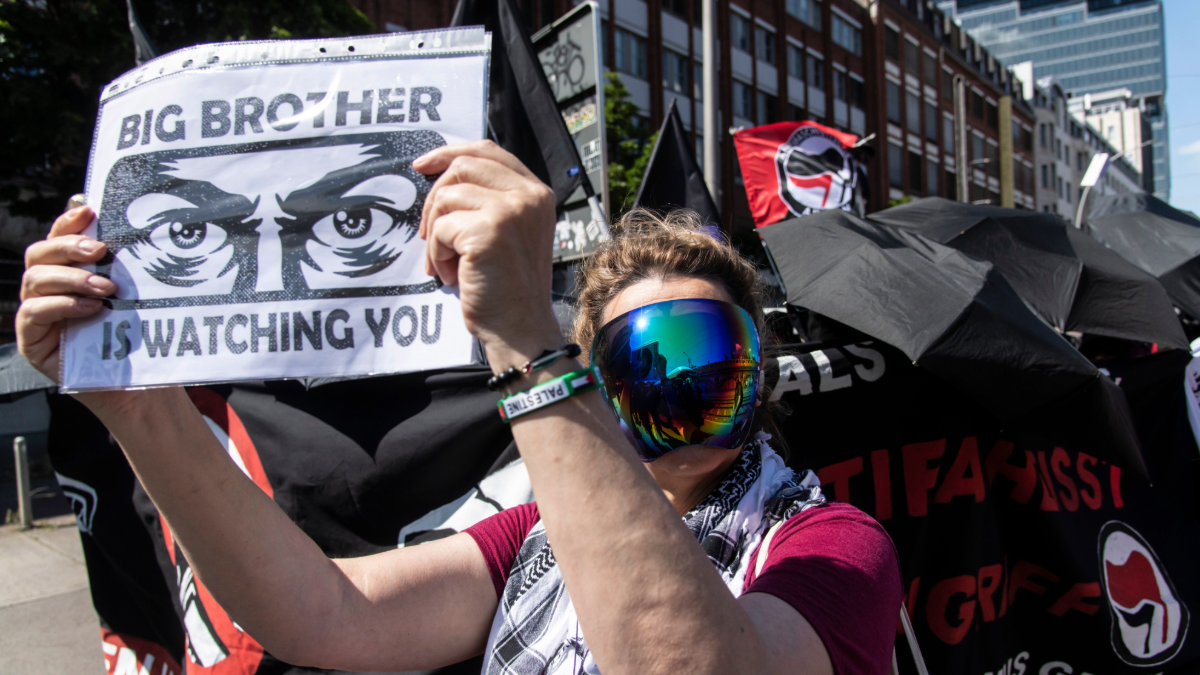
Demonstrators march in Berlin, Germany, during a June 2026 protest against the digital expansion of police powers, biometric surveillance technologies, and the use of AI systems by authorities. (Sipa via AP Images)
When I assumed my role as United Nations Special Rapporteur on the rights to freedom of peaceful assembly and of association in 2024, I immediately began hearing alarming stories from civil society organizations and protesters worldwide indicating a sharp increase in state-led surveillance, with activists’ phones being bugged across the globe with Pegasus and other highly invasive spyware.
But the true turning point for me was seeing how surveillance trickled down into everyday spaces of youth activism. Watching university campuses rapidly deploy advanced surveillance networks to aggressively curtail student organizing, especially as the pro-Palestine solidarity movement gained momentum, made it clear that this was a coordinated global pattern. It extended far beyond police departments putting up more AI-powered CCTV cameras with facial recognition under the guise of enhanced security or data maximalization measures.
This realization led me to prepare an official report on how digital surveillance affects the rights to assemble and associate, which I am presenting today to the Human Rights Council. The research underpinning this report was guided by three objectives.
First, to unpack a phenomenon everyone talks about but few truly understand: the "chilling effects" of surveillance. Because these effects have historically been dismissed as too subjective or difficult to prove, my research team and I wanted to provide a concrete human rights framework that courts can use at the national and regional levels.
Second, we wanted to break out of the traditional privacy silo. Most legal approaches to surveillance focus almost entirely on the right to privacy, and occasionally on freedom of expression. This overlooks how deeply surveillance harms other interconnected rights, including freedom of assembly and association, creating compound harms across the broader human rights framework.
Third, I wanted to take a closer look at how surveillance is reshaping freedom of association. While the impact of surveillance on public assemblies is often visible, the gradual erosion of an organization’s ability to organize, operate and survive on a day-to-day basis is far less visible but no less consequential. This is the issue I want to focus on because the evidence we have uncovered is deeply concerning.
The right to freedom of association in general, and civil society in particular, has been deeply affected for years now by the abuse of national security, counter terrorism, money laundering, and cybercrime frameworks. Civil society organizations, social movements, and grassroots activists have been systematically mislabeled as "national security threats," "foreign agents," "criminals," or "terrorists.”
This stigmatization creates an environment of permanent suspicion, which in turn fuels harassment, violence and criminalization, while rationalizing intrusive monitoring.
This monitoring does not consist of isolated acts of surveillance, but rather represents the establishment of a permanent, interconnected, remote and invisible surveillance ecosystem. It combines spyware, location tracking, data scraping, SIM cloning, cyber patrolling, among other practices, which, in many cases, are followed by offline actions.
Perhaps most troubling was hearing from civil society actors in nearly every region of the world that they now operate under the assumption that they are being surveilled.
The work of civil society, and the exercise of freedom of association, are deeply rooted in trust and engagement. But when these pillars are eroded by the permanent suspicion of monitoring, the entire fabric that sustains collective action begins to unravel.
This creates a process of de-socialization that fractures movements, breaks associations, and ostracizes civil society actors. Colleagues, communities, allies, donors or benefactors, and even family members and intimate partners may fear guilt by association, isolating those who may be targeted because of their work.
As organizations operate under the constant assumption that they are being monitored, their core functions are profoundly affected. Their ability to serve as watchdogs, provide rights-based services, protect victims of human rights abuses, and educate the public is severely constrained. Ultimately, the very possibility of advancing and protecting rights, democracy and the rule of law is undermined. Two consequences of digital surveillance are especially damaging during the sector's current funding crisis.
First, civil society organizations are being forced to dedicate scarce resources to digital security measures while altering their methods of work to reassure community members that engagement remains safe. As a result, operational budgets are redirected toward security expenditures, diverting funds from core mission-related activities.
Second, when organizations withdraw from public engagement and reduce their social media presence to avoid criminalization, they become less visible to donors. This can cut off potential funding streams and threaten their long-term survival. Beyond these economic hardships, some organizations have been forced to delete websites and online archives to protect staff and networks. When they do, critical institutional memory disappears. The loss of these digital repositories weakens organizational continuity and increases the costs of rebuilding knowledge and capacity over time.
These trends disproportionately affect local organizations and associations representing vulnerable communities, including those in exile, as digital surveillance increasingly enables transnational repression. This demonstrates that digital surveillance-related chilling effects also create a profound intersectional harm.
Finally, one of the least discussed consequences of the pervasive surveillance is the severe psychological harm it inflicts. It creates a state of constant hypervigilance, deep psychological stress, clinical depression, burnout and chronic trauma, ultimately forcing individuals to leave the sector and abandon human rights work entirely.
Backed by a global study that provides concrete evidence of these chilling effects across eighty-four countries and territories, my report presents clear recommendations to dismantle this architecture of permanent suspicion. The study reveals a lack of transparency surrounding the relationship between state power and non-state actors, creating an information vacuum that makes surveillance practices exceedingly difficult to challenge through litigation. As a result, the right to an effective remedy is fundamentally weakened.
To address this gap, governments and corporations should adopt interdisciplinary, precautionary approaches to risk in their human rights impact assessments and due diligence processes. That means moving beyond a narrow cause-and-effect framework and assessing how surveillance systems operate as a whole. Policymakers and companies must evaluate the cumulative human rights harms these systems can produce and their long-term effects on civic space, democratic participation and fundamental freedoms.
If civil society is to remain free and vibrant, people must be able to organize, speak and connect without fear of being watched.
Authors