The Pope’s Encyclical on AI Was Important—Now Comes the Hard Part
José Marichal / May 27, 2026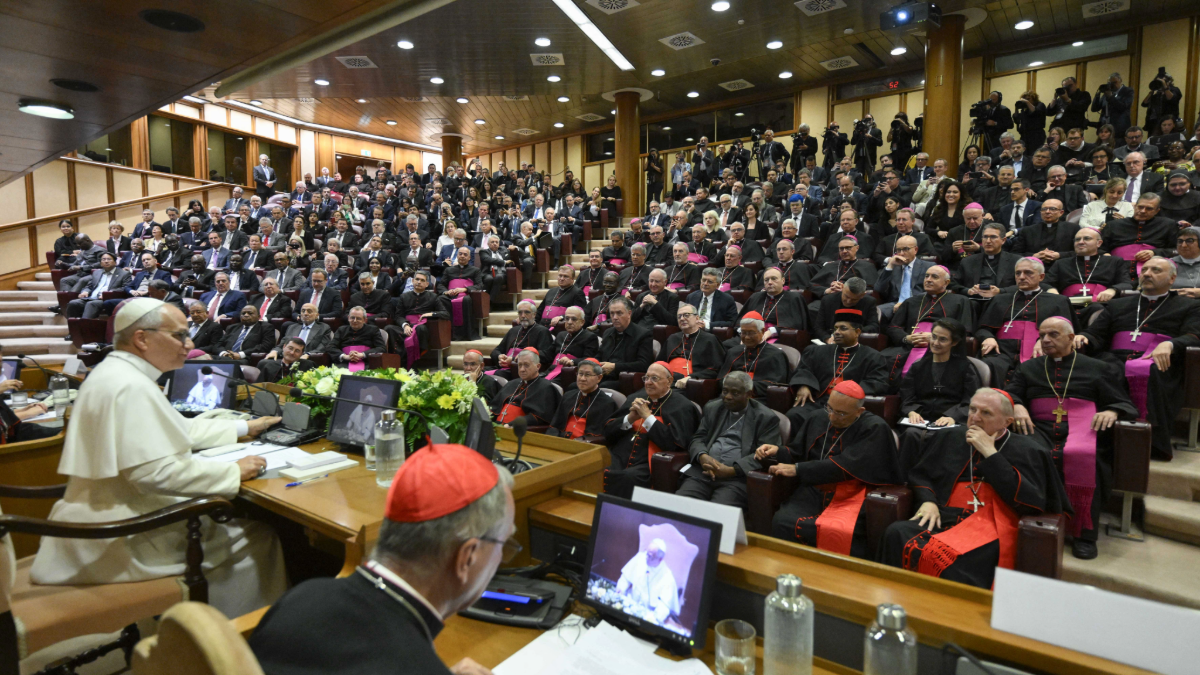
Pope Leo XIV attends the presentation of his first Encyclical titled 'Magnifica humanitas' (Magnificent Humanity), in the Vatican on May 25, 2026, a call to remain human in the age of artificial intelligence (AI). Pope Leon XIV appealed for the safeguarding of humanity, promotion of truth, dignity of work, social justice, and peace. Photo by (EV) Simone Risoluti/Vatican Media/Abaca/Sipa USA (Sipa via AP Images)
On Monday, Pope Leo XIV issued an encyclical letter titled “On Safeguarding the Human Person in the Time of Artificial Intelligence.” The text repeatedly returns to the importance of respecting human dignity, the wonder of creation and a necessity of a pluralistic search for the truth. While the encyclical was full of cautionary notes against dehumanization and blind adherence to acceleration in technological progress that exacerbates inequality, it was also characterized by a hopefulness in the potential for this technology to promote human dignity and flourishing.
The encyclical opens with a contrast between two familiar literary/biblical tropes—the Tower of Babel and the City of God. In his depiction of the Tower of Babel story, the Pope emphasizes the problem with building a tower to reach heaven not as simply a tale of hubris but as one of promoting a conformity that undermines the plurality of the human creation—choosing homogenization over communion. Pope Leo pairs the story with the Book of Nehemiah, a story designed to show the importance of shared responsibility in collective action. The juxtaposition between a story that emphasizes the importance of differences and one that implores collective action and shared responsibility is important and hopefully resonant in a world that pits one trait against the other.
The fact of this encyclical reminds us of how different our relationship to technology has become in a short decade. The ‘cyber optimism’ of the early 2010’s and its failed promise have led to a justifiable techno-pessimism. Instead of online tools that promote habits of democratic deliberation and inclusion, our current technological tools feel exploitative and disempowering. The list of technology’s challenges to human dignity and social good are long: algorithmic bias, data colonialism, platforms that steer young people towards dangerous content, misinformation, elite surveillance, and a growing welcoming attitude towards AI slop, misinformation and hate speech. As such, this encyclical came at a critical time in the development of AI.
From this historical vantage point, it's hard to see how AI can be steered towards serving human dignity and the common good. But the question remains: If there is a chance that these tools can promote human dignity, how can we bring that about? How do we build technology tools that promote a healthy liberal democracy and restore the individual’s sense of self worth?
Current responses follow a familiar pattern to social scientists—what economist Albert Hirschman posed in the 1970’s as exit, voice or loyalty. We can engage in a process of “analog refusal” where we outright reject the technology and resist its adoption (exit). We can develop a “techo-pessimism” about the prospect of ever living lives “emancipated” from these technologies and learn to find meaning within our new “AI regimes” (loyalty). Or we can cultivate a politics of “techno-possiblity” where these tools are aimed at promoting human dignity (voice).
The Vatican is to be commended for its thoughtful call towards techno-possibility—referring to AI as a “valuable tool that requires vigilance.” Multiple times in the encyclical, readers are implored to not see human limitations or the complexity of personal relationships as a problem to be addressed but as part of the mystery of humanity that should be addressed with wonder and compassion.
There is little I can disagree with in the encyclical. For me, the question that looms is if we are going to create systems that do promote human dignity and the social good, where does the ultimate responsibility lie? At times, the responsibility seems to lie with the user, while at others, it is aimed squarely at those in power—particularly the designers of the technologies. While I have written about the role that individual agency plays in renegotiating our sociotechnical contract, we run the risk of assigning too much individual responsibility to systems that are seemingly designed to undermine our judgment and ability to discern the good.
In Langdon Winner’s 1980 essay “Do Artifacts Have Politics,” he argues that technological artifacts have political goals embedded within them through their design. Put another way, the goals and biases of designers get transmitted into their products. In his essay, Winner uses as an example how the US interstate highway system produced certain racial and socioeconomic ‘winners’ and ‘losers’ and impacted the design of urban space. Humans certainly had agency over how they reacted to the “politics” of the interstate highway system, but that agency wasn’t equally distributed across all racial and ethnic groups. Similarly, a good argument can be made that AI's incentives are aligned to make a small set of tech company moguls and their circle the "winners" while those on whom AI was trained get left behind.
In her wonderful 2022 book, Designing for Democracy, Jennifer Forestal argues for three core elements of democratic design for tech platforms 1) recognition (the ability to form communities with “clear boundaries,” e.g. identity markers); 2) the ability to develop affective attachments (feelings of connection); and 3) an emphasis on experimentalism that gives communities the ability to “self-correct” and become inclusive (adaptable, interoperable spaces). Forestal argues that affordances of individual social media platforms drive democratic possibilities for their users. ‘Affordances’ is a term from the psychologist James Gibson, who defined it as an animal’s “action possibilities” that emerge from its environment. The affordances structure what behavior is easily practiced within an environment and what behavior becomes challenging. As an example, a wall does not afford permeability, but a stove affords heat that allows for cooking food.
We are in the early stages of understanding the affordances of AI tools. We are far from understanding which types of AI affordances enable human dignity. Fortunately, along with the encyclical, a number of groups are working on this very question. Last week, the nonprofit New Public published a slide deck (that I am honored to have helped with) entitled “After the Feed” that sought to identify ways in which AI can be beneficial for human relationships and communication. Likewise, Data and Society is leading an initiative called AI Civics that is aimed at strengthening channels for public participation in AI design.
While firmly setting moral guardrails is critical, now comes the hard work of designing platforms that actually carry out the vision of the Pope’s encyclical. Jennifer Forestal’s work offers us a useful cautionary note. Rather than talk in terms of AI affordances, we should be thinking more in terms of “Anthropic affordances” and “OpenAI affordances.” Each of these platforms comprises a network of AI that will have different impacts on human relationships and well being, and which may or may not contribute to the health of democracy or human dignity. To borrow from the encyclical’s reference to the Book of Jeremiah, this work will not come from tech companies themselves, “but through the shared responsibility of all: men, women, priests, artisans, heads of households and young people all play a part.”
This article was updated June 4 to correct the spelling of Langdon Winner's name and to adjust the link to his essay.
Authors