The Pentagon Has a Big Tech Problem
Amos Toh, Margaret Mullins / Oct 26, 2026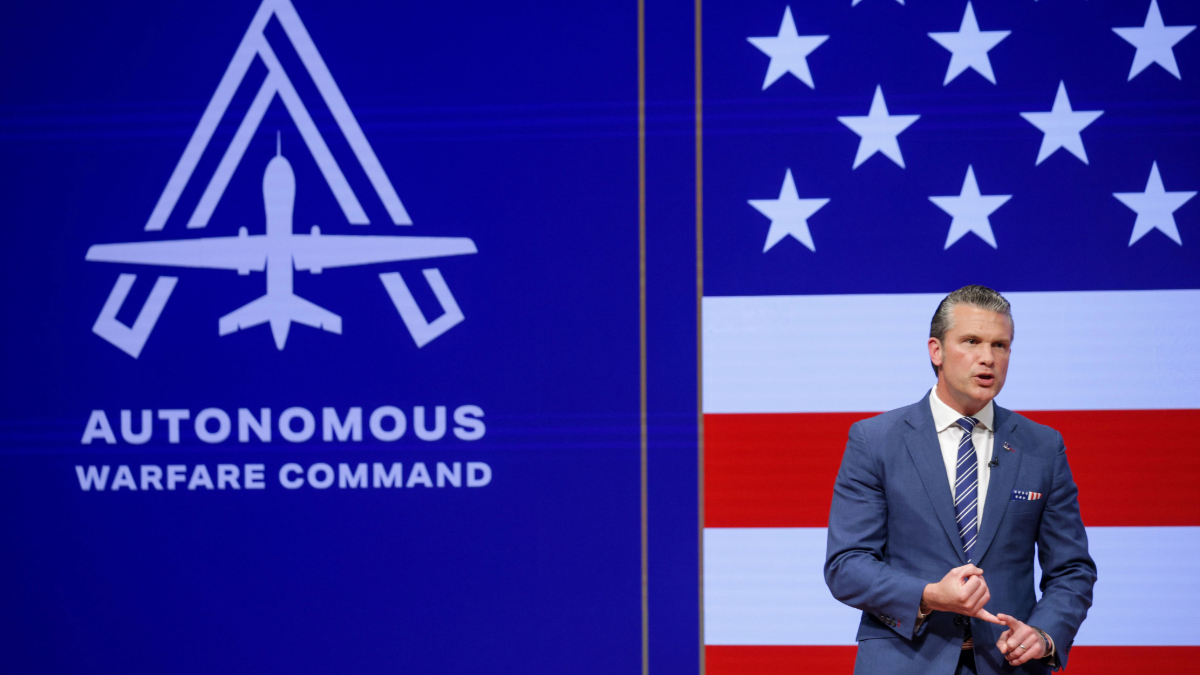
Secretary of Defense Pete Hegseth gives a State of the Force address at Marine Corps Base Quantico, Wednesday, Sept. 30, 2026 in Quantico, Va. (Alex Wong/Pool Photo via AP)
In February, the Trump administration designated Anthropic a “supply chain risk” and blacklisted the artificial intelligence firm from federal contracting after it refused to loosen restrictions on the use of its models for mass domestic surveillance and fully autonomous weapons. Nearly a year later, however, it is still unclear whether the Pentagon has found an adequate replacement for Anthropic’s foundation models, which were the first to be deployed on classified military networks. Media reports indicate that the military is relying more broadly on OpenAI’s models, but still struggling to unwind Claude from mission-critical systems.
Whatever one thinks of Anthropic’s specific red lines — autonomous weapons and mass domestic surveillance — the dustup was yet another reminder of Silicon Valley’s outsized role in shaping the conduct of war. The Pentagon won the immediate fight, cutting deals with other AI firms that appear to give it more control over how it uses their models in military operations. One of the lessons, according to the Pentagon’s chief technology officer Emil Michael, was that “you can’t put the rules and the policies of the United States military … in the hands of one private company.”
But it is far from clear that the military has weaned itself off Anthropic’s technology, much less its broader dependency on the tech industry. In fact, this dependency stretches beyond Silicon Valley and AI. It is the culmination of a decades-long shift in defense policy that has progressively ceded power over critical national security technologies to private companies.
The military has engaged with private industry since the nation’s founding. During World War II, government planners dictated the terms by which industry produced weapons and military equipment, centralizing key decisions ranging from the allocation of scarce materials to setting prices and wages. But by the end of the 1970s, and accelerating in the 1980s and 1990s, the government increasingly outsourced technology development, shedding its own capacity to produce weapons, maintain systems, and manage acquisition along the way. The thinking was that commercial competition would deliver faster, cheaper innovation than the government could — but the shift largely failed to deliver on its promise. As defense budgets fell after the Cold War, the defense industry consolidated into a handful of dominant firms. Competition dwindled and costs failed to fall — all while the military was left short of the technology and equipment it needed.
Yet the thinking that underpinned this trend still drives US policy, and AI is just the latest iteration, and potentially the most consequential. As the Pentagon embraces an "AI first" approach to force modernization, the military is rushing to adopt the technology across a wide range of functions — recruiting, supply-chain management, cybersecurity, logistics, targeting, intelligence, and more — and turning to a small handful of powerful tech firms to supply their needs.
In the battlefield, commercial AI is shaping decisions to go to war, identify and strike targets, and anticipate civilian impact. Because the military is by and large renting access to this technology, it has limited capacity to control and oversee the models, algorithms, and data pipelines that guide operational decisions, despite their life-and-death stakes. In some cases, it has become so reliant on a single vendor that it has little flexibility to pursue alternative platforms that are more user-friendly, effective, or secure.
Reversing this dependency is essential to restoring democratic control of how the military adopts and uses AI. This begins with rebuilding the government’s capacity to develop, maintain, and oversee key parts of its AI infrastructure — particularly the systems of data that models and algorithms learn from and process into intelligence about the battlefield. This does not mean a full break from buying commercial technology, which when done right can save costs, harness private sector innovation, and redirect government resources towards core defense functions. But it does mean that the government has to absorb the inefficiencies and upfront costs of cultivating the expertise needed to properly harness the benefits of AI, maintain a clear-eyed view of its limits, and ensure human control and accountability over use of force.
Data is the new dependency
The Pentagon’s reliance on Silicon Valley for core AI competencies traces back to the 2017 launch of Project Maven, a flagship initiative to partner with tech firms to accelerate adoption of the technology to generate targets and other forms of battlefield intelligence at scale. A year after Maven’s launch, Google, the Pentagon’s primary industry partner, withdrew from the project when thousands of employees protested its involvement. The controversy forced a public reckoning with the dangers of automating warfare, but less so about whether this set of capabilities should even be outsourced in the first place. The data analytics company, Palantir, quickly took over Google’s contract. The Pentagon’s efforts to privatize the military’s AI architecture continued apace, and it has progressively relinquished ownership and oversight of some of the nation’s most sensitive technologies.
Project Maven’s most consequential output to date is the Maven Smart System (MSS), a command and control platform used in many targeting operations today. MSS has facilitated strikes in Iraq, Syria, and Iran. Although MSS was developed with taxpayer dollars, Palantir owns the platform, and licenses its use to the US military and its allies. The platform houses a vast array of data from military sensors, data brokers, and the open web, as well as the AI tools to turn this information into recommendations and strategies for targeting.
Large language models from Anthropic, OpenAI, and other AI companies are among these tools. After Google’s exit, Microsoft, Amazon, and the computer vision specialist Clarifai took turns developing the image and video recognition algorithms that identify and locate people and objects of interest from drone feeds. These algorithms learn what to detect from descriptions that human analysts give to raw footage, a labor-intensive process that is now led by the startup Enabled Intelligence. These contracts are so large and complicated that they require a separate contractor to manage all of them.
The Defense Department has insisted that it exercises meaningful control of operational decision-making, even as it cedes ownership, and arguably understanding, of the software underlying these decisions. This is despite the fact that AI is increasingly shaping what commanders see and how they understand the battlefield.
To see why, it helps to know how platforms like MSS work. All of the data coming in — drone footage, satellite images, radio intercepts, radar tracks, location data harvested from mobile apps, social media feeds, and more — has to be organized into a coherent stream of information. Let’s say there is incoming drone footage of a possible enemy vehicle labeling the vehicle as a “truck” and reporting its position in GPS coordinates and the local time zone. Ground radar tracking the same vehicle might instead identify it with the standard military symbol for a transport truck, and report its position in grid-based coordinates and a time zone commonly used by the military. On the surface, these look like reports of two different threats. Properly integrating this data means figuring out that they are in fact the same threat, establishing a ground truth that human analysts and their AI assistants can work off to develop intelligence and other insights.
This process, known as “data integration,” is not simply a matter of combining sources of information. Once disparate feeds are unified into a common system, developers must make consequential choices about what the system allows users to do with the data, and how it records these actions. The feeds must also be able to “talk” to each other, by developing what is known in computer and information science as a data ontology. The ontology functions like a knowledge graph, defining how data exists within the system, such as the categories they fall into, and all the possible relationships that can be drawn between them.
If a large language model is plotting potential targets on a map, the ontology determines how the map is drawn. A system could merely establish the presence of weapons in a building, or also indicate how many there are, their make and model, whether they are in the basement or on the second floor, and the list of civilian structures in the vicinity. The ontology additionally resolves inconsistencies between data feeds. For example, when one feed labels the building as a hospital and another classifies it as a military facility, the system might automatically flag this for human review, or resolve it in favor of the most recent label.
The Department of Defense has ultimate responsibility for the baseline ontological standards that dictate what battlefield systems record, visualize, and display. By outsourcing data integration — and the technology and processes that establish and implement these standards — it risks losing control of the military’s field of vision. Contract engineers who lack expertise and authority to interpret and apply military doctrine may, for example, inadvertently merge data fields about a building’s “purpose” (how enemy forces might use it in the future) and “use” (how it is currently used). Every screen downstream inherits this change, shaping what commanders and operators see and use to assess the anticipated military advantage of an attack, or its potential civilian impact. This is the sort of error that makes or breaks whether data-driven decisions in the battlefield comply with the rules of engagement and the law of war.
Broad assertions of intellectual property also stymie efforts to ensure accountability for such decisions. To understand how an AI-enabled strike results in civilian deaths, it is not enough to analyze a model’s outputs. The military and those conducting oversight need to be able to examine how a model is trained and fine-tuned, or even the model weights themselves. Given that much of this information is proprietary, lawmakers are weighing whether to compel disclosure, but only for a narrow range of security incidents.
The problem cuts both ways: If the error instead lies in the information that AI is asked to interpret, then access to the rules and logic of data integration becomes critical. For example, this would clarify whether the faulty merging of location data feeds triggered an incorrect AI estimate of a target’s coordinates. But tech companies also own the source code that establishes these standards, making it harder to pinpoint their role in AI-related incidents.
The risks of outsourcing data integration go beyond the Maven program and targeting on the battlefield. The Army has selected the autonomous systems developer Anduril to lead its flagship data integration effort. The military’s expanding drone fleet also relies on command and control software by Anduril and other defense contractors to communicate and coordinate with each other. At the Pentagon, the Chief Digital and Artificial Intelligence Office has struck a deal with Accenture to help it integrate 4,000 unclassified data sources for training agentic AI on its War Data Platform. Though the department retains ownership of this system, it is still reliant on a third party for development and implementation.
The privatization trap
These AI dependencies stem from a decades-long shift toward privatization of the US military’s weaponry and technology needs. During World War II and throughout much of the Cold War, the government worked closely with industry, but was at the forefront of defense innovation, directing and coordinating much of the research and development that led to significant advances, from stealth aircraft to the internet. This meant that the government had broad rights to the resulting technology along with deep in-house knowledge of its technical specifications and logic, which allowed it to operate on a level footing with the private sector.
This began to shift as broader support for privatization of the state and deregulation swept the American zeitgeist beginning in the late 1970s. Congress passed the Bayh-Dole Act in 1980, which allowed recipients of federal funding to claim patent rights to innovations created with the help of that funding, and the Defense Procurement Reform Act of 1984 shifted the burden onto the government to justify why it should have rights to data for systems it bought. The Reagan Administration privatized a range of government functions determined not to be “inherently governmental,” and government spending on research and development declined while the private sector’s accelerated, as the potential of commercial applications of internet-related technologies became clear.
The push to make government more efficient through privatization continued throughout the 1990s. As the Cold War wound down and the public demanded a peace dividend, the theory that the private sector was better equipped to develop and maintain government technology than the government itself offered a promise of being able to spend less and get more. The Clinton administration shifted a higher percentage of weapons systems maintenance to defense contractors and closed key maintenance depots. In doing so, it gave up the government’s rights to data needed to keep these systems in good working order.
Instead of driving down costs, this decision sharply limited the military’s capacity to maintain and repair its own equipment, forcing it to outsource even when it was cheaper and faster to do so in-house. Most upkeep for conventional surface ships is now outsourced to private commercial shipyards, but ship maintenance delays have increased from five to 19 days between 2011 and 2021. The program to produce F-35 fighter jets, which has faced persistent maintenance backlogs and billions in cost overruns, has saddled the military with aircraft that can complete all the missions they were assigned only 25 percent of the time.
Repair restrictions are a key reason for this dismal record. Because contracts increasingly award private companies exclusive intellectual property rights, the services are often legally barred from fixing their own gear. This undermines military readiness. In a 2019 letter to the Federal Trade Commission, Marine officers reported that during a field exercise in Korea, a unit had been forced to choose between fixing a generator and voiding its warranty, or losing access to equipment they needed for their training. They raised concern that contracts establishing similar warranty conditions on tactical trucks would prevent Marines from making necessary repairs in hostile environments.
The dangers to troop safety have been such a concern that, in 2025, rare agreement across the political spectrum — ranging from former Army Secretary Dan Driscoll to Democratic Senator Elizabeth Warren — led to draft provisions in that year’s annual defense policy spending bill that would restore the military’s “right to repair.” But the defense industry opposed the provisions, and lawmakers eventually dropped them from the bill. Lawmakers are pushing for them again as of writing. In the meantime, services are advancing creative solutions to address supply and maintenance gaps.
The privatization of military technology has had lasting effects beyond the mismanagement of conventional weapons. Congress passed the Federal Acquisition Streamlining Act of 1994 (FASA), establishing a statutory preference for commercial technology, while further limiting government rights to underlying intellectual property as well as cost and pricing data. For anything broadly considered a “commercial” item, contracts would limit the government’s ability to look “under the hood” to determine whether contractors were fairly assessing the costs of what they were producing. The hope was that deregulation would encourage commercial vendors to sell to the department and allow the military to take advantage of private sector growth. The government’s faith in privatization also led it to shed in-house capacity to manage contracts and defer investment in the expertise needed to understand and leverage emerging technology.
This approach has led the military to outsource enterprise software, low earth orbit satellite internet, and cloud computing. In some cases, the Department of Defense has become so embedded in a single vendor’s ecosystem that it cannot practically extricate itself even when better technology becomes available. The Navy, for example, indicated in 2025 that switching from Microsoft’s Azure cloud and enterprise software to another approved provider would require a complete reengineering of key information systems and risk mission failures. This type of lock-in forces the government into impossible choices between its obligation to protect taxpayer dollars and safeguard national security.
To be sure, the government can benefit from buying goods and services from the private sector and should not recreate truly commercial commodities where prices are competitive, the threat of vendor lock-in is low, and the service provided is not core to the conduct of government. In those cases, it might make sense to cede rights to development, control, data, or repair. That takes the best features of the private sector and allows service members and taxpayers to benefit.
But the reality today is far different for much of what the government is buying. In the case of AI, outsourcing the data backbone that powers the technology creates a dependency loop. Contractors are labeling data, establishing an analytic framework, and creating an interface for AI models – all mission-critical functions where the lack of ownership or robust IP rights leads to vendor lock-in and makes switching to another vendor prohibitively costly and challenging.
Further, because nearly the entire capability is effectively rented, the government has little incentive to hire military personnel or civil servants with the technical skills to understand and support this work. This public-private talent gap saps the Department of Defense of its capacity to provide oversight, hold contractors accountable, and make build-or-buy decisions that account for long-term strategic needs, such as controlling lifecycle costs and sustaining in-house expertise. This shortsightedness becomes self-reinforcing, as any subsequent innovation is more likely to happen outside the government, leaving the military with little choice but to rent access to critical functions.
Reclaiming data ownership
How can the US government get out of this trap? One path is for the Pentagon to develop, manage, and maintain its own data integration systems. Former Secretary Driscoll has lauded Ukraine’s flagship platform for integrating drone, satellite and other data feeds, known as Delta, as a model for the Army’s own efforts. Delta started out as a volunteer initiative, but is now state owned. The government has enabled widespread adoption throughout the military, and added analytic, communication and security features at a rate comparable to development cycles in the private sector.
Ukraine’s Delta does not nearly approach the scale of data integration the US military will need to undertake. But it shows that it is possible for the military to retain ownership of its data backbone without sacrificing innovation, provided it acquires the technical expertise necessary to engage successfully with emerging technologies. Ownership would also give the Pentagon much greater visibility into critical technology and remove an unacceptable point of leverage private companies have over the capabilities the military uses on the battlefield. This is the cleanest way for the government and the military to reclaim strategic control of its AI future.
An alternative would be for the government to insist on securing substantially more robust rights to intellectual property, and legally mandate open and interoperable software standards. These standards enable the military to freely inspect and audit the source code underlying its data backbone, and more actively collaborate on modifications and updates. This would not only enhance oversight of data-driven failures in the battlefield, but would better equip the government to enforce policy fixes down to the code level.
Contractors should also be required to store data on platforms developed for government in a format that the government can export and re-use on alternative platforms. This would reduce the government’s reliance on a single vendor, lower the cost of switching to a competitor if needed, and enable it to integrate its data and the accompanying ontology with other IT systems not by the same vendor.
Both options, however, presume that the government has the technical capacity to build its own technology or to check the work of contractors, even as decades of privatization and deregulation have had the opposite effect, gutting in-house expertise and shrinking the workforce charged with administering ever-more complicated contracts. As the defense procurement budget rose at the turn of the century, the defense acquisition workforce failed to keep pace, increasing only 21 percent compared to a 43 percent rise in contract spending from 2001 to 2015. Similarly, spending on defense contracts rose by 41 percent from 2015 to 2020 but the workforce only grew 18 percent. The department’s Intellectual Property Cadre, which provides expert advice, resources, and strategic guidance to the defense acquisition workforce, also suffers from critical staffing deficits. And this is all prior to the departure from the Pentagon of thousands of civilian employees in the past year at the behest of the Department of Government Efficiency.
The Defense Department needs more technology experts with the authority and funding to build at scale. Pockets of internal software and data expertise and capacity in the US military provide a glimpse of what is possible when the government makes productive investments in the military and civilian workforce. The National Reconnaissance Office’s efforts to develop a “common operational picture,” for example, provided an early blueprint for how Maven would fuse, analyze and visualize disparate streams of data. The Marine Corps launched a software factory in 2023; the Army is building one too. The Air Force, the Space Force, and the Navy also have teams building apps for service members, leaning into AI applications, and offering government-owned solutions to real world problems.
But in order for the government to fully regain control of its data infrastructure — and its understanding of the battlefield — it will need to hire attorneys with experience dealing with AI companies and issues of data rights; managers who know how to lead software development teams; contracting officers that can navigate acquisition regulation and ensure the military retains sufficient rights in their data and software; and engineers who can run enterprise systems. These investments are necessary regardless of whether the goal is ownership or simply effective oversight and management. To entrench lasting institutional knowledge, these positions cannot be filled by two-year stints or time-limited fellows. They must be full-time staff with opportunities for career advancement, funded by the core defense budget.
None of this necessary change will be cheap or fast. A generational evolution in the Pentagon’s workforce requires acceptance of upfront costs and a commitment to a long-term vision. Congress already requires the department to give “special consideration" to in-sourcing for defense functions where it is necessary to maintain sufficient government expertise and technical capabilities. This would seem to demand a review of the work that is currently being managed by defense tech contractors.
Congress should also revise the Federal Acquisition Streamlining Act and other procurement laws that require the government to default to commercial technology. Instead, it should ensure that the government evaluates the potential impact of vendor-lock in and market concentration, long-term operational readiness, and the need to preserve effective management and oversight in-house before committing to a commercial option.
As AI becomes more pervasive in military operations, reasserting government control over the universe of data that supports it will become even more important. This will reduce the military’s reliance on any one vendor for key data integration functions, enabling it to more freely switch between platforms based on cost, effectiveness, and operational need. Moving more of this technology in-house will also cultivate the resources and expertise needed to align data-driven decisions in the battlefield with legal constraints on the use of force.
Authors