How to Think About the Anthropic-Pentagon Dispute
Justin Hendrix / Feb 28, 2026The Tech Policy Press podcast is available via your favorite podcast service.
The Pentagon wants AI that can fight wars — without limits. One of the United States’ leading AI companies says there are lines it won't cross. And this week, that standoff turned into an all-out confrontation.
To discuss the implications of the dispute between Anthropic and the Pentagon, including the determination that the company represents a supply chain risk, I spoke to two experts:
- Kat Duffy, senior fellow for digital and cyberspace policy at the Council on Foreign Relations, and
- Amos Toh, senior counsel in the Liberty and National Security Program at the Brennan Center for Justice.
What follows is a lightly edited transcript of the discussion.
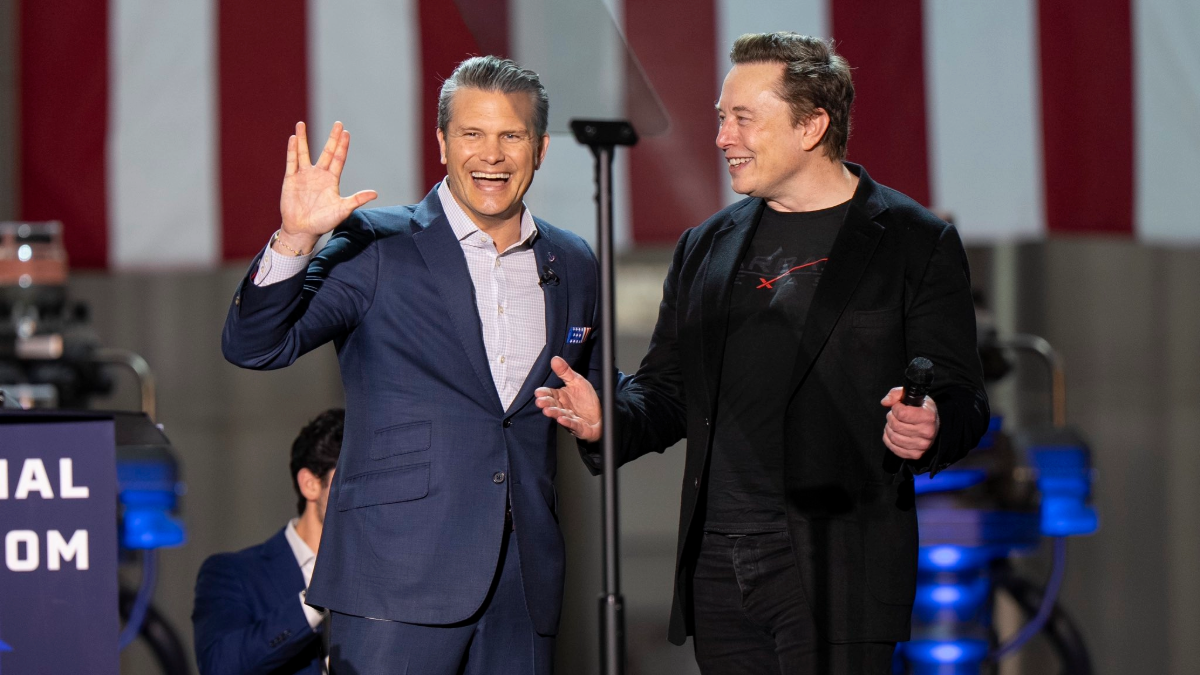
Secretary of Defense Pete Hegseth at SpaceX in Starbase, Texas, on January 12, 2026. Source
Justin Hendrix:
To understand the conflict between Anthropic and the Pentagon, you have to understand where President Donald Trump and Secretary of Defense Pete Hegseth, want to go. In January, Hegseth unveiled the Department's AI acceleration strategy in a speech at SpaceX in Star Base, Texas with Elon Musk by his side. He declared that speed wins in an AI-driven future.
Secretary Pete Hegseth:
…To further that, today at my direction, we're executing an AI acceleration strategy that will extend our lead in military AI established during President Trump's first term. This strategy will unleash experimentation, eliminate bureaucratic barriers, focus on investments and demonstrate the execution approach needed to ensure we lead in military AI and that it grows more dominant into the future.
In short, we will win this race by becoming an AI first warfighting force across all domains, from the back offices of the Pentagon to the tactical edge on the front lines.
Justin Hendrix:
The drive to build an AI-first warfighting force didn't emerge in a vacuum. It emerged in the context of the Trump administration’s broader accelerationist policy. And last July, President Trump signed Executive Order 14319 — "Preventing Woke AI in the Federal Government" — directing federal agencies to procure only AI models the administration considers free of ideological bias. In that context, perhaps it’s not surprise that Hegseth’s vision of an AI-first war fighting force came with a pointed message about what kind of AI the Pentagon would — and wouldn't — accept from its vendors.
Secretary Pete Hegseth:
Today I want to clarify what responsible AI means at the Department of War. Gone are the days of equitable AI and other DEI and social justice infusions that constrain and confuse our employment of this technology. Effective immediately, responsible AI at the War Department means objectively truthful AI capabilities employed securely and within the laws governing the activities of the department. We will not employ AI models that won't allow you to fight wars.
We will judge AI models on this standard alone; factually accurate, mission relevant, without ideological constraints that limit lawful military applications. Department of War AI will not be woke. It will work for us. We're building war ready weapons and systems, not chatbots for an Ivy League faculty lounge.
Justin Hendrix:
Anthropic — the company behind the Claude AI model and one of the Pentagon's contractors — had a different definition of responsible. CEO Dario Amodei said his company could not agree to unrestricted military use, drawing two firm lines: no domestic surveillance, no lethal autonomous weapons. Secretary Hegseth gave him a deadline: 5 p.m. last Friday. Amodei did not relent. And then yesterday, this:
PBS News Hour:
The standoff between the artificial intelligence firm, anthropic and the US government escalated sharply today, president Trump lashed out at the company's leadership. And directed all federal agencies to stop using Anthropics products. And the Pentagon designated the company a supply chain risk to national security.
NBC News:
Remember we, we brought you that breaking news on the show Anthropic, CEO, saying it cannot agree to terms laid out by defense secretary Pete Hegseth. Those terms, essentially asking Anthropic to turn over its tech for any legal military purpose, but Anthropic’s drawing two lines in the sand, over domestic surveillance and lethal autonomous weapons. And the president is calling that quote, “selfishness that puts American lies at risk, troops and danger and national security in jeopardy.”
He added, “We don't need it. We don't want it, and we'll not do business with them again.”
Kat Duffy:
I'm Kat Duffy. I'm with the Council on Foreign Relations as our senior fellow for digital and cyberspace policy.
Amos Toh:
I'm Amos Toh. I'm senior counsel in the Liberty and National Security Program at the Brennan Center for Justice.
Justin Hendrix:
I'm pleased to have the two of you on this Friday afternoon.
We are minutes before a deadline that was set by Defense Secretary Pete Hegseth to come to sum conclusion on a dispute that's been unrolling throughout the week between Anthropic and the Defense Department or I should say the Department of War, depending on whether you choose to use that particular nomenclature.
And it already looks like we have a general indication of where things are headed. We've had this preemptive truth social post from the president, and even as we talk right now, could in fact be additional news out of the Pentagon, but I'm hoping in this conversation we can step back a little bit, talk a little bit about how we got here, big picture, what some of the big issues are, and either way this works out, what some of the issues are that will remain.
So I thought I might start with you, Amos, just ask us to walk us through a little bit of how we got here.
Amos Toh:
Right. So I think, in January, it was Reuters basically broke the news that there was a dispute between Anthropic and the Pentagon about whether Anthropic could impose usage restrictions on its AI model, Claude. And two of the restrictions that were at dispute were, a, that the DOD could not use Claude for surveillance on Americans and the second was that it could not use Claude to deploy autonomous weapons without sufficient human oversight. And the genesis for this dispute was really that Claude had reportedly been used in the invasion of Venezuela as well as the capture of Nicolas Maduro and that led to a series of escalations that prompted Anthropic to reinforce and reiterate these usage restrictions to the Pentagon.
The Pentagon has now said that it should be able to use Claude in a way that it wants to as long as these are lawful. But my question throughout this entire episode has always been whether the disputed users are actually lawful.
Justin Hendrix:
Kat, from your perspective, you have framed this as a live stress test of America's global tech trust premium. Take us back to the point that you're watching all this from.
Kat Duffy:
I think it's twofold. Geopolitically, this is not a great look. Anthropic is arguably the most safety-conscious leading company in frontier AI. They are one of America's major frontier AI innovators. They have focused more than any other company on enterprise deployments, such as those that you would see inside the US government as opposed to consumer-first applications, which is more where OpenAI has sat. And so in many respects, Anthropic should be, one would think, a company that the United States government is really leaning into if its greatest priority is "winning" the AI race with China or I guess more clearly saying really pushing for adoption of safer, reliable AI systems around the world.
And instead, what we've seen is the US government demanding that a private company do something that it says is against its own terms of service in its contract and then threatening in a very incoherent manner, either to say that it's so critical to national security that they will compel the company to provide that service under the Defense Production Act, or alternatively, they will declare the company a supply chain risk, in which case the company will not be allowed to be part of government contracts more generally. I should be clear that the supply chain risk is around government contracts. It would prohibit them from being in government contracts, not from being an underpinning technology for government contractors.
So there is a bit of a distinction here that I think has gotten lost a little bit in the confusion around this designation, but that's understandable because that's a designation that has historically been given to adversaries like Huawei in China where there is a perceived significant national security risk. So anyway, in real time, we are seeing both incoherence and a very strange tack and push from the US government onto one of its leading tech companies. And at the same time, we are seeing geopolitically governments all around the world pushing for digital sovereignty and trying to decouple themselves from American technology stacks in part because I think many governments around the world are increasingly seeing American companies an untenable risk exposure to the wavery tantrums and unpredictability of this current administration.
So this is not a good look for us. It's not good for our national security. It's certainly not good for our foreign strategy. And most puzzlingly, it doesn't actually seem to align with anything the administration has said is a priority in terms of how it wants to push adoption of American AI systems globally because it is certainly an uninspiring trust in the countries that would be partnering with us in that endeavor.
Justin Hendrix:
Do we really even know what's going on here? You laid out the timeline, Amos, from Venezuela on, but you bring up what's happened just since January. The first inklings we got of this were these sort of strange comments that Pete Hegseth made at SpaceX with Elon Musk by his side about not wanting to invest in AI systems that won't let us win wars. We know that one of Anthropic's competitors for business with the military, of course, is xAI and Grok apparently has been designated one of the other systems that can interface with classified settings now.
Elon Musk is tweeting that Anthropic hates Western civilization. This is all in the context, of course, of the administration's war on "woke AI." How much of this is just politics versus anything to do really with national security?
Amos Toh:
Well, I will say that the disputed users, if the Pentagon is to be believed, are actually not users that they will act on to implement, right? But then that really begs the question of what they mean when they say they should be free to use Claude as long as their users of the model is lawful. So when they take mass surveillance, for example, the mass surveillance of Americans using AI really involves the large scale collection analysis of the personal and sensitive data belonging to Americans in a way that, sure, the Supreme Court and Congress has not directly grappled with, but is at odds with the Fourth Amendment and the protections that it requires, right?
And when it comes to autonomous weapons targeting, the DOD's own manual has really emphasized that it needs to abide by the law of war when it deploys such weapons. And it is unclear and even doubtful that the use of such weapons actually is able to distinguish between military objectives and civilians and prevent excessive civilian harm in ways that comply with the laws of war.
Justin Hendrix:
Kat, anything from your end on this question of just the politics of this, the men involved? These are as much kind of personal disputes, it seems like to me, as they are policy disputes.
Kat Duffy:
From the outside, I look at it and I think, "How did this spiral in the way that it did?" I agree with Amos, at the most core level, it sounds like, on the one hand, you have a company leader who was concerned about how their software, their tools might be being used and wanted to inquire about it. And on the other hand, you have the Secretary of War essentially saying that the department can do absolutely whatever it wants with a service that it has procured under contract, regardless of whether that is in violation of the contract. And so at some degree, this is just a basic contractual dispute that one would think, again, to Amos' point, this question around autonomous systems isn't really the germane question.
The question is the technology, is the technology, are LLMs in a place where it would be remotely safe for that technology to be underpinning, targeting or warfare without significant human judgment being involved? Now, where that human judgment is exerted and should be exerted is going to change as the technology changes and as the context of whatever conflict changes. So that's been decided for a really long time actually. We've had autonomous weapons in some form or fashion for a very long time and there's always been human judgment involved in some form or fashion.
On the other token, this question of mass surveillance is I think a very real one to be concerned about. Now, the DOD's or the Department of War's, I guess I should say, role in that feels very unclear to me. There are both very legitimate concerns about what is lawful right now in terms of mass surveillance of US citizens and the way that AI systems will allow that to be scaled. And also it would be outside of the traditional remit of the Department of War to be conducting that type of intelligence gathering or work. So that to me seems more germane in a contract dispute with perhaps something like the NSA or the FBI. It doesn't make as much sense to me in a contract dispute with the Department of War.
So there's just a lot here where I feel like the real question should be, what's happening with the technology? And if the technology is not in a good enough place to be safe for use in conflict, then we want that to be abundantly clear, we want to be transparent about that and we want that the companies and our military working as closely together as possible to make sure that they are using the best technology possible and that they're doing so responsibly and safely and in keeping with law.
Justin Hendrix:
Amos, can we dig into the mass surveillance thing just a little bit more?
Amos Toh:
Yeah, so I think what Dario might be concerned about, and this is in actually some of his writing on this, is that the military may be engaging in mass surveillance of Americans in three ways, right? The first is that when it actually monitors targets overseas, perfectly legitimate military targets, the way that it might collect information on those targets may involve large scale collection of information that inevitably sweeps up the personal and sensitive data of Americans, right? So the way that our communications networks are built nowadays, if you're communicating with somebody in the UK, it's not that your communications decisions stay in the US. It runs through networks that are global and so can be tapped by military intelligence, right?
And then the second way in which the military might acquire US person information is when they buy up data sets from data brokers. All of this information is collected by advertisers through internet-connected devices, your location records, your financial records. Data brokers essentially sell this to the government and other buyers and they don't segregate US person from non-US person information. So when the military gets hold of it, all of this data is mixed up. When they apply an LLM across all of these datasets to generate intelligence and other insights, that invariably involves some level of analysis about US person information.
And then I guess the one thing I would say is that Kat is absolutely right that we should be concerned about the NSA. The way that it works out is that the NSA is actually a component of DOD and it is unclear the extent to which the NSA under that kind of structure is sharing information with DOD and has access to DOD systems that have clawed and other models integrated. So I think there are these touchpoints where the military's use of these models, whether to automate some kind of large scale collection of data or to I think more pertinently analyze that data and generate insights, could lead to the kinds of surveillance concerns that Dario is trying to bait into the usage restrictions on Claude.
Kat Duffy:
Amos is making an excellent point. And I think it also goes to the more generalized confusion out here right now because we're talking about what is a very important moment in terms of the US government's relationship with one of its leading AI companies on the one hand that involves a lot of demands, public inquiry and interest. And on the same token, we're talking about a contractual dispute where no one's seen the contract. So, to Amos's point, it's not clear how comprehensive that is and if it's anything the DOD could touch or if this is a contract for some specific purposes. And now, of course, we've had President Trump also go out and say that Anthropic won't be allowed for any US government agencies.
And most government agencies, I think, are on the $1 a subscriber plan with Claude that Claude has offered essentially as a loss leader to help the US government advance in terms of its technological access and acumen. I find it hard to believe that taxpayers, that Congress, that the federal employees and all of those other agencies that may be trying to learn how to use these tools now suddenly can't because there's a determination that it's woke because the company is concerned about mass surveillance of US citizens and uses that it would deem to be in violation of its contract. So I don't know when contracts became woke.
Justin Hendrix:
So let me ask you about oversight. Amos, you've been writing about how the Department of Defense seems to have either ended or relaxed various forms of oversight or may or may not have been doing the types of reporting that it's pledged to do around AI in general. Can you just walk us through that a little bit? And then I want to ask you both about Congress. There are a lot of folks right now wondering whether Congress can get involved here. Isn't Congress the right entity maybe to draw some of these lines that seem to be unclear in this current dispute? But Amos, what is DOD's responsibility right now with regard to transparency, with regard to reporting and oversight on these things?
Amos Toh:
So I think, in general, when it comes to AI, we are not actually seeing a lot of reporting requirements and we are seeing even fewer transparency requirements, right? So in the last annual defense policy spending fight, Congress actually imposed a reporting requirement on DOD, "If you want to waive any of your safeguards when it comes to developing autonomous weapons, then you need to let us know and you need to explain the rationale and the duration and all of that stuff." This is the bare minimum of what Congress could be doing, right?
Essentially, how the military deploys AI in weapon systems that may engage and fire upon a target with document intervention is something that has enormous foreign policy consequences. It has enormous consequences for US obligations under the law of war and it's not something that should be left to DOD to regulate. And how DOD has actually regulated this, and this is something that I do think there's a little bit of confusion out there, is that DOD has not banned itself from developing weapons, fully autonomous weapons, meaning weapons that can engage and fire upon a target without the intervention of a human operator. They've merely established a framework for essentially reviewing and potentially approving all of these weapon systems by senior military leaders.
So I think it's really incumbent on Congress to impose substantive rules because I think part of the oversight responsibility here, aside from transparency and reporting, is really that the substantive rules of the road need to be laid down by Congress. And what is considered appropriate levels of human judgment in the use of force is very consequential question that Congress should address.
Kat Duffy:
I would add to that. At some point, Congress must deal with privacy of Americans' personal information, full stop. The reason that the mass surveillance concern is such a real one is because there is so much that can be purchased from data brokers that can then be piled together, aggregated and analyzed all within a purely lawful framework. Now by the same token, I don't really understand how Anthropic would monitor whether its software is being used for mass surveillance of US citizens, because what if, for example, Anthropic discovers that it's underpinning 90% of license plate readers in the country or it is now the software of choice of 80% of the country's largest commercial data brokers or it is like it'd become an underpinning for a whole bunch of companies that are a third-party supplier to a lot of bodycam footage that's being indiscriminately analyzed or even potentially sold.
So there is an aspect here of I salute Anthropic and any company that is saying, "We don't want to be paid to be part of the mass surveillance of US citizens," and by the same token, then I would hope all of those companies are really throwing their weight behind much stronger data privacy protections for Americans, so that our data is not the commodity that it currently is and that it has been for so long. And to do that will also, in many respects, undercut how these companies have built what they've built, how they've grown and how they're going to continue to keep their systems learning. So it is a tricky question.
Justin Hendrix:
It is an irony that an AI company throws its hands up at the collection of personal information and is attempting to communicate to the public about this vulnerability that exists where the government can effectively purchase endless reams of information about American citizens, movements, web browsing associations as Dario Amodei writes a statement from public sources without obtaining a warrant. It feels like these issues that the two of you have been talking about writing about for some time are coming full circle in a way.
Kat Duffy:
I would say yes and will it matter? There have been so many issues that I would argue have come full circle where we still have complete congressional inaction. And so I don't know what it would have to take to get actual bipartisan consensus and collaboration on some of these core issues where Americans need their elected officials doing their job.
Amos Toh:
There are things that Congress can do, right? Short of passing legislation, comprehensive legislation that is long overdue on privacy, on AI, on surveillance, right? In its investigations of US actions, military actions in Venezuela, in Iran, on the high seas. I think there is ample room to be asking questions and pressing DOD leaders on how they're using AI, what they're using it for, what safeguards if at all exist. There are multiple pressure points that Congress can bring that it really hasn't actually lived up to. So I think there are things that Congress can be doing that lawmakers can be doing and that we should expect and call on lawmakers to do at this point given that we see the limits of requiring ... We see the limits of leaning on a company to enforce what are essentially constitutional and legal restrictions on the Defense Department.
Kat Duffy:
I'm noting that it's 5:19. Have we gotten any sort of update?
Justin Hendrix:
Yup. So I'm just going to ... I guess I'll break in here just to say, even as we're having this conversation, Pete Hegseth has put out a post on X stating that, "In conjunction with the president's directive for the federal government to cease all use of Anthropic's technology, I'm directing the Department of War to designate Anthropic a supply chain risk to national security." And so that is effectively the route they have chosen. I guess I'd ask you both to respond to that. Amos, you've been looking into what the supply chain risk means. You've mentioned it already.
Amos Toh:
I just want to first say that it is doubtful that the secretary actually has legal authority to issue supply chain risk designation of this nature given the circumstances of their dispute, right? So essentially, what it appears the secretary has done is to exclude Anthropic from defense procurement under 10 USC 3252 as well as the Federal Acquisition Supply Chain Security Act. But if you look at the language of 10 USC 3252, the definition of a supply chain risk is the risk that adversaries and I really want to emphasize, adversaries may sabotage or otherwise subvert a national security system.
And it's not at all clear to me how restrictions, on usage restrictions on Claude could be exploited by adversaries to sabotage military systems. In fact, these restrictions might actually reduce the likelihood of misidentification of targets and accidental misfirings and they'll improve the safety and reliability of these systems, the very opposite of the definition of a supply chain risk. And then I think the other clause to keep in mind is that this kind of exclusion is permitted only if less measures are not reasonably available to mitigate whatever supply chain risks the secretary deems to be at play here, right?
And again, it's doubtful that the Pentagon has made a good faith attempt to pursue less intrusive measures. It could still continue negotiations about the usage restrictions. It could even cancel the specific contract at issue. It doesn't actually need to go a very significant step further and designate Anthropic as a supply chain risk, right? Because as Kat was just saying, Claude can still be safely used and used without controversy, even with these usage restrictions in the DOD's administrative functions or in any kind of other government administrative function. So I think I want to really emphasize how unprecedented this kind of designation is and how potentially legally dubious also this designation is.
Kat Duffy:
Well, and can we just reflect on the fact too that this ... I'm looking at the very last part of the statement where it says, "Directing the Department of War to designate Anthropic a supply chain risk to national security effective immediately. No contractor, supplier or partner that does business with the United States military may conduct any commercial activity with Anthropic." And then immediately says after that, "Anthropic will continue to provide the Department of War its services for a period of no more than six months." They're going to need Anthropic to provide services to the Department of War, but everyone else the Department of War relies on who is using Anthropic now suddenly magically can't and that's somehow going to be safe?
This is just a stunning lack of coherence. And I'm very interested to see how the other frontier companies respond. Because to say that Anthropic was trying to strong arm the Defense Department or the Department of War, Anthropic just said, "We don't want our stuff used for this, so we would need to pull out of the contract," and they would've just stopped the contract and they would've provided services for as long as was needed in order to provide a smooth transition. I don't understand how that's duplicity. I definitely don't understand how that's strong arming.
It's not like Anthropic is the only frontier company out there or system that the department could use given a transition window. And frankly, it's worth noting there's been some press about it's a $200 million contract with the DOD. Well, that's ... Again, I haven't read the contract, but my understanding is that that's a ceiling. That's not the floor. It's not at all clear that DOD would be, or DOW, sorry, close to spending anywhere near $200 million. I find it extremely hard to believe that Anthropic has been making a profit off of its support for the US government. They just did a what? How large was their most recent valuation? Do either of you remember, it was-
Justin Hendrix:
I think the number's 350 billion, but-
Kat Duffy:
I think maybe 380, yeah, but it's well north of 300 billion as their recent valuation. These contracts are around a error For them in terms of revenue. So in many respects, I hope that the other major frontier companies are looking at this and saying, "If we felt that our contracts were being violated and we raised this with DOD or we needed to pull out of a contract, we will also be declared supply chain risks? And then are we suddenly in a moment where Google, OpenAI and Anthropic have all been declared supply chain risks? And then we are going to have a government going out there and saying, 'Also, we're going to beat China in the AI race, but we've declared all of our leading frontier companies supply chain risks.'"
The daisy chaining here is baffling. So I'm really interested to see how the other companies respond because I would hope that they would be standing up right now very significantly in support of Anthropic and against this type of interference from the USG. And I'm also very interested to see how the employees keep responding because it's been a minute since we saw the employee organizing and collective activism that we have seen around this topic in the past couple of days and that used to be much more common in tech and in Silicon Valley than it has been recently. So it's been interesting to see that uptick. And I don't see the employees and the AI engineers in the various companies taking kindly to this.
Amos Toh:
Yeah, and it's so important now more than ever also for Congress to respond, right? It can do something with this supply chain risk designation, right? It can actually say that, "I'm sorry, hold up, we are not going to allow you to designate a supply chain risk in this way where it's clearly arbitrary and where that it's trying to essentially transform a contract dispute about usage restrictions into something where the Department of Defense is essentially abusing a national security power in order to blacklist a company." So I think this is part of a continuing pattern we're seeing with abuses of emergency powers, with abuses of executive power and it is the pressure on Congress to act here is piling on.
Justin Hendrix:
You've already talked a little bit about how this might be received abroad, but what is the message to the world here? I'll ask you maybe to just restate it again, having now seen this decision from Pete Hegseth and I'll note, hence, his expos by saying, "This decision is final."
Kat Duffy:
I spent years in diplomacy. I think, if you're a foreign government looking at this, you are just astonished and have no idea how to engage with the United States. It's a level of erraticism and irrationality and a lack of coherence and a lack of strategy that is breathtaking within a national security space. I think you're probably also more interested in working with Anthropic than you might have been because Anthropic hasn't shown that it is going to crumble to political pressure from the US government. And most nations are looking for providers and partners in their tech stack where they know that they, as a client, have a company that they can rely on who will serve them and will not then simply change its tune or start providing their information or whatever else it might be because of the whims or the demands of the US government.
So I think this is bad for Americans. I think this is bad for the American military. I think this makes us less safe. I think it probably may turn out well for Anthropic in terms of Anthropic's own credibility and larger revenue. And again, part of this is based on how they will truly interpret this statement around supply chain risk. I completely agree with Amos. It's unclear to me what of this is rhetoric and what of this is actually legally operable. I don't know how fast Anthropic might be able to get an injunction, but I think if you're Lockheed or if you're Boeing, you're probably pretty annoyed by this statement as well because you are probably relying in some form or fashion on Claude or on Claude code.
And this is not helpful and it's confusing and it's going to screw up your operations until you get clarity. So I don't think anyone from abroad will look at this and say, "Wow, thank goodness the US government jumped in here to protect its national security." What I think is notable is that, when we go back to Huawei having been designated a supply chain risk and what we call the rip and replace of Huawei that occurred under the Trump administration, that decision, I have always stated was I think wise within the interests of national security and give a very strong statement to the rest of the world that they should also be considering their reliance on that same hardware.
And so we have come to the upside down in terms of how we've thought about technologies, where they're coming from, the threats that they might pose and how the US government or the federal government should exert its authority. And so it's disheartening and very concerning to see how in the first administration there were uses of these authorities that I think were making sense and were really done to achieve hard national security goals that would've been very difficult to achieve otherwise. This feels like a lot of egos and a lot of unnecessary confusion and preponderance of bombast and not necessarily a preponderance of logic or true concern for our military, for our war fighters or for Americans.
Justin Hendrix:
Amos, I'd give the last word to you. You've been looking at this relationship between artificial intelligence, defense and the intelligence services in a bunch of different ways. I don't know, what does this moment pertain to you for where we're headed? Does this show you a path? How should my listeners be thinking about this?
Amos Toh:
I think part of what we are seeing play out and what's getting really lost in this escalation is the assumption that has not just been pushed by the Department of Defense, but has been pushed by this administration and I would say many players in industry as well, that we need to adopt AI at breakneck speed, guardrails be damned, right? And I think you are seeing the logical conclusion of that narrative that guardrails and AI adoption and uptake are fundamentally incompatible and that the former will inevitably throw down the ladder and the former is woke and blah, blah, blah and all of that, right?
And I think, paradoxically, the reason why DOD might be fighting so hard to keep Claude on its systems is precisely because Claude may be one of the better, if not the best-performing model out there. And Claude is one of the best-performing models not because it has conceded on the usage restrictions. Claude was developed with these usage restrictions front and center with these principles and red lines front and center and that doesn't appear to have compromised model performance. In fact, it seems it has made the model a leading and world-class one.
So I think whether I think that will get true to military leaders at this moment, I'm not sure, but I'm certainly hoping that this is something that lawmakers are sitting up and listening to and drawing from this dispute.
Kat Duffy:
So can I just say? There is a weird world. I'm always looking at these things in terms of, "Is this opening bargaining space closing, bargaining space?" There is a world in which this is escalated so dramatically that the administration is a bit boxed in, that it escalated and escalated in an attempt to create a bargaining space. Anthropic didn't cave. Even with President Trump's statement, Anthropic didn't move up until the last minute and so then you have this very strong signaling from Secretary Hegseth. There is a world of possibility in which the Anthropic's ability to challenge the supply chain risk designation is going to be so simple and clear that this actually buys time, so you're not losing face on the bombast, but you're also still maintaining the functionality and it's not a great look.
So there is a world in which that could potentially be at play. There's also a world in never underestimate where how Musk, Elon Musk could be behind the scenes here, especially trying to push Grok into the systems. And so there are so many different ways that this could be happening behind the scenes and our military deserves better than that. They deserve the best faith effort to give them the best technology available and Americans deserve that as well from the Department of War and from their elected officials. And this is just not the type of brinksmanship that should be getting served up to American citizens on an issue this serious at this moment in time. It's a really terrible excuse for leadership.
Justin Hendrix:
We can leave it there. I believe there'll be many more questions to answer in the coming days. I'm grateful to the two of you being on with me on a Friday afternoon, technically after happy hour and to responding to the news as it happened, even as we were on this conversation. So thank you both, Kat, Amos. Thank you so much.
Kat Duffy:
Thank you. We'll see where it goes.
Amos Toh:
Thank you.
Authors