The FTC Statement on AI Bias Lacks Conviction
Kevin Moriarty / Jul 23, 2026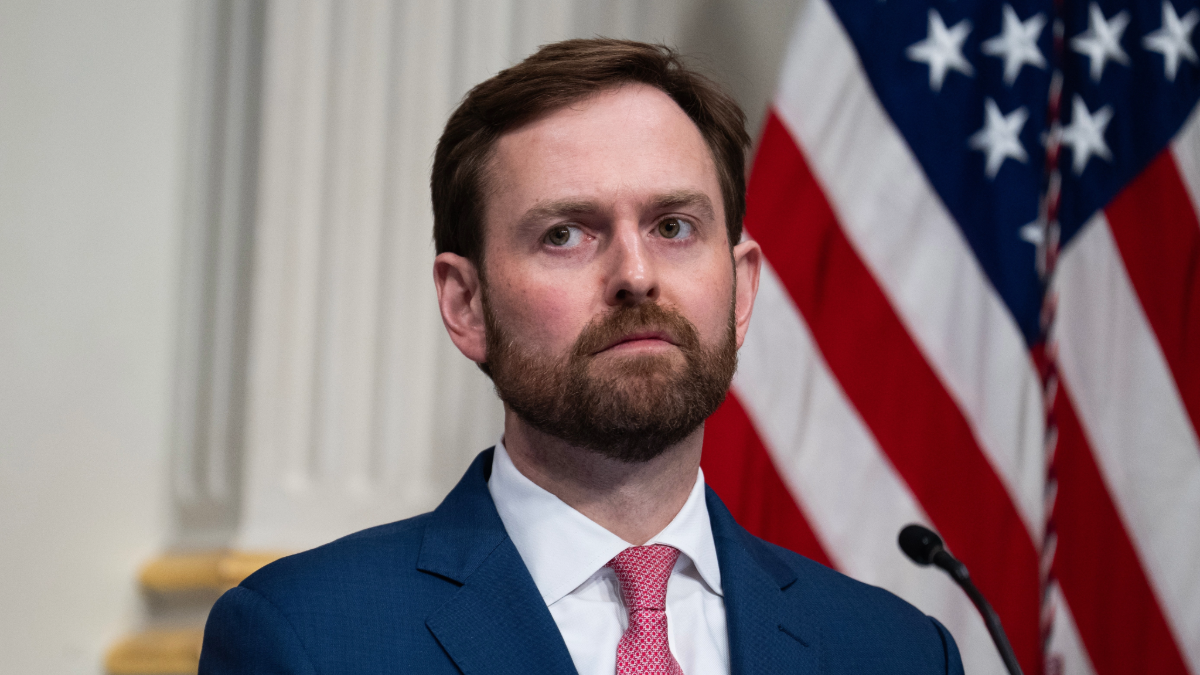
Federal Trade Commission Chairman Andrew Ferguson speaks during a roundtable with Vice President JD Vance and state attorneys general on anti-fraud initiatives in the Eisenhower Executive Office Building on Tuesday, May 26, 2026. (Tom Williams/CQ Roll Call via AP Images)
On July 1, just hours before the holiday weekend, the Federal Trade Commission (FTC) published its “Proposed Policy Statement Concerning the Suppression of Accuracy in Artificial Intelligence Systems.” The statement complies with Executive Order 14365, which directed the FTC, within 90 days of the EO, to publish a statement that “must explain the circumstances under which state laws that require alterations to the truthful outputs of AI models are preempted by the Federal Trade Commission Act’s prohibition on engaging in deceptive acts or practices affecting commerce.” Despite being a part of the administration’s cross-agency push to decrease AI regulations, the FTC’s statement articulates a fairly aggressive theory of regulating AI models under the Commission’s deception authority and does not meaningfully argue for any implied preemption theory freeing companies from state laws regulating artificial intelligence.
The executive order
The Trump administration has tried a variety of mechanisms to rid AI companies of state consumer protection laws. These efforts hit their first roadblock one year ago, on July 1, 2025, when the Senate voted 99 to 1 to remove the White House’s poorly conceived and likely unconstitutional 10-year moratorium on state AI regulation enforcement. Following this legislative failure and an even-less-successful effort to insert the same moratorium into a defense spending bill, President Trump attempted to accomplish industry’s goals through Executive Order 14365, “Ensuring a National Policy Framework for Artificial Intelligence.”
Executive Order 14365 states that “it is the policy of the United States to sustain and enhance the United States’ global AI dominance through a minimally burdensome national policy framework for AI.” The Order identifies the “patchwork of 50 different regulatory regimes” as antithetical to a national policy, and announces a variety of preemption-focused actions to address state AI regulation:
- A DOJ task force that will challenge state AI laws for, among other things, “preempt[ion] by existing Federal regulations.”
- An FCC “proceeding to determine whether to adopt a Federal reporting and disclosure standard for AI models that preempts conflicting State laws.”
- An FTC policy statement that “must explain the circumstances under which State laws that require alterations to the truthful outputs of AI models are preempted by the Federal Trade Commission Act’s prohibition on engaging in deceptive acts or practices affecting commerce.”
- A legislative recommendation for a “Federal policy framework for AI that preempts State AI laws that conflict with the policy set forth in this order.”
The order takes aim in particular at the (now repealed and replaced) Colorado law that allegedly required AI companies to “embed ideological bias within models.” (The original Colorado law did not expressly require companies to “embed ideological bias,” but it did require measures to protect against algorithmic discrimination.)
The pretext of the FTC’s role in the executive order is that a law like Colorado’s required the AI model to deceive consumers and thus actually conflicts with the FTC Act’s prohibition against deception. The order directed the FTC to issue a formal policy statement within 90 days articulating an implied preemption theory that would render laws such as the Colorado law unenforceable. The two-part mandate of this executive order is to assert the application of the FTC Act to AI models and to make a case for state-law preemption.
Immediately upon the announcement of the executive order, commentators noted that the FTC Act did not conflict with any state laws, including Colorado’s. In addition, the Colorado statute was subsequently repealed and modified to clarify that the various federal and state civil rights laws would be the yardstick on which AI systems would be measured to prevent bias in housing, employment, lending, and other critical decisions. Thus, when the March deadline for the FTC’s order came and went, some observers simply assumed that the Commission and White House had agreed that with the Colorado law repealed, the policy benefits of a potential statement no longer outweighed its legal dubiousness.
The statement
Then, on July 1, 2026, almost four months after the 90-day deadline, the FTC released its “Proposed Policy Statement Concerning the Suppression of Accuracy in Artificial Intelligence Systems.” The statement begins by explaining the significance of AI in the modern economy and the current administration’s goal of “removing regulatory barriers that impede AI innovation.” The statement then explains that the Commission polices the marketplace against deceptive acts or practices, whether implied or express. Finally, the statement articulates that the Commission has the ability to use its deceptive practices authorities in areas of new technologies, including AI systems.
Throughout the statement, the Commission repeatedly sensationalizes that AI companies with hidden agendas plan to indoctrinate unsuspecting users with progressive ideology. The statement asserts that “AI technologies should not be used to silence or censor lawful expression of dissent.” The statement further speculates that an AI “company could be tempted, for example, to abuse consumer trust by training a model surreptitiously to produce ideologically motivated distortions in a response to a factual question, such as to correct what the developer believes are ‘historical injustices’ in the facts.” The statement reads like the FTC intends to sue companies for deceptive practices if the output of their AI models includes liberal ideology.
But, the legal analysis in the statement applies the deception prohibition of the FTC Act to statements about AI models, not the statements by AI models. The statement does not threaten to sue if an AI model makes a statement that the FTC believes to be imbued with a liberal agenda. Instead, the statement stands only for the anodyne proposition that the deception prohibition of the FTC Act applies to claims about AI chatbots. The FTC can sue if a company expressly or impliedly represents that its chatbot will not have a liberal agenda, when in fact the company instructed the chatbot to have a liberal agenda. But, under this theory, to the extent that a company wanted to make their chatbot “woke,” as the FTC suspects is rampant, they are free to do so, provided they do not make representations—express or implied—to the contrary.
To be clear: although the statement does not claim that liberal AI outputs are per se deceptive, it does make the case that all AI models impliedly claim that they will not skew liberal. According to the statement, AI companies promote themselves as accurately “distill[ing] all of human knowledge to solve problems, large and small, in furtherance of users’ given objectives.” The statement claims that this an implicit representation that the output will be free of bias. In order to overcome this implied claim of ideology-free output, the AI company would have to clearly and conspicuously disclose its ideological intent: “[S]uch a disclaimer would have to be adequate to shift consumer expectations that would be based otherwise both on companies’ explicit representations and on the inherent value proposition of AI systems as tools to solve human problems.” Thus, the statement sets the table for being able to sue AI companies if they intentionally insert misleading ideology in their model outputs and omit a disclaimer clarifying their intent to do so.
The statement’s heavy reliance on the implied representation and omitted disclaimer exposes a doctrinal issue at the nexus of the FTC’s unfairness and deception authorities. In the seminal unfairness case International Harvester, the Commission rejected staff’s “pure omission” deception theory based on staff’s argument that offering a product implied a basic level of safety, explaining: “[W]e could not declare pure omissions to be deceptive without expanding that concept virtually without limits.” Instead, the Commission permitted a pure omission unfairness count based on the injuries to consumers from fuel geysering. Likely because Chairman Andrew Ferguson is dubious of unmeasurable injury claims, the statement declines to advance an unfairness theory, and instead must rely on the type of broad theory of implied statement similar to that which the International Harvester opinion rejected.
Newly aggressive posture on AI models
The statement forcefully asserts the FTC’s robust regulatory authority in the AI space. Although its focus is the phantom threat of ideology-imbued AI output, its analysis is equally applicable to a broad array of implied claims by AI companies. For example, users might reasonably expect:
(a) that AI will use personal information only for the purposes for which the user provided it,
(b) that AI will have only the users’ best interests in mind as make product recommendations (and not the interests of paid partners or advertisers),
(c) that users’ data is reasonably secure from misuse, and even
(d) that AI will advise users based only on training data that it lawfully acquired.
To the extent any of these are reasonable expectations, AI companies must comply with them, or clearly and conspicuously disclose their intent to do otherwise. The FTC has staked out a broad, aggressive approach of implied claims in order to police deceptive practices by AI companies.
The posture of this statement regarding AI models that threaten users with supposedly progressive ideology appears to be a departure from Chairman Ferguson’s previous reluctance to apply the FTC Act to AI models. Chairman Ferguson previously dissented from a referral of a complaint against Snap, the parent company of Snapchat, to the Department of Justice. Although neither the FTC nor the DOJ has made public the complaint against Snap, around the same time state attorneys general in Utah, Texas, and Arkansas took action against Snap for deceiving consumers by “insisting My AI was safe and age-appropriate” and “designed with safety in mind.” According to these complaints, Snap’s My AI chatbot in fact would offer advice on “how to hide alcohol and drugs from a parent” and also suggested “ways for the 13-year-old to have sex with an adult.” The complaints allege that Snap’s express and implied representations of the safety of the My AI chatbot were deceptive in light of this output.
In his dissent from the FTC’s referral, Chairman Ferguson stated that “I can say that the complaint’s application of Section 5 of the Federal Trade Commission Act is not only wrong as a matter of statutory interpretation, but is also in direct conflict with the guarantees of the First Amendment.” Although it is impossible to know how exactly Chairman Ferguson disagreed with the non-public complaint, it’s difficult to square his dissent with the Commission’s AI statement. The complaints from Utah, Texas, and Arkansas present very straightforward applications of deception law: Snap made statements that its AI model was safe for children, but in fact it was not. To the extent the FTC’s complaint was anything like these allegations, it would appear that Chairman Ferguson is more motivated to wield the FTC Act against AI products that output progressive ideology than AI products that harm children.
(Of course, it’s entirely possible that there is an explanation here. One of the problems with the Commission no longer having minority Commissioners is that there is no member of the opposing political party to either criticize—or, alternatively, validate—the Commission’s actions.)
For whatever reason, he has staked out a much more aggressive position on pursuing deceptive practices actions by AI companies. This Commission and future Commissions can build on this statement to aggressively police this new technology.
Absence of good preemption arguments
Notably, the statement does not spend much time on preemption. Because there is no express preemption, the statement must rely on conflict preemption: “A state law that requires an AI firm to deceive its consumers obviously conflicts with Section 5’s express purpose of protecting consumers from such conduct.” The statement implicitly acknowledges that impossibility-type conflict preemption is inapplicable, because an AI company can comply with the FTC Act simply by disclosing its compliance with the previous version of the Colorado law. This leaves only the other type of conflict preemption: obstacle preemption.
The statement makes clear that it is endorsing obstacle-type conflict preemption with its citation of Schneidewind v. ANR Pipeline. This theory applies preemption where the state law creates an “obstacle to the accomplishment of the full purposes and objectives of Congress.” The “purposes and objectives” approach of obstacle-type conflict preemption has been significantly narrowed in subsequent cases addressing Schneidewind, and at least one conservative justice has repeatedly called for the complete abandonment of the “purposes and objectives” approach. The Statement’s invocation of Schneidewind suggests Chairman Ferguson’s willingness to take up a more aggressive approach to implied preemption than most conservative legal scholars.
Even a broad reading of the purposes and objectives approach to implied preemption is difficult to satisfy here, since any entity subject to the original Colorado law could comply with it without undermining the FTC Act. As a result, the statement backs down from any strong preemption argument. For close followers of the FTC, how the Commission handled this assignment is of interest because it pitted Chairman Ferguson’s background as a serious lawyer with a record advocating against federal preemption as Virginia’s solicitor general, where he described obstacle preemption as “an incoherent doctrine,” against his unfailing loyalty to and eager coordination with the Trump Administration, which had asked him to advance this spurious preemption theory. His resolution of this conflict conspicuously retreats into the passive voice: “although the FTC Act does not expressly preempt state law, state law is impliedly preempted to the extent it conflicts with a federal regulatory scheme.” In other words, the Commission avoids saying that the FTC Act preempts anything (“state law is impliedly preempted”) and does not even say that any state laws actually conflict with a regulatory scheme (“to the extent”).
Conclusion
Ironically, the FTC’s statement seems to have accomplished the opposite of minimizing the regulatory burden on AI companies. It stakes out an aggressive approach to policing implied representations by AI companies. But even when doing so, it fails to argue meaningfully for preemption of any state laws. Although this FTC is unlikely to pursue AI companies with a heavy hand, it certainly has created the road map for aggressive enforcement.
Authors