The Fight for Civil Rights in the Age of AI
Justin Hendrix / May 24, 2026Audio of this conversation is available via your favorite podcast service.
On Tuesday, May 12, the Center for Civil Rights and Technology hosted its 2026 annual convening, "All Eyes on Tech: Power, Protection, and the Fights for Civil Rights in the Age of AI," at the Mayflower Hotel in Washington, DC. The Center is a joint project of The Leadership Conference on Civil and Human Rights and The Leadership Conference Education Fund, and it engages in advocacy, education, and research on issues at the intersection of civil rights and technology policy.
During the event, I hosted a conversation with Dr. Ruha Benjamin, an acclaimed author, professor of African American Studies at Princeton University, and founding director of the Ida B. Wells Just Data Lab; and Alejandra Montoya-Boyer, vice president of the Center for Civil Rights and Technology. The conversation touched on the necessity of cultural and narrative work as the foundation for policy work; how to build collective power and alternatives, not just guardrails; and why it is important to focus on the people behind technology and their motivations, not just technology itself.
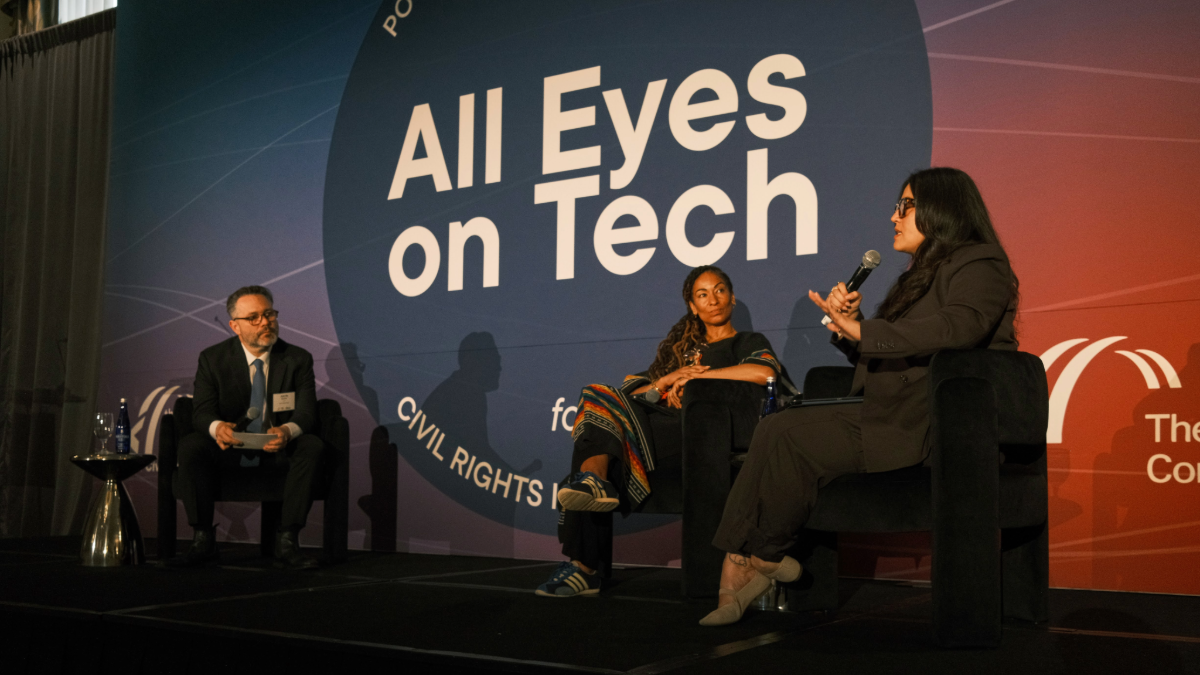
Justin Hendrix, left; Dr. Ruha Benjamin, center; Alejandra Montoya-Boyer, right. Photo by Brandon Forester, MediaJustice.
What follows is a lightly edited transcript.
Justin Hendrix:
On Tuesday, May 12th, I traveled to Washington, D.C., for the Center for Civil Rights and Technology's 2026 annual convening, titled “All Eyes on Tech: Power, Protection, and the Fights for Civil Rights in the Age of AI,” hosted at The Mayflower Hotel. The center is a joint project of The Leadership Conference on Civil and Human Rights & The Leadership Conference Education Fund. Launched in 2023, it engages in advocacy, education, and research on issues at the intersection of civil rights and technology policy, with experts working on AI and privacy, industry accountability, and broadband access.
That Tuesday morning, Maya Wiley, president and CEO of The Leadership Conference, gave opening remarks. She expressed anger and frustration about the Supreme Court decision just days prior in Louisiana v. Callais. The court ruled 6-3 that Louisiana's congressional map was an unconstitutional racial gerrymander. The decision further weakened Section 2 of the 1965 Voting Rights Act, a law that is regarded as one of the most significant achievements of that era's civil rights movement, but that has been hollowed out by previous court decisions. And it immediately opened the door to more redistricting across the country, bolstering Republican efforts to control Congress.
Maya Wiley:
So I'm angry. And it's not even surprising, right? It's not even a shock. And yet we can be outraged and shocked even when we knew it was coming.
Justin Hendrix:
Wiley connected her broader concerns on voting rights and democracy to the themes of the event.
Maya Wiley:
So, why am I starting there in a tech conference? Because ultimately, what we're talking about is, do the people get to decide the shape of society? And does everyone in society get the opportunity to then help shape it?
Justin Hendrix:
Following her introduction, Wiley introduced Dr. Ruha Benjamin, who gave the morning keynote. Dr. Benjamin is the Alexander Stewart 1886 Professor of African American Studies at Princeton University and founding director of the IDA B. WELLS Just Data Lab. She's written and edited multiple books, including 2019's Race After Technology, 2022's Viral Justice, and 2024's Imagination: A Manifesto.
In her remarks, Dr. Benjamin said that the "conversation about technology and civil rights is part of a much longer freedom struggle, that there's a legacy of freedom fighters who thought critically and creatively about the role of science and technology in advancing or thwarting social liberation." She called on the audience to unlearn the narrative of inevitability around tech and to challenge the dystopian and utopian narratives that both follow technodeterministic logic. She said the problem is not rooted in "a handful of discriminatory technologies, but rather a fundamentally corrupt ideology of power and governance." We must cultivate "both our critical and our creative capacity to pierce through the illusion swirling around emerging technologies, not only identifying the harms, which is our critical capacity, but also envisioning alternatives."
After her remarks, I sat down with her alongside Alejandra Montoya-Boyer, Vice President of the Center for Civil Rights and Technology. Here's the audio from our discussion. Dr. Benjamin is the first voice you'll hear after my question.
Good morning. It's great to see so many of you here today, so many friends and Tech Policy Press contributors as well, and my neighbor, Maya Wiley. We're neighbors in Flatbush, Brooklyn. Good to see you.
So, I normally record my podcast either in a little booth in a co-working space off Flatbush Avenue in Brooklyn or in my basement, which is not very nice, I must say. So this is a much more palatial environment. I must say the thread count of the sheets is much higher than in my home here at the Mayflower. So this is nice. And I'm really looking forward to this opportunity to speak with you all.
I just want to start, though, where you ended, Dr. Benjamin, with this global struggle. The V-Dem Institute, which does these measures of democracy around the world, came out with its report on 2025. And it's not a good picture for democracy generally around the world and not a good picture here. Incredibly steep decline. I think V-Dem Institute said that the decline in the health of democracy in the United States occurred at a rate that would be similar to what you'd see in a coup d'etat or some other type of extraordinary phenomenon. They put us back to perhaps where we might have been in 1965. And perhaps, per Maya Wiley's framing this morning, we will have fallen even further on that next measure.
This is a global phenomenon. Technology is playing a role around the world. It feels almost like there's a sort of race against time right now to perhaps turn the tide, to preserve democracy. Do you have a sense of time in this, how much time we've got before it's difficult to leave your home without a drone overhead?
Dr. Ruha Benjamin:
Yeah, this is a great place to start. It's a way in which the discourse of urgency, I understand and I can appreciate the sense of... The title of one of my books is Race After Technology, this idea of speed, movement. And I understand the urge and the longing for a recent prior era, as you're describing, a pre-AI manipulation of elections era, pre-Trump era. But where I kind of situate myself is with a sober understanding that even what we call democracy, a year ago or 10 years ago or a couple decades ago, often wasn't serving the vast majority of people anyway. So I want to caution against a longing or a return idea to a prior era that, in fact, wasn't all it's cut out to be. It was often in name and not in substance.
The other thing about time is that when we think about the rapid kind of collapse, the accelerationist narratives, the ideas of bringing things down, apocalyptic stories, many communities around the world have already lived through various forms of apocalypse, various forms of the ends of their world. And what I want us to think about is what we can learn from people who have already seen collapse in various ways and what kind of resources, insights, and knowledges that we need to draw upon, whether we're talking about environmental crises, whether we're talking about political dystopias, really drawing upon that reserve.
So if this was a longer talk, I would actually unpack another form of AI that I think is central to the conversation, but I was sort of limited, and that is the notion of ancestral intelligence, that many of us come from communities and forms of knowledge and insight that are passed down that are crucial for navigating this particular version of the end of the world. And so, where I've sort of come down is a kind of Butlerian or Octavia Butler sort of school of thought, which is that it may indeed be the end of the world, but there are other worlds, other ways of thinking about organizing society that actually invite us to be even more radical in our imagination of what true participation is in social processes beyond this two-party system. That's just one line of thought. And so, again, it's an invitation not to a return, but to a radical imagining of what we want to see going forward.
Alejandra Montoya-Boyer:
I can't play the crystal ball game of, like, "How long before we could see these dystopic futures?" but I surprisingly woke up in an optimistic mood today because I get to spend the day with friends and colleagues. And so I'm going to take the opportunity to say, instead of... Professor Benjamin was breaking down these two stories of AI dystopia versus AI savior or tech savior. All of us are here showing up to say, there's a middle ground. We can live in an environment where we have technological success and innovation and tools that make our lives better, that make work easier, that provide all of those opportunities. And all of us are working to put guardrails on those technologies to make sure that that technology works for all of us. And in that optimism, we're seeing some shifts. There's public polling. There's a lot of momentum fighting for those guardrails, including the people in this room. And to me, that's saying, we're not going to allow for that dystopic future. We're not even going to get to the point where we're having the conversation of, "Oh, in five years, 10 years, 50 years, this awful scenario is going to come." Instead, we are going to use our collective power now to ensure that these technologies work for all of us in an effective, safe, ethical way.
Justin Hendrix:
So, I want to ask you in particular about the center and how you think about situating some of these challenges in an actionable way, a policy agenda. We've talked about a lot of big themes here. You all will talk about through the day and into tomorrow a lot of big ideas, but also some more tactical things that are happening in the country and policy agendas that need to be addressed. How do you think about both kind of connecting to some of these bigger themes and then also the next year, the next two years, what needs to be done?
Alejandra Montoya-Boyer:
Yeah, I think the critical thing here is that we're seeing a real momentum and agenda around guardrails for AI. It looks different depending on who you're talking to. But that conversation around a federal AI standard has been opened. And we at the center have a lot of thoughts on making sure that states still have the power to pass legislation as well, that it's not just a federal standard. But what we want looks like... I mean, Professor Benjamin gave the AI Civil Rights Act a shout-out, which I think a lot of folks here know we've worked really hard on with our colleagues at the Lawyers' Committee. But we also have an opportunity with the Democratic House AI Commission, with Leader Jeffries, and momentum with our folks on the right that are saying, "We need to pass guardrails." There is an opportunity to have this conversation around standards. From our perspective, it has to include civil rights protections. It has to make sure that workers are protected. We should put prohibitions on things like domestic mass surveillance, autonomous weapons, which some of the companies have named specifically. And we're having these conversations across our diverse coalition directly with the tech industry and with policymakers on the Hill as well.
Justin Hendrix:
Ruha, I don't pull you back into the politics, but when you look at the next couple of years, there's huge challenges to achieving that agenda politically, the maps not working out in perhaps the way. Yet you pointed to this groundswell of popular support, the phrases we see popping up on protest signs. Some of you saw the social media clip of the students howling in laughter and-
Dr. Ruha Benjamin:
The graduation speech, yeah.
Justin Hendrix:
... recoiling at the graduation speech the other day. There does seem to be a kind of popular sentiment that's, I don't know, set in at this point about the dangers of artificial intelligence. Do you see the politics of this shifting?
Dr. Ruha Benjamin:
Yeah. I mean, I'm heartened by specifically, and perhaps we're going to get into this in a bit, but I'll just point to it now, in terms of the fights around data centers. Why? Because it's cutting across racial and class lines. We're seeing rural white communities, urban Black communities, and everyone in between sort of understanding the environmental and the economic costs of this sort of incursion of these facilities across the United States. And it's the billions pouring into this directly related to the job loss issues that we're also seeing. I think one headline that came across my feed this morning or yesterday was around AI now costing more than keeping the workers because of all of the money being poured into the data centers. And so, part of it is to start to galvanize this in terms of mass movement. I think we have someone from MediaJustice here. They put out a really important report recently about fighting data centers in the South with proactive strategies communities can take even before a data center is established. So to me, this is one data point or one line of understanding how these coalitions across our typical silos are starting to galvanize. We saw the students.
And I think one clue of how important the cultural work is. You all are in the policy world. I see myself as a cultural worker. And that has to do with the values, the assumptions that are the bedrock of then what gives rise to demand for certain kind of policies. And one of the spaces that we see the importance of culture, narrative values is that these same tech companies that are laying off all of their computer science, engineers, software workers are paying six figures for people who do communications, who do media, marketing. So they understand that they need different stories to try to convince us that these are good investments. And so even as they're laying off the tech, they're hiring in the people who can help spin their narratives, which should tell us something about the power of storytelling as part of our larger strategy toolkit, because they're starting to invest more into that as they see what some call the techlash, both among students, among environmental justice communities, and more.
Justin Hendrix:
Please, Alejandra.
Alejandra Montoya-Boyer:
Yeah. I was having an interesting conversation that was brought... Some tech company brought together a lot of us to talk specifically about data centers. And I think what's really interesting there is it is showcasing so much of a response beyond just what a data center represents in any community, to Professor Benjamin's point, whether it's in an urban Black community, rural white community. It's beyond just that conversation of the data center, the environmental impact, the economic impact. It's a broader question of, what do these technologies represent for our society? How do people feel they're able to engage with these technologies? What is their role in representation of these technologies? And so, how do we use that momentum and that response to ensure that the technology, the policy, the work that we're doing is representative?
I think we have a lot of conversations in one... "It has to be this or it has to be that." It's very black-and-white thinking where is there an opportunity to have a chance to say, "Okay, we're going to create these technologies and they're going to be representative. We're going to make sure... do the work to engage in the really challenging, maybe really grappling with who has that power in a way that's uncomfortable," but to say, "We can do these things together. We can have the technology that we need to advance our society, and we can make sure we're not destroying our environment. We're not losing jobs. We're not dismantling our civil rights."
And I think the data center conversation, which we are having a breakout later, just a plug, I think is a really interesting space for us to kind of say this goes far beyond just the ugly cost impacting thing in our backyard. It represents, what is this technology meaning for our society? And do we all have a voice in deciding what that looks like?
Dr. Ruha Benjamin:
If I can just add one more thing, just kind of to give you a visual of discerning the superficial versus the substantive approach to data centers. A couple years ago, Google had this data center mural challenge where it hired artists to make data centers really pretty. So if you look up Google mural data centers, you'll see all of these very cheesy murals on data centers. And that is a illustrative of the kind of like change the surface, but the substance doesn't change much.
On the other hand, we have alternatives, experiments like a Hawaiian scientist by the name of Keolu Fox and his team that are developing this idea of AI sovereignty and data terrariums. Rather than these massive energy hungry centers, much smaller scale data terrariums that are recycling GPUs that are often thrown away after very short turnaround by NVIDIA and others, recycling them. They cost about $10,000 versus the billions of dollars we're seeing. And they're community controlled and owned, have a much lower environmental imprint. And so, if you look up computer-friendly, sort of earth-friendly computation, it's a framework that's being used to think exactly about how do we develop these tools in a way that are stewarding them, both environmentally, socially, culturally, and that have this more grassroots, community-owned model around them. And so, again, superficial to the substantive alternatives, I think we see a broad spectrum of approaches.
Justin Hendrix:
You mentioned MediaJustice, and you had a slide that mentioned Take Back Tech. I just attended the Take Back Tech event that they hosted recently in Atlanta with Mijente. Someone there said, "When you see the data centers being built, it reminds us of what's not being built," which I thought was a fairly powerful idea. I wanted to ask about where you're seeing the fights specifically, Alejandra, on data centers. There's, of course, NAACP suing xAI over Colossus and the gas turbines in Memphis, where I was born. Southaven. The Google fight in Bessemer, Meta fight in Louisiana. Stokes County, North Carolina, where it's a fight over data centers built on Black farmland. Where else are you kind of watching around the country, or what are you paying attention to as these fights unfold?
Alejandra Montoya-Boyer:
Yeah. I mean, admittedly, I will say the work at the center around data centers we are a little bit new to because we're trying to be responsive to our growing coalition around this issue and make sure that we're capturing some pretty diverse perspectives here. We also work predominantly at the federal level and not state and locally. But we have been tracking through friends and colleagues like MediaJustice and others work in the southwest, in Tucson specifically. There's actually a data center and there was a fight in response to it. And now... I mean, it was already built in my hometown right outside of Albuquerque, New Mexico. But I think for us, the conversation is much more focused on, as we have policy conversations around federal guardrails, that has to include conversations around data centers or vice versa. There's a growing policy movement around data centers that can't just be about the data centers themselves. This is about broader, like I said, broader response to AI and these technologies across the board.
So, for us, the conversation is not necessarily just about tracking the local response that we do have representatives here today with us, including from Memphis. We have KeShaun Pearson and Vice Chair Mike Turner from Loudoun County, which has one of the largest representation of data centers in the country. And so, what are the opportunities for federal policymaking around these things? And then, as we see these growing community responses, how can... So to the point about what isn't being built, what are the community investments that we can pump back into communities that have... Some of these places, it's already been built. How do we ensure that those structures are creating pipelines for jobs, are making sure that the K-12 systems are successful to be able to maintain that pipeline, making sure that, I mean, the economic costs aren't driving up people's utility bills, that there's an environmental response. There are growing conversations around significantly more efficient data centers. Are we investing in the water and electric usage of these centers in places where they've already been built?
So that the response has to be, we're looking at a spectrum of issues, whether it's anywhere from, "Don't build in my backyard. I don't want this here," from communities, which those communities are the ones that we need to take note from, all the way to, "This data center already exists. How do we make sure that the communities that are there are benefiting from the financial, economic, and broader opportunities in those places?"
Dr. Ruha Benjamin:
By the last count, I read that two out of every three data centers that has been challenged by communities have been stopped or delayed. So the community organizing around this has been quite effective. And I think two earnings reports ago, Microsoft listed community opposition as a liability to its stakeholders. So, basically, people power is an operational cost for these companies. And so we're starting to see the growing concern around this... And I think part of the reason why it has become such a lightning rod, because it is, as you said, a physical manifestation of a much broader set of anxieties and rage against the incursion of these tech-mediated harms.
And so, again, it's not just the private companies, but I've seen it when I was going to speak at Michigan, I learned before I went that the University of Michigan was partnering with the Los Alamos labs around a data center that was being challenged near the university. And so it's also other kinds of more public investments in these that are raising alarm.
And so, I think both environmental but also the labor issue. It's a lie that these are going to be big hiring opportunities for places. So I think we should be really vigilant around the narratives that are being spun, whether job creation or even let's imagine all of these data centers magically become green facilities. What that means is that it's like the greenwashing of a surveillance system, right? So still military and policing and surveillance these facilities are enabling, but yay, they're going to be greenwashing them. And so, it's not, again, just the environmental cost, but it's what's happening within the facilities, what they're enabling that we have to also keep our eye on, not simply the energy and water issues.
Justin Hendrix:
So, I want to maybe from there ask a couple of questions about sort of the health of the field, the people who are in this room who are leading these fights. A lot of money is now getting poured into the data center fights, as is being poured into the AI policy fights. This is not a symmetrical battle, right? Hundreds of millions being poured into PACs, supporting various candidates, pushing various points of view. Lots of advertising, just even around data centers, for instance, pushing the idea that these are crucial to our national security and to generally the health of society. How do the people in this room think about fighting on that uneven playing field? It's always been uneven, but it seems like it's, again, maybe even a step change, a level different as we go forward, this enormous concentration of wealth in tech firms. How do you think about that question?
Dr. Ruha Benjamin:
Yeah, I think sort of circling back to this idea that there's a need for popular belief and investment in this. If that wasn't important, they wouldn't be investing so much on the sort of spinning of these narratives and these justifications. I think one of the crucial sort of starting points in terms of building movement around this is that because it's technology, so many people feel that it's mystified or out of reach. Or if they don't have a background in computer science, they can't really wrap their heads around it. And that's part of the intention, is to make people feel not smart enough to engage. And so it's really important for us to pierce through that illusion that "Oh, before we can have a conversation or debate or intervene in this, the public needs more digital literacy." Okay, that may be, but the technologists need more social and historical literacy.
So, the issue of always putting it on what's lacking or deficit on the part of people before they can actually mobilize around this is part of the strategy. But there are organizations, for example, like the Detroit Community Technology Project that's been working on this that have, for example, done popular education initiatives called DiscoTech, hosting DiscoTech, which stand for Discovering Technology, in communities where they invite people of all ages, from elder to youth, to open up the black box of these computers and these servers and really understand the nuts and bolts to bring it back down to earth, that the cloud is not up there, it's under our feet, right? And that is the precursor to then being able to go to the city council and fight against the Green Light program, the surveillance infrastructure that's being put into the communities.
And so, understanding the importance of popular education, piercing the mystique around AI and technology, again, the cultural work that's necessary to build the momentum to challenge this at the policy level, in my view, is people power, and it's what they're really scared of, and that's why we see in the earnings reports them starting to point this out as part of what they have to invest more in. And so we shouldn't give away our power when it comes to this. Yes, resources, but there are other cultural resources that we have within our grasp that we can invest in yesterday that is scary to them, and we need to mobilize around that.
Alejandra Montoya-Boyer:
Yeah, I'd just add, I mean, I think Professor Benjamin mentioned this already about the ancestral intelligence, while yes, the amount of money and resourcing and just the, to Maya's introduction earlier, the widespread and broad attacks that we are facing are all a massively uphill battle, one that feels, especially to us younger... I like to include myself in the younger folks crowd. My staff would say otherwise. The fact that we're here feels like unsurmountable sometimes, but that ancestral intelligence tells us otherwise. Our familias, our communities, our ancestors have fought against uphill battles for a really long time, for centuries in this country and globally.
And so thinking through... Again, I said that I woke up optimistic today, which is rare in Washington, D.C., for me. We can build collective power. We are. It's not we can. We are. There is momentum. We are seeing shifts. Polling shows us that, the response to data centers, the response to the state moratorium last year. There are so many different things that can show us that we are building collective power. And it's like one step forward, 10 step back sometimes, but it doesn't mean that we're not going to show up and we're going to do this work, put in the time. And we do have champions in our policymakers, we have champions and friends in the tech companies, we have people that are with us across these sectors that make it a little bit easier, a little bit like that hill, or that mountain looks a little bit more like a hill some days. And so, I think it's investing in ourselves and in that collective power through ancestral intelligence and other spaces that allow for that optimism. And as cheesy as it is, I'm going to lean on that.
Justin Hendrix:
So, there are so many new applications of artificial intelligence across the government. If you look at the federal AI use case inventory that OMB just put out for 2025, and just hundreds and hundreds of new applications, some of them mundane, people using ChatGPT for office tasks and that sort of thing. Some of them very concerning. If you look at some of the applications at DHS, things like the ELITE app, which helped to target doors getting kicked in in the siege of Minneapolis that we talked about last on our podcast, Mobile Fortify, these other types of applications. When you think about just the volume of that, is the field prepared to kind of pick through each of those things and to challenge them to do the legal analysis? Do we have the resources we need? Are people's minds focused in that way?
Alejandra Montoya-Boyer:
I mean, do the nonprofits and legal experts and civil rights organizations that are doing that work have enough resources? Absolutely not. I will not be overly optimistic there that there is enough resourcing, capacity, money, all the things to be able to respond to a mountain of issues of the federal AI use right now.
That being said, I'm trying to uphold my promise of being optimistic, is, we have experts and folks that are responding with everything they do have, even though those resources are not enough, people in this room, people that couldn't make it because they're probably analyzing all of the different tools as is. We have answers. I think the challenge isn't, "What do we do about Mobile Fortify or all of these surveillance technologies that the government is procuring or building?" some of which are maybe not even legal uses, depending on who you talk to. So, we know how to respond here. The matter is making sure we pass federal legislation, making sure this administration responds to the legal requests that we have, which is its own challenge, prohibiting the building and creation of some of these technologies. I think it says something when a massive tech company says, "No, we will not allow you to use our technology for mass domestic surveillance."
So there are strategies that are working in response to what this administration is doing. But we are spread thin. We are under-resourced. We do not have the staff capacity that this administration or other places have. So, I think we need to be able to ask the questions of what is it that we need from philanthropy, from our funders, from the broader ecosystem to be able to effectively respond and counter some of the challenges that we're facing.
Dr. Ruha Benjamin:
And I would say in terms of longer term strategy, I think it's really important not to focus on the individual technologies and trying to tweak them and make them a little less harmful, a little more fair, and to step back, as you said, and think about the production process to begin with. In the same way that we don't just have drugs floating through and see, "Let's see what harm gets done," and then try to tweak them as they're in the population. We have to longer term have a much more robust set of protections before our children, for example, are being experimented upon with all of these EdTech systems that are being rolled out.
I saw one colleague whose kids were in public schools in Texas, and the whole school decided it was going to become an AI school. And so she went to visit it and saw that basically the kids were sitting behind screens for the vast majority of their day. And so she started to tour other schools hoping to find an alternative and saw one after another that this was the case. I don't know if you guys followed that in New York, they just stopped this process from happening, again, through groundswell that, again, the marketing of "We're going to become an AI school."
And so, these individual fights are important, and I don't want to minimize them, whether around a particular technology or schools, but we need a longer term game plan that is not about sort of trying to play whack-a-mole with these problems, but is really thinking proactively about the systems in place before things actually roll out.
Justin Hendrix:
I want to give you an opportunity, Alejandra, to maybe preview some of this thinking around the racial wealth gap. I know you're going to talk about this a little later today. Just give us the quick preview, the quick points on what we can expect of that conversation.
Alejandra Montoya-Boyer:
Yeah, absolutely. I mean, first off, I think that... Well, one, I'm actually going to take an even further step back and just share. This is something I've been really interested in and super excited that we're launching this research because for folks that know I've been with the center for just over two years now, and this is something that I interviewed to get this job talking about wanting to explore the impact that AI is having on the racial wealth gap just because it's... We can't just be having conversations, although to the point about whack-a-mole, this is impacting across so many issues, but without the understanding, research and really the knowledge of what does this mean, what are these technologies doing and what does this mean, particularly for Black communities, for Latino communities, knowing that people of color are most impacted by these systems. So, I'm just starting with a point of pride and excitement about the research.
The long and short of it is without guardrails, AI is going to and is already exacerbating the racial wealth gap, particularly for Black communities, but across basically every community of color, we're going to see that type of exacerbation. Again, with the optimism in mind, there are things that we can do, whether it's the federal guardrails and legislation that I've talked about, but we also, our research includes what can tech companies, what can landlords and employers and all of the different kind of sector breakdown, what can they do, things as small as what types of tenant screening technologies are people using to as large as passing federal legislation.
So, we have a really extensive body of research that's really showcasing across housing, employment, and financial services, banking and financial services, what does it mean for these tools to be developed and deployed in these systems? And what are the opportunities both to make sure that those technologies aren't exacerbating the racial wealth gap, but also what are opportunities to use technology to further economic opportunity? How can we make sure people have access to jobs that understand the systems and tools to... There's one opportunity that appraisal systems in housing, which have longstanding discriminatory impacts, particularly in Black communities, some of the tech tools, the AI-driven technologies that are being used, are actually mitigating that. They are more successful at appraising homes in Black communities than... or less biased, which is more successful in my mind. Others might disagree. But so we can create tools that are actually helping to minimize the racial discrimination that we see in these systems.
Dr. Ruha Benjamin:
And if I could give just two examples, again, remember I talked about the critical and the creative capacity. And so thinking about guardrails is about creating protections and regulations about technologies other people have created that we identify harms within. And then we need investment in creating our own community-owned and imagined types of technologies that don't need the same kinds of guardrails because they have different types of values encoded into them. And so, one initiative that's been taking shape over the last few years, again, the tenant screening brought this to mind, is around the Anti-Eviction Mapping Project, which is about creating technologies that housing justice advocates can use to identify landlords that are breaking the law, right? And so it shifts the lens, rather than pointing in the direction of tenants, it's pointing the digital data collection lens in the direction of developers and landlords. And so the different kind of power dynamics encoded.
Another is a more satirical project, but it brings to light some of the dimensions around predictive policing and technologies used by police, and that's called the White Collar Crime Early Warning System. So it's actually an app that you can download on your phone before you leave today, so that when you go to a new city, you can see where white-collar crimes are likely occurring, so you can have more vigilance and awareness when you enter those neighborhoods.
So, again, it's pointing out the power and racialized dimensions about so many of these technologies. Often these tools are being used already, pointing in the direction of racialized individuals and communities, predicting so-called street crime. But what about crimes of capitalism, talking about the racial wealth gap? We're not investing in technologies that are pointing in the direction of power. And I think that's another way of thinking about how do we bring to life technologies that are in service to our communities that are pointing out the people who are creating the risk, not the people who are so-called risky in many of these contexts.
Justin Hendrix:
I assume if you find us on that map right now, we're sitting under the big red blob.
Dr. Ruha Benjamin:
I'm sure we are. Please be vigilant today. Be careful.
Justin Hendrix:
I want to maybe just finish up by asking you both a few more examples. You mentioned the stars, who are the stars that you see in the darkness right now. The premise of this panel is kind of what keeps you up at night, but I suppose I want to give you both just a chance to talk about who is nourishing you, who's bringing you comfort, who's doing the work, who's making a difference. You've mentioned a couple of good project examples, but Alejandra, are there other shout-outs that you'd like to make?
Alejandra Montoya-Boyer:
We have a list. It's on our website. It's our 240-plus coalition member organizations that all are doing things, whether in the tech ecosystem or not, that are all giving me hope and life. The Center for Civil Rights and Technology is staffed by six fantastic people. But I also think one of the things that we had talked about was kind of the cultural leaders in our space, writers, musicians, movies. I think those are the types of things that I look to. I think anyone that knows me knows I'm a big reader. I like to write about it and post about it even using tech tools that I complain about in my day job. But I think looking to that type of kind of optimism and whether it's... Octavia Butler was mentioned today, but also new folks, R. F. Kuang. There's people that are talking about these issues across different spectrums and different ways that I think bring me just a lot of joy and optimism.
And then I will also say that I think the work that the folks of us that are doing, again, I feel like a broken record talking about the federal guardrails, but the folks in this room and outside of it that are really pushing the federal government in these spaces, it can't be... to your point, about the uphill battle and the resources, it can't be understated, the impressive groups of people that are coming together to to respond there.
Justin Hendrix:
It does make sense to me that you you talk about cultural artifacts in particular because it does feel like, despite all the money, all the investment, all the effort, they can't win the culture, right? Seems like the majority of people are opposed to a lot of these things.
Dr. Ruha Benjamin:
Yeah, absolutely. Yeah, so the question being what inspires... I think it was last weekend in Atlanta was Take Back Tech. You were there, a number of people in this room were. I would encourage you, if you haven't heard about it, or if you haven't been yet, put that on your radar and look at the organizations from around the world, not just US-based, that are working across the spectrum, from data center fights to building autonomous infrastructure, digital platforms that are owned by the people. And so, there's so many great things happening that you can't help but feel the energy and the momentum in that kind of space.
One initiative I just want to plug, just because my lab has started to collaborate with the Hope Gap XR project. We were just at the National Museum of African American History and Culture two weeks ago, and we brought Dela Wilson and her team there. And what the Hope Gap XR is, virtual reality experience that brings people inside of actually existing reparations initiatives around the world, one in the US, Evanston, Illinois, one in Aotearoa, New Zealand, one in Namibia, Southern Africa, where reparations initiatives are underway. And the idea for this is the Hope Gap is a kind of technical term that refers to the gap between what we want to see in the world, our vision of justice and liberation, and our belief that it could actually happen. So the gap between sort of our realism and our aspiration, the kind of the exercise that we did.
And so, what this initiative tries to do is by bringing people inside of the reality that these things are underway, it starts to close the gap and gives you the energy to fight for it in your own locale or your own context. And Dela developed this and is in the process of developing this because her own father, who was a civil rights activist, freedom fighter, she noticed in her conversations and her time with him that the cynicism was starting to set in. The set of hopelessness was starting to set in as he saw the waves of dystopian tyranny take shape in the last few years. And so, in some ways, this is a love letter to her father to reanimate that sense that it is possible to continue to further this long freedom struggle. And in the process of developing this, she's now taking it to cities and locales around the country.
So you might consider inviting the Hope Gap to your own locale to, again, be a conversation starter for people to feel the energy and momentum they need as the fatigue, the sadness, the grief start to set in when you only doom scroll, when you only look at what's going wrong in the world. And I think that part of sort of inciting faith, hope, determination, imagination in what's possible is a key ingredient. It can't be tangential to our struggles, but it's really something that we need to invest more in.
Justin Hendrix:
I definitely would agree that at Take Back Tech, one of the great things about that program is that there were many opportunities to pause and be joyful, to dance, to engage in music and art, and that was an important piece of it.
I should hope that some of you will find opportunities to look for joy today in your conversations with one another. I think this conversation hopefully has got us off to a good start just in framing some of the big ideas. And of course, the center's work will be on display throughout the day and you'll hear about that research a little later. And Dr. Benjamin, of course, your books I would commend everyone to. Important reading, which I always send to my students. I'm grateful to the two of you for speaking with me today. And thanks to all of you.
Dr. Ruha Benjamin:
Thanks, Justin.
Authors