The Coming Data Center Slowdown Might be Good for AI Developers
Mark MacCarthy, David Klaus / Nov 16, 2026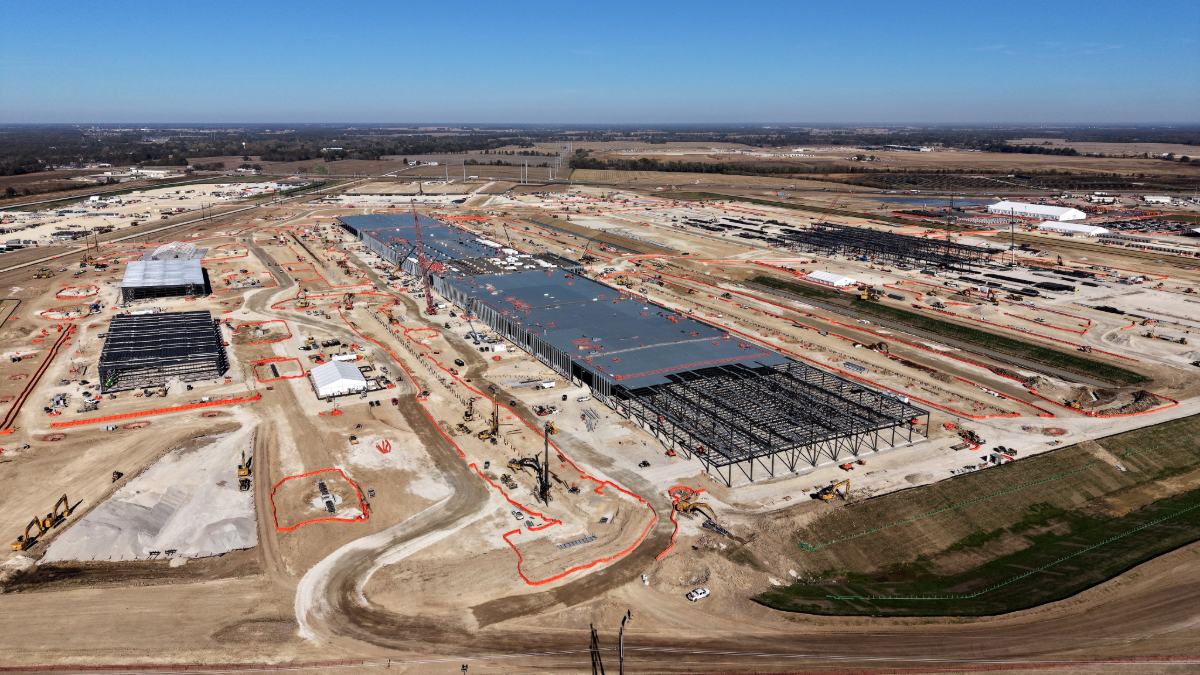
In this aerial photo, an Amazon data center is under construction Monday, Nov. 9, 2026, in New Florence, Mo. (AP Photo/Jeff Roberson)
A curious rewriting of history is happening right before our eyes. It holds that the market crash this month that wiped out some $3 trillion in value was in response to the United States midterm election results which saw a massive Democratic sweep in local, state and federal elections. AI investors are fleeing the coming AI regulatory crackdown, so it is said, denying the industry the needed capital to continue bringing this transformative technology to the public.
You would expect this revisionism from industry boosters like United States President Donald Trump who wrote on Truth Social on Nov. 5, “The Stock Market crashed today because the Dumocrats had a big Tuesday.”
The backlash against data centers certainly was a crucial element in these mid-term Democratic victories. But this story conveniently overlooks the beating AI stocks took before the election, caused not by the prospect of AI regulation, but by a widespread recognition that AI revenue was not likely to be commensurate with the massive scale of AI investment. On Oct. 14, weeks before the election, the research and advisory firm Gartner estimated that the industry will spend $7 trillion on infrastructure through 2030 but will generate only $3.6 trillion in related revenue over that same period. The following week the stock of CoreWeave, a major neo-cloud provider of AI data centers, fell 17%, in line with declines from other neoclouds including Nebius and Iren. The market is still jittery about AI’s prospects and neoclouds in particular, despite CoreWeave’s price rebound this week.
So, the current market crash is likely due more to investor recognition of overinvestment in a promising new technology than fear of regulation.
It is true that the data center backlash will slow the roll out of new data centers. Voters rejected data centers in 40 out of 41 local ballot measures. According to one estimate, 41% of planned data center capacity is in states backing a pause and another suggests half of proposed AI data center additions across the US are vulnerable to stricter local scrutiny and pushback.
But as analyst Paul Kedrosky notes, the AI policy backlash could be a good thing for the AI companies. It “might save them from themselves.” If, for example, the industry can support only 100 new AI data centers but out of irrational exuberance companies are planning on building 1,000, the political backlash against data centers might reduce the glut of 900 unnecessary data centers.
The slower growth of AI data centers will allow AI developers to refocus their efforts on useful applications rather than training what they hope will be ever more capable but expensive base models. Right now OpenAI and Anthropic are seeking vast amounts of compute capacity to train new models in the hopes of establishing a permanent and decisive advantage over their rival. But this is likely a fool’s errand. For almost all normal business uses, existing models are capable enough. Spending on Fable 5, Anthropic’s largest and priciest model, for instance, has plateaued at about 11 per cent of revenue from the company’s tools. As computer scientists Arvind Narayanan and Sayash Kapoor have written, AI is a normal technology where the key question is how to integrate AI capabilities into business processes and how to modify these processes in ways that take advantage of the new capabilities, a decades long restructuring task.
The backlash against data centers means that the AI developers have an opportunity to abandon their foolish AI race, where a “prisoner’s dilemma” dynamic seemed to force them to spend astronomical amounts of money to produce ever smaller relative improvements in capabilities. With the increases in data center supply slowing, it will become more and more expensive to press ahead with training new models and less likely that a rival’s investment will produce model improvements that will enable it to capture customers usage and market share. So, with the prisoner’s dilemma dynamic lessened, the AI developers can spend less on training and focus their compute needs on inference, which is where the revenue is in any case.
There is, however, no guarantee that concentrating on AI inference will work as a business strategy. Corporations are clearly becoming more cautious about unrestricted use of AI by their employees. They are shifting away from expensive frontier models toward open-weight models and intelligent task-routing to control runaway token costs and improve return on investment. The investment firm Goldman Sachs has prohibited non-engineers from using advanced AI tools out of concerns about risk, expense and productivity. Productivity benefits are indeed modest, as documented in a recent Bank of England report, showing AI has contributed “about 0.1–0.2 percentage points to annual productivity growth since early 2024.”
In the face of this new corporate caution, the skyrocketing use of AI in the last year or so is not likely to continue into the indefinite future. Indeed, the reduction in the valuation Anthropic is seeking from its IPO from $2 trillion to between $1.3 and $1.5 trillion suggests investors are not expecting exponential AI use trends to continue.
The resignation of Nvidia CEO Jensen Huang last Thursday in connection with extra marital affairs — one involving an alleged Chinese spy — will almost certainly drive down the value of the company and may affect US policy on export controls on chips to China. But it is a distraction from the business case for corporate use of AI services, which will continue to be driven by underlying costs and productivity benefits.
The US does not have industrial policy tools capable of dealing with overinvestment — contraction cycles. But the political backlash against data centers might provide an accidental substitute, forcing a necessary slowing in data center growth just as the oversupply was becoming increasingly evident to everyone. Let’s hope that AI developers take advantage of reduced compute supply to cut back on an increasingly dead end AI race and focus on providing real value to AI users.
Authors