Ireland is Helping Shape a Data Center Boom That Could Benefit Big Tech
Layla Wade / Nov 12, 2026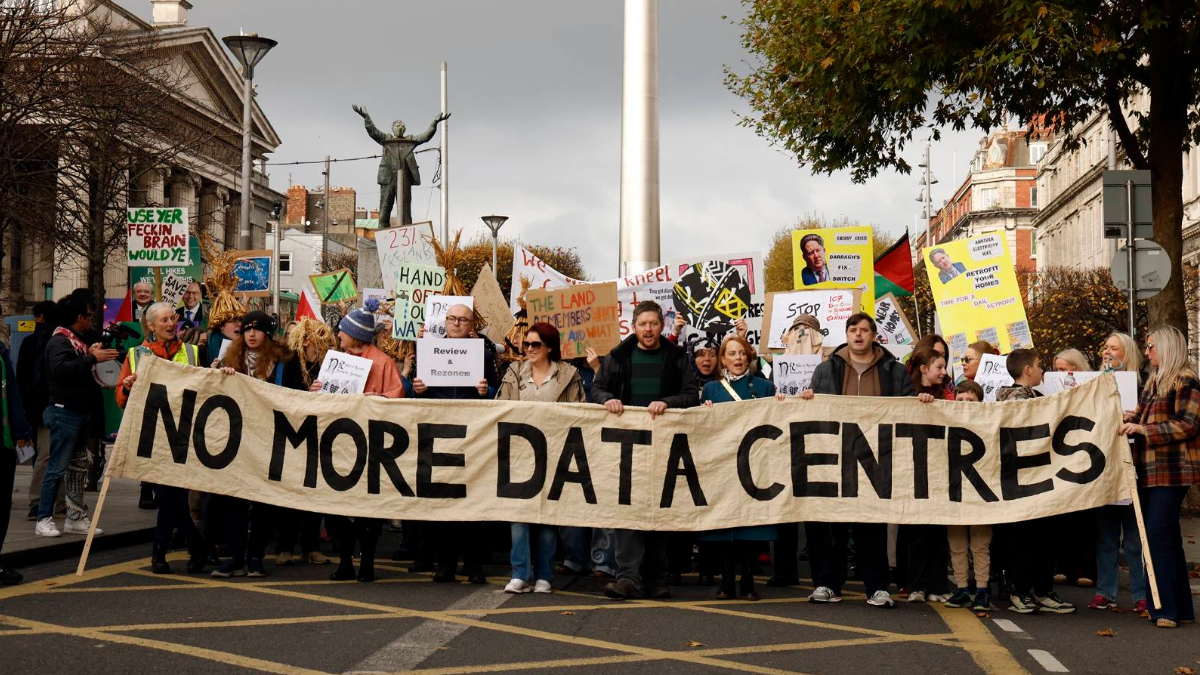
Campaigners march against data centers in Dublin, Ireland, on November 6, 2026. Photo by Paula Geraghty.
This week, Dublin is hosting two significant gatherings, the European Political Community Summit and an informal meeting of the EU Council — with AI sovereignty atop the agenda. Both events are part and parcel of Ireland's EU Presidency, with major disruption and road blockages expected in Dublin amid the largest police security operation the state has ever seen.
On the streets of Dublin last weekend, the roads were blocked in protest against the growing threat posed by data centers. Thousands of people representing community groups affected by data center expansion took to the streets. With handmade posters underarm, protesters made their way to the capital to demand a moratorium on new large-scale data center projects, to stop the concentrated power grab by Big Tech companies, and to prevent the irreparable harm data centers pose to the well-being of people and planet. They were joined by thousands taking to the streets from Helsinki to Amsterdam to Paris to Zaragoza, as part of the StopDirtyDatacenters.eu campaign.
By contrast, the EU has set its sights on at least tripling data center capacity across Europe over the next five to seven years through the Cloud and AI Development Act (CADA). It has arrived at this prescription by correctly diagnosing a dependence on Big Tech companies from the United States. It seeks to reduce that dependency through a union sovereignty framework for cloud computing while simultaneously accelerating data center expansion through the creation of data center acceleration zones, with fast-tracking permitting and cutting “red tape” that stands in the way of expansion. Unfortunately, we consider this red tape the core barrier to meaningful and democratic civic engagement under the Aarhus Convention.
Set against the mycelium of resistance mushrooming across Europe, this tension speaks to a wider disconnect between the public mood across Europe and political choices shaping our future. The EU's current policy on data centers, notably the CADA, is deeply out of step. What was once a nebulous concept like the cloud is now a doorstep issue. The blue wave across the US following last week's midterm elections could send ripples closer to home. One NBC exit poll cited that 56% of respondents said data centers and AI were “crucial” for their Congress vote.
Ireland, which already hosts more data centers than most, is drafting revisions to proposed CADA rules in ways that would benefit Big Tech firms. The Irish government now holds the pen on the Council’s position on CADA until the end of the year.
Regarded as a cautionary tale for runaway AI infrastructure growth by the United Nations, there is arguably an opportunity here for Ireland to course correct and guide Europe. Yet its draft revisions to the law push further in the same direction. One of CADA’s stated purposes is to make Europe less dependent on US Big Tech, and while the European Commission’s proposal doesn’t quite tackle Big Tech's entanglement in Europe’s cloud and AI market, Ireland’s counter proposal tilts further toward industry. It lowers the bar for those same firms to qualify as “sovereign” in line with the demands of industry lobbyists.
Ireland and the AI boom
Ireland sits at the epicenter of the AI boom. Last month it hosted the AI Summit in Dublin. European Commission Executive Vice President Henna Virkkunen addressed the industry-dominated event, saying more needed to be done to stay in the race.
Though its reputation has perhaps turned a corner for some, Ireland has been criticized for dancing to the tune of US tech companies. CADA would not be the first policy issue on which Ireland’s Presidency has been accused of siding with the industry.
In October, the Presidency secured a joint Council position on the Digital Omnibus, with 24 of 27 member states agreeing. Campaigners warned that the measures would give tech firms greater scope to use personal data to train AI models.
Ireland has increasingly found itself caught between its dependence on major US technology companies, demands from campaigners for stronger oversight, and criticism from EU partners that enforcement has been too weak. At times, this delicate balancing act has led to allegations that Ireland is out of step with the EU's regulatory ambitions.
When Ireland assumed the rotating Presidency of the Council of the EU, more than 70 academics called on it to recuse itself from negotiations on certain digital policy files, citing concerns about impartiality. Last week, UN experts warned that regulators “must be able to take decisions without undue influence, including from the powerful industries they oversee.”
A report published by the Corporate Europe Observatory last month traced the runway of Big Tech ramping up their lobbying campaigns in the run-up to Ireland’s EU Presidency. Ireland would go on to preside over the Digital Omnibus, one of the largest deregulation exercises in EU history. These changes to the EU’s digital rulebook come after sustained pressure to reshape the rules in ways that weaken fundamental rights, sideline democratic oversight, and stretch the meaning of EU values, in the name of competitiveness.
Who controls the fast-tracked data center capacity?
Ireland is not alone in facing relentless Big Tech lobbying. Analysis by research group SOMO, based on lobbying meetings with the European Commission, shows how quickly Big Tech zeroed in on the EU’s data center policy, including the CADA.
From the beginning of the Commission’s mandate in 2024 until the announcement of the CADA, the three hyperscalers, Google, Microsoft and Amazon, which control 70% of the cloud market in Europe, held 41 meetings between them with the Commission, according to SOMO
The fingerprints of this lobbying are apparent in the CADA text. One example is the treatment of “public acceptance” of data center expansion as something to be engineered from above, rather than something driven by public consent. As Google recommended in its submission to the Commission’s consultation, the EU should limit the right of affected communities to challenge data center projects. Community involvement should not be treated as a barrier to be simplified away or a problem to be solved.
By accelerating the data center expansion, CADA treats market concentration as a symptom of Europe’s dependency on a small number of providers. But dependency on the hyperscalers not simply the result of insufficient data center capacity. he largest providers primed to take up the capacity benefit from scale, established infrastructure and customer bases, access to capital, and high switching costs.
On sovereignty, CADA’s framework grades cloud providers across four assurance levels, with higher levels carrying stricter limits on ownership, control and exposure to third-country law. Last week, Ireland’s revisions to CADA’s draft text were published, revealing a series of changes related to autonomy that could seemingly benefit US Big Tech incumbents.
This is a peek through the letterbox of the door Ireland is holding open for Big Tech hyperscalers in Europe. The amendments soften safeguards around autonomy that were designed to prevent US Big Tech from gaining certain levels of sovereignty assurance. This includes watering down the sovereignty framework and lowering the barrier to entry for US hyperscalers to qualify for accelerated treatment.
If the objective is greater technological sovereignty, it is hard to see how lowering the barriers for third-country, or non-sovereign, providers to access advances that ambition. Instead, it maintains the status quo, facilitating their frictionless access to an already heavily dominated and concentrated market like the cloud and AI ecosystem. Allowing enormous amounts of power to be concentrated in the US tech companies will not make a sovereign Europe. It’s not beyond the realm of logic to consider that Ireland’s proposed amendments could undermine Europe's stated sovereignty aims.
Who funds it? And at what cost?
The resources and infrastructure needed to transform Europe’s data center capacity can be matched only by global financial capital. Wall Street giants and asset managers like Vanguard and BlackRock are pouring enormous amounts of capital into the AI companies driving this expansion. And they want to generate returns on it. Quickly.
At a time of deepening cost-of-living crisis, is allocating resources in this way economically justified, or even rational? In Ireland, and across Europe? Researchers from Ireland have put forward the same question. They draw comparisons between the capital committed to data centers, primarily owned by US tech giants, and what that money could have funded instead. Between 2019 and 2024, the equivalent investment could have built some 50,000 homes in Ireland.
Irish leaders face a choice: Will they prioritize the needs of Big Tech over reducing Europe’s dependence on these companies amid a cost-of-living crisis?
And on what terms?
As European leaders meet in Dublin for their informal gathering, they should listen to the bellows of people taking to its streets. Their demands challenge the assumption that more data centers necessarily serve the public good.
Ireland’s Presidency should use the CADA negotiations to address Europe’s dependence on Big Tech, not simply give that structural dependence a sovereignty label.
The test for CADA should not rest on how quickly it expands AI infrastructure, but rather who controls it, who benefits and who bears the costs. Ireland has a choice to hold the door open for the incumbents or help put Europe’s digital future on more democratic terms, with power less concentrated in the hands of a few.
Authors