Europe's AI Ambitions Meet the Data Center Backlash
Ramsha Jahangir / Nov 6, 2026Audio of this conversation is available via your favorite podcast service.
This month, the European Commission is marking European AI Innovation Month, bringing together policymakers, industry and researchers to showcase how AI can strengthen Europe’s competitiveness across industries and public services. Europe says it needs more data centers to power those ambitions, yet their rapid expansion is raising questions about energy, water, labor conditions and who gets a say in where they are built.
To learn more, I spoke first with three of the organizers behind this weekend’s planned protests across 15 European countries, where more than 100 groups are calling for a moratorium on new projects: Owen Espley of Global Action Plan (UK), Aurora Gómez of Tu Nube Seca Mi Río (Spain) and Rosi Leonard of Friends of the Earth Ireland.
I then turned to two journalists investigating the industry: Mei-Ling McNamara of Investigate Europe, whose reporting with Tech Policy Press exposed labor abuses on construction sites, and Daniel Howden of Lighthouse Reports, which has filed a legal challenge under the Aarhus Convention over EU secrecy about data centers’ environmental costs. We talked about who gets to shape Europe’s digital future, who pays for it and who holds the industry accountable.
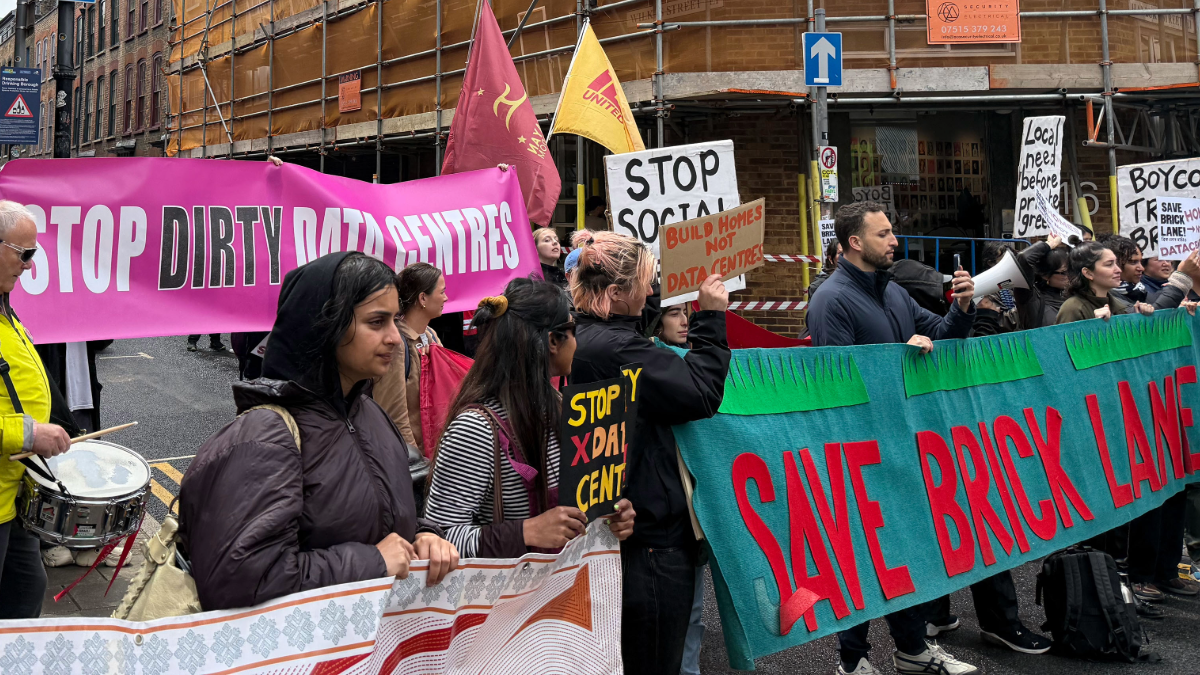
Protesters march outside the South by Southwest festival in London on June 4, 2026, opposing a planned data center development at Brick Lane in east London. The demonstration was part of a series of actions organized by the “Stop Dirty Data Centres” campaign, which is holding Europe-wide days of action this weekend involving more than 100 groups across 15 countries. (Global Action Plan)
What follows is a lightly edited transcript of the discussion.
Ramsha Jahangir:
This month, the European Commission is marking European AI Innovation Month, bringing together policymakers, industry and researchers to showcase how AI can strengthen Europe's competitiveness. But Europe's AI ambitions require infrastructure and the rapid expansion of data centers is raising questions about energy and water use, as well as environmental costs and the impact on local communities. This weekend, more than 100 groups across 15 European countries are mobilizing against large scale data center development, calling for a moratorium on new AI projects. I spoke to the campaigners and protest organizers about what's driving these protests, what campaigners want to change, and who gets to decide Europe's digital future.
Rosi Leonard:
My name is Rosi Leonard. I work as the data center campaign lead in Friends of the Earth, Ireland, and I am based in Dublin.
Owen Espley:
My name's Owen Espley. I'm the community campaigns manager at Global Action Plan, working with communities facing data centers. And I'm also playing a role coordinating stopdirtydatacentres.eu.
Aurora Gómez:
I am Aurora Gómez from Tu Nube Seca Mi Rio, which means your cloud dries my river. We are a Spanish data center resistance, and we are also part of the Spanish coordination of the campaign of the moratorium.
Ramsha Jahangir:
Thank you so much, wonderful group. And I just want to appreciate first that you are joining us a day ahead of the protests starting across Europe, so busy times, and I really appreciate your time and space for Tech Policy Press. Maybe we could start a little bit by introducing what Stop EU Data Centers is to our global listeners and how did you come about it?
Owen Espley:
So Stop.dataCenters.EU is a large coalition now with over 103 different organizations supporting us from 16 countries across Europe, planning currently 85 actions across Europe and counting. It's a movement of civil society groups, digital rights groups, and especially communities facing data centers who are coming together onto the European political stage to demand a moratorium. And so groups are facing data centers in lots of different contexts and different national spaces where the politics of what's happening vary, but groups in all the different levels and across different countries have called said that a moratorium is what we need to put halt to the development of large scale data centers so that we can have the democratic debate that we need to consider the huge environmental, energy, water, social impact of data centers. And so really it's a day for those groups to come and step proudly onto the European political scene and say, "We are here and now we're ready to be a force to be reckoned with and politicians need to listen and hear our call for a moratorium."
Ramsha Jahangir:
And generally what we've seen so far in Europe, momentum has been slow, at least at the public level, especially when we compare it to what's happening outside Europe, specifically in the United States. Was it challenging to mobilize people on the ground and what are the type of communities that are coming together for this effort?
Aurora Gómez:
For us, take us a lot of time to create the community and awareness. We have been traveling around Spain for four years in a very tiny places where they are facing the problematics, not only with the data centers, but also the mineral destruction that are going with data centers and the macro energetic problems related with data centers. So finally, these people are having this conversation, these rural communities are having this conversation. And in the cities, they're having the conversation about AI and we are able to bring these two worlds together in only one conversation together. So for us, it has been a long time to do that. So it's when you want to be an agriculture and you have this lamp and you have to put the seeds and wait until it's the proper momentum. I think right now in Europe is the proper momentum to do that.
Rosi Leonard:
Yeah, I would really agree with what Aurora said. So in Ireland, our context is kind of interesting because in Ireland right now, 23% of electricity goes to data centers, which is really, really high. And it's been much higher than in a lot of other European countries also like states in the United States for many years. And there have been waves of calls for a moratorium in Ireland. But I think in the last year and a half, there have been a lot of new proposals for data centers that are coming in, like Aurora said, across the island, also at a time of really rising electricity bills and a real need, I think a real sense of urgency for people to ask why is this happening so fast? Why is this industry developing so fast at such a massive scale in Ireland when there are still so many issues around say energy poverty, around electricity bills being very high, around fossil gas lock-in?
We have in Ireland a really worrying project happening in the west of Ireland where there is plans for an LNG terminal to import frack gas from the states. It's being proposed by government, which has been really unpopular and really worrying because fracking is actually banned in Ireland. So there is this kind of question over who is benefiting from this development? How is it affecting our bills? How is it affecting fossil gas lock-in? And I think that what we've seen in the last year is communities in areas where data centers are being built are getting a lot more organized than they might have been previously before. And I think that is really making people pay attention because they are very credible local voices who are really worried about the impact on local electricity constraints, on emissions, on electricity prices, like I said. So it has brought the issue to a new level and the organization has been fundamental to that because previously I think it was isolated individuals, possibly smaller communities making planning applications, but now the organization is much stronger and that's really, really brilliant.
And I think what's really important about this linking in on a wider European level is one of the questions that we often get asked in Ireland by people who want the industry to keep growing here is they say, "Well, if you have a moratorium in Ireland, you just want it to move elsewhere. You just want the data centers to move to Spain." And what we're able to say now is actually no, we need a much stronger pause. The EU is talking about tripling data center capacity. It's going to cost us a lot of money. It's going to lock in a lot of fossil fuels. Communities across Europe are saying the same things in different places and that's really, really powerful because it is ultimately saying, look, who is benefiting from this? Is it going to be a small amount of American multinationals or is it going to be people on the ground?
So it's a really interesting moment.
Owen Espley:
So I think the context in England and Wales and the UK has been quite different because say maybe a year ago you had one or two small community groups, particularly those in the Greenbelt area who were facing data centers and they were the ones getting some profile from it. But over the last year as it's been clear that the huge scale of the data centers that we're seeing being proposed, hundreds of them that would require potentially tripling, doubling or tripling the UK's entire electricity supply, and we've been having forcing that debate into the media, communities in inner cities, communities in post-industrial areas are joining those in rural areas to say that they're not happy about this and they're fighting at the bit. And this summer has seen a kind of quite rapid transformation of data center activism taking place. The phone has been ringing off the hook with groups saying, "We've just found out about a new proposal down our road and we're not very happy about it.
How do we organize and fight it?" All the communities have been saying, "I've just been reading about data centers and didn't realize that our council has been signing off deals and approving data centers that we had no idea were happening and we're very worried about the consequences." And there's been an absolute groundswell of communities saying, "Wait a sec, these politicians have been saying they're going to build these data centers and they've not been having the conversation with us about the consequences. Where's the democracy here? Where's they've been putting in freedom of information requests and finding out that councilors have had information that's been withheld from the communities?" And they're absolutely up in arms about it at this moment and ready to come together and fight. And the groups vary and they have slightly different perspectives. The concerns of a post-industrial community are going to be slightly different from a rural one, are going to be slightly different from an inner city community.
But they're all aghast that these decisions are being taken and imposed on them without their participation and in often many cases in opposition to what the community says they want.
Ramsha Jahangir:
It's interesting because big platforms and companies building data centers have also made community engagement a big part of their public strategy. We're seeing them hiring community focused positions and just having a lot of engagement and building things at a very local level to help communities. So it's very ironic, but I'm also curious from a policy perspective and in concrete terms, what role can local communities play in decisions around planning or building data centers? And is there a way that they can meaningfully object to a project?
Rosi Leonard:
Yeah, I think there's loads of ways. I think one of the things we're seeing in Ireland is, like Owen said, a lot of the, I suppose, tactics of the industry have been to hide impacts and to try and get in with decision makers before any level of democratic planning happens. And I think what we're really seeing in Ireland is that is now changing where there is a lot of pressure on the government to enforce more transparency requirements at a minimum. At a minimum, transparency requirements are needed. So that is shifting the balance of power a little bit where I think that there is no longer this idea that companies can submit a planning application that has very little detail, that is very poorly put together, and everyone else has to figure out how it interacts with climate law, how it interacts with electricity prices, how it interacts with potentially local water shortages or anything like that.
So I think at a very local level, that kind of power building amongst communities is impacting on politicians. It's definitely having an impact on government politicians in Ireland who would be fairly sympathetic and enabling of the tech sector in Ireland. So I think that's very, very strong. I think it's also moving into a very interesting space where we want a moratorium, but we want a moratorium so that we can put in place more sustainable guidelines so we can actually put the ball back in our court, take the power back and say, "These are the terms under which we think more private data centers are acceptable given the current context, given the current challenges, given the need to tackle climate breakdown." So I think that's very powerful in the influence it's having. And then there's another aspect of it that I think is quite interesting, which is tech worker organizing I think is gaining momentum as well.
And that is putting additional pressure in terms of an industrial strategy to say, again, the corporate power that these companies hold, we don't necessarily agree that they need to be carrying out these mass layoffs that we're seeing. We're seeing a lot of layoffs in Ireland in the tech sector. And workers in a lot of instances are directly relating that to companies expending so much capital on data centers and trying to go in hard on generative AI as a sort of almost like a disciplining tool of workers that they're not going to benefit from. So there's sort of a very interesting moment I think for mutual power building between communities and tech workers in the sense of pushing decision makers to say this industry has developed at such speed and at such scale with so little safeguards for a very long time that it is no longer legitimate for you to keep pushing it this way.
You have to now recognize this as an electoral issue and as a worker's issue.
Ramsha Jahangir:
We're also having this conversation and the moment you mentioned during what the European Commission is calling the European Innovation Month, and there's a lot of push for AI adoption across European industry and also public services. Just today there was reporting around EU encouraging AI support in lawmaking and policymaking as well. So how do you respond to that moment at the time that you're pushing back against building more?
Aurora Gómez:
And for example, one of the communities that are raising up against data centers are Mora de Lebre, that is an project coming from the European Union. So when we are talking about that we want sovereignty, digital sovereignty, we want data sovereignty as we though that food sovereignty. We want to have the minimal needs that we need, but also with social justice, we want to create sacrifice zones in some places that are less powerful or put in these minds of critical minerals in some regions. And for example, we have this battle right now in Spain because we are trying to approve, Spanish government is trying to approve a real decree that around data center that is not an out, but at least is some kind of regulation and the starting point of have some regulation on data centers before the election. But what happened that the European Union says yesterday that we cannot approve the royal decree because it has to go before to them.
So what I understand from my individual point of view is that the tech lobbies are really powerful in the European Union and they're trying to push against any kind of regulation in any kind of country. So we need to be smarter. We need to be farther and we don't want to have this narrative of sovereignty in European Union without looking for social justice. We have to looking for another kind of narratives that everyone can be safer and have our communities keep going without these kind of language in our place.
Rosi Leonard:
Yeah, I think that point around sovereignty is so important. We hear that a lot in Ireland. And then I think what's so funny about it for me is we hear this idea of EU tech sovereignty, but when we look into what's actually being built and proposed in Ireland in terms of data centers, it is either the same names, it's the Amazons, it's Google, it's the big American companies building the data centers directly, or it's big co-locator providers building data centers that it then turns out in many cases they are leasing to say Amazon or TikTok. So again, it's really poorly defined, I think, as Aurora mentioned, what does sovereignty actually mean? How much compute is needed? Where is the figure of this tripling of data center capacity? Where does it come from? In Ireland, the energy regulator carried out what they called a market intelligence exercise when they were writing their recent connection policy for data centers last year.
And they said that, "Oh, we've asked the industry, we've asked the energy providers, and it looks like there's 5.8 gigawatts of future demand in the pipeline, which would be the same as the amount of electricity that Ireland uses right now as I'm talking to you." So it would be huge. And again, it's like where did this figure come from? On what basis is it justified? These are questions that have not been worked out, and I think it all leads back to this idea of a moratorium. This is an industry that is advancing at a very quick scale, but for its benefit. And all signs when we see sovereignty seem to be pointing at more or less the same companies benefiting. And there's really brilliant research from SOMO that I'm sure you're aware of, which points to this. And I would encourage anyone listening to read it because it kind of tracks the companies who are building out and that kind of power mapping I suppose is very important when we discuss this, especially for policymakers.
Owen Espley:
I think it's always interesting to hear about these government initiatives that big tech are pushing for disseminating the use of AI and creating demand for data centers across the state, across public bodies and across industry. Because what it shows is that this is a top-down initiative to build out data centers. The estimate of seven trillion US dollars being spent in five years is not coming from people demanding extra data center capacity. In fact, there was a recent Bain and Company report that showed a revenue gap of $4 trillion annually in 2030. They're spending so much money on data centers, they're not even clear where the revenue to pay for that and get a return on that is coming from, which is what's leading to all of the discussion about it being a bubble. And that demonstrates something quite important, I think, which is that this is an initiative from big tech who've amassed huge money piles from their monopolistic practices arguably, and from investors who see this as a way of capturing rents into the future and dominating the future global economy.
But it's an investment cycle and there's very worrying signs that it is a bubble and there are very worrying signs that actually this isn't something which people, workplaces or enterprises are demanding at the scale of which it's being built out, which leaves the question, what are we going to end up with when a devaluation takes place and the rest of it? And policymakers I think would be incredibly wise to question what that means because it's not the case. The scale of the hype coming from these companies to benefit their own share offers and their own capital raising is what's driving the speed and pace and demand to push aside every single barrier and every single constraint on that build out. And people are saying, wait a sec, why are you rushing so much? Why are you shifting our planning laws so we no longer have as much voice in it?
Why are you accepted as acceptable that big tech is lobbying for the abandonment of climate targets when it's hype and it's obviously hype? And I think what's really worrying and what I see is communities that I speak to are having really nuanced, detailed debates about AI and data centers and the role of big tech in society. And yet our politicians are in a slightly different place. They're saying this is the only way forward. We have to do it. There is no choice. There is no alternative. And it feels very much like they've completely bought into the hype that's coming from these big tech companies. And what the days of action are about is those people having that discussion, reclaiming democratic right to say that we should have sovereignty over the decisions about data centers. Sovereignty is about people making decisions and democracy. And at the minute we've got politicians who are going headlong at speed to build evermore and bigger and saying every single barrier should be moved out of the way, whether that's climate constraints, whether that's concern about water, whether that's community constraints, and seeing community objections as a barrier or constraint on this build out which must take place.
Whereas actually that's democracy in action. And it's those communities who are taking action this weekend, whether it's having a march in Dublin or marching in Madrid and Barcelona, whether it's having public debates in their communities, whether it's writing poetry as they're doing in Slough, whether it's protesting about the cutting downs of trees in Finland. That's what sovereignty over AI is about. It's about people taking action together and exercising their democratic right to say, we should be the ones that decide on what conditions these data centers get built out, on what conditions they are, on what environmental harms we think are acceptable and how we should be mitigating those harms. And so if we're going to have a conversation about sovereignty, it's so important that we push it back down to those community discussions which I see happening because the gulf between where people are at and where our elected leaders are at at this moment is a very worrying place to be that there's such a gap.
And I think wise politicians would be waking up and going having those communities and leading those discussions to their communities and coming up with a policy based on where people are actually at, not where big tech lobbyists are telling them they need to go.
Ramsha Jahangir:
Campaigners and protestors have raised fundamental questions about the data center boom, about who gets access to information, who bears the environmental and social costs, and what Europe's ambitions for technological sovereignty actually mean in practice. These questions are also at the center of recent investigations into the industry. Last week, Tech Policy Press in partnership with Investigate Europe and other media partners published an investigation into labor abuses on data center construction sites. Separate reporting by Investigate Europe and Lighthouse Reports have looked into Big Tech's influence over EU transparency rules and the public's right to know about the environmental costs of data centers. Lighthouse Reports has taken this issue further with a legal challenge under the Aarhus Convention. I spoke to Mei-Ling McNamara from Investigate Europe and Daniel Howden from Lighthouse Reports about their work and what will it take to influence policymaking on data centers. Daniel and Mei-Ling, thanks so much for being here.
You've both at your organizations been investigating different aspects of your data center expansion. Mei-Ling, you, Investigate Europe recently in partnership with Tech Policy Press has published this investigation on conditions of workers building those facilities and how also previously big tech has influenced EU rules in terms of transparency. And then Lighthouse has done something very interesting as a journalistic organization and taking this issue further by filing a legal challenge on EU's approach under the Aarhus Convention. So let's start by briefly introducing your investigative work on this topic and what do you think it reveals about how the industry operates in Europe?
Mei-Ling McNamara:
Yeah, I mean this really was an important investigation for us because so much of what we've been seeing is the way in which we're unable to penetrate inside data centers, what is being disclosed to us and what is actually happening. These sites and these projects are so secretive and they're usually secretive because of the client confidentiality. So typically behind these large projects that are run by really big companies, we have big tech companies. They're the ones who are the clients that move in. But what we hear so little about is the people actually building these projects during active construction. And so what was really important about this was to actually get inside and understand. I had a tip off that there might be something going on up in Sweden, but then what I found when I did this was that there was a number of issues all around Europe and it concerned a lot of the construction companies that were actually hiring these contractors and subcontractors.
So this was a major point and I was able to really get access to workers for the first time and able to actually get access into some of the real conditions that they're facing, both through their wages, but also through their living conditions and their day-to-day.
Ramsha Jahangir:
And Daniel, what prompted your investigation into the transparency aspect and also more necessarily take this issue further by filing a legal challenge?
Daniel Howden:
Our starting point for this investigation were the same kinds of questions that people all over the world are increasingly asking about the AI rollout and about its most visible manifestation, which is data centers. They want to know how much water is going to get used. They want to know how much power is going to be used. They want to know what are the potential forms of pollution this creates. They want to know about climate emissions and those consequences. So if you start from those questions, it's been extremely hard to get simple answers to these. And our focus was to target an EU efforts to gather information. Essentially, the European Union has for the last three years been on a huge information gathering spree. They have probably the best answers to those questions anywhere in the world. They're being held centrally. The member states have been told to gather up key performance indicators on every data center in Europe.
So that is the water and power usage, that is excess heat, that is the kind of indicators that would help us to reconstruct climate emissions. All of this gets centrally gathered. It's been gathered in a place where freedom of information laws should guarantee us access to this. So we began asking for it to begin initially. We were told by member states that they haven't yet gathered the data. Then we were told that it was commercially confidential. And then finally we received the string of refusals from the European Commission and it became clear and answers to this question were really helped by the work that's been done at the Corporate Europe Observatory and some of the reporting's also have been done by Investigate Europe to highlight how big tech companies got to write their own provisions into European laws and strengthen the commercial secrecy around individual data center sites.
So what you can get publicly is aggregated to the point where it's completely useless for communities themselves and for people and for any kind of democratic participation. So it's kind of locked out of answers to the questions that we might have. Strategic litigation is a poorly understood tool. It takes an enormous amount of patience to wield it effectively. But the one aspect of it that doesn't necessarily require so much patience is that strategic litigation's fundamentally about changing public discourse. You set up legal challenges. Of course, you hope in the end to win your legal challenge, but the fact of the legal challenge in and of itself can generate headlines and it can help the public to see where their politicians stand and what influence over them big tech companies have. And that can be really clarifying and that's why we took the decision. We don't relish the idea as journalists of writing 16,000-word legal submissions, but sometimes that's necessary if you want to move at the pace which can actually help this.
While we are trying to break through what we call a wall of silence and data centers, the facts on the ground are changing every day and reporting that illustrates the human cost of that in terms of data center construction workers is profound. The signs from the little windows that we can look through to see the bigger picture, the climate emissions situation is profound. So making the stakes clear for the public. And there's one last thing I would say about it. People have really responded to the idea that investigative journalists spent a year pushing with every lawful means to get answers to this. And it's really helped people to understand that there is a conspiracy of silence and that their own kind of gut feeling in response to these companies actually accords with reality. And sometimes the answers you can't get are almost more illustrative than the technical information that you might have otherwise been able to obtain.
Ramsha Jahangir:
And it really says something that you spend a year and also Investigate Europe has been looking into this issue that it's so hard to get access to critical information by journalists. So imagine for public, and I was speaking to campaigners of the EUI protest this weekend earlier before speaking to you and they were talking about the same fundamental question is that how do you support development of projects when you don't really understand who they're for, what they're for, and at the same time your electricity bills are going up, up, up because you just... So there's this communication gap and public gap that we're seeing, but it's just so hard to also understand at the same time that from the commission and at a political level, they have bought into this idea of going all out on AI adoption and building for AI adoption without actually understanding what is at stake here.
So yeah, one of the things that I wanted to come into as well is commercial confidentiality is often the excuse. The commission users and generally also globally do hide data about environmental impact, but also other impacts. So how do we go past this problem and what is the fundamental legal but also democratic problem when this is the argument they use?
Mei-Ling McNamara:
Well, maybe Daniel can go first around the work that they're doing and then I can speak a little bit about some of the access issues that we've had in terms of making the public... Aware of what is going on behind some of these data centers with workers. And I'm talking it all high up the chain. So Daniel, if you'd like to go first and I can go in.
Daniel Howden:
One of the first things that comes out is that people feel powerless in the face of what is described as an inevitable AI build out. But we do actually have laws and those laws do offer protections when it comes to our right to know. One of those legal frameworks is an international convention, the Aarhus Convention. And what that enshrines is our right to know, especially when it comes to emissions related information. And Aarhus is really specific in so much as it says that this right supersedes commercial confidentiality in all but the most limited of circumstances. Now, this is an international treaty. All EU governments are signed up to it. It is legally binding, but it isn't a substitute for the commission changing its own stance and deciding that transparency is the way to go. We really are in a very interesting political moment. We're having this conversation in the immediate wake of the US midterms where there was essentially a wipe out for the industry itself.
A large amount of money was sunk into contests all over the country in search of positive outcomes for light regulation or deregulation or avoidance of any regulation tool over tech. There were data center provisions on many of the ballots and they all got swept away inside of public opposition. And trust has been right at the heart of that. I know from conversations that I've had that people in senior roles, big tech companies know that they've got this wrong. Their secretive approach born out of a culture in Silicon Valley of NDAs, which are used for right, left and center for almost everything, has just bred this culture in which you change the facts on the grounds, you give away as little as possible, secrets from your competition, secrets from the public authorities. The public is disregarded. In our reporting that she found senior people in the data center industry referring to the public as CAVE people for their opposition to data centers.
They're all having a good laugh sitting up on stage and caves refers in this instance as citizens against virtually everything and then everyone fools about laughing. So there's a contempt of the public, a culture of secrecy. And this means in practice that people feel that they're being lied to and manipulated that even in instances where data centers could be a good option for a community, maybe they have a water surplus, maybe they have sources of power which aren't going to mean that the centers compete for resources with housing and ordinary people. Even those instances, they're now getting blocked. As much good work has been done and out of the work lighthouse has done and I think Investigate Europe and many others have done really useful reporting here. Public has been well ahead of both politics and journalism. There has been a kind of folk wisdom in people's attitudes towards big tech and data centers.
And now it's up to politicians, it's up to civil society, to journalists to inform that resistance. Public has been well ahead on this.
Mei-Ling McNamara:
Yeah, I think I might add as well, I don't think we can underestimate the amount of money that is now being poured into Europe and European data centers. We're seeing a migration from a lot of investment in the United States due to a lot of the pushback migrate now into Europe. And particularly what we've seen is the Nordics. Data centers come in and they'll come in for all sorts of reasons. They'll look for a way to have a wedge into a community and they'll move in and they will use what they can to get the contract. I think we also can underestimate the amount of money, but also the legal threat that communities and the public and journalists face if they do try and cover these stories. And this is something that we came up against when we did this story as well. There's a lot of money involved not only with the big tech companies, but with the companies that are also profiting hugely from building these data centers.
There is a lot of fear for those who are on the subcontracting chains that they will not get these jobs if they speak out. So there's a complicity of silence, there's a culture of silence, and there's fear that they won't get the next jobs as these subcontracting chains move around Europe in groups, hiring the same people and hiring the same companies. If you stick your head above the parapets, it'll be cut down. You won't get another contract. And this is what we've seen. So there is also of course the legal secrecy, the NDAs that are at every aspect of the project. But then there's also something I think less visible, and that is that sense of hiring precarious workers who don't have a lot of power, who don't have a long-term contract, who come from a poor EU country or even not from an EU country and cannot speak up.
So I agree absolutely that ultimately the fact that people did speak up and showed tremendous courage and bravery and took incredible risks is the power of the public to hold ultimately these companies accountable. And you can see that in the States, of course it was on the ballot and you can see how they can't necessarily triumph, right? But I do think that information is power and to stymie that information getting out to the public is absolutely the point because the public does wield the most power here. And so I think it is on the shoulders of journalists, on the shoulders of politicians, on the shoulders of anyone who can actually join up the dots around Europe and beyond to present this to the public in a way that they feel that they can take some form of actionable defense. I think we've seen in Ireland efforts to stymie some of these objections through legal means.
And I think that we're going to see that more throughout Europe as well. We know the bottleneck happens during the planning permission process and we know it happens through any form of legal objection. And once that gets to the bottleneck, it's pretty much a clear path for data centers. And sometimes countries, communities will have buyer's remorse, but it's really difficult once it's being built, once it's in the active phase to go back. So I think that is where they're hoping they can keep the silence until they actually break ground. We can see what happened in Finland recently. It's now been suspended, this project that cut 250,000 acres in Finland without an environmental planning going through. But how many other data centers are doing this right now? So I think we need to ask those questions.
Ramsha Jahangir:
Certainly Netherlands is also precedent of data center development being stopped in response to protests and opposition. But I think both of you are talking about the accountability to the supply chain and policymaking process I think is very important and there are gaps there. And I often ask this question, of course there's a lot of public outrage right now. There's a lot of public resistance. Certainly this weekend is one of the biggest, I think, moments of momentum against data centers. But realistically and in concrete terms, from the policy perspective as well, can communities be involved in that policymaking process? And throughout the supply chain decision making, is there anything legally that requires their involvement? And I would also point out this irony because we're in the European Innovation Month, what the commission is celebrating right now, and there's an Apply AI Summit, which is a year after the Apply AI Strategy was introduced happening this month.
A lot of people in civil society organizations and researchers and communities have said the same thing, that they're not being involved in those discussions. They've also had trouble registering for these events. It's sort of the same story that happened with the Dublin Summit under the Irish presidency. So how do we involve the communities in these decisions outside protests?
Daniel Howden:
I'm happy to jump in there. If you want to make a journalist feel really awkward, you just ask them what are you supposed to do with their work and with their findings? It's like, okay, but what do I do about this? How do I respond to it? And I think this is where nonprofit mission-driven newsrooms really have a responsibility to provide some parts of the answer there and to work more broadly and in a more collaborative way with civil society organizations and others who can actually make suggestions and interventions, like give paths to action. The traditional journalist model was I stay completely outside of processes of change. I deliver my findings and the world needs to change in response to them if it wants to, but that's nothing to do with me. Nonprofit journalism needs to begin with the understanding that investigations, findings are upstream of policy and culture, and you've got to be willing to walk downstream part of the way towards people who are actually working on change and people who are making culture.
I'll give a few examples to make a point. A 16,000 word Aarhus submission seems like an unlikely publication to drive wild popular response, but the fact of that legal challenge drove headlines. The fact that those headlines then gave us a chance to work with popular creators who have really substantial audiences running from half a million upwards in different countries. And those creators knew how to translate those findings into a public conversation, which would both be funny, entertaining, informative, and the volume of response and questions that those posts got meant that they're now completely switched on to the idea that data centers are a hot cultural topic. So that's a form of public awareness. What you're doing there is building a constituency that can help to change the political calculus for the actual decision makers. If we go back a year or go back two years, let's say that you are a regulator, you are somewhere in European political decision making framework, your political calculus is pretty clear and you have the largest lobby in the EU by some distance.
It's spending freely. It can offer jobs in the future. It can offer potential theoretical rewards in a way that you can sell to constituents right now. Your political calculus leans totally towards buying into the future. You're being told by well-paid and intelligent people that opposing data centers means opposing the future, which isn't a great look. What we're doing at the moment, yes, we can talk about very specific policy prescriptions, but we're working on changing the political calculus here. You are sitting at some point in the decision making hierarchy. That calculus also needs to change for you and you need to see how it's going to be to your benefit, to your constituent's benefit's going to make a difference or you are visible and will be scrutinized for the decisions that you make. So the hard end of that is investigative journalism that highlights the influence on specific decision makers.
And at the cultural end of it, there's a growing constituency which is activated around the idea of asking questions and being skeptical about visions of the future that they're being sold.
Mei-Ling McNamara:
Yeah. And if I may just jump in one last bit is that as part of this story we did, we highlighted the existing unions that were available to some of these workers. I don't think you have to reinvent the wheel or create new things that are already in the public, but what you can do is help to strengthen what does exist and to have this form of information sharing and to show that because some of these things are companies coming in without collective agreements, deciding not to do collective agreements, whether they're led by the big tech companies or they're led by the contractors. And a lot of the workers, for example, weren't aware of this. Or if the unions were there, they weren't speaking in the language that a lot of these workers use. So I think it's sort of making it aware of what sort of public entities exist for workers or those involved to be able to get these sorts of protections.
But I also think, of course, with Investigate Europe, we do things at the EU level as well. And part of that is really to talk to some of our policymakers looking at, for example, the Quality Jobs Act that they're considering now for December and how to then strengthen the rights of workers and the general oversight of some of these sites. So there aren't secrecy clauses in a way that unions can actually get access. And in the course of our investigation, just in the last week, there's this incredible momentum that you're seeing that in the public that they know this is going to go public. So maybe collective agreements that were stalled at the moment actually got pushed through as part of reporting or making more visible. But also too, you're starting to see a much bigger momentum of how people can start to enshrine more laws to protect workers in these kind of really extraordinary circumstances.
When you have a buildup that's accelerating so much quicker than normal, you're having sites that are so much more dangerous than normal, but you're not getting access. So even just since publication, unions that weren't able to get access to some of these sites, whether it's the Netherlands or it's Finland or it's Sweden, have been able to actually get access now in ways that I don't think they were before. And I think that this is really important the way that civil society can also work together and really just highlight what's out there already. So I think there's good ways that you can work. And I do agree with Daniel. I also think there still is and can be a firewall between journalism and civil society. And at the same time, there could be an exchange of real value here where they don't have to be so separate from each other.
And I think that's critical.
Ramsha Jahangir:
Absolutely. It's the season for collaborations, and we're all here for it.
Mei-Ling McNamara:
Thanks.
Daniel Howden:
Thanks, Ramsha.
Authors