South Africa Has AI Leverage. Its Draft Policy Leaves It Unused.
Nathan-Ross Adams / Apr 23, 2026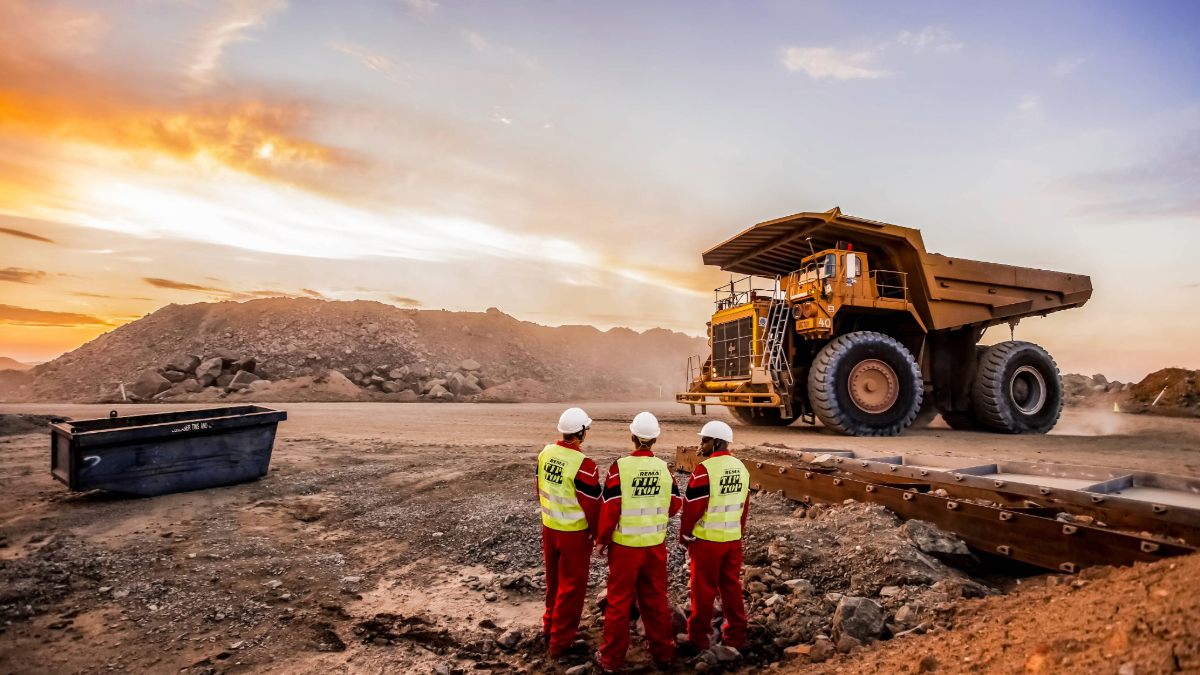
Rustenburg, South Africa, October 15, 2012. Large dump trucks transporting platinum ore for processing with mining safety inspectors in the foreground. Shutterstock
South Africa is not just another developing country struggling to govern artificial intelligence (AI); it is the exception, and the window to act on it is closing. It holds approximately 88% of global platinum-group metal reserves, critical inputs to parts of the semiconductor and data center supply chains that make AI infrastructure possible. It hosts the largest data center market on the continent. Its existing hyperscaler relationships give it procurement leverage that most African states will never have. And a major geopolitical contest over AI infrastructure is being fought on its soil right now, between Chinese and American technology companies competing for control of the systems that will underpin an entire continent's public sector.
In physics, leverage requires three things: a fulcrum, a lever arm and the ability to apply force. The Bushveld Complex, the world's largest platinum-group metal deposit, is the fulcrum: a mineral endowment that gives it a position in the semiconductor supply chain that no other African state holds. The draft policy is the lever arm. The unresolved “OPTION” provisions in the policy are where force would be applied. Without a policy that specifies what South Africa wants in return for market access, the lever arm sits unused, and the weight of two of the world's largest technology ecosystems settles exactly where those ecosystems want it to settle.
This makes South Africa a global test case. Not because its proposed means of governance is exemplary, but because it is the one developing country with enough structural leverage to negotiate genuinely different terms, and the one that is choosing, through inaction, not to.
The contest already underway
Last year, Harrison Li, chief solutions architect for Huawei Cloud in sub-Saharan Africa, pitched an emerging product bundle to tech executives across the continent. The pitch, documented by Bloomberg, was direct: Huawei and DeepSeek's parent company, High-Flyer, had begun collaborating, and Huawei was now bundling access to the Chinese large language model with its own cloud and storage infrastructure. The price differential was stark: reportedly significantly cheaper—in some cases by more than 90%—delivered through infrastructure already embedded in South Africa's digital economy, where Huawei operates three data centers and has played a major role in building the country's fiber-optic infrastructure.
At the same time, Microsoft announced plans to spend ZAR 5.4 billion ($300 million) by the end of 2027 on cloud and AI infrastructure in South Africa, building on a prior ZAR 20.4 billion investment. Google, AWS and Oracle already have cloud regions in the country. According to one analysis, the country’s data center market was valued at $2.16 billion in 2024, the largest in Africa.
These are not commercially neutral investments. Huawei's infrastructure reach has been explicitly linked to Chinese strategic objectives, including a documented track record of providing governments with surveillance infrastructure through its Safe Cities network. US hyperscaler investment comes with its own dependency structure: closed models, pricing set unilaterally and terms of access that no African government has meaningfully shaped. South Africa is being asked to choose between these dependency models without a policy that specifies what it wants in return.
The leverage it has
There is a particular irony in South Africa's position. The country whose mines supply platinum-group metals essential to semiconductor manufacturing, and through them to AI compute, has drafted a policy that treats it as a consumer of AI systems rather than a stakeholder in their governance. South Africa digs up the minerals that make AI possible. It has no say over the AI built from them.
The AI triad framework covers algorithms, compute and data. South Africa has no frontier model development capacity. South Africa holds significant data assets in financial services, healthcare and agriculture, with no clear framework for their sovereign management. South Africa possesses PGM leverage of global significance on the compute axis, currently being transferred without meaningful condition. It also has exceptionally high solar irradiance and significant renewable energy potential. Data centers require enormous power. A country that can offer both critical mineral inputs and the energy to power the infrastructure those minerals help build occupies a negotiating position of unusual strength.
The Draft Policy proposes no minimum terms for hyperscaler investment, no data sovereignty requirements, no technology transfer conditions and no compute visibility mechanism. Multiple provisions are explicitly left unresolved, marked "OPTION", including the most consequential choices about how governance will function. Infrastructure decisions made now determine what is renegotiable later, and the answer is: very little.
Three futures, one default
Governments rarely make binary infrastructure choices. Mixed approaches are common. But mixed approaches without minimum terms do not produce the best of each option. They produce the worst: data stored on infrastructure accessible to foreign governments, pricing set unilaterally and no locally hosted capability that South African institutions can control. The absence of a procurement policy does not preserve optionality. It forfeits it.
The three infrastructure futures on offer are not points on a spectrum. Each creates a structurally different form of dependency, and only one creates sovereign capability. The first is Huawei-hosted DeepSeek integration: low cost and open-source weights, but with data stored on infrastructure potentially accessible under Chinese legal frameworks, creating surveillance dependency in a pattern already documented across Africa. The second is US closed-model dependency: higher capability, more reliable data protection, but complete API dependency on developers in Seattle and San Francisco. The OpenAI boardroom episode, in which a safety-focused governance structure was effectively abandoned within a week under commercial pressure, illustrates why governance structures without external incentives are fragile. The third is locally hosted open-weight infrastructure: models governed under South African data sovereignty rules, on infrastructure subject to minimum terms, developed with South African data. As Nathan Lambert at Interconnects has observed, open-weight models are likely the only realistic way to get sovereign AI off the ground as a real effort, enabling local communities and economies to integrate meaningfully with the technology. But this requires procurement conditions, not goodwill.
Every day that passes without a procurement policy, another investment proceeds on standard commercial terms. Every day that passes without a compute reporting threshold, more infrastructure is built without regulatory visibility. Every day that passes without a data sovereignty framework narrows the third option and with it, the capacity to choose at all.
What binding governance looks like
The GovAI "Governing Through the Cloud" framework identifies four roles compute providers should accept as conditions of operating at scale: securers (protecting model weights and training data), record keepers (maintaining infrastructure usage logs), verifiers (confirming customer compliance with safety standards) and enforcers (restricting access when violations occur). These are operational requirements, not theoretical categories — specific, enforceable, and well within the bargaining power of a market of South Africa's size and mineral position.
A detailed policy analysis submitted to the Department of Communications and Digital Technologies (DCDT) identifies the specific provisions the final policy must contain: mandatory minimum terms for foreign compute infrastructure investments above ZAR 500 million (~$30 million); a compute reporting threshold; a National AI Safety Institute mandate covering defensive monitoring of AI capability accumulation; and National AI Champion Sector designations to create data assets for domestic model development. Each provision converts a structural advantage into a governance instrument before that advantage is foreclosed by market reality.
Why this is the continental test case
South Africa's choices will establish a regional precedent for what is commercially negotiable in AI infrastructure. Countries with less leverage, which means most of Africa, will find it significantly harder to demand terms that the continent's most leveraged market did not require. If South Africa negotiates data sovereignty guarantees and technology transfer conditions as requirements for hyperscaler investment, it creates a replicable model. If Microsoft's $300 million investment and Huawei's infrastructure expansion proceed on standard commercial terms, as they are currently, it normalizes extractive AI infrastructure across the continent for a decade.
The public comment period closes on June 10. After that date, multiple unresolved “OPTION” provisions will become fixed policy choices. The infrastructure investments are not waiting.
South Africa has more AI leverage than any country on the continent. To serve the public interest, its AI policy must use it.
Authors