Shareholder Control and the New Politics of Platform Regulation
Paddy Leerssen / Mar 6, 2026This piece is part of a series with the DSA Observatory featuring articles adapted from selected papers presented at the second DSA and Platform Regulation Conference, marking two years since the Digital Services Act came into full effect. The author delivered the keynote address at the conference; this article provides a shortened overview of those remarks.
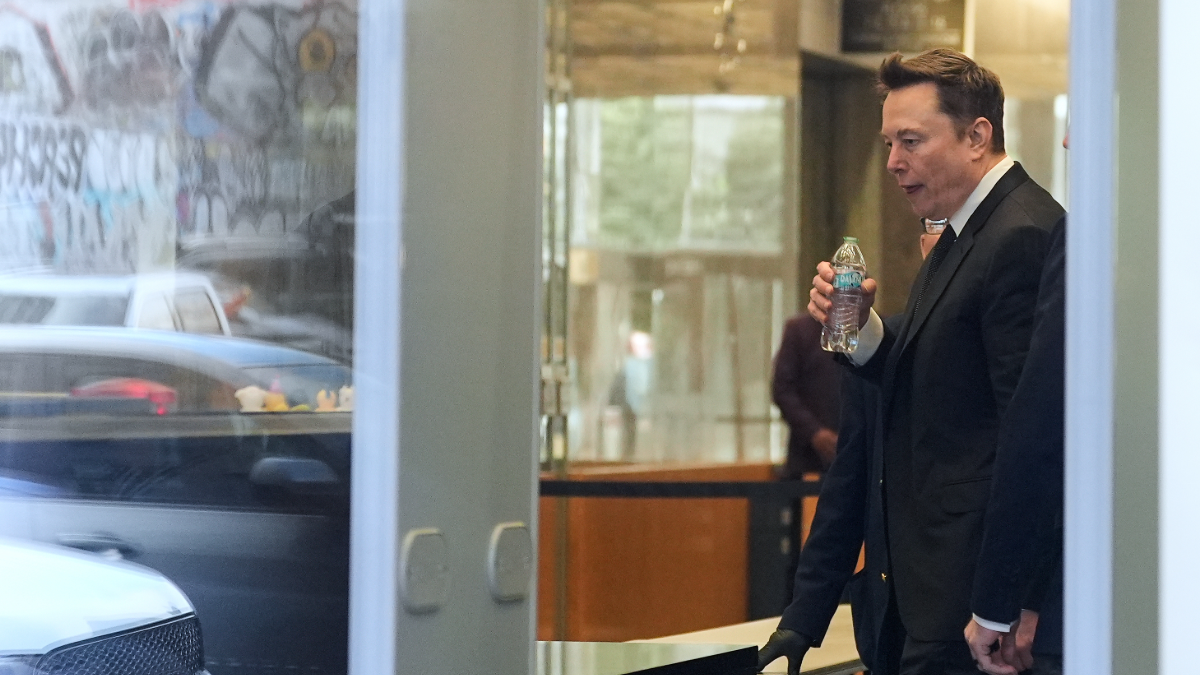
Elon Musk arrives for a Twitter shareholder trial at the US District Court for the Northern District of California in San Francisco, on Wednesday, March 4, 2026. (AP Photo/Godofredo A. Vásquez)
The deal is done: On January 20, TikTok finally agreed to sell its United States operations to a consortium of American investors. This wasn’t just a routine commercial transaction, however; it was a geopolitical power play, concocted by the White House and its billionaire accomplices to assert control over the feeds and profiles of American users. Together with Elon Musk’s takeover of X, the TikTok deal illustrates the new reality of US tech oligarchy: ownership of social media is increasingly seen as an instrument of political power, and a means to control public discourse.
For the platform governance community, ownership is a blind spot: we talk a lot about “stakeholders” — users, civil society, advertisers, regulators — but almost never about shareholders. How can social media ownership be held accountable? I have outlined a three-step agenda for researchers and policymakers: we need to (1) map ownership structures, (2) study ownership’s effects on social media, and (3) introduce regulatory safeguards to make ownership influence more transparent and accountable.
For each of these projectswe can find helpful precedents in media governance, where the question of ownership has also been acknowledged as absolutely crucial. As I argue in my recently published paper, ‘From Murdoch to Musk’, there’s a lot we can learn from past debates about press barons to understand our current predicament with tech oligarchs. And perhaps Europe can even learn a thing or two from America’s experiments; do we need our own TikTok EU? Or even an Instagram EU? This could be an opportunity to rein in the oligarchs and experiment with more democratic ownership arrangements.
Who owns social media?
Ownership concentration can be assessed at two levels: market-level concentration (how many firms compete in a given market) and firm-level concentration (how many individuals control a given firm). Antitrust and media pluralism scholarship have focused heavily on the former. But the latter has received far less attention and is now the focus of my research on oligarchy.
Researching ownership is easier for some firms than for others. For publicly traded firms, US securities law provides relatively robust disclosure of major shareholders. For private firms, as we’ll see below, mapping ownership structures is often challenging.
Dispersed ownership: Apple and Microsoft
Firms such as Apple and Microsoft exhibit highly dispersed ownership. The only shareholders exceeding 6% are asset managers like BlackRock and Vanguard, which manage shares on behalf of diversified clients. So there is no individual who can really dictate corporate policy. Instead, executive leadership remains accountable to a broad base of institutional investors whose primary interest is shareholder value maximization.
Dual-class control: Meta and Alphabet
By contrast, Meta exemplifies concentrated control through a dual-class stock structure. While Mark Zuckerberg holds approximately 13.5% of the firm’s economic shares — worth over $200 billion at today’s price — these shares confer roughly 61% of voting rights. So here we have a single shareholder controlling the entire firm. Zuckerberg still has a fiduciary obligation to serve the interests of the minority shareholders, but in practice, his controlling share makes him almost impossible to remove as CEO.
Alphabet also employs a dual-class structure. However, control is shared between founders Larry Page and Sergey Brin. Since 2019, both have stepped back from executive roles, retaining board influence but ceding day-to-day management. Alphabet thus occupies an intermediate position: concentrated control, without a dominant founder-CEO figure like Zuckerberg.
And let’s be clear that this kind of concentrated shareholder power is historically unique. Dual-class stock structures are a comparatively recent innovation and are not common amongst the largest publicly listed firms. Now we have some of the largest firms in world history making using this to create unprecedented levels of private power over industry. As Julie Cohen observes: “Especially for the dominant tech platform firms, the dual-class ownership structure has thrown a wrench into conventional understandings of corporate governance. The traditional bargain — increased scale in exchange for increased accountability —no longer holds.”
Private platforms: TikTok and X
Other social media firms are private, and we know even less about these. TikTok’s parent company, ByteDance, has disclosed that roughly 20% is owned by founders, 20% by employees, and 60% by institutional investors. Unlike Meta or X, it lacks a dominant founder-CEO. So, counterintuitively, the privately-listed firm Bytedance seems to have a more dispersed structure than the publicly-listed Meta and Alphabet.
Ownership of X, following Musk’s acquisition, was initially opaque. Litigation in US courts — which was unsealed thanks to interventions by tech journalist Jacob Silverman — revealed that nearly one hundred investors helped finance the purchase. Among them were Larry Ellison (now involved in the TikTok USA deal) and Saudi investors previously accused of leveraging influence over the platform. I was also surprised to see, among others, Sean Combs, a.k.a the disreputed rapper and alleged sex criminal “P. Diddy”. Unfortunately, we only know their identity and not the size of their shares. The consensus seems to be that Elon Musk does have sole control of the share — he certainly acts that way.
It’s important to note that figures for TikTok and X may be outdated, since they have no structural obligation to disclose ownership and since both firms have recently undergone major restructurings; this lack of transparency is a problem we’ll return to.
How ownership shapes governance
Media sociology offers a helpful framework for understanding why ownership matters. Research suggests that dispersed ownership tends to inculcate a “market logic”: institutional investors prioritize profitability and generally refrain from interfering in management decisions so long as shareholder value increases. By contrast, concentrated individual ownership enables what Rodney Benson et al. refer to as a “private logic,” including political instrumentalism —where owners pursue ideological or political goals, even at financial cost.
Musk and political instrumentalism
Musk’s tenure at X is a perfect example of political instrumentalism. By his own admission, the acquisition was not a ‘way to make money’, but a bid to protect ‘civilization’ and ‘free speech’. Now, whether Musk has achieved these goals is very much in doubt, but what’s certain is that he has not made money; by some estimates, Twitter has at least halved in value since the acquisition, and at several points was close to bankruptcy. So Elon’s moves are hard to explain in commercial terms and seem instead to be driven by political motives.
Content governance changes under Musk have been well documented. In some respects, more speech was permitted, such as by reinstating the account of prominent Holocaust denier Nick Fuentes. But new restrictions were also introduced, such as the banning of journalists reporting on the tracking of Musk’s private jet, and by contesting fewer takedown requests from certain authoritarian governments. Most tellingly, Musk also adjusted X’s algorithms to boost the visibility of his own posts, and integrated a GrokAI tool that appears to have been prioritizing Musk’s personal opinions. Perhaps the best summary of Musk’s eclectic tenure, in an excellent overview by Joao Magalhaes, Clara Iglesias Keller and Robert Gorwa, is that “the only consistent principle behind his view of free speech is that content moderation should primarily serve his own interests and beliefs.”
Meta under Zuckerberg: Private divergence or market realignment?
Meta under Zuckerberg presents a more ambiguous case. Whistleblower accounts suggest that Zuckerberg initially deferred to professional trust and safety teams on most issues. Over time, however, he appears to have taken a more assertive role. This culminated in the announcement last January that Meta would be abandoning professional fact-checks whilst permitting a broader range of hateful speech, and, crucially, “working with President Trump” to oppose foreign regulations, including the DSA. Other large firms quickly followed suit — not just dual-class firms like Alphabet but also the Microsoft-owned LinkedIn — by abandoning their fact-checking commitments under the EU Code of Conduct on Disinformation.
This begs the question: Is this an example of Zuckerberg’s personal influence, or a broader market shift? On the one hand, we can see the recent changes across the industry as reflecting a broader market logic, a sign of the times and political headwinds. On the other hand, it also seems plausible that Zuckerberg, with his uniquely strong position, was able to spearhead a change, a break with the past, that might not have occurred otherwise. These are poorly understood empirical questions about corporate governance conditions — stock structure, public listing, board composition — and their effect on content and compliance strategies. In my paper, I argue for a comparative research agenda for a stronger empirical grounding of these developments.
TikTok USA: Regulation through ownership
Since writing my paper, the most significant development has been ByteDance’s creation of TikTok USA, a new joint venture, amid the threat of a total ban on TikTok in the United States. What it shows is that the US government is targeting ownership as a means to exert control over platforms and their content.
Make no mistake; the TikTok deal is not just about data protection or security. Content moderation and curation are equally important motives. A House Resolution on the matter cites the threat of “manipulat[ing] social discourse”, whilst Senator Mike Gallagher referred to “propaganda and censorship” of the Chinese Communist Party and "rampant pro-Hamas propaganda on the app" as leading concerns. Senator Mitt Romney, for his part, claimed that the prevalence of “number of mentions of Palestinians, relative to other social media sites” was the reason “why there was such overwhelming support for us to shut down potentially TikTok.” The final version of the White House Executive Order approving the TikTok deal makes clear that the White House considers the transfer of content moderation and curation functions an essential part of the deal.
The new owners also have a clear motive to control public discourse. Two of the key shareholders, Larry Ellison and Michael Dell, are tech billionaires with close ties to Donald Trump and the GOP. Ellison is one of the top donors to many Republican campaigns; he helped to challenge the results of the 2020 election, and in 2017, made the biggest-ever donation to the Friends of the IDF. His son, David Ellison, is rapidly buying up legacy media companies, like Paramount, which owns the news broadcaster CBS, and now Warner Brothers Discovery.
With only 15% of the shares, Ellison’s stake is not strong enough to give him sole control over TikTok USA. Control is shared with Bytedance, and the investment firms Silver Lake and MGX. Thus, TikTok’s negotiators appear to have been at least somewhat successful in reaching a deal that limits private oligarchic control over the firm. But these arrangements cannot be seen in isolation from the massive legal threats issued by the Trump administration, on which the deal hinges; as long as TikTok USA continues to operate under Trump’s regulatory approval, Ellison and Dell could act as key power brokers, with influence far greater than their ownership share suggests.
So all these forces are clearly aligned to steer TikTok USA in a new direction. Clearly, the means and the motives for politically motivated interference are there, and we need further research to understand the full ramifications of this undoubtedly significant deal.
For politically active billionaires and their allies in the US government, social media platforms are increasingly seen as instruments of political power. We are seeing the emergence of a new regulatory paradigm for content moderation in the US; while the EU writes laws, the US buys shares.
A research agenda for social media oligarchs
Research and policy should adjust accordingly: a first step is understanding the political convictions and ties of important platform owners. What are their beliefs? What networks do they move in? What other properties do they own? What politicians are they donating to? Scholars like Julie Cohen and industry reporters like Jacob Silverman, Zoë Schiffer, and, in the AI context, Francesca Bria and the AI Now Institute. Projects such as these are offering pioneering work in making sense of the new Silicon Valley’s oligarchic political networks — with new tech-inflected ideologies like posthumanism, AI boosterism, rationalism, and, through their ever-closer alliance with the US Republican party, increasingly mingled with more long-standing conservative ideas like white supremacy, militant Zionism, and anti-EU jingoism.
The next question is: to what extent are owners leaving their mark on content governance? Do we see significant differences between public firms like Meta and private firms like X? Or between dual-class firms like Meta and diversified firms like Apple or Microsoft? And, of course, how can European policy respond?
Policy implications for Europe
For Europe, social media oligarchy presents a problem of media pluralism: a handful of (foreign) individuals obtain disproportionate influence over public debate and freedom of expression in Europe. Historically, however, laws governing media pluralism, and related concepts like ‘opinion power’, have tended to focus on market-level concentration, rather than firm-level concentration. Still, media law provides relevant precedents to consider.
Ownership transparency
In media law, ownership transparency requirements are widespread throughout Europe and were recently harmonized in the European Media Freedom Act (EMFA). Article 6 EMFA requires Member States to introduce ownership transparency laws. Given platforms’ central role in public discourse, and the ongoing opacity of their ownership structures, similar transparency obligations for major social media companies are undoubtedly justified.
Independence safeguards
EMFA also mandates measures to guarantee editorial independence in news services, insulating editorial decisions from owners and executives (Article 6(3)).
Translating this principle to platforms is complex. Under EU law, platforms are considered to exercise “organizational” rather than traditional editorial control. Yet functional analogues exist. One possible model would separate the formulation of moderation policies (set at the executive level) from their application in individual cases (entrusted to professional trust and safety teams insulated from interference). Historical experiments — such as Twitter’s Trust and Safety Council or Meta’s Oversight Board — illustrate partial moves in this direction. Unsurprisingly, Elon Musk disbanded the Trust and Safety Council after gaining control over Twitter.
These ideas are more experimental and deserve further researcher before enactment. The basic points we can take from media law, however, are that (1) content governance decisions ought, to some extent, be independent and free from arbitrary or politically motivated interference from shareholders, and (2) that the law can demand that a firm’s management structures reflect this principle.
Foreign ownership limits
Several EU Member States impose limits on foreign media ownership. France, for example, caps non-EU ownership of French-language newspapers at 20%. Can the same not be required for social media? This would perhaps be controversial, but supported by precedents in media law — and, indeed, by America’s own TikTok law.
Interestingly, the US TikTok law is only concerned with adversary states, such as China and Russia. But in European media law, ownership limits can apply to all non-EU states. So, without claiming that the US is (or should be) an adversary state, it is in keeping with European regulatory traditions to pursue domestic ownership of media industries.
This is a debate Europe needs to have: Does it need to follow the US example and the creation of local spinoffs? Does it need a TikTok EU, and perhaps even an Instagram EU? This is obviously a far more radical approach and more challenging to implement; this being said, the more that US tech CEOs and their government continue to undermine the legitimacy of EU platform regulation, the more attractive this alternative becomes.
Of course, the point is not to replace American oligarchs with European oligarchs. Ideally, investing in new domestic spinoffs and startups should also be an opportunity to experiment with new ownership structures; again, media policy has important precedents to consider. We can look at public broadcasting and the idea of public ownership insulated from the executive state power, as well as non-profit ownership and the tradition of media foundations and associations with shareholding stakes.
Again, these are areas for future research. And once again, the analogy to media is instructive. It helps us realize that none of these proposals are as radical as they might otherwise sound. We’ve been doing this stuff for decades.
Authors