Robotics Is Coming for Workers’ Data. It’s Time for a National Response
Eliza McCullough, Tim Newman, Aiha Nguyen / Nov 23, 2026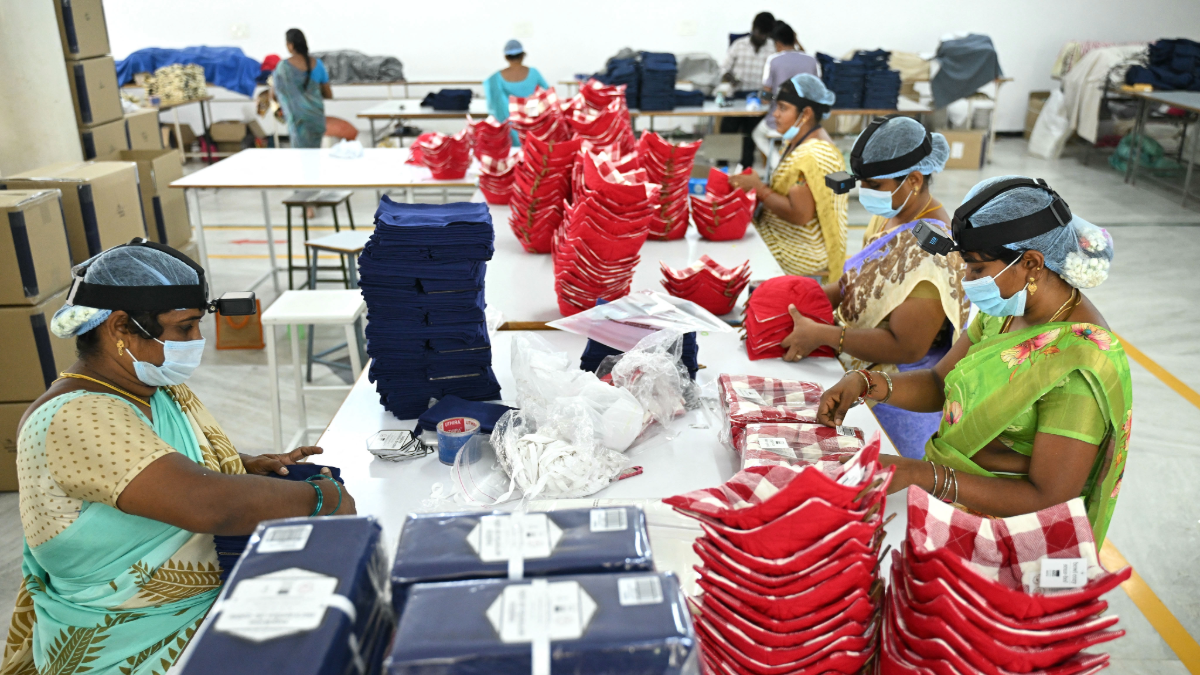
This photograph taken on May 13, 2026 shows workers wearing GoPro cameras on their heads recording actions through motion capture inside a factory in Tamil Nadu's Karur district. (Photo by R.Satish BABU / AFP via Getty Images)
AI technology is built not only on land, energy, and water, but also on the endless extraction of worker data.
With textual and visual data mostly scraped from the internet, AI companies are turning to humans for new data sources, particularly data from our workplaces. Worker data concerns have mostly flown under the radar, but more intimate forms of data extraction may make this issue as visceral to the public as a data center. If the midterm elections are any indication of the economic priorities for American voters, then the incoming Congress should address how the AI economy is structured, who has power in that economy, and who benefits.
New modes of worker data extraction
Companies are extracting data from the work process in order to train AI systems in several new modes, with data collection for the robotics industry providing one key case study. Increasingly, venture capital is investing in robotics or physical AI, systems that combine software models with hardware to complete tasks in real-world environments. Investment in robotics startups grew by 185% in 2026, reaching about $10 billion each quarter. This speculative rush is driven by the belief that these systems are capable of unlocking “the next productivity curve,” a market transformation that will one day be worth upwards of $100 trillion, according to an Nvidia executive. However, a recent report from Anthropic insists robots are still only a cost-effective substitute for just 0.3% of job tasks, a sentiment echoed by additional reporting.
Regardless, the physical AI sector is already impacting the lives of workers globally. Physical AI increasingly relies on world models that purport to learn how the physical world behaves, such as how objects move and respond to actions. Whereas large language models are trained on text, images, and audio, world models are trained on sensor, simulation, and egocentric data, which refers to first-person video captured from people performing tasks.
Some egocentric data already exists. But far more is needed. A crop of companies is focusing on this challenge, including startups, established data companies, and even gig platforms.
Data collection for the robotics industry
As reporter Nilesh Christopher writes: “How humans write, speak, code and compose was easily scraped off the internet, but the bots need more information to master how to stand, step, lift, squeeze, pour and perform other physical movements.” VC-backed startups, including Scale AI, Micro1, Encord, and Figure AI, are collecting egocentric data either through their own platforms, facilities, or in partnership with other gig companies or employers.
Workers globally are being recruited to film themselves performing household tasks. A few startups have generated publicity by offering free services to customers in exchange for video of workers performing this labor in customers’ homes. Data collection is becoming more granular as devices used by workers can include multi-camera headsets, brainwave headsets, and gloves. Workers collect this footage across a diverse range of geographies and jobs, from waste management, garment, and construction workers in India to barbers, nail technicians, plumbers, and HVAC experts in the US. Gig platforms like DoorDash now pay delivery workers to submit videos of their tasks.
The prospect of extra pay entices workers in precarious positions to participate in these data extraction schemes. Even if pay starts out looking good, as the field gets more crowded, worker pay often falls. This is a trend long observed in other platform sectors. Workers are then left in the same conditions found in gig work, like unpaid labor, alleged wage theft, and unexplained deactivation.
How did we get here?
Data collection at this level is possible because of two factors. The first is economic and political infrastructure that protects managerial prerogative; the second is gaps in labor protections and weak enforcement. The Industrial Revolution set the stage for the current labor and employment framework. This era, marked by significant economic growth fueled by grueling, unsafe working conditions for factory employees, galvanized the labor movement and led to the passage of foundational worker protections.
Despite these victories, labor advocates were not able to push back against greater employer control in the workplace — control that was increasingly predicated on monitoring workers. As employment shifted from manufacturing to service sector, workers could still be perpetually monitored, often at a more granular level. For example, labor platforms for ride hailing and nursing rely on worker-generated data to assign tasks, set pay rates, and discipline or even terminate workers.
AI has made data collection not just a tool of workplace management, but a profitable asset that workers produce to fuel their own disempowerment and potential displacement. As data collection becomes easier and more profitable, employers are demanding more information from employees. Labor advocates have documented the impacts of surveillance on workers, but legal regimes have not kept pace and offer uneven protection.
For example, while unions can negotiate over workplace technology, current US law affords employers wide discretion to embed surveillance and management systems. Some unions have bargained over and won foundational technology rights along with privacy protections like imposing limits on tracking and automated decisions.
Likewise, some states are pursuing data privacy protections in the absence of federal action: as of October, 24 states have passed data privacy laws with varying degrees of reach and coverage. However, only a few states specifically cover workers. Moreover, most laws still primarily consider personal identifying information as the cornerstone of data privacy protection. This leaves much of the data (and knowledge) that workers generate open to employer capture.
What this means for workers
The most likely near-term impact on workers is that their labor will be roboticized. Already, Amazon employees work in highly automated warehouses. And one company that designs gloves and headgear equipped with sensors for workers describes its aim to “sensorize humans.” But the end goal of robotics CEOs’ worker data capture is the full automation of manual labor.
According to physical AI startup Sanctuary AI, “If you want to actually build a robot capable of doing things like people, you must begin by gathering an enormous amount of data from the activities that people would do if they were a robot... [This] is what builds the foundational blocks toward embodied artificial general intelligence.”
Robotics companies are generating massive investment with this vision of fully automated factories for manufacturing. Tech startup Foundry Robotics raised $100 million to construct factories it claims will be designed “around AI-powered robots, rather than slotting robots into existing production lines,” according to The Information. In this case, the factory itself is primarily constructed around robots, potentially leaving only a skeleton crew of workers.
The population of workers at risk is markedly different, and potentially broader, than the often college-educated and higher-paid white-collar workers in professions with the highest exposure to generative AI. Workers most exposed to physical AI, such as those in construction, manufacturing, and logistics, earn lower wages and are disproportionately Black and Latino. When this population contributes to egocentric data collection, it may be contributing to the potential automation of its labor. As one garment worker said: “We are not even getting our full worth for the work we do now. Who is going to pay us when we are replaced by robots?” Beyond the threat of job loss, workers experiencing the integration of robotics in their workplaces may experience other job quality concerns, like health and safety issues.
What’s next?
The 2026 midterm elections were a referendum on AI and corporate power driven by the hard work of community organizers. As the new Congress takes office, it must develop a comprehensive agenda that addresses Big Tech power and the ecosystem of companies that collect worker data, which is foundational to the political economy of AI. We need to use this moment of opportunity to contend with the managerial prerogative to continuously extract and profit from workers’ knowledge and to strengthen labor law and enforcement for the threats that increasingly face workers.
Workers need effective privacy protections. Privacy law should explicitly center and recognize workers and go beyond typical notice-and-consent regimes. The California Consumer Privacy Act is a good starting place because it extends to individual workers, but the ultimate value of data collection goes beyond individual harms. As legal scholar Salomé Viljoen argues, data is valuable not just for what it reveals about an individual, but also for what it can reveal in aggregate. This is especially true in the context of machine learning and robotics, which rely on vast amounts of data for pattern recognition.
This speaks to a need for prohibitions on business practices. Scholar Veena Dubal has argued for a statutory ban on algorithmic wage discrimination based on workers’ data. Some states have prohibited the sale of certain sensitive data, like precise geolocation and demographic information. California’s new laws on AI in the workplace provide another avenue forward. These laws will ban some of the most egregious forms of workplace monitoring, like AI-enabled emotion recognition and neural data collection. We need to expand the range of data collection practices that are covered by these bans.
Finally, strengthening worker power needs to be at the center of this agenda. We must address employers’ prerogative to continuously find new ways to take information from workers in the first place. This requires that we truly have the ability to collectively negotiate and reject forms of data capture in the workplace. Public policy can create some conditions for workers to build power and we should explore frameworks that help expand the ability for workers to bargain, such as sectoral bargaining, industry standard boards, and other proposals to expand union density, as well as organizing approaches like bargaining for the common good. In addition, as federal institutions like the National Labor Relations Board are weakened, it becomes more important to shore up and empower local authorities to enforce such laws in partnership with labor and community organizations.
Robust worker power along with labor law reform and enforcement are essential to shifting the direction of technological development away from the continued exploitation of workers and toward more beneficial ends.
Authors