New Mexico Court Orders Meta to Pay to Establish $567 Million Fund to Abate Harms to Youth
Justin Hendrix / Aug 6, 2026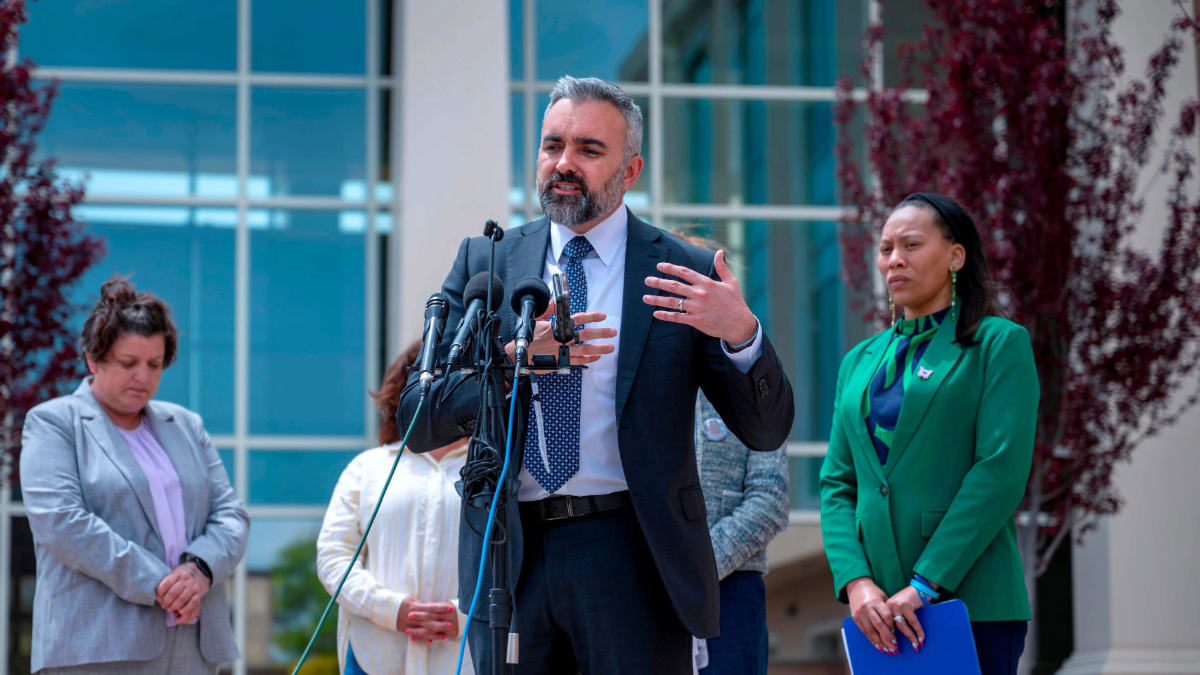
Attorney General Raul Torrez, is joined by a group of mothers advocating for a change to social media, at a news conference outside First District Court, in Santa Fe, N.M., Monday, May 4, 2026. (Eddie Moore/The Albuquerque Journal via AP, Pool)
On Thursday, the First Judicial District Court in Santa Fe, New Mexico issued a decision in the remedies phase of State of New Mexico v. Meta Platforms Inc. The court found Meta created a public nuisance by contributing to the youth mental health crisis and by facilitating child sexual exploitation. It ordered a range of remedies, including that Meta pay $567 million to create an abatement fund to finance various measures intended to address the harms to the public.
“In sum, the Court finds that New Mexico is in the midst of a teen mental health crisis affecting public health and public safety in and throughout the state, and that Meta’s platforms are a significant contributing cause to the crisis,” wrote Chief Judge Bryan Biedscheid in the decision.
The decision follows the second phase in State of New Mexico v. Meta Platforms Inc., which consisted of a bench trial. Its central question was whether Meta's platforms amounted to a public nuisance in New Mexico, and, if the court found that they did, what remedies would be needed to address it. In March, a Santa Fe jury found Meta liable for violations of New Mexico’s Unfair Practices Act, awarding $375 million in civil penalties. The jury deliberated less than a day following the nearly seven-week first phase of the trial.
Meta said it would appeal today’s decision, just as it did the March jury verdict. “We remain confident in our record of protecting teens online and will continue to defend ourselves against claims that misrepresent the facts,” a Meta spokesperson said.
If established, the requirement for Meta to pay $567 million into an abatement fund would be in addition to the civil penalties, according to today’s decision, and would be put toward different categories of activity, including treatment, awareness and prevention, and ongoing monitoring.
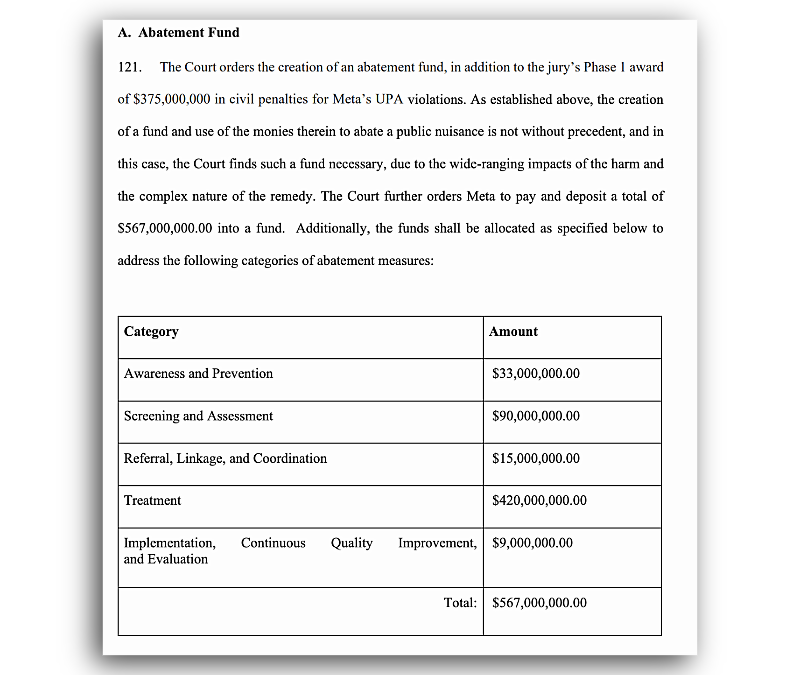
A breakdown of the categories of abatement measures stipulated in the decision. Source
New Mexico Attorney General Raúl Torrez sued Meta in December 2023, alleging the company made false public statements about the safety of its platforms while knowing internally that its products facilitated child sexual exploitation. The court denied Meta’s Section 230 defense in May 2024.
In today’s decision, the court asserted that “Section 230 does not preclude the State’s public nuisance claim,” but the decision attempted to thread the needle on issues that the court determined might have run “afoul” of the statute, or of the First Amendment, such as issuing remedies around any particular product feature.
Nonetheless, regulation of industry-wide features that contribute to problematic use, such as infinite scroll and autoplay, require legislative or executive branch action; if the Court were to order changes to such features, it would risk competitively damaging Meta’s platforms to an unreasonable extent, and possibly running afoul of the First Amendment and Section 230 because of the direct effect those features have on content presentation.
The Attorney General had sought to force Meta to remove such features. Nevertheless, in a statement, Torrez called the decision another landmark victory.
“This case has always been about protecting children, standing up for families, and making sure that one of the world’s largest technology companies cannot profit from practices that endanger young people without consequence,” said Torrez.
Authors