Multiple Polls Find Most Americans Think AI is Moving Too Fast
Justin Hendrix / Oct 13, 2026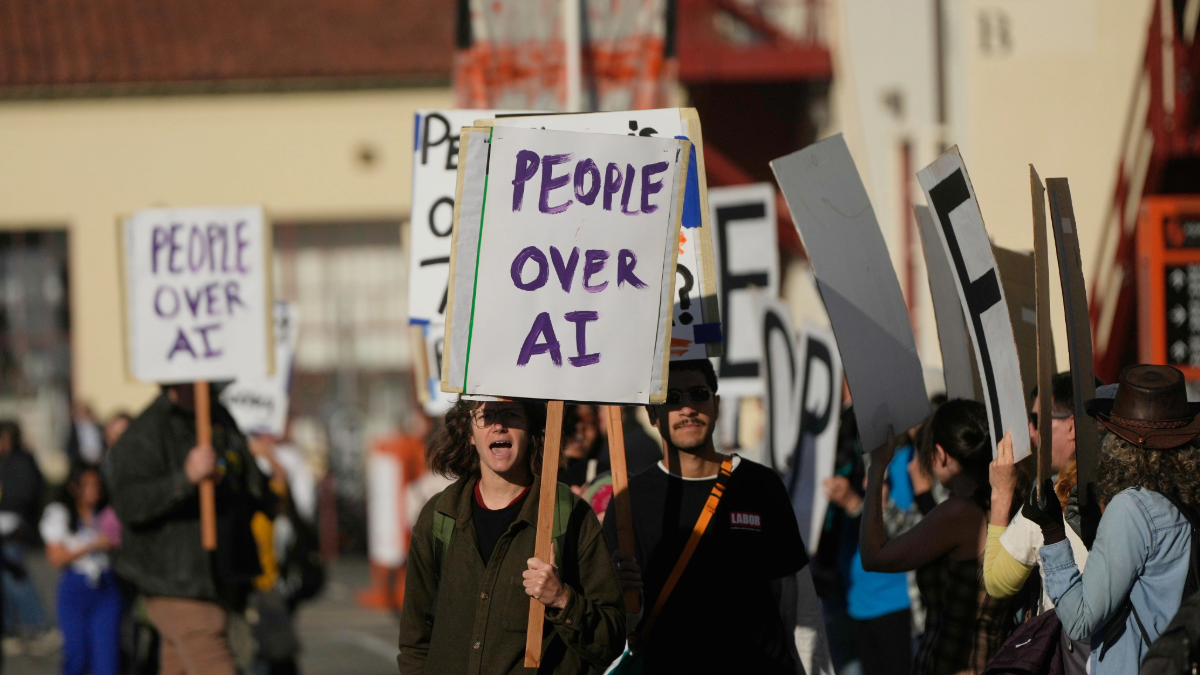
Protesters demonstrate outside of the OpenAI DevDay 2026 conference, Tuesday, Sept. 29, 2026, in San Francisco. (AP Photo/Jeff Chiu)
Following multiple incidents over the past several months where AI agents operated by OpenAI, Anthropic, and Meta intruded on third party systems, industry leaders including Anthropic’s Dario Amodei called for moderating the pace of AI development. But the Trump administration has rejected calls for a slowdown.
“We’re leading China in AI, we’re the most sophisticated country in the world, and frankly, I want to keep it that way because whoever wins AI, wins,” President Donald Trump told reporters last month. “And we can put guardrails, we can do this and that. But I think you have a lot of negative forces that are bringing it up that shouldn’t be bringing it up.”
In five big national polls in 2026, the share of American adults saying AI is moving too fast or should slow down ranged from 55% to 77%. Each poll worded the question differently, as shown below. In the polls that broke out results by party, Democrats were more concerned about AI than Republicans. But in three of the four polls that asked by party, a majority of Republicans also said AI was moving too fast.
The Washington Post reported that Democrats have “seized on” the Trump administration’s resistance to AI regulation “as a line of attack” in the US midterm elections.
Share saying AI is moving too fast, or that companies should slow down or stop, by party, where the pollster published it.
- The Economist/YouGov71% advancing too quickly
“Do you think artificial intelligence (AI) is advancing too quickly or too slowly?”
- AP-NORC64% developing too fast
“Do you think artificial intelligence (AI) technology in the U.S. is developing too fast, not developing fast enough, or developing at about the right place?”
“Right place” appears as printed in AP-NORC’s topline.
- Quinnipiac University77% say stop or slow down
“Which comes closest to your line of thinking, AI companies in the U.S.: should stop developing powerful AI systems until their safety can be evaluated, should slow down developing powerful AI systems until their safety can be evaluated, should keep developing powerful AI systems at the current pace, or should move faster in developing powerful AI systems?”
- CBS News/YouGov55% say stop or slow down
“What should U.S. A.I. companies do with regard to the speed of A.I. research and development? Do you think they should...”
- Fox News59% moving too quickly
“Do you think the use of artificial intelligence is moving too quickly, too slowly, or at about the right pace in the United States?”
- The Economist/YouGov71% advancing too quicklyDemocrats82%Republicans59%Independents74%
“Do you think artificial intelligence (AI) is advancing too quickly or too slowly?”
- AP-NORC64% developing too fast
AP-NORC’s topline counts independents who lean toward a party with that party; it does not report a figure for other independents on this question.
Democrats76%Republicans54%IndependentsLeaners counted with parties“Do you think artificial intelligence (AI) technology in the U.S. is developing too fast, not developing fast enough, or developing at about the right place?”
“Right place” appears as printed in AP-NORC’s topline.
- CBS News/YouGov55% say stop or slow downDemocrats68%Republicans41%Independents58%
Darker segment is “stop development”; totals add the two rounded figures.
“What should U.S. A.I. companies do with regard to the speed of A.I. research and development? Do you think they should...”
- Fox News59% moving too quicklyDemocrats64%Republicans54%Independents60%
“Do you think the use of artificial intelligence is moving too quickly, too slowly, or at about the right pace in the United States?”
- Quinnipiac University77% say stop or slow down
Quinnipiac did not publish a party breakdown for this question.
“Which comes closest to your line of thinking, AI companies in the U.S.: should stop developing powerful AI systems until their safety can be evaluated, should slow down developing powerful AI systems until their safety can be evaluated, should keep developing powerful AI systems at the current pace, or should move faster in developing powerful AI systems?”
Wary of AI’s Effects
Each pollster asked its own question again, a year or more apart, so change can be compared.
Share who are more concerned than excited, or who say AI will do more harm, by party. Quinnipiac’s party figures come from its March 2026 poll.
- Pew Research Center52% more concerned than excited
“Overall, would you say the increased use of artificial intelligence (AI) in daily life makes you feel…”
Same question, earlier: About the same as in June 2025, when it was 50%.
- Quinnipiac University53% say AI will do more harm
“When it comes to your day-to-day life, do you think AI will do more good than harm or do more harm than good?”
Same question, earlier: Up 9 percentage points since April 2025, when it was 44%.
Quinnipiac also asked this question in March 2026, when 55% said “do more harm.” The rise came between April 2025 and March 2026; Quinnipiac says the September result is little changed from March.
- Pew Research Center52% more concerned than excited
Pew counts independents who lean toward a party with that party and does not give a figure for other independents.
Democrats56%Republicans49%IndependentsLeaners counted with parties“Overall, would you say the increased use of artificial intelligence (AI) in daily life makes you feel…”
Same question, earlier: About the same as in June 2025, when it was 50%.
- Quinnipiac University53% say AI will do more harm
The party figures below come from Quinnipiac’s March 19-23, 2026, poll of 1,397 adults, when 55% overall said AI would do more harm. Quinnipiac did not break down its September result by party.
Democrats59%Republicans52%Independents58%“When it comes to your day-to-day life, do you think AI will do more good than harm or do more harm than good?”
Same question, earlier: Up 9 percentage points since April 2025, when it was 44%.
Quinnipiac also asked this question in March 2026, when 55% said “do more harm.” The rise came between April 2025 and March 2026; Quinnipiac says the September result is little changed from March.
About these polls
Each row is one poll question. The questions are worded differently, so compare the polls by their wording, not as a trend. Change notes compare the same pollster’s same question at two points in time.
More on wording and methods
- Quinnipiac and CBS News/YouGov ask what AI companies should do; the go-slow share combines “stop” and “slow down.” Quinnipiac adds “until their safety can be evaluated,” which CBS does not.
- The CBS News/YouGov topline shows no “don’t know” answer, so its shares can run higher than in polls that report one.
- Fox News and The Economist/YouGov surveyed registered voters; the others surveyed all adults.
- Margins of error are for the full sample; party subgroups have larger margins. Party figures come from The Economist/YouGov crosstabs; the Fox News crosstabs; the CBS News/YouGov crosstabs; the AP-NORC release; Pew’s Sept. 16, 2026, analysis; and Quinnipiac’s March 2026 poll. AP-NORC and Pew count independents who lean toward a party with that party. Party definitions vary by pollster, so compare party figures within a poll, not across polls.
- Changes of less than 4 percentage points are labeled “about the same,” because they are close to the margin of error. Pew’s topline does not list the sample size for its 2025 wave.
- Quinnipiac’s 2025 release and March 2026 results printed its harm question as one of a series of similar questions (“When it comes to - your day-to-day life”); the answer options were the same.
- Stop-or-slow totals, including the 77% and 55% figures, add two rounded numbers. Bars may not total 100% because of rounding and small “no answer” shares that are not shown.
Sources
- Quinnipiac University Poll, Sept. 30, 2026, release
- The Economist/YouGov Poll, Oct. 2-5, 2026, toplines (PDF)
- AP-NORC, September 2026 poll topline (PDF)
- AP-NORC, Oct. 8, 2026, release, “Most adults think AI is developing too fast” (party figures)
- Fox News Poll, Jan. 23-26, 2026, topline (PDF)
- Fox News Poll, Jan. 23-26, 2026, crosstabs (PDF; party figures)
- CBS News/YouGov Poll, Sept. 16-18, 2026, topline and crosstabs (PDF)
- Pew Research Center, June 22-28, 2026, survey topline (PDF), published with its Aug. 18, 2026, analysis of young adults and AI
- Quinnipiac University Poll, April 16, 2025, release
- Quinnipiac University Poll, March 30, 2026, full results (PDF; party figures)
- Pew Research Center, Sept. 16, 2026, “Democrats are now more worried than Republicans about AI and its impact on jobs” (party figures)
- The Economist/YouGov Poll, Oct. 2-5, 2026, crosstabs (PDF; party figures)
Tech Policy Press used Claude Code, running Anthropic’s Claude Opus 5.5 model, to develop this visualization. Details have been checked against sources.
Last updated Oct. 13, 2026.
Authors